
For anyone involved in the financial markets, from seasoned institutional investors to budding retail traders, understanding the operational hours of key market indices is fundamental. The Dow Jones Industrial Average (DJIA), often simply called “the Dow,” stands as one of the most recognized and influential barometers of U.S. economic health and corporate performance. Its daily movements capture headlines and dictate sentiment. But when exactly does this critical index conclude its official trading day, and what are the broader implications for investors tracking its pulse? This article delves into the specifics of the DJIA’s closing time, explores the nuances of extended trading sessions, and outlines why these timings are paramount for strategic investment decisions.

The Standard Trading Day: A Fixed Schedule for the DJIA
The heartbeat of the U.S. stock market operates on a clearly defined schedule, a rhythm that has largely remained consistent for decades. This schedule dictates when the official prices of the constituent companies within the DJIA are set and when the index itself ceases its official daily fluctuations.
New York’s Financial Rhythm: Opening and Closing Bells
The primary trading hours for major U.S. stock exchanges, including the New York Stock Exchange (NYSE) and Nasdaq, which list the companies comprising the DJIA, are from 9:30 AM Eastern Time (ET) to 4:00 PM ET. This six-and-a-half-hour window constitutes the core trading day. It’s during these hours that the iconic opening and closing bells ring, signaling the start and end of official market activity. The DJIA, being an index derived from the prices of 30 specific large-cap U.S. companies traded on these exchanges, consequently reflects this same schedule.
It’s crucial to remember that this schedule applies to weekdays only. Stock markets observe various U.S. federal holidays, during which they remain closed. These holidays can include New Year’s Day, Martin Luther King, Jr. Day, Presidents’ Day, Good Friday, Memorial Day, Juneteenth National Independence Day, Independence Day, Labor Day, Thanksgiving Day, and Christmas Day. Additionally, markets sometimes close early on certain days preceding or following a holiday, such as the day after Thanksgiving (Black Friday) or Christmas Eve, typically closing at 1:00 PM ET. Investors must always be aware of these exceptions to avoid missing opportunities or being caught off-guard. The precise nature of these market closures ensures a structured and predictable environment for trading and investment analysis, fostering transparency and fairness by providing clear periods for price discovery and settlement.
The Significance of the Closing Bell
The moment the closing bell rings at 4:00 PM ET holds immense significance for the financial world. It’s not merely an end to the trading day; it’s a critical juncture that solidifies the market’s performance and sets the stage for the next session. The price of the DJIA recorded at 4:00 PM ET is the official closing price for that trading day. This figure is widely reported in financial news, used by analysts to assess daily performance, and forms the basis for countless financial calculations.
For investors, the closing price is the definitive reference point for daily portfolio valuation. It reflects the aggregate sentiment and trading activity of millions of participants over the standard market hours. Asset managers use it to mark the value of their portfolios, individual investors compare it against their entry points, and algorithms rely on it for end-of-day processes. Furthermore, the closing price plays a crucial role in the calculation of various financial products, such as mutual funds and exchange-traded funds (ETFs) that track the DJIA or its components. Many option contracts and futures contracts also settle based on the closing prices of underlying securities or indices. This final print is often the most scrutinized data point of the day, shaping narratives about market strength or weakness and influencing investor psychology well into the overnight hours and the start of the subsequent trading session.
Beyond the Bell: Exploring After-Hours and Pre-Market Trading
While 4:00 PM ET marks the official end of the trading day for the DJIA, market activity doesn’t simply cease. The underlying stocks that comprise the Dow continue to be traded in extended sessions, significantly influencing how the index might open the following day. Understanding these sessions is crucial for any informed investor.
Defining Extended Trading Sessions
Extended trading sessions refer to the periods before the official market opens (pre-market) and after it closes (after-hours). These sessions are typically facilitated by Electronic Communication Networks (ECNs) rather than the traditional exchange floor. Pre-market trading generally runs from 4:00 AM ET to 9:30 AM ET, while after-hours trading can extend from 4:00 PM ET until 8:00 PM ET, though specific brokerages may offer slightly different windows. During these periods, investors can place buy and sell orders for individual stocks, including those that make up the DJIA.
The primary participants in extended trading are often institutional investors, such as hedge funds and large asset managers, as well as highly sophisticated retail traders who have the tools and expertise to navigate these less liquid environments. The technology driving these sessions allows for rapid order execution and reaction to breaking news, making them vital for professionals who need to adjust positions quickly outside of standard hours. While the DJIA itself doesn’t have an official “after-hours close,” the trading activity in its constituent stocks during these periods can cause significant price shifts that are then reflected in the index’s opening value the following morning. This means that the official closing price from 4:00 PM ET might be immediately outdated if substantial news breaks overnight, leading to a “gap up” or “gap down” at the next day’s open.
Risks and Opportunities in Extended Hours
Trading during extended hours presents a unique set of characteristics that differentiate it from the regular session. The most significant factor is lower liquidity. With fewer participants, bid-ask spreads tend to be wider, making it more challenging to execute trades at desired prices and potentially leading to greater price volatility for individual stocks. This increased volatility can present both risks and opportunities. For instance, a small order can have a disproportionately large impact on a stock’s price compared to the regular session.
However, extended hours also offer distinct advantages. They provide an immediate opportunity for investors to react to news events that often occur outside of standard market hours, such as corporate earnings reports, analyst upgrades/downgrades, major economic data releases, or geopolitical developments. Investors can adjust their positions without having to wait for the next trading day, potentially mitigating losses or capitalizing on early gains. For international investors, extended hours can also provide a more convenient window to participate in the U.S. market, aligning better with their local time zones. Despite these opportunities, the inherent risks of lower liquidity and higher volatility necessitate caution and a thorough understanding of the mechanisms at play.
How Extended Hours Affect the DJIA (Indirectly)
While the DJIA as an index doesn’t officially trade after 4:00 PM ET, the activities in extended sessions profoundly impact its trajectory. When individual component stocks of the Dow are traded after-hours, their price movements are not directly reflected in the published DJIA value until the next official open. However, these movements are critical indicators. If, for example, a major DJIA component like Apple announces stellar earnings after 4:00 PM ET, its stock might surge in after-hours trading. This pre-market surge will then heavily influence how the DJIA opens the following morning, potentially leading to a significant “gap up” at 9:30 AM ET.
Furthermore, futures contracts tied to the DJIA, such as the E-mini Dow futures, trade almost 24 hours a day, five days a week, typically from Sunday evening to Friday afternoon. These futures contracts serve as a continuous proxy for market sentiment regarding the Dow. Their movements during extended hours provide a real-time indication of how market participants expect the DJIA to open. By tracking these futures, investors can gain insight into potential market direction before the official bell rings, allowing them to prepare their strategies and anticipate the next day’s opening price action for the actual DJIA. This indirect but powerful influence underscores the importance of monitoring activity beyond the official 9:30 AM – 4:00 PM ET window.
Why Market Hours Matter: Implications for Investors
Understanding the specific operational hours of the DJIA and its underlying components goes far beyond mere curiosity. It has profound implications for every aspect of an investor’s strategy, from trade execution to risk management and information processing.
Strategic Trading and Execution
The timing of trade placement can significantly impact its outcome, particularly when dealing with large market-cap stocks like those in the DJIA. During regular market hours, liquidity is at its peak, and bid-ask spreads are typically tighter. This means investors are more likely to execute trades at or very near their desired prices. Placing orders during periods of low liquidity, such as extended hours, can lead to unfavorable execution prices due to wider spreads and fewer participants. Therefore, savvy investors often strategize their entries and exits to coincide with peak liquidity, usually during the middle of the trading day.
The opening and closing hours also exhibit unique market psychology. The “opening bell” often sees a flurry of activity as investors react to overnight news, leading to increased volatility. Similarly, the “closing bell” can see a surge in volume as institutions make end-of-day adjustments, which can create opportunities or risks. Understanding these patterns allows investors to make informed decisions about when to execute orders, potentially avoiding unnecessary slippage or capitalizing on specific intra-day trends. For example, some traders prefer to avoid the first 15-30 minutes of trading due to heightened volatility, while others actively seek to capitalize on the initial market reaction.
Monitoring News and Economic Data Releases

A significant amount of market-moving information is released outside of the standard trading window. Corporate earnings reports are often announced after the market closes or before it opens. Key economic data, such as inflation reports, unemployment figures, or GDP growth, might also be scheduled for release before 9:30 AM ET. Understanding market hours is critical because these announcements can dramatically influence stock prices and the broader market, including the DJIA, at the next open.
Investors who are aware of these release schedules can position themselves to react promptly, either by setting up conditional orders or by being ready to execute trades as soon as the market opens. Conversely, those unaware might find themselves caught off-guard by a sudden “gap up” or “gap down” in the DJIA, leading to unexpected gains or losses. Staying informed about the economic calendar and company-specific news releases outside of official trading hours is an essential part of an active investment strategy, enabling investors to anticipate market reactions rather than simply reacting to them.
Managing Risk and Volatility
The difference between a stock’s closing price and its subsequent opening price, known as a “gap,” is a direct consequence of market activity during non-trading hours. These gaps can be substantial, leading to significant overnight gains or losses for investors holding positions. Understanding when the market officially closes and opens helps in managing this overnight risk. For instance, if an investor is holding a position in a DJIA component and there’s a high-impact news event expected after hours, they might choose to adjust their position before the 4:00 PM ET close to mitigate potential adverse movements.
Risk management tools like stop-loss orders can be employed to limit potential losses, but it’s important to remember that standard stop-loss orders are typically executed only during regular market hours. If a stock gaps down significantly overnight, a stop-loss order placed at a specific price might be executed at a much lower price when the market opens, leading to a larger-than-anticipated loss. Some brokers offer “gap protection” or stop-loss orders that work in extended hours, but these usually come with different execution guarantees and higher costs. By being fully aware of market hours and the associated volatility, investors can make more informed decisions about position sizing, hedging strategies, and the appropriate use of various order types to protect their capital.
The Dow Jones Industrial Average: A Pillar of the Market
While the primary focus is on its closing time, it’s impossible to discuss the DJIA without acknowledging its historical significance and enduring role as a cornerstone of the U.S. stock market. Its origins and evolution offer a deeper context to its daily movements.
A Brief History and Its Evolution
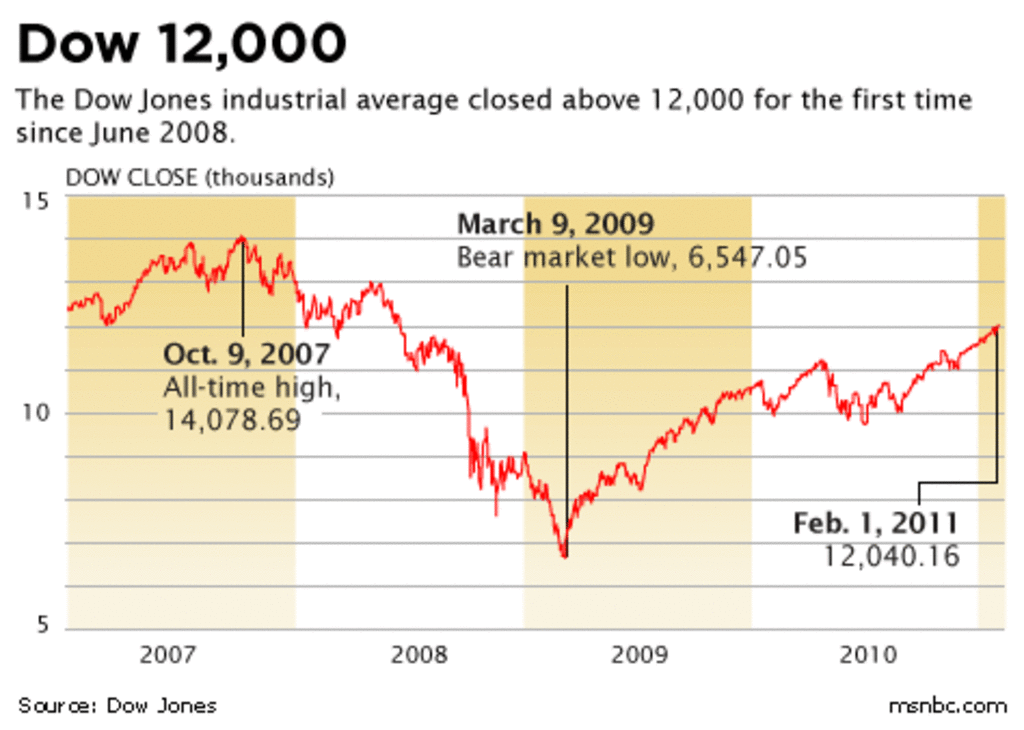
The Dow Jones Industrial Average is the second-oldest U.S. market index, created by Charles Dow, editor of The Wall Street Journal and co-founder of Dow Jones & Company. It first appeared on May 26, 1896, initially comprising just 12 industrial companies. Its purpose was, and largely remains, to serve as a proxy for the broader health of the U.S. industrial sector and, by extension, the entire economy. Over the decades, the DJIA has evolved significantly. Its composition has changed numerous times to reflect shifts in the American economic landscape, moving from heavy industry towards technology, finance, and consumer goods.
Today, the index consists of 30 “blue-chip” companies—large, well-established, and financially sound corporations. These are often household names, representing various sectors and chosen for their stability, size, and influence on the overall economy. Examples include Apple, Microsoft, Goldman Sachs, Boeing, and Procter & Gamble. While some critics argue that 30 companies are too few to represent the entire economy, the DJIA’s historical resonance and its consistent presence in financial news make it a widely watched and influential indicator, often seen as a quick barometer for investor confidence.
How the DJIA is Calculated and Its Weighting
Unlike many modern market indices, the DJIA is a price-weighted index. This means that stocks with higher share prices have a greater influence on the index’s value than those with lower share prices, regardless of their market capitalization. For example, if a company trading at $300 a share moves by $1, it will have a greater impact on the Dow than a company trading at $100 a share moving by $1. This is a key distinction from market-capitalization-weighted indices like the S&P 500, where larger companies (by total market value) have a greater impact.
To account for stock splits, dividends, and other structural changes that would otherwise distort the index’s historical continuity, the DJIA uses a Dow Divisor. This divisor is a dynamically adjusted number that ensures the index’s value remains comparable over time. The DJIA’s value is calculated by summing the prices of the 30 component stocks and then dividing by this divisor. While the price-weighted methodology has faced criticism for giving undue influence to high-priced stocks rather than economically significant ones, its simplicity and historical lineage have kept it relevant. Investors often compare its movements with other indices to get a more comprehensive picture of market performance.
The DJIA in Your Investment Portfolio
For individual and institutional investors alike, the DJIA serves multiple roles within an investment portfolio. Firstly, it acts as a benchmark and indicator of broad market health. A rising DJIA generally signals economic expansion and corporate profitability, while a declining DJIA can indicate a downturn or uncertainty. Investors frequently use its performance as a quick check on overall market sentiment and as a point of comparison for their own portfolio’s returns.
Secondly, investors can gain exposure to the DJIA’s performance without owning all 30 individual stocks. This is commonly achieved through Exchange Traded Funds (ETFs) or mutual funds that track the Dow. For example, the SPDR Dow Jones Industrial Average ETF (DIA) is designed to replicate the price and yield performance of the DJIA. Investing in such funds allows for diversification across the 30 blue-chip companies with a single transaction, providing an efficient way to invest in the performance of the U.S. industrial giants. While direct speculation on the DJIA’s closing price for short-term gains can be risky, integrating DJIA-tracking funds can be a strategic component of a long-term, diversified investment strategy, offering exposure to a foundational segment of the American economy.
Practical Tips for Navigating Market Hours
Effectively managing investments around market hours requires a proactive approach and the use of available tools and resources. Being prepared can significantly enhance decision-making and mitigate risks.
Setting Up Market Alerts
Modern trading platforms and financial news apps offer customizable market alerts. Investors can set up notifications for when the market opens and closes, for significant price movements in the DJIA or its components, or for when specific news events are about to be released. These alerts can be invaluable for staying informed without constantly monitoring screens. For instance, an alert for a substantial drop in the DJIA futures overnight could prompt an investor to review their portfolio before the official market opens, allowing for a more considered reaction.
Utilizing Financial News Sources
Reliable financial news outlets and data providers are indispensable. Subscribing to services that provide real-time news feeds, economic calendars, and market analysis can help investors stay ahead of market-moving events. Many services highlight upcoming earnings announcements for DJIA components and key economic data releases, often indicating their expected impact and release times. Developing a routine of checking these sources before the market opens, during the lunch hour, and after the close can provide a comprehensive understanding of the forces shaping the DJIA’s daily performance.
Understanding Time Zones
While the official market hours for the DJIA are always quoted in Eastern Time (ET), investors living in other time zones must convert these hours to their local time. Miscalculating this can lead to missed opportunities or unintended actions. For instance, a trader on the West Coast of the U.S. (Pacific Time) needs to remember that the market opens at 6:30 AM PT and closes at 1:00 PM PT. International investors face an even greater challenge, requiring careful calculation to align their schedules with New York’s market rhythm. Many financial apps and websites offer integrated time zone conversion tools to simplify this process.
Consulting a Financial Advisor
For complex investment strategies or when navigating significant market volatility, consulting a qualified financial advisor is always a prudent step. An advisor can offer personalized guidance tailored to individual financial goals, risk tolerance, and time availability. They can help in crafting strategies that account for market hours, extended trading risks, and how the DJIA fits into a broader diversified portfolio. Their expertise can be particularly valuable in explaining the nuances of different order types, the implications of after-hours trading, and how to interpret market signals effectively, thereby enhancing an investor’s ability to make informed and strategic decisions.
In conclusion, knowing what time the DJIA closes is far more than a simple factoid; it is a foundational piece of knowledge that underpins effective investment strategy. By understanding the official trading hours, the dynamics of extended sessions, and the broader implications for risk and opportunity, investors can position themselves to navigate the financial markets with greater confidence and precision. The Dow Jones Industrial Average, with its rich history and prominent role, continues to be a central figure in the financial landscape, and a deep understanding of its operational rhythm is an indispensable tool for any market participant.
aViewFromTheCave is a participant in the Amazon Services LLC Associates Program, an affiliate advertising program designed to provide a means for sites to earn advertising fees by advertising and linking to Amazon.com. Amazon, the Amazon logo, AmazonSupply, and the AmazonSupply logo are trademarks of Amazon.com, Inc. or its affiliates. As an Amazon Associate we earn affiliate commissions from qualifying purchases.