
The question “how much did the stock market lose?” is a common and often urgent one for investors, signaling periods of anxiety and uncertainty in financial markets. It reflects a fundamental concern about wealth preservation and growth, prompting both seasoned investors and novices to scrutinize their portfolios and the broader economic landscape. Understanding the extent of market losses isn’t just about a headline number; it’s about dissecting the underlying causes, assessing the impact on various asset classes and individual investors, and, critically, identifying the strategic responses that can mitigate damage and even create future opportunities.
Financial markets are inherently cyclical, characterized by alternating periods of growth and contraction. While bull markets generate excitement and prosperity, bear markets and corrections are inevitable, testing investors’ resolve and discipline. Measuring a “loss” in the stock market can be complex, involving different metrics, timeframes, and perspectives. Is it a decline in a major index like the S&P 500 or the Nasdaq? Is it the evaporation of market capitalization? Or is it the personal hit to an individual’s retirement account? This article delves into the nuances of market downturns, exploring the magnitude of recent and historical losses, the forces that drive them, and the essential strategies investors can employ to navigate these turbulent waters professionally and insightfully.
Understanding Market Volatility: Defining “Loss” and Key Metrics
When the news reports that “the stock market lost,” it often refers to a decline in the value of major market indices. However, truly understanding the extent of a market loss requires a deeper dive into what these metrics signify and how different types of downturns are categorized.
What Constitutes a Market Loss?
At its core, a market loss signifies a reduction in the aggregate value of publicly traded equities. This reduction can be measured in several ways:
- Index Performance: The most common measure. Major stock market indices, such as the S&P 500 (representing 500 large U.S. companies), the Dow Jones Industrial Average (30 large U.S. companies), and the Nasdaq Composite (technology and growth stocks), serve as benchmarks. A “loss” is typically the percentage decline in these indices from their recent peak. For example, if the S&P 500 dropped from 4,800 to 4,000, it would represent a loss of approximately 16.7%.
- Market Capitalization: This refers to the total value of all outstanding shares of a company (share price multiplied by the number of shares). For the entire market, it’s the sum of all individual company market caps. A significant market loss can wipe out trillions of dollars in collective market capitalization, directly impacting the perceived wealth of nations and individuals.
- Individual Stock Performance: While indices provide a broad picture, individual stocks may perform very differently. Some stocks may fall more sharply than the overall market during a downturn, while others (e.g., defensive stocks) might hold up better or even gain. An investor’s personal loss is dictated by the specific assets in their portfolio.
Key Indices and Market Capitalization
The primary indices give us a snapshot of market health. The S&P 500 is often considered the best gauge of large-cap U.S. equities, while the Nasdaq Composite, with its heavy weighting toward technology, can be more volatile and indicative of growth stock sentiment. The Dow Jones Industrial Average, though narrower, is still widely followed.
When these indices experience significant drops, it translates directly into a reduction in the total market capitalization. For instance, a 20% decline across the board on a market valued at $50 trillion means a $10 trillion loss in theoretical wealth. This figure, while theoretical for those who haven’t sold, reflects a real erosion of asset values and confidence.
Bear Markets vs. Corrections
Not all declines are created equal. Financial experts distinguish between different types of market contractions:
- Market Correction: A short-term pullback of 10% to 20% from a recent peak. Corrections are relatively common, often occurring once every year or two on average, and are generally seen as healthy recalibrations of an overheated market. They can last from a few weeks to several months.
- Bear Market: A more severe and prolonged decline, typically defined as a drop of 20% or more from recent highs. Bear markets are usually accompanied by widespread pessimism, economic slowdowns, and often last for many months, sometimes even years. The average bear market since World War II has seen declines of around 30-40% and lasted for approximately a year.
Understanding these distinctions helps investors put current market movements into historical context and manage their expectations, preventing impulsive decisions driven by fear.
Recent Downturns and Historical Context: A Look at Market Performance
To quantify “how much did the stock market lose,” it’s vital to examine both recent events and major historical downturns. While specific, real-time figures are dynamic, we can draw upon common examples to illustrate the magnitude and frequency of these events.
Recent Market Corrections (e.g., 2022)
The period spanning late 2021 through much of 2022 provides a salient example of significant market losses. Following a prolonged bull run, fueled in part by pandemic-era stimuli, markets faced a confluence of headwinds: soaring inflation, aggressive interest rate hikes by central banks (particularly the U.S. Federal Reserve), geopolitical tensions, and fears of an impending recession.
- S&P 500: Experienced a decline of over 25% from its peak in early 2022 to its low later in the year. This officially pushed it into bear market territory.
- Nasdaq Composite: Being heavily weighted towards growth and technology stocks that are often more sensitive to rising interest rates, the Nasdaq saw an even steeper decline, falling more than 35% from its all-time high.
- Russell 2000 (Small-Cap Index): Also entered a bear market, underscoring the broad-based nature of the downturn across market capitalizations.
These figures represent billions, if not trillions, of dollars in market capitalization losses, impacting everything from retirement accounts to corporate valuations and investor confidence. While painful, these corrections were, in many ways, a response to a rapidly changing economic environment.
Echoes from History: Major Market Crashes
Looking further back reveals periods of even more profound losses, demonstrating the market’s capacity for both dramatic falls and eventual recoveries:
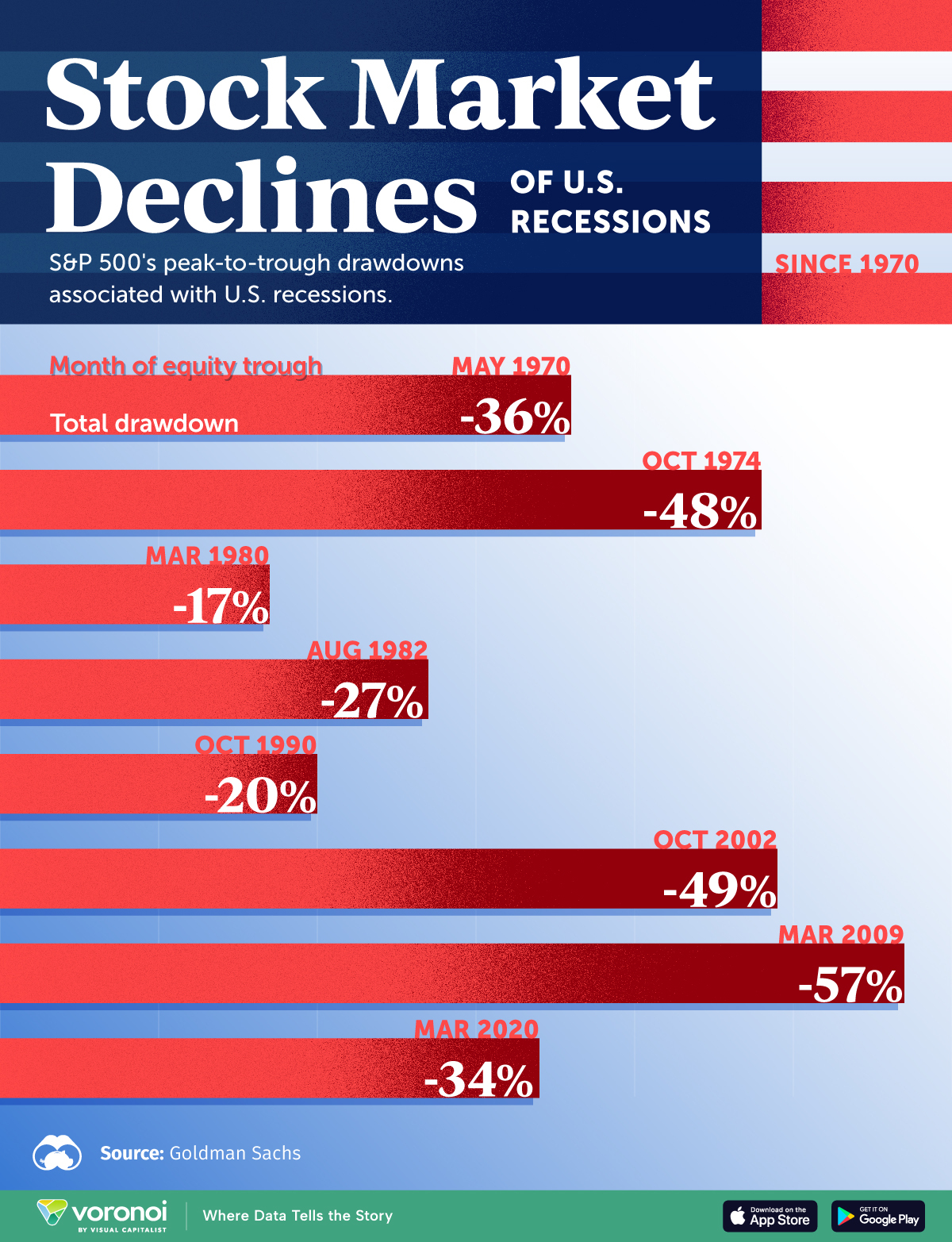
- Dot-Com Bubble Burst (2000-2002): Following a period of irrational exuberance in technology stocks, the Nasdaq Composite plunged approximately 78% from its peak in March 2000 to its trough in October 2002. The S&P 500, though less severely affected, still dropped around 49%. This period taught a harsh lesson about valuations and speculative investing.
- Global Financial Crisis (2008-2009): Triggered by the subprime mortgage crisis and systemic failures in the financial sector, this event saw the S&P 500 plummet roughly 57% from its October 2007 peak to its March 2009 low. This was one of the most severe downturns since the Great Depression, leading to widespread economic recession and significant government interventions.
- COVID-19 Pandemic Crash (February-March 2020): A remarkably swift and sharp bear market, where the S&P 500 fell about 34% in just over a month. This unprecedented speed was due to the sudden global economic shutdown, but it was followed by an equally rapid recovery as central banks and governments deployed massive stimulus measures.
These historical examples serve as stark reminders that significant market losses are a recurring feature of financial history. They highlight the importance of understanding the causes and preparing for such eventualities rather than being caught off guard.
The Cycle of Market Performance
The pattern of market gains followed by losses, and then subsequent recovery and new highs, is known as the market cycle. No market downturn has ever lasted forever, and every bear market has eventually been followed by a new bull market. This long-term perspective is crucial for investors, helping to frame “losses” as temporary setbacks within a broader upward trend, assuming a diversified, long-term investment strategy. The stock market’s ability to recover, often surpassing previous highs, is a testament to economic innovation and resilience.
Driving Forces Behind Market Corrections: Why Markets Decline
Understanding the factors that trigger market downturns is as crucial as quantifying the losses themselves. While the immediate trigger can vary, most significant corrections and bear markets stem from a combination of economic, geopolitical, and psychological elements.
Macroeconomic Factors (Inflation, Interest Rates, Recessions)
The health of the broader economy is perhaps the most significant determinant of stock market performance.
- Inflation: When inflation (the rate at which prices rise) becomes persistently high, it erodes the purchasing power of money and corporate profits. Central banks often respond by raising interest rates to cool the economy.
- Interest Rates: Higher interest rates increase the cost of borrowing for businesses, slowing expansion and reducing profit margins. They also make bonds and other fixed-income investments more attractive relative to stocks, causing investors to reallocate capital away from equities. Furthermore, higher discount rates used in valuation models reduce the present value of future corporate earnings, impacting stock prices, especially for growth companies whose earnings are projected further into the future.
- Recessions: A recession, typically defined as two consecutive quarters of negative GDP growth, signifies a broad economic contraction. During a recession, consumer spending drops, corporate earnings decline, and unemployment rises. These conditions directly impair corporate profitability and investor confidence, leading to widespread stock market losses. Markets often anticipate recessions, declining before the official declaration, and tend to bottom out before the economy fully recovers.
Geopolitical Events and Global Shocks
Events beyond traditional economic cycles can also profoundly impact markets.
- Wars and Conflicts: Geopolitical instability can disrupt supply chains, increase commodity prices (especially energy), and create widespread uncertainty, leading investors to seek safer assets and reduce exposure to equities.
- Pandemics and Public Health Crises: As seen with COVID-19, global health emergencies can trigger sudden economic shutdowns, severely disrupting production, consumption, and international trade, resulting in sharp market declines.
- Political Instability: Domestic or international political turmoil, trade wars, and policy uncertainty can deter investment, slow economic growth, and lead to market apprehension.
These shocks often introduce an element of unpredictability, making market responses harder to forecast and requiring swift adjustments from investors.
Investor Sentiment and Behavioral Economics
While fundamentals play a crucial role, human psychology and herd behavior can exacerbate market movements, particularly downturns.

- Fear and Panic: During periods of uncertainty, fear can quickly spread among investors, leading to panic selling, where individuals sell assets indiscriminately, often at a loss, out of a desire to avoid further declines. This selling pressure can overwhelm fundamental valuations.
- Lack of Confidence: A loss of confidence in the economy, corporate earnings, or government policies can lead investors to pull back, reducing demand for stocks.
- Herd Mentality: People tend to follow the crowd. If many investors are selling, others may feel compelled to do the same, even if their individual analysis suggests otherwise. This can create self-fulfilling prophecies, pushing markets down further than underlying economic conditions might warrant.
- Market Bubbles: Periods of irrational exuberance, where asset prices detach significantly from their intrinsic value (e.g., the Dot-Com Bubble), inevitably lead to sharp corrections or crashes when the bubble bursts, causing substantial losses.
Understanding these intertwined drivers helps investors recognize that market losses are complex phenomena, often a blend of rational economic adjustments and emotional responses.
The Investor’s Perspective: Impact and Psychological Challenges
While financial news focuses on headline numbers, the true impact of stock market losses is felt by individual investors. The experience can be profoundly challenging, affecting not just financial portfolios but also emotional well-being and long-term planning.
Erosion of Wealth and Retirement Savings
For many, the stock market is a primary vehicle for long-term wealth accumulation and retirement planning. Significant market losses can:
- Delay Retirement: If a substantial portion of a retirement portfolio is lost close to retirement age, individuals may be forced to work longer to recoup losses or significantly adjust their post-retirement lifestyle.
- Reduce Retirement Income: Even for those already retired, a downturn can drastically reduce the value of their nest egg, potentially forcing them to draw down less income or take on more risk in a bid to recover.
- Impact Major Life Goals: Funds earmarked for a down payment on a house, children’s education, or starting a business can shrink, delaying or even derailing these critical life milestones.
- Intergenerational Wealth Transfer: Market downturns can also affect the ability to pass on wealth to future generations, as the value of inherited assets may be diminished.
The perceived loss of wealth, even if unrealized (meaning the assets haven’t been sold), can be a significant source of stress and anxiety.
The Emotional Rollercoaster of Investing
Market volatility is a test of emotional fortitude. Investors often experience a cycle of emotions during market downturns:
- Anxiety and Fear: As prices fall, concerns about further losses mount, leading to anxiety about one’s financial future.
- Panic: If losses accelerate, fear can escalate into panic, driving impulsive decisions to sell assets at low points, locking in losses. This is often the worst time to sell, as historical data shows that missing the early days of a recovery can severely impair long-term returns.
- Regret and Self-Blame: After selling low, investors often feel regret when the market eventually recovers, blaming themselves for not having held on.
- Euphoria and Greed: Conversely, during booming bull markets, investors can become overly confident and greedy, leading them to take on excessive risk, often right before a correction.
Recognizing these emotional biases is critical for disciplined investing. Professional investors and financial advisors often emphasize the importance of having a robust investment plan that accounts for these psychological challenges, allowing for objective decision-making rather than reactive ones.
Different Investor Profiles and Their Exposure
The impact of market losses varies significantly depending on an investor’s profile:
- Long-Term Investors (e.g., Retirement Savers): For those with decades until retirement, market downturns, while unsettling, are often viewed as temporary setbacks or even opportunities to buy assets at lower prices (dollar-cost averaging). Their long time horizon allows for recovery.
- Near-Retirement or Retired Investors: These individuals are more vulnerable as they have less time to recover from significant losses. Their portfolios are typically weighted more towards less volatile assets like bonds.
- Short-Term Traders: These investors are highly exposed to market volatility and can incur rapid and substantial losses if their trades go awry during a downturn. Their strategies are often built around profiting from short-term movements, both up and down, but require sophisticated risk management.
- Novice Investors: Without experience or a strong understanding of market cycles, new investors can be particularly susceptible to panic selling, potentially derailing their financial journey before it even truly begins.
Understanding one’s own investor profile and risk tolerance is the foundation for developing a resilient investment strategy that can withstand the inevitable periods of market loss.
Strategies for Resilience: Navigating and Profiting from Downturns
While market losses are an inescapable part of investing, they don’t have to be devastating. With a strategic and disciplined approach, investors can not only navigate these periods but also position themselves for future growth.
The Power of Diversification
One of the most fundamental principles of investing, diversification, becomes paramount during downturns.
- Asset Class Diversification: Spreading investments across different asset classes (e.g., stocks, bonds, real estate, commodities) helps reduce overall portfolio volatility. When stocks are falling, bonds might provide a cushion, and vice versa.
- Geographic Diversification: Investing in markets across different countries or regions can mitigate risks associated with economic downturns or political instability in any single nation.
- Sector Diversification: Within equities, investing across various industries (e.g., technology, healthcare, consumer staples, industrials) prevents over-reliance on a single sector that might be particularly hard-hit.
- Company-Specific Diversification: Holding a sufficient number of individual stocks reduces the impact of any single company’s poor performance or bankruptcy.
A well-diversified portfolio acts like a shock absorber, lessening the impact of market turbulence and ensuring that not all your eggs are in one vulnerable basket.
Dollar-Cost Averaging: A Disciplined Approach
Dollar-cost averaging (DCA) is a powerful strategy, particularly effective during volatile or declining markets. It involves investing a fixed amount of money at regular intervals (e.g., monthly contributions to a retirement account), regardless of market fluctuations.
- Buying More When Prices Are Low: When market prices are down, your fixed investment buys more shares. Conversely, when prices are high, it buys fewer shares.
- Removes Emotional Bias: DCA automates investing, taking the emotion out of timing the market, which is notoriously difficult even for professionals.
- Averages Out Purchase Price: Over time, this strategy helps to average down the cost per share, potentially leading to better returns when the market eventually recovers.
DCA transforms market dips from a source of fear into an opportunity to accumulate assets at a lower average cost, setting the stage for greater gains in a rebound.
Maintaining a Long-Term Vision
The most consistent lesson from market history is that, despite numerous corrections and bear markets, the stock market has always recovered and reached new highs over the long term.
- Focus on Time, Not Timing: Instead of trying to predict market bottoms or tops, which is futile, focus on time in the market. The longer your investment horizon, the greater the likelihood of overcoming short-term losses.
- Ignore the Noise: Constant news cycles and daily market fluctuations can be distracting and anxiety-inducing. Long-term investors learn to filter out short-term noise and focus on their overarching financial goals.
- Revisit Your Investment Thesis: During a downturn, it’s wise to review the fundamental reasons for your investments. If the underlying company or asset’s long-term prospects remain strong, holding on (or even buying more) is often the best course.
A steadfast long-term perspective is the bedrock of resilient investing, allowing individuals to ride out the storm and benefit from the market’s historical upward trend.
Rebalancing and Risk Management
Proactive portfolio management is key to navigating market losses.
- Portfolio Rebalancing: Over time, market movements can shift your asset allocation away from your target. For example, a strong bull market might lead to an overweighting in equities, increasing your risk. Rebalancing involves periodically selling some assets that have performed well and buying more of those that have lagged to restore your desired asset allocation. This often means selling high and buying low, a counter-intuitive but effective strategy.
- Emergency Fund: Maintaining a robust emergency fund (3-6 months of living expenses in cash or highly liquid assets) is crucial. This prevents you from being forced to sell investments at a loss to cover unexpected expenses during a market downturn.
- Understanding Risk Tolerance: Regularly assessing your personal risk tolerance and adjusting your portfolio accordingly ensures that you are comfortable with the level of volatility you are exposed to.
Seeking Professional Guidance
For many, navigating the complexities of market downturns is best done with the assistance of a qualified financial advisor.
- Objective Perspective: Advisors can provide an objective, unemotional perspective, helping investors avoid impulsive decisions driven by fear or greed.
- Tailored Strategies: They can help create a personalized investment plan that aligns with your financial goals, risk tolerance, and time horizon, specifically designed to withstand market volatility.
- Education and Support: Advisors can educate investors on market cycles, diversification, and long-term planning, fostering greater confidence during turbulent times.
In conclusion, “how much did the stock market lose?” is a question that prompts a deep dive into financial realities. While market losses can be significant and emotionally taxing, they are an intrinsic part of the investment landscape. By understanding their causes, maintaining a long-term perspective, and employing disciplined strategies like diversification, dollar-cost averaging, and regular rebalancing, investors can transform periods of loss into stepping stones for future financial success. The professional and insightful approach to personal finance during these times often distinguishes those who merely survive market downturns from those who ultimately thrive.
aViewFromTheCave is a participant in the Amazon Services LLC Associates Program, an affiliate advertising program designed to provide a means for sites to earn advertising fees by advertising and linking to Amazon.com. Amazon, the Amazon logo, AmazonSupply, and the AmazonSupply logo are trademarks of Amazon.com, Inc. or its affiliates. As an Amazon Associate we earn affiliate commissions from qualifying purchases.