
The world of futures trading is dynamic, fast-paced, and increasingly global, operating across a sophisticated network of exchanges that span continents and time zones. Unlike traditional stock markets with their relatively fixed daily hours, futures markets offer a more extended and often near 24/5 trading experience, presenting both unique opportunities and challenges for investors. Understanding when these markets are open is not merely a matter of curiosity; it’s fundamental to effective strategy, risk management, and capitalizing on global economic shifts. This article delves into the intricate schedules of futures markets, exploring the driving forces behind their extended hours and providing a comprehensive guide for navigating this ever-active financial landscape.

Understanding the Global Landscape of Futures Trading Hours
The operational hours of futures markets are significantly different from the typical 9:30 AM to 4:00 PM EST schedule of major stock exchanges. The global nature of commodities, currencies, and indices that futures contracts represent necessitates a continuous trading environment to reflect real-time supply and demand dynamics from around the world. This continuous flow of information and price discovery is critical for market participants who require constant access and liquidity.
The Rationale Behind Extended Futures Trading
The primary reason for the extended hours in futures markets stems from the underlying assets themselves. Crude oil, gold, major currencies, and agricultural products are globally traded commodities. A political event in the Middle East, an economic announcement in Asia, or a harvest report in North America can instantaneously impact prices worldwide. To prevent significant price gaps and provide continuous risk management tools, exchanges have evolved to offer near 24-hour electronic trading. This allows market participants from different time zones to access markets during their respective business hours and ensures that market movements are priced in immediately, reducing overnight risk and increasing market efficiency. The interconnectedness of global economies demands a trading infrastructure that never truly sleeps, except for weekends and major holidays.
Electronic vs. Open Outcry: A Historical Perspective on Hours
Historically, futures trading was synonymous with “open outcry” pits, where traders vocally bid and offered contracts on exchange floors. These physical trading sessions had very defined, often shorter, hours. For example, the trading pit for a specific commodity might operate from 8:00 AM to 1:30 PM. However, the advent of electronic trading platforms has fundamentally transformed the industry. Today, the vast majority of futures trading occurs electronically, allowing exchanges to extend their trading sessions far beyond what was physically possible. Electronic platforms facilitate seamless global access and enable continuous trading, often starting late Sunday afternoon/evening EST and running through Friday afternoon EST, with only short breaks for system maintenance or daily settlements. This shift has not only lengthened trading hours but also democratized access, allowing a wider range of participants to engage in futures markets from virtually anywhere.
Time Zones and Market Overlap
The extended hours of futures markets mean that different global regions often have active trading periods that overlap. For instance, as Asian markets begin their trading day, European markets are typically entering their afternoon session, and North American markets are preparing to open or are already active. This overlap creates periods of increased liquidity and volatility, as more participants are actively engaged. Understanding these overlaps is crucial for traders looking to capitalize on specific market conditions or manage positions during periods of high activity. For instance, major economic data releases from one region can have immediate ripple effects across contracts traded globally, and the ability to react to these during simultaneous trading hours is a significant advantage.
Key Global Futures Exchanges and Their Operating Schedules
While the general principle of extended trading holds, specific hours can vary by exchange and even by contract. Major global exchanges serve different regions and specialize in particular types of futures contracts.
CME Group: A Hub for Diverse Futures Contracts
The CME Group (Chicago Mercantile Exchange, Chicago Board of Trade, NYMEX, and COMEX) is one of the largest and most diverse derivatives marketplaces in the world. It offers a vast array of futures contracts across interest rates, equity indices, foreign exchange, energy, agricultural commodities, and metals.
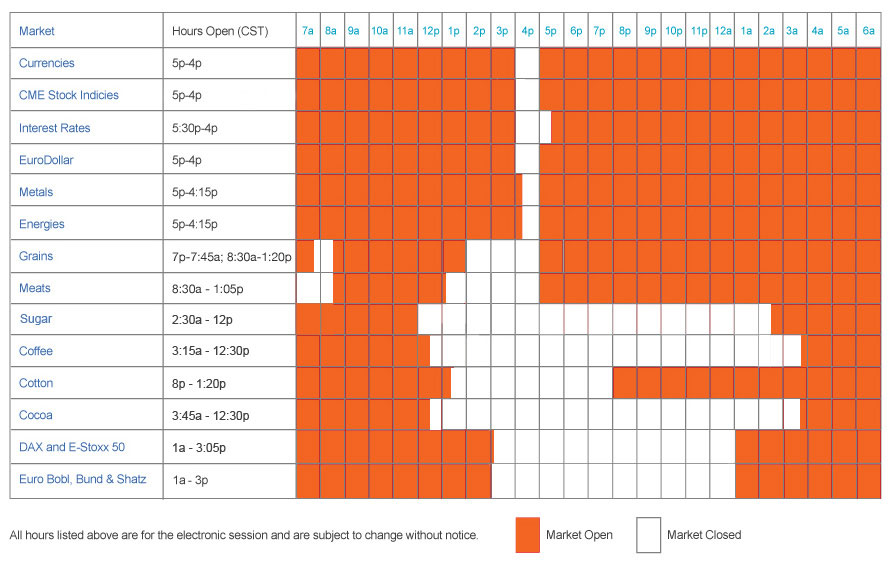
- Equity Index Futures (e.g., E-mini S&P 500): These are among the most actively traded contracts and often run nearly 24 hours a day, five days a week. For instance, the E-mini S&P 500 futures typically trade from Sunday 5:00 PM CT to Friday 4:00 PM CT, with a daily break from 4:15 PM CT to 4:30 PM CT.
- FX Futures: Similar to equity indices, currency futures (e.g., Euro, Yen) also boast extended hours, often aligning with the global forex market, trading from Sunday 5:00 PM CT to Friday 4:00 PM CT, with a daily break.
- Energy Futures (e.g., Crude Oil – WTI): NYMEX crude oil futures are highly liquid and trade from Sunday 5:00 PM CT to Friday 4:00 PM CT, with a daily break from 4:15 PM CT to 4:30 PM CT.
- Agricultural Futures (e.g., Corn, Soybeans): While also electronically traded, agricultural futures often have slightly more defined hours, often running from Sunday evening to Friday, with a longer daily break or a split session (e.g., an overnight electronic session followed by a day session). Hours might be, for example, 7:00 PM CT Sunday to 7:45 AM CT Monday, then 8:30 AM CT to 1:20 PM CT, and then 2:30 PM CT to 7:00 PM CT for the next overnight session. These variations are important to note.
Intercontinental Exchange (ICE): Energy and Soft Commodities
ICE is another dominant player, particularly in energy and soft commodity futures. Key contracts include Brent Crude Oil, Natural Gas, Coffee, and Sugar.
- Brent Crude Oil Futures: ICE Europe’s Brent crude futures are a global benchmark and typically trade from 1:00 AM London time (8:00 PM ET previous day) on Monday through 11:00 PM London time (6:00 PM ET) on Friday, with a brief maintenance break daily.
- Natural Gas Futures: Similar extended hours for natural gas contracts.
- Soft Commodities (e.g., Coffee, Cocoa, Sugar): These contracts also offer extended electronic trading, often starting Sunday evening and running through Friday, with specific breaks that align with their underlying market dynamics.
Eurex: European Derivatives Market Hours
Eurex, based in Europe, is a major exchange for European equity index futures (e.g., DAX, Euro Stoxx 50), interest rate futures, and equity options.
- Equity Index and Interest Rate Futures: Eurex futures generally trade from 8:00 AM CET (Central European Time) to 10:00 PM CET (or later for some contracts like Euro Stoxx 50, which can extend to 10:00 PM CET), Monday to Friday. The overnight electronic session for some key indices can start as early as 7:00 PM CET on Sunday, running until the Monday morning opening.
Asian Exchanges: SGX, HKEX, and More
Asian exchanges play a crucial role in the global futures landscape, especially with the growing economic influence of the region.
- Singapore Exchange (SGX): Offers futures on Asian equity indices (e.g., Nikkei 225, FTSE China A50) and currency pairs. Many SGX contracts offer extended hours (SGX Globex) to accommodate traders from different time zones, often running from early morning Singapore time, through the day, and into an evening session. For instance, Nikkei 225 futures can trade from 7:45 AM SGT to 5:10 PM SGT, then a night session from 5:30 PM SGT to 5:15 AM SGT.
- Hong Kong Exchanges and Clearing (HKEX): Offers futures on the Hang Seng Index and other China-related derivatives. HKEX typically has a morning, afternoon, and an after-hours trading session, often running from 9:15 AM HKT, through the day, and extending into the evening.
It’s paramount for traders to consult the specific exchange’s official website for the most accurate and up-to-date trading hours, as these can be subject to change.
Factors Influencing Futures Market Timings
While electronic trading has standardized much of the futures market schedule, several factors can still influence and alter these timings.
Weekends, Holidays, and Early Closures
Futures markets, like most financial markets, typically observe weekends, remaining closed from Friday afternoon until Sunday evening. Major national and international holidays can also lead to full closures or shortened trading days. For example, exchanges in the U.S. will often be closed on holidays like Christmas Day or New Year’s Day, and might have early closures on days preceding holidays. Similarly, European and Asian exchanges will observe their respective national holidays. Traders must stay informed about these special schedules as they can impact liquidity and trading opportunities, and unexpected market-moving news during a closure can lead to significant price gaps upon reopening.
Daylight Saving Time Adjustments
Daylight Saving Time (DST) changes in different parts of the world can create temporary shifts in observed trading hours relative to a fixed time zone (like UTC or GMT). For traders operating across multiple time zones, it’s crucial to adjust their understanding of market opening and closing times. While an exchange’s local time might remain consistent, its opening/closing time relative to EST or GMT will shift when DST comes into effect in either the exchange’s jurisdiction or the trader’s location. Most electronic platforms automatically adjust for these changes, but manual verification is always recommended.
Regulatory Considerations and Market Safeguards
Regulatory bodies often impose rules and safeguards that can influence trading hours. For instance, circuit breakers designed to curb excessive volatility might temporarily halt trading. Exchanges also schedule brief daily “maintenance periods” or “settlement windows” where trading is paused for a short duration (e.g., 15 minutes on CME for E-minis) to allow for processing and reconciliation. These are standard operational procedures, but awareness of them is part of a diligent trading plan. Unexpected technical issues or extraordinary market events can also lead to temporary halts or alterations to scheduled trading.
Strategies for Trading Across Futures Market Hours
The extended nature of futures trading demands a different approach to strategy and risk management compared to markets with shorter, more defined hours.
Adapting to 24-Hour Electronic Trading
The near 24/5 trading cycle means that market-moving news can break at any time. Traders must decide whether to monitor markets continuously, use automated trading systems, or accept the risk of overnight positions. Day traders might focus on specific, highly liquid sessions (e.g., London or New York overlap) where their preferred assets are most active. Swing traders and longer-term investors, while not needing constant monitoring, must still be aware that positions held overnight or over a weekend are exposed to news-driven gaps that can occur outside of their active monitoring periods. Automated trading systems (algos) are particularly well-suited for continuous markets, as they can execute strategies around the clock based on predefined rules.
Pre-Market, Regular, and Post-Market Sessions
Within the extended electronic trading hours, traders often conceptualize different sessions.
- Pre-market/Asian Session: Typically refers to the period from Sunday evening EST through early Monday morning EST, often influenced by Asian economic news and trading activity.
- European/London Session: Overlaps with the late Asian and early North American session, characterized by high liquidity in European indices, currencies, and global commodities.
- North American/New York Session: Often the most volatile period for U.S.-centric contracts, driven by U.S. economic data releases and institutional trading.
- After-hours/Overnight Session: Refers to the periods outside the primary “regular trading hours” of a specific geographical market but still within the overall electronic trading window. These sessions can have thinner liquidity, but also present opportunities for savvy traders.
Each session can exhibit different characteristics in terms of volatility, liquidity, and trading patterns. A trader might specialize in trading certain contracts during specific sessions when their strategy is most effective.
Risk Management in Continuous Trading Environments
Continuous trading necessitates robust risk management. Holding positions overnight or over a weekend in futures exposes traders to significant “gap risk” if major news breaks when markets are closed or when they are not actively monitoring. Stop-loss orders are crucial, but even they might not protect against large gaps that jump past the stop price. Position sizing, diversification, and awareness of upcoming economic announcements (especially those during off-hours) become even more critical. Some traders opt to flatten all positions before the weekend or before major holiday closures to completely eliminate gap risk, even if it means missing potential opportunities.
The Significance of Knowing Market Hours for Traders
Beyond mere operational details, a deep understanding of futures market hours profoundly impacts a trader’s performance and strategy.
Optimizing Trading Opportunities and Liquidity
Different hours bring different levels of liquidity and volatility. For example, currency futures might be most active when the corresponding central banks are open or when major economic data for those currencies are released. Equity index futures tend to be most liquid during their primary regional trading hours. Knowing these peak liquidity periods allows traders to execute larger orders with less slippage and potentially capitalize on clearer trends. Conversely, trading during low-liquidity periods (e.g., late night in certain contracts) can lead to wider bid-ask spreads and increased transaction costs, which might not be suitable for all strategies.
Mitigating Overnight Risk
As mentioned, overnight risk is a significant concern. A company reporting earnings after the close, a political announcement, or a natural disaster can cause futures prices to gap dramatically when markets reopen. Traders who are aware of these risks can choose to close positions before critical events, hedge their exposure, or reduce their position size. Ignoring market hours and the associated risks is a common pitfall for new traders.

Crafting a Personalized Trading Schedule
Ultimately, understanding futures market hours allows traders to craft a personalized trading schedule that aligns with their lifestyle, risk tolerance, and chosen strategies. Some might prefer to trade the high-volatility overlaps between Europe and North America, while others might find success in the quieter, more predictable trends during Asian sessions. The flexibility offered by 24/5 futures trading empowers individuals to participate in global financial markets on their own terms, but it demands diligence in understanding the intricate ballet of global market openings and closings.
In conclusion, the question “when are futures markets open” reveals a complex and continuous trading environment that contrasts sharply with traditional equity markets. From the global mandate for continuous price discovery to the technological shift from open outcry to electronic platforms, futures markets are designed to be almost perpetually active. For any serious participant, mastering the nuances of these operating hours across various exchanges and asset classes is not just good practice—it’s an indispensable element of successful and disciplined trading.
aViewFromTheCave is a participant in the Amazon Services LLC Associates Program, an affiliate advertising program designed to provide a means for sites to earn advertising fees by advertising and linking to Amazon.com. Amazon, the Amazon logo, AmazonSupply, and the AmazonSupply logo are trademarks of Amazon.com, Inc. or its affiliates. As an Amazon Associate we earn affiliate commissions from qualifying purchases.