
Robinhood has dramatically reshaped the landscape of retail investing, democratizing access to financial markets for millions. By pioneering commission-free trading, the platform has lowered the barrier to entry, empowering a new generation of investors to take control of their financial futures. This guide delves into the practicalities of trading on Robinhood, offering a comprehensive overview for both nascent and seasoned investors looking to leverage this popular financial tool effectively within the broader context of personal finance and wealth accumulation.
Navigating the Robinhood Ecosystem: A Gateway to Investing
Robinhood’s core appeal lies in its simplicity and accessibility. It’s designed to make investing feel less intimidating, transforming complex financial transactions into user-friendly interactions. For anyone considering dipping their toes into the stock market, or even experienced traders looking for a streamlined platform, understanding Robinhood’s structure is the first critical step.

Understanding Robinhood’s Appeal for Modern Investors
Before Robinhood, trading often involved significant commission fees, which could eat into profits, especially for those trading smaller sums or making frequent transactions. Robinhood eliminated these commissions for stocks, ETFs, options, and cryptocurrencies, fundamentally altering the economics of investing for individual traders. This innovation, coupled with an intuitive mobile-first design, resonated deeply with younger demographics and those new to investing. It presents itself not just as a brokerage, but as a gateway to financial literacy and participation. Its user interface is clean, making it easy to track portfolio performance, research potential investments, and execute trades without getting bogged down by overly complex data displays or jargon. For many, Robinhood represents financial empowerment, offering direct access to markets that once seemed exclusive. However, this ease of access also underscores the importance of a well-informed approach to managing one’s money.
Setting Up Your Account: The First Steps to Financial Freedom
Embarking on your Robinhood investing journey begins with a straightforward account setup process. This initial phase is crucial, as it establishes your financial identity within the platform and ensures compliance with regulatory requirements. To open an account, you’ll typically need to be 18 years or older, have a valid Social Security Number, and reside in the United States.
The process usually involves:
- Downloading the App or Visiting the Website: Robinhood is primarily a mobile app experience, though a web platform is also available.
- Providing Personal Information: This includes your name, address, date of birth, and Social Security Number. This information is vital for identity verification and tax purposes.
- Answering Financial Questions: Robinhood will ask about your employment status, income, investment experience, and financial goals. These questions help the platform understand your risk tolerance and suitability for certain types of investments, adhering to regulatory standards like “Know Your Customer” (KYC) rules.
- Linking a Bank Account: To fund your trading activities, you’ll need to link an external bank account. This is usually done through instant verification services or by manually entering your bank’s routing and account numbers, followed by micro-deposit verification.
Once your account is approved and linked, you’re ready to fund it and begin exploring investment opportunities. It’s essential to ensure all information provided is accurate, as this forms the foundation of your financial dealings on the platform.
Mastering the Mechanics of Trading
With your account established, the next phase involves understanding how to move money into your Robinhood account and then how to execute trades. This section demystifies the practical steps of buying and selling, and how to diversify your holdings across various asset classes available on the platform.
Funding Your Investment Journey
Before you can make any investments, you need capital. Robinhood offers several convenient ways to deposit funds into your brokerage account, making the transition from traditional banking to active investing seamless.
- Bank Transfers (ACH): This is the most common method. You can link your bank account and initiate transfers directly from the Robinhood app. Standard transfers typically clear within 1-3 business days.
- Instant Deposits: For eligible accounts, Robinhood offers instant access to a portion of your deposit (up to $1,000-$50,000, depending on your account tier like Robinhood Gold). While the full amount may still take a few days to settle, instant deposits allow you to start trading immediately with a portion of your funds, which can be advantageous in volatile markets.
- Wire Transfers: Though less common for individual retail investors due to potential fees from banks, wire transfers are also an option for larger deposits and offer faster settlement than ACH for the full amount.
It’s crucial to understand the implications of these funding methods, particularly regarding withdrawal limits and settlement times, which impact when you can access your funds after selling investments.
Executing Trades: Buying and Selling Assets
The core of trading on Robinhood is remarkably user-friendly. Once your account is funded, you can search for specific stocks, ETFs, options, or cryptocurrencies and initiate a trade.
- Searching for Assets: Use the search bar at the bottom of the app to find specific companies by ticker symbol (e.g., AAPL for Apple) or company name.
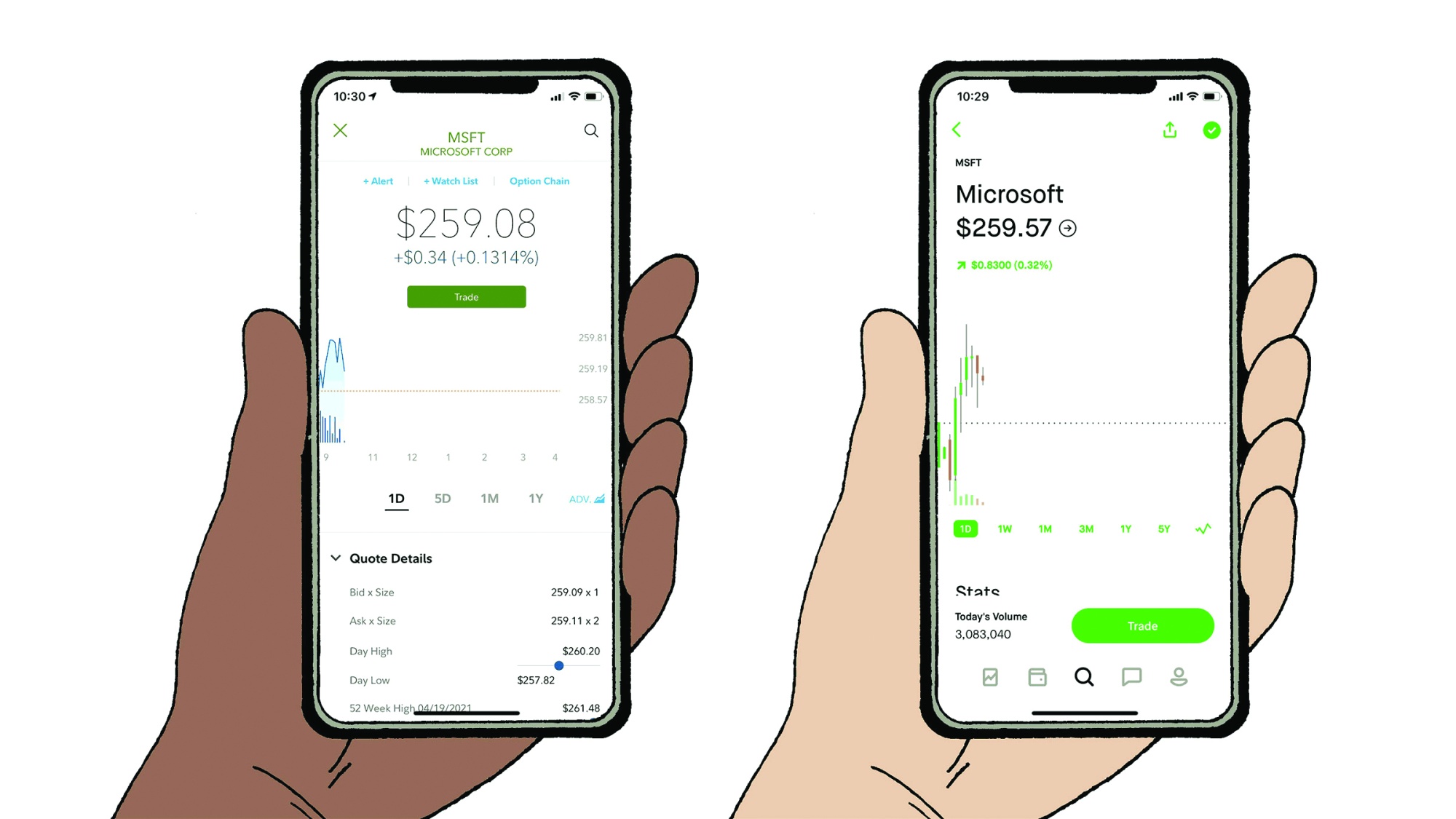
- Understanding the Asset Page: Each asset page provides key information: current price, price history, market capitalization, analyst ratings, news, and relevant financial metrics.
- Placing an Order:
- Market Order: This is the simplest order type, instructing Robinhood to buy or sell an asset immediately at the best available current market price. While convenient, it doesn’t guarantee a specific price, especially in fast-moving markets.
- Limit Order: Allows you to specify the maximum price you’re willing to pay when buying or the minimum price you’re willing to accept when selling. Your order will only execute if the market price reaches your specified limit. This provides more control over the execution price.
- Stop Order (Stop Loss): Used to limit potential losses. A stop-loss order becomes a market order once the asset’s price falls to or below a specified “stop price.”
- Stop Limit Order: Combines features of stop and limit orders. It becomes a limit order once the stop price is triggered, aiming to execute at a specific limit price or better.
- Trailing Stop Order: Similar to a stop order but the stop price is not fixed; it trails the market price by a specific percentage or dollar amount, adjusting as the stock price moves up.
When placing an order, you’ll specify the quantity (number of shares) or the dollar amount you wish to invest. Review your order carefully before confirming to avoid errors.
Diversifying Your Portfolio with Various Asset Classes
While Robinhood is often associated with stock trading, the platform offers avenues for diversifying your investments across several asset classes, which is a cornerstone of sound financial management.
- Stocks: Ownership shares in publicly traded companies. You can buy fractional shares on Robinhood, allowing you to invest in high-priced stocks with smaller amounts of capital.
- Exchange-Traded Funds (ETFs): Baskets of securities (like stocks, bonds, commodities) that trade like individual stocks. ETFs offer instant diversification, as a single ETF can give you exposure to an entire industry, index, or sector.
- Options: Financial contracts that give the buyer the right, but not the obligation, to buy or sell an underlying asset at a specified price (strike price) by a certain date. Options trading is complex and carries significant risk, often requiring a higher level of financial sophistication and approval on Robinhood.
- Cryptocurrencies: Digital or virtual currencies that use cryptography for security. Robinhood allows trading of popular cryptocurrencies like Bitcoin (BTC), Ethereum (ETH), Dogecoin (DOGE), and others without commission fees. Cryptocurrency markets are highly volatile and speculative.
Strategically allocating your capital across these different asset classes can help manage risk and potentially enhance returns, aligning with your personal financial goals and risk tolerance.
Strategic Approaches to Responsible Investing
Trading on Robinhood isn’t merely about pressing “buy” or “sell”; it’s about making informed financial decisions that align with a broader investment strategy. Responsible investing involves careful planning, disciplined execution, and continuous risk assessment.
Developing a Personal Investment Strategy
Every successful investor operates with a strategy, even if it’s a simple one. Your personal investment strategy should reflect your financial goals, time horizon, and comfort level with risk.
- Define Your Goals: Are you saving for retirement, a down payment on a house, or simply growing your wealth? Specific goals influence the urgency and aggressiveness of your strategy.
- Determine Your Time Horizon: Long-term investors (5+ years) can typically weather market fluctuations and adopt a growth-oriented approach. Short-term traders might focus on market timing and technical analysis.
- Assess Your Risk Tolerance: How much volatility can you comfortably endure? Aggressive investors might lean towards growth stocks or options, while conservative investors might prefer stable ETFs or dividend stocks. Robinhood’s interface makes it easy to track performance, but understanding the underlying risks is paramount.
- Research and Due Diligence: Never invest in something you don’t understand. Robinhood provides some research tools (analyst ratings, news feeds), but supplementing this with independent research (company financial reports, industry news, expert analysis) is crucial.
- Dollar-Cost Averaging (DCA): A popular strategy involving investing a fixed amount of money at regular intervals, regardless of the asset’s price. This averages out your purchase price over time and reduces the impact of market volatility.
A well-defined strategy acts as your roadmap, guiding your decisions and helping you avoid impulsive, emotion-driven trades that often lead to losses.
Essential Risk Management Techniques
The allure of quick gains can be strong, but investing inherently involves risk. Effective risk management is not about avoiding risk entirely but about mitigating potential losses.
- Diversification: As mentioned, spreading your investments across different assets, sectors, and geographies is fundamental. Don’t put all your eggs in one basket.
- Position Sizing: Determine how much capital to allocate to any single investment. A common rule is not to risk more than a small percentage (e.g., 1-2%) of your total portfolio on any single trade.
- Stop-Loss Orders: Utilize stop-loss orders to automatically sell an asset if its price drops to a predetermined level, helping to cap your downside. While not foolproof (e.g., in gap-downs), they are a valuable tool.
- Only Invest What You Can Afford to Lose: This golden rule of personal finance is particularly relevant in investing. Never invest money you might need for essential expenses or an emergency fund.
- Avoid Over-Leveraging: Robinhood Gold offers margin trading, allowing you to borrow money to invest. While this can amplify gains, it also significantly amplifies losses. Use margin cautiously and with a thorough understanding of its risks.
Understanding and implementing these risk management techniques are crucial for preserving capital and ensuring the longevity of your investment journey.
Understanding Tax Implications of Trading Gains
An often-overlooked aspect of trading is the tax implication of your gains and losses. In the “Money” category, this is a critical component of overall financial planning.
- Capital Gains Tax: Profits from selling investments are generally subject to capital gains tax.
- Short-Term Capital Gains: For assets held for one year or less, profits are taxed at your ordinary income tax rate, which can be significant.
- Long-Term Capital Gains: For assets held for more than one year, profits are taxed at preferential long-term capital gains rates, which are typically lower.
- Capital Losses: If you sell an investment for a loss, you can use these capital losses to offset capital gains and, to a limited extent ($3,000 per year), offset ordinary income. This is known as “tax-loss harvesting.”
- Form 1099-B: Robinhood will provide you with a Form 1099-B at the end of the tax year, detailing your sales proceeds and cost basis for various transactions. This form is essential for filing your taxes.
- Wash-Sale Rule: Be aware of the wash-sale rule, which prevents you from claiming a loss on a security if you buy a “substantially identical” security within 30 days before or after the sale.
Consulting with a tax professional is highly recommended to understand your specific tax obligations and to optimize your investment strategy for tax efficiency. Proper tax planning can significantly impact your net returns.
Beyond the Basics: Advanced Considerations and Platform Nuances
As your experience grows, you might explore more advanced features of Robinhood and reflect on its broader implications for your financial journey. Understanding the full spectrum of its capabilities and limitations is key to long-term success.
Exploring Advanced Features and Tools
While Robinhood is known for its simplicity, it has evolved to offer some more sophisticated tools for investors:
- Robinhood Gold: A premium subscription service that offers benefits like instant deposits up to $50,000, professional research from Morningstar, Level II market data, and access to margin investing at a competitive interest rate.
- Analyst Ratings and News: Within the app, you can find consolidated analyst ratings, company news feeds, and earnings calendars to inform your investment decisions.
- Portfolio Diversification Analysis: Robinhood provides tools to visualize your portfolio’s breakdown by sector, helping you identify areas of concentration or under-diversification.
- Recurring Investments: Set up automatic, recurring investments for stocks or ETFs, facilitating dollar-cost averaging without manual intervention.
Leveraging these features can provide deeper insights and automate parts of your investment process, enhancing your overall trading experience.
Weighing the Advantages and Disadvantages of Robinhood
Like any financial tool, Robinhood comes with its own set of pros and cons, particularly from a money and investing perspective.
Advantages:
- Commission-Free Trading: A major draw, allowing investors to keep more of their profits.
- User-Friendly Interface: Simplifies investing, making it accessible to beginners.
- Fractional Shares: Enables investing in high-priced stocks with small amounts of capital, promoting diversification.
- Instant Deposits: Allows quick access to funds for trading.
- Cryptocurrency Trading: Offers a convenient way to invest in digital assets alongside traditional securities.
Disadvantages:
- Limited Research Tools: While improving, it still may lack the in-depth research tools found on more traditional brokerage platforms, potentially requiring investors to seek external resources.
- Customer Service: Historically, Robinhood’s customer service has been primarily app-based or email-centric, sometimes lacking immediate phone support for complex issues.
- Educational Resources: While it provides some learning materials, the platform sometimes faces criticism for not sufficiently educating new investors about the inherent risks of trading, especially with options and volatile assets.
- Order Flow Revenue (PFOF): Robinhood generates significant revenue by selling its customers’ order flow to market makers. While legal, critics argue this could potentially lead to suboptimal execution prices for retail investors, though Robinhood maintains it strives for best execution.
- Controversies: The platform has faced scrutiny during periods of high volatility or technical outages, raising concerns about reliability and market manipulation.
Understanding these nuances helps investors make an informed decision about whether Robinhood is the right fit for their financial strategy.
The Importance of Continuous Learning and Due Diligence
The financial markets are dynamic and constantly evolving. Successful long-term investing on Robinhood, or any platform, hinges on a commitment to continuous learning and rigorous due diligence. Never stop educating yourself about market trends, economic indicators, specific companies, and new investment vehicles.
- Stay Informed: Follow financial news, read reputable financial publications, and understand macroeconomic trends.
- Understand What You Own: Regularly review the performance and fundamentals of the companies or funds in your portfolio.
- Review Your Strategy: Periodically assess whether your investment strategy still aligns with your financial goals and risk tolerance. Life circumstances change, and so too might your investment approach.
- Seek Professional Advice: For complex financial situations or significant wealth management decisions, consider consulting with a qualified financial advisor.
Robinhood provides a powerful tool for self-directed investing, but the responsibility for prudent financial management ultimately rests with the individual. By combining the platform’s accessibility with disciplined learning and strategic thinking, investors can leverage Robinhood to build and grow their wealth effectively.
aViewFromTheCave is a participant in the Amazon Services LLC Associates Program, an affiliate advertising program designed to provide a means for sites to earn advertising fees by advertising and linking to Amazon.com. Amazon, the Amazon logo, AmazonSupply, and the AmazonSupply logo are trademarks of Amazon.com, Inc. or its affiliates. As an Amazon Associate we earn affiliate commissions from qualifying purchases.