
Microsoft stands as a colossus in the global technology landscape, a household name synonymous with innovation and digital transformation. Yet, the seemingly straightforward question, “who owned Microsoft?”, reveals a complex tapestry of financial structures, investment strategies, and the evolution of capital markets. For a publicly traded entity of Microsoft’s magnitude, ownership is not a static concept tied to a single individual or entity. Instead, it’s a dynamic, multi-faceted financial arrangement involving millions of shareholders, from individual retail investors to some of the world’s largest institutional funds. This exploration delves into the financial journey of Microsoft’s ownership, from its nascent days under the direct control of its founders to its present-day status as a widely distributed financial asset, examining how capital, investment, and market mechanics have shaped who truly “owns” a piece of this tech titan.
From Garage Vision to Public Powerhouse: The Early Ownership Structure
Every corporate giant begins somewhere, often with a handful of visionary individuals pooling their resources and intellect. For Microsoft, this journey started with two ambitious young men whose initial financial and intellectual capital laid the groundwork for an empire.
The Founding Shares: Gates and Allen’s Initial Capital
In 1975, Bill Gates and Paul Allen founded Microsoft. Their initial “ownership” was absolute and direct, proportional to their contributions – a mix of intellectual property, time, and very modest financial inputs. There were no external investors, no public shares; it was a private enterprise. Gates and Allen made all financial decisions, bore all risks, and reaped all the early, albeit conceptual, rewards. Their equity stake was a direct reflection of their pioneering effort and the nascent value they were creating. This period represents the purest form of ownership, where control and financial interest were consolidated entirely within the hands of the creators. The financial structure was simple: founders owned everything, and their personal capital was the company’s capital.
Early Investors and Pre-IPO Funding Rounds
As Microsoft grew beyond a two-man operation, it required more significant capital injections to fund research, development, and expansion. While Microsoft famously achieved success with relatively minimal external venture capital compared to some Silicon Valley counterparts, it did bring in early employees who often received equity as part of their compensation. Crucially, as the company matured towards its IPO, internal stock option plans and perhaps small private placements would have begun to slightly dilute the founders’ absolute control, granting ownership stakes to key talent in exchange for their contributions to the company’s financial and operational growth. This pre-IPO phase is critical in understanding how early financial commitments by employees and potential strategic partners start to broaden the ownership base, even before going public. These early equity grants were not just compensation; they were investments in the company’s future, aligning the financial interests of key contributors with the company’s long-term success.
The Transformative IPO: Democratizing Ownership and Raising Capital
The Initial Public Offering (IPO) is a pivotal financial event for any private company, fundamentally altering its ownership structure and opening up new avenues for capital. Microsoft’s IPO on March 13, 1986, was a landmark moment, not just for the company, but for the burgeoning software industry.
Why Go Public? Capital Infusion and Liquidity
Microsoft’s decision to go public was driven by classic financial motivations: the need to raise substantial capital for continued rapid expansion, ambitious research and development projects, and potential acquisitions. An IPO allows a company to tap into a vast pool of public market capital, far exceeding what private investors or venture capitalists typically provide. This infusion of cash is critical for sustained growth in a competitive industry.
Equally important was the aspect of liquidity. Going public provided a mechanism for early investors, including Gates and Allen themselves, and employees with stock options, to convert their previously illiquid equity stakes into cash. This ability to monetize their investments was a massive financial incentive and a testament to the value they had created. The IPO essentially democratized ownership, allowing anyone with a brokerage account to buy a “piece” of Microsoft, transforming it from a privately held entity to a publicly owned financial asset with millions of shareholders. Each share represented a fractional claim on the company’s assets and future earnings, subject to the whims and valuations of the open market.
The Mechanics of Stock Ownership for the Masses
Post-IPO, “owning Microsoft” meant holding shares of its common stock, traded on the NASDAQ exchange under the ticker MSFT. Each share represents a tiny fraction of the company, entitling the holder to certain rights, including typically one vote per share on corporate matters and a claim on a portion of the company’s profits via dividends, if declared. The total financial value of all these outstanding shares constitutes Microsoft’s market capitalization, a constantly fluctuating figure reflecting investor sentiment, company performance, and macroeconomic conditions.
When an individual buys Microsoft stock, they are investing capital into the company in an indirect way (as the company received capital at IPO, and subsequent sales are between investors). This investment allows them to participate in the company’s financial success (or failure) through changes in stock price and dividend distributions. The stock market provides an efficient, transparent mechanism for buying and selling these ownership units, enabling a broad base of investors to participate in the company’s financial growth without being involved in its day-to-day operations.
The Modern Ownership Landscape: Institutional and Retail Investors
Today, Microsoft’s ownership is a mosaic of different investor types, each with their own financial motivations and strategies. This distributed ownership model is characteristic of most large, publicly traded corporations.
The Dominance of Institutional Investors
The largest portion of Microsoft’s shares, like most major companies, is held by institutional investors. These are large organizations that invest capital on behalf of their clients or members. This category includes:
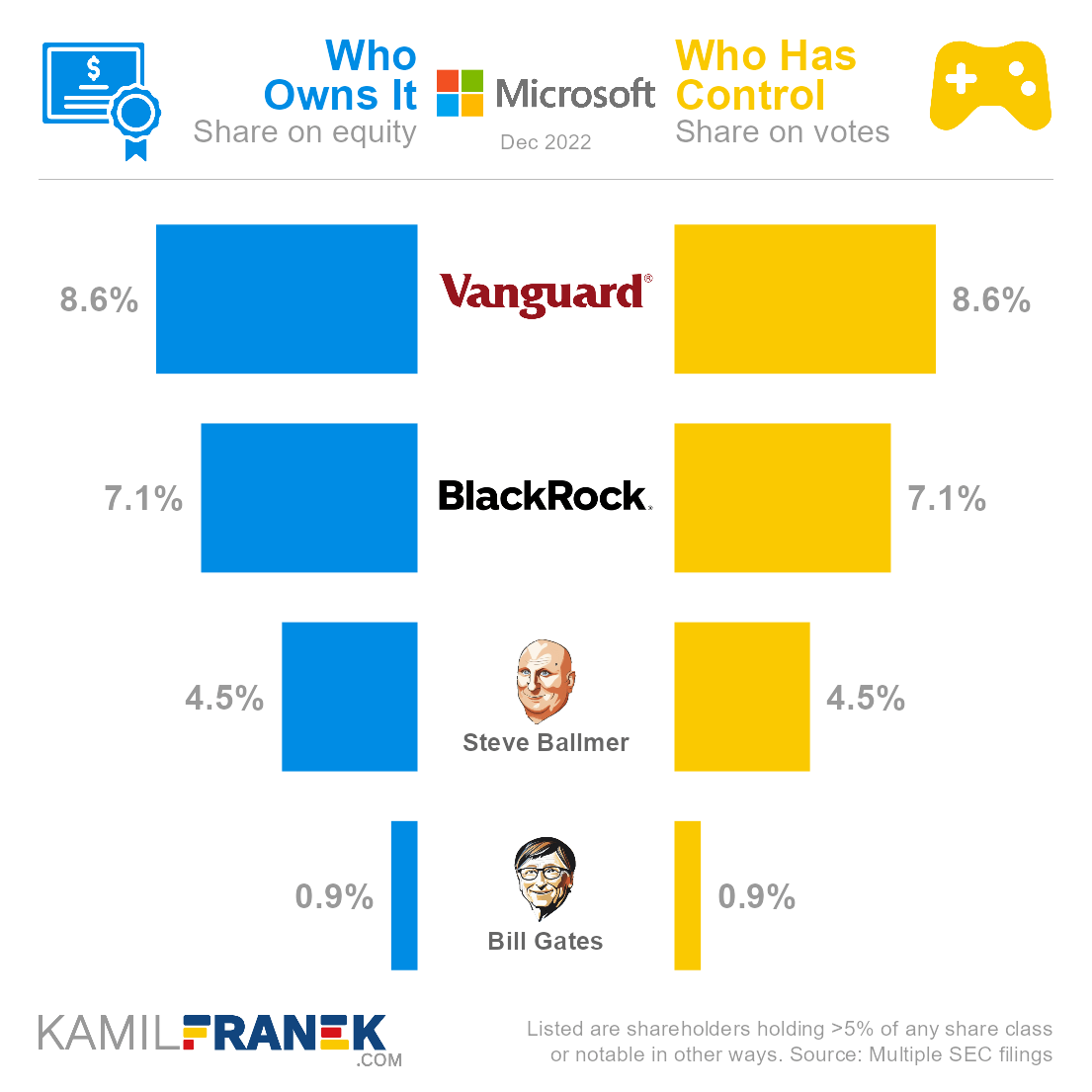
- Mutual Funds and Exchange-Traded Funds (ETFs): Giants like Vanguard, BlackRock, and State Street manage trillions in assets, often holding Microsoft stock as a core component of broad market index funds (e.g., S&P 500 ETFs) or actively managed growth funds. Their investment is driven by diversification, long-term growth objectives, and passive market exposure.
- Pension Funds: Funds managing retirement savings for employees invest heavily in stable, profitable companies like Microsoft to ensure long-term returns for retirees.
- Hedge Funds: While some hedge funds might take activist positions, many hold Microsoft shares as part of their diversified portfolios or specific long/short strategies aimed at generating superior financial returns.
- Sovereign Wealth Funds: Government-owned investment funds from countries with large surpluses (e.g., Norway, Singapore, UAE) also hold significant stakes in major global companies.

These institutional investors collectively represent enormous pools of capital. Their large block holdings give them significant financial influence through their voting rights on corporate governance issues, executive compensation, and strategic direction. Their investment decisions can move markets and shape the perceived financial health and future prospects of Microsoft.
The Role of Retail Investors
While institutional investors dominate in terms of sheer volume, millions of individual retail investors also own Microsoft stock. These are everyday people who buy shares through brokerage accounts, either directly or through investment apps. Their motivations vary from long-term wealth accumulation and retirement planning to short-term trading. Retail investors, despite holding smaller individual stakes, collectively contribute significantly to market liquidity and price discovery. Their collective buying and selling activity reflects broader public sentiment and can influence stock price movements. The accessibility of investing in a well-known, financially stable company like Microsoft makes it a popular choice for many personal finance portfolios.
Insider Holdings: Executives and Directors
Even as ownership disperses, current and former executives, as well as members of the board of directors, continue to hold significant shares. Figures like CEO Satya Nadella and other key leadership team members possess substantial equity stakes, often granted through stock options or restricted stock units (RSUs) as part of their compensation packages. This ownership structure is strategically designed to align the financial interests of management with those of the broader shareholder base, incentivizing them to make decisions that enhance company performance and shareholder value. While their percentage ownership may be small compared to institutional giants, their insider knowledge and direct influence on company operations make their financial stake particularly impactful. Bill Gates, while no longer involved in day-to-day operations, still holds a significant, albeit much reduced, number of shares, continuing his financial interest in the company he co-founded.
Ownership Dynamics and Financial Influence
Beyond simply holding shares, ownership in a public company like Microsoft carries significant financial rights and the potential for influence, shaping corporate strategy and distributing wealth.
Voting Rights and Shareholder Activism
Each share of Microsoft stock typically carries one vote. These votes are cast annually during the company’s shareholder meeting on matters such as the election of the board of directors, executive compensation plans, and other proposals. While individual retail investors often delegate their votes through proxy, institutional investors meticulously exercise their voting rights. Large institutional shareholders can exert considerable financial pressure and influence corporate governance by voting against management proposals or supporting shareholder activism. Activist investors, for instance, might acquire a substantial stake with the explicit goal of pushing for strategic changes, divestitures, or leadership changes they believe will unlock greater financial value for shareholders. This power of the vote is a direct financial mechanism through which owners can influence the stewardship of their investment.
The Impact of Stock Buybacks and Dividends on Ownership
Microsoft, being a mature and highly profitable company, regularly engages in two key financial strategies that directly impact its shareholders: stock buybacks and dividend distributions.
- Stock Buybacks: When Microsoft repurchases its own shares from the open market, it reduces the total number of outstanding shares. This financial maneuver can increase earnings per share (EPS), as profits are divided among fewer shares, and often boosts the stock price, benefiting existing shareholders. It’s a way for the company to return capital to shareholders by increasing the value of their remaining shares.
- Dividends: Microsoft pays quarterly dividends, which are direct cash payments from the company’s profits to its shareholders. For many investors, especially those seeking income, dividends represent a tangible financial return on their ownership stake. The decision to pay dividends, and the amount, is a strategic financial choice made by the board of directors, balancing retained earnings for reinvestment against direct shareholder payouts.
Both buybacks and dividends are critical components of a company’s capital allocation strategy, directly impacting shareholder wealth and representing different ways companies choose to financially reward their owners.
Bill Gates’ Evolving Financial Relationship with Microsoft
No discussion of Microsoft’s ownership is complete without acknowledging Bill Gates, the co-founder whose initial ownership was virtually absolute. His journey reflects a profound evolution from creator-owner to investor-philanthropist.
Strategic Divestment and Diversification
Following Microsoft’s IPO, Bill Gates meticulously and strategically sold down his ownership stake over decades. This was not a sign of diminishing faith in the company but a calculated financial strategy driven by several factors:
- Diversification of Wealth: Holding the vast majority of one’s wealth in a single company, no matter how successful, carries inherent risk. Gates diversified his enormous fortune into a wide array of investments through Cascade Investment LLC, a move common among ultra-high-net-worth individuals to mitigate risk and seek new growth opportunities.
- Funding Philanthropic Ventures: A significant portion of the proceeds from his stock sales has been channeled into the Bill & Melinda Gates Foundation, which has become the world’s largest private charitable foundation. This strategic divestment transformed his direct corporate ownership into philanthropic capital, influencing global health and development.
- Reducing Direct Control: As Microsoft matured into a global behemoth, Gates recognized the need for distributed leadership and less concentrated individual control. His step back from daily operations and eventually from the board facilitated this transition.
This gradual reduction of his stake highlights that while he was once the undisputed “owner” of Microsoft, his financial interest evolved into that of a major, but not controlling, shareholder, with his primary influence shifting towards the philanthropic sector.

Post-Microsoft Financial Engagements
Even after stepping down from his executive roles and significantly reducing his shareholding, Bill Gates maintained an interest, both financial and emotional, in Microsoft’s success. He remained a board member until 2020 and has continued as a technological advisor, demonstrating an ongoing connection. His remaining shares ensure he still benefits financially from the company’s performance, but his role has fundamentally shifted from a principal owner-operator to a substantial long-term investor and an influential figure within the broader tech and philanthropic ecosystems. His journey encapsulates the transition of a founder’s stake from total ownership to a distributed financial asset, underscoring the dynamic nature of corporate ownership in the modern capital markets.
In conclusion, the question “who owned Microsoft?” reveals that for a multi-trillion-dollar public company, ownership is not a simple, singular concept. It is a testament to the power of capital markets to fund innovation, distribute wealth, and allow millions of individuals and institutions to hold a financial stake in a global enterprise. From the foundational capital of Gates and Allen to the vast collective investment of today’s shareholders, Microsoft’s ownership structure is a dynamic reflection of modern corporate finance, where a tech giant is truly a shared financial asset.
aViewFromTheCave is a participant in the Amazon Services LLC Associates Program, an affiliate advertising program designed to provide a means for sites to earn advertising fees by advertising and linking to Amazon.com. Amazon, the Amazon logo, AmazonSupply, and the AmazonSupply logo are trademarks of Amazon.com, Inc. or its affiliates. As an Amazon Associate we earn affiliate commissions from qualifying purchases.