
In an increasingly digital world, money is evolving, and at the forefront of this evolution stands Bitcoin. Often heralded as “digital gold” or the future of finance, Bitcoin has captured the imagination of investors, technologists, and the general public alike. Yet, for many, its inner workings remain shrouded in a perplexing technical jargon. This article aims to demystify Bitcoin, explaining its fundamental principles and practical applications in clear, accessible language, focusing squarely on its financial implications and role within the broader economy. For those looking to understand this groundbreaking digital currency without getting lost in cryptographic complexities, consider this your essential guide to how Bitcoin works.

Understanding Bitcoin’s Core Financial Principles
At its heart, Bitcoin represents a radical departure from traditional financial systems. It challenges centuries-old models of currency issuance, transaction processing, and monetary control by introducing a decentralized, digital alternative. To grasp Bitcoin, one must first understand the foundational principles that govern its existence and operation.
What is Bitcoin, Really? A Digital Currency Explained
Bitcoin, launched in 2009 by an anonymous entity known as Satoshi Nakamoto, is the world’s first decentralized digital currency, often referred to as a cryptocurrency. Unlike traditional currencies like the US dollar or Euro, which are issued and controlled by central banks and governments, Bitcoin operates on a peer-to-peer network without any central authority. This means there’s no bank, financial institution, or government agency managing Bitcoin transactions or controlling its supply.
From a financial perspective, Bitcoin serves multiple functions. It can act as a medium of exchange, allowing individuals and businesses to send and receive payments globally without intermediaries. It’s also increasingly viewed as a store of value, akin to gold, due to its finite supply and resistance to inflation. Furthermore, it offers a degree of financial sovereignty, giving users direct control over their funds without relying on traditional banking infrastructure.
The Blockchain: A Transparent and Immutable Financial Ledger
The technological backbone of Bitcoin, and arguably its most revolutionary aspect, is the blockchain. Imagine a vast, public, and continuously growing digital ledger that records every single Bitcoin transaction ever made. This ledger is not stored in one central location but is distributed across thousands of computers (nodes) around the world. Each “block” in the blockchain contains a list of transactions, and once a block is added, it’s cryptographically linked to the previous one, forming an unbroken “chain.”
For financial operations, the blockchain offers unparalleled transparency and security. Every transaction is publicly verifiable, though the identities of the participants remain pseudonymous. More importantly, once a transaction is recorded on the blockchain, it is practically irreversible and immutable. This means that financial records cannot be altered, forged, or deleted, providing an unprecedented level of integrity for digital money. This transparency and immutability are critical for maintaining trust in a system without central oversight.
Decentralization: No Banks, No Middlemen
The most profound financial implication of Bitcoin’s design is its decentralization. In traditional finance, banks act as trusted intermediaries for all transactions. When you send money to someone, your bank verifies the transaction, updates your balance, and communicates with the recipient’s bank. This system works, but it comes with costs: transaction fees, processing delays, and the inherent risk of a single point of failure or censorship.
Bitcoin bypasses these intermediaries entirely. Transactions occur directly between users (peer-to-peer) on the Bitcoin network. The network itself, through the collective action of its participants and the blockchain, validates and records these transactions. This removal of middlemen has several financial benefits: potentially lower transaction fees (especially for international transfers), faster settlement times (compared to traditional banking hours), and increased financial autonomy for individuals. It means that no single entity can freeze your funds, reverse your transactions, or dictate how you use your money, offering a new paradigm of financial freedom.
Getting Started with Bitcoin: Practical Steps for Newcomers
Understanding the theoretical underpinnings of Bitcoin is one thing; engaging with it practically is another. For those considering entering the Bitcoin ecosystem, there are a few essential steps to navigate, all of which touch upon important financial considerations regarding asset acquisition and security.
Acquiring Bitcoin: Exchanges and Beyond
The most common way for individuals to acquire Bitcoin is through cryptocurrency exchanges. These platforms act as digital marketplaces where users can buy and sell various cryptocurrencies, including Bitcoin, using traditional fiat currencies (like USD, EUR) or other digital assets. Popular exchanges include Coinbase, Binance, Kraken, and Gemini. When choosing an exchange, consider factors such as:
- Fees: Exchanges charge fees for buying, selling, and withdrawing Bitcoin. These can vary significantly.
- Security: Reputable exchanges employ robust security measures, but understanding their protocols (e.g., two-factor authentication, cold storage for a portion of assets) is crucial.
- Ease of Use: For beginners, an intuitive interface and clear purchasing process are important.
- Regulatory Compliance: Ensure the exchange operates legally in your jurisdiction and adheres to Know Your Customer (KYC) and Anti-Money Laundering (AML) regulations, which typically involve verifying your identity.
Beyond exchanges, Bitcoin can also be acquired through peer-to-peer (P2P) platforms, Bitcoin ATMs, or even by earning it for goods and services if you’re a merchant. Each method carries its own set of risks and conveniences, and choosing the right one depends on your individual needs and risk tolerance.
Bitcoin Wallets: Securing Your Digital Assets
Once you acquire Bitcoin, you need a secure place to store it. This is where a “Bitcoin wallet” comes in. Contrary to popular belief, a Bitcoin wallet doesn’t actually hold your Bitcoin; rather, it stores your cryptographic keys (a private key and a public key) that allow you to access and manage your Bitcoin on the blockchain. Your public key acts as your Bitcoin address (like an account number), while your private key is your secret password to authorize transactions. Protecting your private key is paramount, as losing it means losing access to your Bitcoin forever.
Wallets come in various forms:
- Software Wallets (Hot Wallets): These are applications installed on your computer or smartphone, or web-based wallets provided by exchanges. They are convenient for frequent transactions but are generally considered less secure because they are connected to the internet.
- Hardware Wallets (Cold Wallets): These are physical devices that store your private keys offline. Examples include Ledger and Trezor. They offer the highest level of security, making them ideal for storing significant amounts of Bitcoin over the long term, as they are impervious to online hacks.
- Paper Wallets: This involves printing your public and private keys on paper. While offline, they require extreme care in storage and handling to prevent loss or damage.
Choosing the right wallet depends on the amount of Bitcoin you hold and your comfort level with technology. For small amounts used for transactions, a hot wallet might suffice. For significant investments, a hardware wallet is strongly recommended.
Making Transactions: Sending and Receiving Bitcoin
Transacting with Bitcoin is fundamentally different from using traditional payment systems. To send Bitcoin, you’ll need the recipient’s Bitcoin address (their public key). You then use your wallet to initiate a transaction, specifying the amount and the recipient’s address. The transaction is then broadcast to the Bitcoin network.
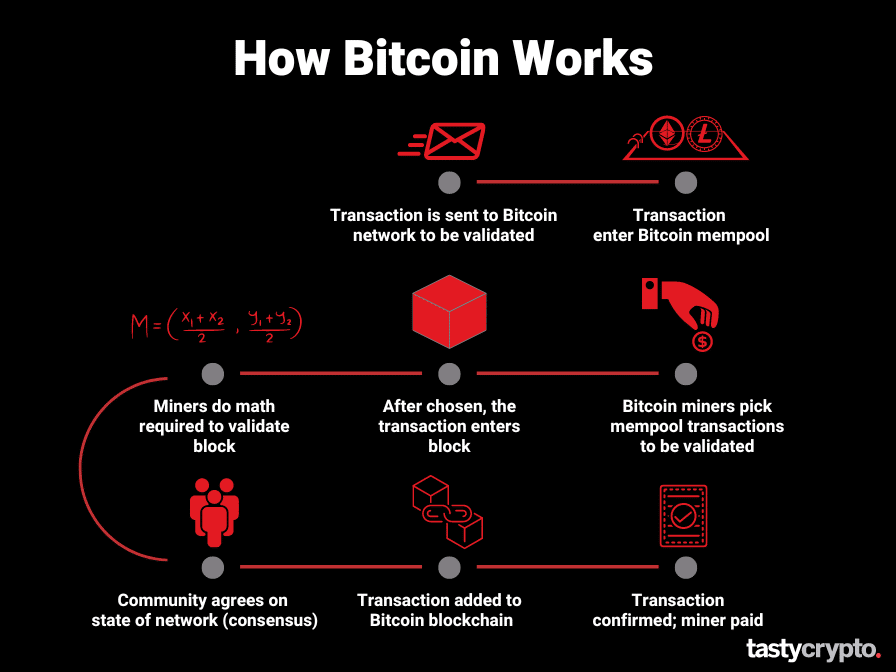
Here’s a simplified breakdown of what happens next:
- Verification: Network nodes verify the transaction’s legitimacy, ensuring you have sufficient funds and the private key used to sign the transaction is valid.
- Mining (Confirmation): “Miners” (powerful computers) group unconfirmed transactions into a block and solve a complex mathematical puzzle. The first miner to solve the puzzle adds the block to the blockchain.
- Confirmation: Once your transaction is included in a block and added to the blockchain, it receives one “confirmation.” For higher-value transactions, merchants or recipients may wait for several confirmations (e.g., 3 or 6) to ensure the transaction’s finality and irreversibility, which can take anywhere from a few minutes to an hour or more depending on network congestion.
Transaction Fees: While often lower than traditional international wire transfers, Bitcoin transactions typically incur a small fee paid to miners. This fee incentivizes miners to process transactions and secure the network. Higher fees usually lead to faster confirmation times, as miners prioritize transactions with greater incentives. Understanding these fees is crucial for efficient financial planning when using Bitcoin.
Bitcoin as an Investment and Financial Tool
Beyond its use as a payment system, Bitcoin has garnered significant attention as a unique investment asset. Its characteristics present both opportunities and challenges for personal and business finance.
Bitcoin’s Value Proposition: Store of Value or Medium of Exchange?
Bitcoin’s dual role as both a potential medium of exchange and a store of value is central to its financial appeal.
- Store of Value: Many proponents view Bitcoin as “digital gold.” Its finite supply of 21 million coins (programmed into its code) makes it inherently scarce, similar to precious metals. This scarcity, combined with its resistance to inflation (as no central authority can arbitrarily print more Bitcoin), leads many to believe it’s an excellent hedge against currency debasement and a long-term store of wealth. For investors, this makes Bitcoin an attractive alternative asset to diversify portfolios.
- Medium of Exchange: While its price volatility has sometimes hindered widespread adoption for everyday purchases, an increasing number of businesses and payment processors are accepting Bitcoin. Its ability to facilitate fast, borderless transactions with relatively low fees makes it a compelling option for international trade, remittances, and online commerce, especially in regions with unstable local currencies or limited access to traditional banking services.
The debate over which role is primary continues, but its capacity to serve both functions underscores its multifaceted financial potential.
The Volatility Factor: Risks and Rewards
One of the most defining characteristics of Bitcoin as an investment is its extreme price volatility. Its value can swing dramatically within short periods, making it a high-risk, high-reward asset. This volatility is influenced by various factors, including:
- Supply and Demand: Limited supply meets fluctuating demand from institutional and retail investors.
- News and Sentiment: Regulatory announcements, technological developments, macroeconomic trends, and even social media sentiment can rapidly impact prices.
- Market Maturity: Compared to traditional asset classes, the cryptocurrency market is relatively young and less liquid, which can exacerbate price movements.
For investors, understanding and managing this volatility is key. Short-term trading can be highly speculative and risky, while a long-term “HODL” (Hold On for Dear Life) strategy—buying and holding Bitcoin for years—is often advocated by those who believe in its long-term appreciation as a store of value. As with any investment, never invest more than you can afford to lose, and conduct thorough due diligence.
Integrating Bitcoin into Your Financial Strategy
For individuals and businesses, integrating Bitcoin into a financial strategy requires careful consideration.
- Diversification: Many financial advisors suggest allocating a small percentage of a diversified investment portfolio to Bitcoin as a hedge against traditional market downturns or inflation. Its low correlation with conventional assets can offer unique diversification benefits.
- Alternative Payments: Businesses might consider accepting Bitcoin to attract new customers, reduce transaction fees (especially for international payments), and position themselves at the forefront of financial innovation. However, they must also factor in price volatility and conversion to fiat currency.
- Remittances and Global Payments: For individuals sending money across borders, Bitcoin can offer a faster and cheaper alternative to traditional wire services, bypassing banking fees and delays.
- Personal Sovereignty: For those in regions with economic instability or restrictive financial systems, Bitcoin offers a path to financial autonomy, allowing individuals to store and transact value independently of centralized control.
However, incorporating Bitcoin also means confronting regulatory uncertainties, potential tax implications (as Bitcoin is often treated as property for tax purposes), and the ongoing need for robust security practices to protect digital assets.
Beyond the Basics: Advanced Financial Concepts
While the “dummies” approach focuses on fundamental understanding, a brief look at some more advanced concepts can deepen appreciation for Bitcoin’s financial architecture and its future trajectory.
The Role of Mining: Ensuring Security and Supply
Bitcoin “mining” is not about digging for physical gold; it’s the process by which new Bitcoin is introduced into circulation and transactions are verified and added to the blockchain. Miners use powerful computers to solve complex cryptographic puzzles. The first miner to solve the puzzle gets to add the next block of transactions to the blockchain and is rewarded with newly minted Bitcoin and transaction fees.
Economically, mining serves two crucial functions:
- Securing the Network: The “proof-of-work” mechanism makes it incredibly expensive and resource-intensive to manipulate the blockchain, ensuring the integrity and security of the entire Bitcoin network. This energy expenditure is often debated but is fundamental to Bitcoin’s trust model.
- Controlling Supply: The rate at which new Bitcoin is created is algorithmically controlled and halves approximately every four years (an event known as the “halving”). This predictable and decreasing rate of supply contributes to Bitcoin’s scarcity and its potential as an inflation-resistant asset. The last Bitcoin is expected to be mined around the year 2140.

Regulatory Landscape and Future Outlook
The regulatory environment for Bitcoin and cryptocurrencies is still evolving globally. Different countries have adopted varying approaches, from outright bans to embracing digital assets and integrating them into existing financial frameworks. Regulatory clarity is often cited as a key factor for wider institutional adoption and greater price stability.
Looking ahead, Bitcoin’s impact on the global financial system is likely to grow. It continues to challenge traditional notions of money, banking, and government control over finance. Whether it becomes a dominant global currency, a primary store of value for institutions, or remains a niche but significant alternative asset, understanding “how Bitcoin works” from a financial perspective is no longer optional but a necessary component of modern financial literacy. As the digital economy continues to mature, Bitcoin stands as a testament to innovation, offering both exciting opportunities and critical lessons for the future of money.
aViewFromTheCave is a participant in the Amazon Services LLC Associates Program, an affiliate advertising program designed to provide a means for sites to earn advertising fees by advertising and linking to Amazon.com. Amazon, the Amazon logo, AmazonSupply, and the AmazonSupply logo are trademarks of Amazon.com, Inc. or its affiliates. As an Amazon Associate we earn affiliate commissions from qualifying purchases.