
In the modern financial landscape, direct deposit stands as a cornerstone of efficient and secure money management. For individuals paid by an employer, receiving government benefits, or even processing certain refunds, direct deposit is often the preferred method due to its speed, reliability, and convenience. Yet, a common point of confusion arises when attempting to set up this service, particularly when forms ask for the “bank’s address.” For customers of major institutions like Bank of America, understanding precisely what information is needed—and what isn’t—is key to a smooth setup.
This article delves into the specifics of setting up direct deposit with Bank of America, clarifying the crucial details required and demystifying the role (or lack thereof) of a physical bank address in this process. We’ll explore the underlying mechanics, guide you through locating your essential account information, and offer insights into optimizing your financial workflow through this ubiquitous service, all firmly within the realm of personal and business finance.
Understanding Direct Deposit Fundamentals
Direct deposit is more than just a convenient way to get paid; it’s a critical component of modern financial infrastructure, designed to streamline transactions and enhance security. To grasp why the specific question of “Bank of America’s address” can be misleading, it’s important to first understand how direct deposit operates.
What Exactly is Direct Deposit?
At its core, direct deposit is an electronic funds transfer (EFT) service that allows funds to be deposited directly into a designated bank account without the need for physical checks. Instead of issuing a paper check, the payer (e.g., your employer, the government) electronically transmits your net pay or benefit amount directly to your bank account. This process relies on a robust network of financial institutions and clearinghouses, ensuring funds move swiftly and securely from one account to another.
For individuals, this means no more trips to the bank or ATM to deposit a paycheck, no waiting for checks to clear, and a significantly reduced risk of lost or stolen funds. For businesses, it translates to lower administrative costs associated with printing and distributing checks, improved payroll accuracy, and a more efficient payment system. The speed and efficiency of direct deposit are unparalleled, with funds typically available in the recipient’s account on the payment date, if not sooner.
Why Direct Deposit is the Preferred Payment Method
The widespread adoption of direct deposit across various sectors is no accident. Its advantages extend beyond mere convenience, impacting personal finance, business operations, and even national economic efficiency.
From a personal finance perspective, direct deposit is a powerful tool for budgeting and saving. Knowing that your income will arrive consistently and automatically in your account allows for better financial planning. It eliminates delays that can occur with paper checks, preventing late fees on bills due to uncashed payments. Moreover, many financial institutions offer features that integrate seamlessly with direct deposit, such as automatic transfers to savings accounts or investment portfolios, making it easier to “pay yourself first” and build financial resilience. The security aspect is also paramount; funds transferred electronically are less susceptible to fraud, theft, or physical loss compared to paper checks.
For employers and benefit providers, direct deposit reduces the operational overhead of payroll management. It minimizes the costs associated with check printing, postage, and manual reconciliation. Furthermore, it enhances employee satisfaction by providing a reliable and immediate payment method, contributing to a more positive and efficient workplace. The environmental benefit of reducing paper waste is an added advantage, aligning with corporate social responsibility initiatives.
Dispelling the “Address” Myth: What Information Is Truly Needed?
This brings us to the central point of confusion. When an employer or payer asks for “bank details,” it’s rarely the physical street address of a branch or the corporate headquarters that is required for the direct deposit process itself. The electronic transfer system relies on unique identifiers for banks and individual accounts, not geographical locations.
The critical pieces of information for direct deposit are:
- Your bank’s routing number: This nine-digit code identifies your specific financial institution (Bank of America, in this case) and where the funds should be sent within the federal banking system.
- Your personal bank account number: This unique number identifies your specific account within Bank of America where the funds are to be deposited.
- Account Type: Whether it’s a checking or savings account.
While some older or less sophisticated direct deposit forms might include a field for the “bank address,” this is often a legacy field or merely for informational purposes rather than being a functional requirement for the electronic transaction. In almost all modern direct deposit setups, providing the correct routing and account numbers is sufficient and paramount. The system is designed for electronic data exchange, not mail delivery.
Locating Your Bank of America Direct Deposit Information
For Bank of America customers, finding the necessary details for direct deposit is straightforward, thanks to multiple convenient channels. Understanding where to locate your routing number and account number is the first critical step to setting up any electronic transfer.
The Crucial Routing Number
A routing number, also known as an ABA (American Bankers Association) routing transit number, is a nine-digit code that identifies the financial institution that holds the account. It’s essential for all electronic transactions, including direct deposits, wire transfers, and ACH (Automated Clearing House) payments. Bank of America, being a national bank, operates with multiple routing numbers depending on the state where the account was opened and the type of transaction.
- Key Point: For direct deposits (ACH transfers), Bank of America typically uses specific routing numbers that correspond to the state or region where your account was opened. It’s vital to use the correct one to avoid delays or rejections of your deposit.
- How to find it:
- Online Banking: Log into your Bank of America online account. Your routing number is usually displayed prominently on your account summary page or under your account details.
- Mobile App: Similarly, the Bank of America mobile app often shows your routing number when you view your account details. Look for a section like “Account Info” or “Direct Deposit Info.”
- Personal Checks: The routing number is the first set of nine digits printed on the bottom left of your checks.
- Bank Statement: Your routing number can also be found on your monthly bank statements.
- Bank of America Website: Bank of America provides a routing number lookup tool on its official website, where you can enter your state to find the correct ACH routing number.
- Customer Service: If all else fails, calling Bank of America customer service can provide you with the correct routing number.
Your Personal Bank Account Number
Your account number is a unique string of digits (typically 10-12 digits for Bank of America) that identifies your specific checking or savings account within the bank. This number ensures that the funds are deposited into your account, distinguishing it from other accounts at the same institution.
- How to find it:
- Online Banking/Mobile App: After logging in, navigate to your specific account details. Your full account number is usually listed there.
- Personal Checks: Your account number is the second set of numbers printed on the bottom of your checks, located to the right of the routing number.
- Bank Statement: Your account number will be clearly displayed on your monthly bank statements.
- Deposit Slips: If you have deposit slips, your account number will be printed on them.
When a Physical Address Might Be Required (and which one)
While a physical address is generally not required for setting up direct deposit, there are edge cases or specific forms where it might be requested. If a form absolutely insists on a bank address, it typically refers to:
- Your specific branch address: This is the address of the Bank of America branch where you originally opened your account or the primary branch you typically use. This is for administrative purposes, not for routing electronic funds.
- A corporate address: Less commonly, some forms might ask for the main corporate address of Bank of America. For general purposes, a commonly cited address for Bank of America’s corporate headquarters is: Bank of America, 100 North Tryon Street, Charlotte, NC 28255. However, it’s crucial to reiterate that this specific corporate address is almost never necessary for setting up a standard direct deposit. Your employer or payer’s payroll system relies on the routing and account numbers to move funds electronically.
Important Note: If a direct deposit form asks for an address and you’re unsure, prioritize providing the correct routing and account numbers first. If an address is absolutely mandatory, using your local branch address is usually the most appropriate choice, but confirm with your employer or the direct deposit source if possible. The default assumption should always be that it’s the routing and account numbers that matter.
Seamlessly Setting Up Your Direct Deposit
Once you’ve gathered your Bank of America routing and account numbers, the process of setting up direct deposit is generally straightforward. This section outlines the typical steps involved for employees and highlights key considerations for ensuring a smooth transition.
Steps for Employees: Initiating with Your Employer
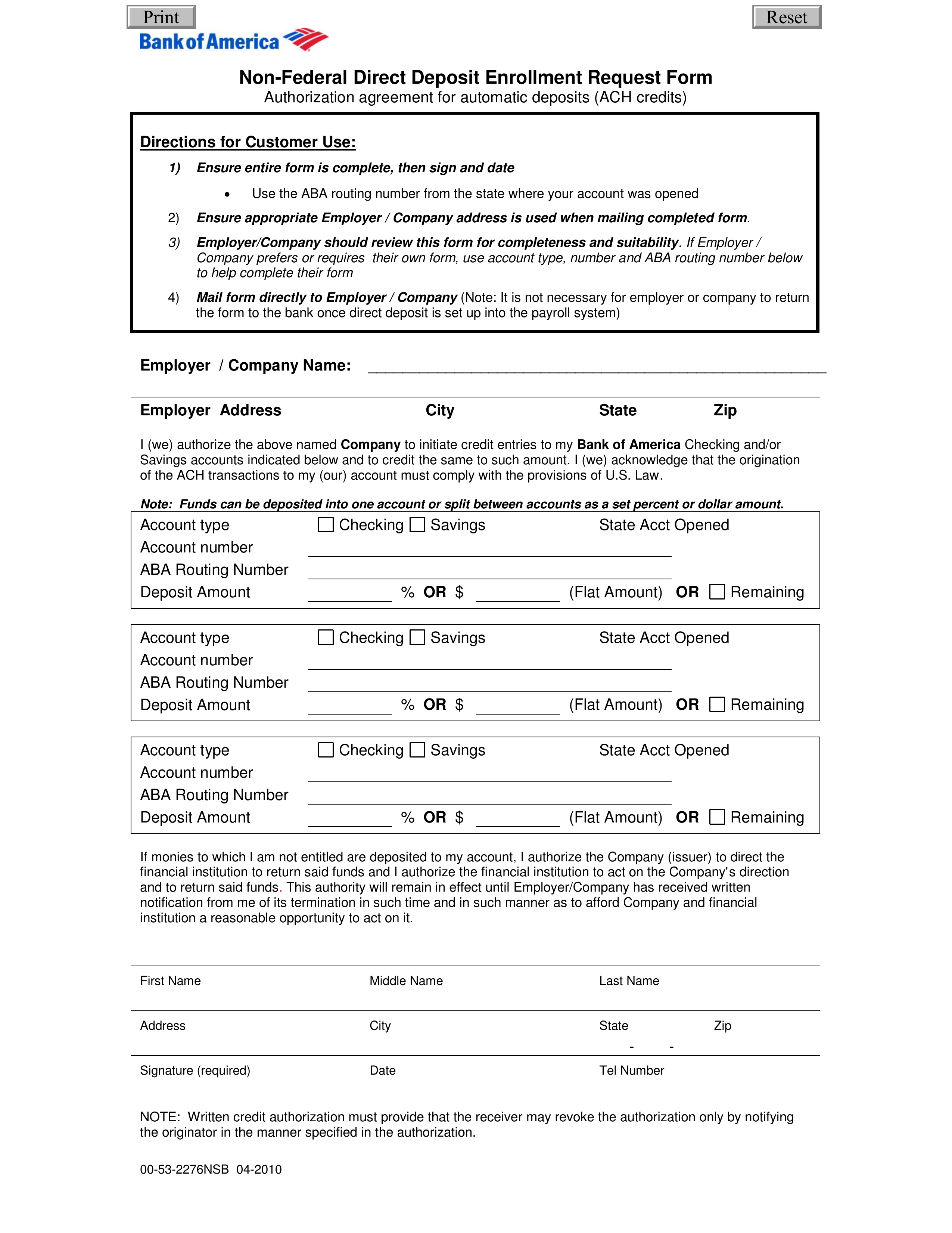
For most individuals, direct deposit is set up through their employer’s human resources or payroll department. The process usually involves completing a direct deposit authorization form.
- Obtain the Direct Deposit Form: Your employer will provide you with a direct deposit enrollment form. This might be a physical paper form, an online portal, or part of your new-hire paperwork.
- Gather Your Information: Have your Bank of America routing number, account number, and account type (checking or savings) readily available. A voided check can often provide all the necessary information at a glance.
- Complete the Form Accurately: Fill out all required fields carefully. Double-check all digits for your routing and account numbers. Even a single incorrect digit can cause significant delays or even send your payment to the wrong account. Indicate whether the deposit is for a checking or savings account.
- Specify Deposit Amount (if applicable): Some forms allow you to designate a specific amount or percentage of your paycheck to be deposited into one account, with the remainder going into another (e.g., a portion to savings, the rest to checking).
- Sign and Submit: Sign and date the form as required and submit it to your employer’s payroll department.
- Confirmation and Verification: Ask your employer how long it will take for direct deposit to become active. It often takes one or two pay cycles for the change to take effect. During this interim period, you might still receive a paper check. Once direct deposit begins, verify the first deposit by checking your Bank of America account statement or online banking.

Key Details on the Direct Deposit Form
Beyond the routing and account numbers, a standard direct deposit form will typically request:
- Your Name: As it appears on your bank account.
- Employee ID Number: If applicable.
- Bank Name: Bank of America.
- Account Type: Checking or Savings.
- Amount to Deposit: Full net pay or a specified amount/percentage.
- Authorization Signature: Your signature granting permission for the electronic transfer.
While a “bank address” field might exist, remember its low priority for the electronic transaction itself. If uncertain, leave it blank or use a local branch address only if explicitly instructed and if the routing and account numbers are fully covered.
Considerations for Multiple Direct Deposits or Account Changes
Many employers offer the flexibility to split your direct deposit across multiple accounts, even at different financial institutions. This can be an excellent strategy for personal finance goals, such as automatically allocating a portion of each paycheck to savings, an investment account, or a joint account. If you wish to set this up, you’ll need the routing and account numbers for each designated account.
If you change bank accounts or wish to update your direct deposit information, you will need to complete a new direct deposit authorization form with your employer. It’s crucial to inform your employer as soon as possible about any changes to avoid interruptions in your pay. Do not close an old account until you have verified that your new direct deposit setup is fully functional and funds are successfully being deposited into the new account.
Benefits and Best Practices for Direct Deposit
Beyond the fundamental setup, understanding the broader benefits and adhering to best practices can significantly enhance your financial management through direct deposit. It’s a tool that empowers greater control, security, and efficiency in your personal financial ecosystem.
The Unmatched Convenience and Speed
The most immediate and apparent benefit of direct deposit is convenience. Gone are the days of physically depositing checks, dealing with bank hours, or waiting for funds to clear. With direct deposit, your funds are typically available on your designated payday, sometimes even a day earlier depending on your bank and payer’s processing times. This immediate access to funds can prevent overdrafts and ensure timely payment of bills. For those who travel or have irregular schedules, direct deposit ensures continuity of income without geographical constraints.
Enhanced Security and Reliability
Direct deposit significantly reduces the risks associated with paper checks. Physical checks can be lost, stolen, or misplaced, leading to delays, fees, and potential fraud. Electronic transfers, by contrast, are encrypted and processed through secure networks. This minimizes the chances of your funds falling into the wrong hands or being delayed due to external factors. The reliability of direct deposit also means fewer errors in payroll processing, ensuring you receive the correct amount on time, every time.
Financial Planning Advantages
For astute financial managers, direct deposit offers powerful advantages. The consistent and predictable arrival of funds makes budgeting far more straightforward. You can confidently set up automatic bill payments knowing funds will be available. Furthermore, many individuals leverage direct deposit to automate savings or investments. By splitting your deposit, a portion of your income can automatically transfer to a savings account, retirement fund, or brokerage account, effectively “paying yourself first” without requiring manual intervention. This passive approach to saving is a cornerstone of effective wealth building.
Verifying Your Direct Deposit Setup
After submitting your direct deposit information, it’s a best practice to actively verify that it has been set up correctly.
- Monitor Your Account: Check your Bank of America online banking or mobile app on your next payday. Look for the expected deposit from your employer or payer.
- Confirm with Payroll: If your direct deposit doesn’t appear as expected after one or two pay cycles, contact your employer’s payroll department immediately. There might have been an error in data entry or a processing delay.
- Keep Records: Retain a copy of the direct deposit authorization form you submitted and any confirmation notices you receive. This documentation can be invaluable if any discrepancies arise.
Addressing Common Queries and Ensuring Financial Security
Even with a straightforward process like direct deposit, questions and potential issues can arise. Understanding how to troubleshoot common problems and, more importantly, how to protect your financial information is paramount for a secure and hassle-free experience.
What to Do if Direct Deposit Goes Wrong
While direct deposit is highly reliable, occasional issues can occur. Here’s a plan of action:
- Check Your Account Statement: First, meticulously review your Bank of America account statement and transaction history online. Confirm the date the deposit was expected and look for any pending transactions.
- Contact Your Employer/Payer: If the deposit is missing, the first point of contact should always be your employer’s payroll or human resources department. They can verify if the payment was sent, when it was sent, and to which account. They might have a trace number for the transaction.
- Contact Bank of America: If your employer confirms the funds were sent to the correct account but you still don’t see them, then contact Bank of America customer service. Provide them with details of the missing deposit, including the date and amount, and any trace numbers from your employer.
- Be Patient but Persistent: Investigating missing funds can take a few business days. Be patient, but also follow up regularly until the issue is resolved. Keep a record of all communications.
- Incorrect Account Number: If the funds were sent to an incorrect account number due to a mistake on your part or your employer’s, recovery can be more complex. If the account doesn’t exist, the funds will usually bounce back. If they went to an active, but incorrect, account, recovery depends on the cooperation of the recipient of those funds. Timely action is critical in such scenarios.
Protecting Your Account Information
Your routing and account numbers, while necessary for direct deposit, are sensitive pieces of financial information. Practicing good security habits is crucial to prevent fraud and identity theft.
- Be Cautious Online: Only enter your direct deposit information on secure, legitimate employer portals or forms. Be wary of unsolicited emails or messages asking for your bank details.
- Secure Physical Documents: Keep voided checks, bank statements, and direct deposit forms in a secure location. Shred old documents that contain this information.
- Monitor Your Accounts Regularly: Routinely check your Bank of America online banking or statements for any unauthorized transactions. Report suspicious activity immediately.
- Strong Passwords: Use strong, unique passwords for your online banking and employer portals. Enable two-factor authentication whenever possible.
- Be Aware of Phishing Scams: Fraudsters often try to trick individuals into revealing bank details through sophisticated phishing emails or texts. Always verify the sender before clicking links or providing information.
Frequently Asked Questions About Bank of America Direct Deposit
Q: Do I need a specific Bank of America branch address for direct deposit?
A: No, for standard direct deposit, you primarily need your Bank of America routing number and your account number. A physical address is almost never required for the electronic transfer itself.
Q: Where can I find my Bank of America routing number?
A: You can find it on your online banking portal, the Bank of America mobile app, on your checks (the first nine digits at the bottom left), or on your bank statements.
Q: How long does it take for direct deposit to start working?
A: Typically, it takes one to two pay cycles after you submit your direct deposit form to your employer for the changes to take effect.
Q: Can I split my direct deposit into multiple Bank of America accounts, or accounts at different banks?
A: Yes, most employers allow you to split your direct deposit among multiple accounts. You will need the routing and account numbers for each account you wish to use.
Q: What if I change banks or account numbers?
A: You must inform your employer immediately and submit a new direct deposit authorization form with your updated bank information. Do not close your old account until you have verified that funds are successfully depositing into your new account.
By understanding these nuances and adopting best practices, Bank of America customers can leverage direct deposit for maximum financial benefit and peace of mind. It remains one of the most effective tools for managing your income securely and efficiently in today’s digital economy.
aViewFromTheCave is a participant in the Amazon Services LLC Associates Program, an affiliate advertising program designed to provide a means for sites to earn advertising fees by advertising and linking to Amazon.com. Amazon, the Amazon logo, AmazonSupply, and the AmazonSupply logo are trademarks of Amazon.com, Inc. or its affiliates. As an Amazon Associate we earn affiliate commissions from qualifying purchases.