
Beyond a simple address, a corporate headquarters is the physical manifestation of a brand’s identity, values, and strategic vision. For a global titan like Amazon, its headquarters are not merely office buildings; they are powerful symbols, strategic hubs, and integral components of its evolving brand narrative. This article delves into the brand significance of Amazon’s headquarters, exploring how their locations, design, and strategic evolution reflect and shape one of the world’s most recognizable and influential brands.
Seattle: The Genesis and Enduring Core of the Amazon Brand
Amazon’s journey began in Bellevue, Washington, but it quickly established its roots in Seattle, a city synonymous with innovation and technological advancement. This foundational choice profoundly shaped Amazon’s corporate identity and brand image for decades.

From Garage to Urban Campus: A Growth Story Reflected in Bricks and Mortar
The story of Amazon, much like many tech giants, starts with humble beginnings. Jeff Bezos founded Amazon in his Bellevue garage in 1994, quickly moving to a small office in Seattle. From these modest origins, the company rapidly expanded, its physical presence mirroring its exponential growth from an online bookseller to the “everything store.” Amazon’s initial campus in the South Lake Union neighborhood of Seattle was not a grand, singular edifice but a collection of buildings, reflecting a pragmatic, iterative approach.
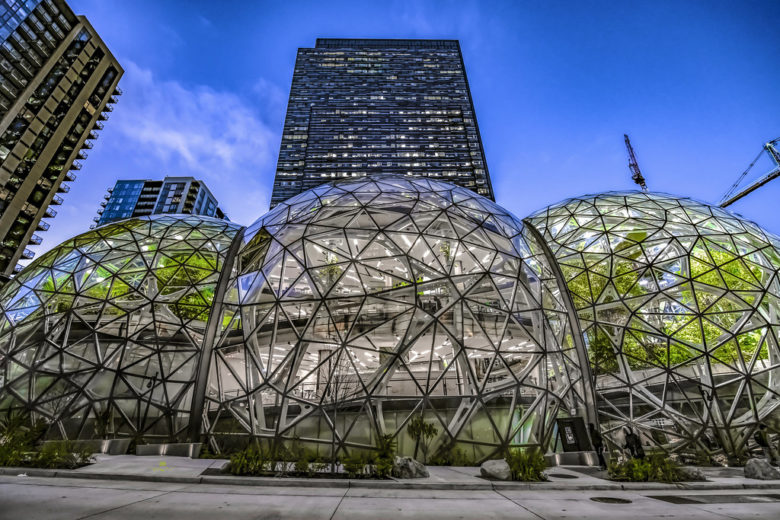
As Amazon matured, so did its architectural identity. The development of its new high-rise campus in Seattle’s Denny Triangle, particularly the distinctive “Spheres,” became a powerful brand statement. These iconic glass domes, filled with thousands of plants, are more than just workspaces; they are architectural marvels that communicate Amazon’s brand values of innovation, sustainability, and employee well-being (at least in principle and aspiration). This physical growth, from scattered offices to a cohesive, architecturally significant campus, visually articulated Amazon’s brand evolution from a nascent startup to a global powerhouse. Each new building, each new amenity, became a tangible representation of its expanding influence and deepening corporate identity. The campus itself became a marketing tool, attracting top talent and showcasing its commitment to a unique work environment.
The Seattle Identity: How Location Shapes Brand Culture and Talent
Seattle provided Amazon with a fertile ground for growth. The city’s strong tech ecosystem, its culture of innovation, and its access to a highly skilled workforce were instrumental. Being headquartered in Seattle allowed Amazon to tap into a vibrant talent pool, benefiting from the city’s academic institutions and its reputation as a hub for software development and cloud computing. This symbiotic relationship meant that Seattle’s innovative, somewhat unconventional spirit became intertwined with Amazon’s corporate culture. The brand image of Amazon—fast-paced, data-driven, customer-obsessed—was, in many ways, nurtured and amplified by its Seattle origins.
Moreover, the proximity to other tech giants and a strong startup scene fostered a competitive yet collaborative environment that pushed Amazon to constantly innovate. The company’s deep roots in Seattle also created a distinct sense of corporate identity, often characterized by a blend of pioneering spirit and relentless execution. This sense of place became a crucial part of Amazon’s employer brand, signaling to prospective employees a unique culture deeply embedded in a dynamic urban setting. For Amazon, Seattle was not just a geographic coordinate; it was a foundational element of its brand’s DNA, shaping its operational style, its workforce, and its public persona for decades.
The Quest for HQ2: A Strategic Brand Expansion
By the mid-2010s, Amazon’s growth necessitated a significant re-evaluation of its physical footprint. The decision to seek a second North American headquarters, famously dubbed “HQ2,” was not merely a logistical solution to overcrowding but a profound strategic move with significant brand implications.
Why a Second Headquarters? A Brand Strategy Perspective
The rationale behind HQ2 was multi-faceted, extending far beyond simple capacity issues. From a brand strategy perspective, the establishment of a second headquarters addressed several critical needs:
- Talent Diversification and Acquisition: Relying heavily on one metropolitan area for talent created bottlenecks and increased competition for skilled professionals. HQ2 aimed to tap into new talent pools in different regions, broadening Amazon’s appeal and mitigating risks associated with a single dominant talent market. This was a strategic move to reinforce its employer brand nationally.
- Risk Diversification: Concentrating all core operations in one location posed geographical, economic, and even political risks. A second headquarters offered a degree of operational resilience, ensuring continuity and stability for its brand in the face of unforeseen challenges.
- Public Relations and Corporate Citizenship: Amazon, as a colossal corporation, faced increasing scrutiny regarding its economic impact and presence. HQ2 was an opportunity to demonstrate commitment to multiple communities, fostering goodwill and potentially improving its brand image as a national job creator and economic engine, rather than a monolithic entity concentrated in one city.
- Proximity to Policy Makers: The eventual choice of a location near Washington D.C. suggested a strategic move to enhance Amazon’s engagement with federal policy-makers, reflecting an evolving corporate identity that acknowledged its growing role in national discourse and regulation.
In essence, HQ2 was a deliberate strategic expansion designed to strengthen Amazon’s brand across multiple dimensions: as an employer, as a resilient corporation, and as a responsible national player.
The HQ2 Selection Process: A Masterclass in Brand Marketing and Engagement
The HQ2 search was an unprecedented corporate real estate endeavor that evolved into a public spectacle and, effectively, a masterclass in brand marketing. By inviting bids from cities across North America, Amazon initiated a highly competitive “beauty pageant” that generated immense media buzz and public engagement. Over 200 cities submitted proposals, each vying for the economic windfall and prestige associated with hosting Amazon.
This process was a genius stroke of marketing for Amazon. It kept the company in the headlines for over a year, portraying it as a desirable, job-creating powerhouse. Each city’s proposal implicitly served as an endorsement of Amazon’s brand, showcasing their eagerness to partner with the company. The competition allowed Amazon to gather vast amounts of data on potential locations, infrastructure, and talent pools, all while maintaining a positive public profile. While some criticized the process for its perceived demands on cities, it undeniably solidified Amazon’s brand image as an economic force and a highly coveted corporate citizen, simultaneously projecting an image of careful, strategic decision-making.

Crystal City (National Landing): A New Chapter for the Amazon Brand
In late 2018, Amazon announced that it would divide HQ2 between Crystal City (Arlington, Virginia) and Long Island City (New York), though the New York plan was later canceled due to local opposition. The focus shifted entirely to the Arlington location, now rebranded “National Landing.” This choice was strategic and loaded with brand implications.
National Landing, with its proximity to Washington D.C., signaled a subtle but significant evolution in Amazon’s corporate identity. While Seattle remains its technological heart, Arlington positions Amazon closer to the nation’s political and regulatory epicenter. This move reflects Amazon’s growing maturity and its increasing need to engage with federal government affairs, policy debates, and public sector contracting. The brand message here is one of national presence and influence. It suggests Amazon is not just a tech company but a significant American institution. This location allows Amazon to more effectively project an image of a company deeply invested in national infrastructure, defense, and public services, broadening its brand appeal beyond its traditional consumer and cloud services. The new campus, with its emphasis on sustainability and urban integration, is designed to reflect a modern, responsible corporate entity, further refining Amazon’s brand perception in the public eye.
Architectural Identity and Brand Values
The physical design of Amazon’s headquarters buildings is far from arbitrary; it is a deliberate expression of its brand values and a tool for fostering its unique corporate culture.
Design as a Brand Statement: The Spheres and Beyond
Amazon’s headquarters architecture in Seattle, particularly “The Spheres,” serves as a potent brand statement. These visually striking biospheres are not just offices; they are unique spaces designed to encourage creativity, collaboration, and a connection with nature. Their innovative design communicates Amazon’s commitment to pushing boundaries, thinking differently, and investing in employee well-being (again, within its corporate framework). The Spheres showcase Amazon’s brand as forward-thinking, environmentally conscious, and a desirable place to work for those seeking an unconventional environment.
Beyond the Spheres, the broader architectural language across Amazon’s campuses emphasizes modern design, functionality, and integration into the urban fabric. In National Landing, the design focuses on creating a sustainable, pedestrian-friendly campus that blends seamlessly with the surrounding community, including features like “The Helix,” another distinctive structure. This emphasis on contemporary, thoughtful design reinforces Amazon’s brand as a leader not just in technology, but also in urban development and sustainable practices, aiming to cultivate a more positive public image as a responsible corporate citizen.
Fostering Innovation and Collaboration: Headquarters as Brand Incubators
The internal layout and design of Amazon’s headquarters are meticulously planned to foster the company’s core brand values: innovation, efficiency, and customer obsession. Open floor plans, collaborative spaces, and accessible meeting areas are designed to encourage serendipitous interactions and cross-functional teamwork. The goal is to create environments where ideas can be exchanged rapidly, decisions can be made swiftly, and the “Day 1” mentality of continuous innovation is ingrained.
These physical spaces act as brand incubators, reinforcing the company’s commitment to a specific work culture. They are designed to embody Amazon’s brand image of a lean, agile organization that values direct communication and rapid execution. The ability to quickly iterate and experiment, a hallmark of Amazon’s brand, is supported by headquarters designed for maximum flexibility and interaction. The physical environment thus becomes a living testament to Amazon’s brand promise of constant evolution and relentless pursuit of efficiency.
The Headquarters as a Symbol of Corporate Power and Brand Influence
Amazon’s headquarters are more than just workspaces; they are powerful symbols of its vast corporate influence, economic impact, and evolving relationship with local communities and global markets.
Economic Impact and Community Relations: The Brand’s Local Footprint
The presence of Amazon’s headquarters in Seattle and now National Landing has had a transformative economic impact on these regions, bringing jobs, investment, and growth. This economic power is a double-edged sword for the brand. On one hand, it solidifies Amazon’s image as a major economic engine, a job creator, and a driver of innovation. On the other, it often brings challenges like gentrification, increased cost of living, and strains on infrastructure, leading to community tensions and scrutiny.
Amazon’s brand management in these host cities involves navigating these complexities. The company invests in community programs, infrastructure improvements, and local partnerships to mitigate negative perceptions and reinforce a positive brand image as a responsible corporate citizen. The headquarters become focal points for these community relations efforts, acting as tangible representations of Amazon’s local footprint and its commitment (or perceived lack thereof) to the well-being of its host communities. How Amazon manages these local interactions significantly shapes its broader brand reputation.
Global Reach, Local Roots: How HQ Locations Project Brand Image
Despite its vast global digital presence, Amazon’s physical headquarters provide essential anchors that project its brand image both domestically and internationally. These locations serve as concrete points of reference for a brand that is largely experienced through screens and packages. They symbolize the scale and legitimacy of Amazon’s operations.
The distinct locations—Seattle representing its tech innovation roots and National Landing representing its growing influence in national policy and enterprise—allow Amazon to project a diversified brand image. Seattle champions its entrepreneurial, pioneering spirit, while National Landing underscores its maturity, stability, and engagement with broader societal and governmental structures. Together, these headquarters communicate a powerful narrative: Amazon is a globally ubiquitous digital force, yet it is firmly rooted in strategic physical locations that reflect its multidimensional brand identity and its profound impact on the world. They are not just places where Amazon employees work; they are key assets in the company’s ongoing brand strategy, shaping perceptions and influencing its trajectory for decades to come.
In conclusion, Amazon’s headquarters are far more than administrative centers. They are integral to its corporate identity, powerful symbols of its brand strategy, and living monuments to its evolution from a nascent online bookseller to a global economic and cultural force. Their locations, architectural designs, and strategic significance speak volumes about Amazon’s past, present, and future brand trajectory, continually shaping how the world perceives this extraordinary company.
aViewFromTheCave is a participant in the Amazon Services LLC Associates Program, an affiliate advertising program designed to provide a means for sites to earn advertising fees by advertising and linking to Amazon.com. Amazon, the Amazon logo, AmazonSupply, and the AmazonSupply logo are trademarks of Amazon.com, Inc. or its affiliates. As an Amazon Associate we earn affiliate commissions from qualifying purchases.