
In the pantheon of global corporations, Amazon stands as a colossus, its influence permeating nearly every facet of modern commerce and digital life. From its humble beginnings as an online bookseller to its current multifaceted empire encompassing e-commerce, cloud computing, artificial intelligence, and entertainment, Amazon’s growth has been nothing short of extraordinary. At the heart of this sprawling enterprise lies the question of its physical anchor: Where is Amazon headquartered? This seemingly straightforward query opens a fascinating window into the strategic evolution of a brand, revealing how its physical locations are not just administrative centers but critical expressions of its corporate identity, market strategy, and profound societal impact.

Amazon’s headquarters strategy, particularly its groundbreaking decision to establish a second major headquarters, offers a rich case study in how a brand adapts, expands, and reinforces its presence in an increasingly complex global landscape. It’s a narrative deeply interwoven with urban development, talent acquisition, public relations, and the intricate dance between a colossal brand and the communities it inhabits. Understanding Amazon’s headquarters means understanding a significant part of its brand strategy – how it projects power, fosters culture, and manages its identity across diverse geographic and economic terrains.
Seattle: The Birthplace and Enduring Core of Amazon’s Brand
For decades, the answer to Amazon’s headquarters question was singular and unequivocal: Seattle, Washington. This vibrant Pacific Northwest city, known for its innovation and tech-savvy population, provided the fertile ground from which Amazon blossomed. Seattle is not just a location; it is inextricably linked to Amazon’s origin story, its formative culture, and the very essence of its brand identity.
From Garage to Global Giant: The Seattle Origin Story
Amazon’s journey began in 1994, founded by Jeff Bezos in a Bellevue garage before quickly relocating to Seattle. This initial choice of Seattle was foundational. The city’s proximity to a skilled workforce, its burgeoning tech scene, and its pioneering spirit aligned perfectly with Bezos’s ambitious vision for an “everything store.” The early years in Seattle were characterized by rapid innovation, a relentless focus on the customer, and a willingness to disrupt traditional business models – traits that quickly became synonymous with the Amazon brand. The brand ethos of “Day 1” thinking, emphasizing agility, experimentation, and a startup mentality, was forged in these Seattle beginnings. This cultural bedrock, rooted in the city’s innovative environment, shaped Amazon’s brand narrative as a disruptor and a pioneer.
The Amazon Campus: Architectural Manifestation of Corporate Identity
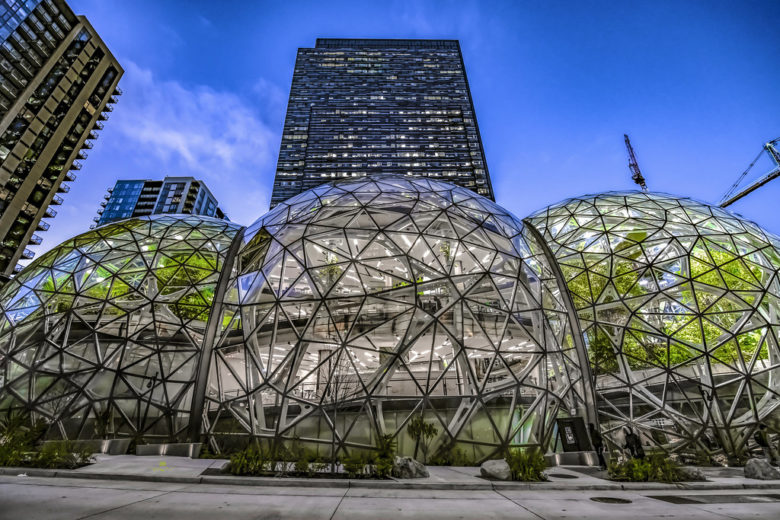
As Amazon scaled, so did its physical footprint in Seattle. The urban campus, sprawling across multiple city blocks in the Denny Triangle and South Lake Union neighborhoods, became a tangible representation of Amazon’s corporate identity. Far from a sterile, isolated corporate park, Amazon deliberately integrated its campus into the urban fabric of Seattle, fostering a sense of connectivity with the city. Iconic structures like “The Spheres”—three glass domes housing a diverse collection of plant species and serving as an employee workspace and public attraction—epitomize Amazon’s brand values of innovation, environmental consciousness, and a unique, somewhat unconventional approach to the workplace.
The Spheres, in particular, serve as a potent brand symbol, showcasing Amazon’s commitment to creating inspiring environments that foster creativity and collaboration. They are not merely buildings but architectural statements that project Amazon’s aspiration to be a progressive, forward-thinking, and even whimsical employer. This deliberate design strategy reflects a brand that seeks to be seen as more than just an e-commerce giant; it aims to be a cultural innovator and a responsible urban partner, despite criticisms sometimes leveled against its impact on local housing and traffic.
Brand Echoes: Seattle’s Influence on Amazon’s DNA
Seattle’s influence on Amazon’s brand DNA extends beyond its physical presence. The city’s culture of innovation, its strong academic institutions, and its rich talent pool have deeply imprinted themselves on Amazon’s corporate values. The brand’s famed “customer obsession,” its long-term thinking, its high-bar hiring philosophy, and its emphasis on peculiar initiatives (like Dash Buttons or drone delivery) all reflect an experimental, pioneering spirit nurtured in Seattle.
The challenges of growth in a densely populated urban environment also shaped Amazon’s approach to brand management and public relations. As Amazon became Seattle’s largest employer, its relationship with the city grew complex, involving debates over urban development, transportation, and social responsibility. This interaction forced Amazon to refine its brand messaging, emphasizing its economic contributions, community engagement, and commitment to sustainability, even as it navigated local skepticism and criticism. Seattle thus became a crucible where Amazon learned to manage its brand identity on a massive scale, demonstrating both its transformative power and the complexities of being a corporate behemoth in a beloved city.
The Quest for “HQ2”: A Bold Expansion of Brand Footprint
In 2017, Amazon sent shockwaves through the corporate and municipal worlds with an unprecedented announcement: it was seeking a location for a second corporate headquarters, dubbed “HQ2.” This decision was not merely an expansion; it was a strategic move designed to amplify Amazon’s brand, diversify its talent acquisition, and address the logistical and reputational challenges of concentrating so much power in a single city.
Strategic Imperatives Behind the Nationwide Search
The rationale behind HQ2 was multifaceted, all serving to bolster Amazon’s brand in the long term. First, talent: Amazon’s insatiable demand for highly skilled tech workers was straining Seattle’s labor market and infrastructure. A second headquarters would allow Amazon to tap into new talent pools, reducing competition and facilitating more efficient hiring. This directly reinforces the brand’s image as a top-tier employer and innovator.
Second, geographic diversification: Placing a major operational hub on the East Coast offered strategic advantages for logistics, market access, and reduced travel times for executives and employees dealing with European and East Coast operations. This move expanded Amazon’s physical presence closer to significant customer bases and political centers, subtly reinforcing its brand as a ubiquitous, accessible, and politically engaged entity.
Third, risk mitigation: Concentrating all strategic operations in one location carried inherent risks, from natural disasters to local political challenges. HQ2 was a safeguard, ensuring business continuity and distributed decision-making capabilities. This move signaled a mature, resilient brand capable of strategic foresight.
The HQ2 Selection Process: A Masterclass in Brand Engagement
The HQ2 search was a public spectacle, a masterclass in corporate branding and a testament to Amazon’s immense gravitational pull. Cities across North America vied for the opportunity, submitting elaborate proposals and publicly courting Amazon. This generated unparalleled media attention, showcasing Amazon’s economic power and its capacity to ignite urban development. The open, competitive process elevated Amazon’s brand stature, portraying it as a highly desirable, job-creating powerhouse whose presence could transform a region.
While some criticized the “beauty contest” aspect, the process undeniably cemented Amazon’s brand as an economic engine. It highlighted the brand’s ability to command attention and demonstrated the profound impact its location decisions could have on local economies, cementing its image as a crucial driver of prosperity and progress. The narrative was clear: being chosen by Amazon was a badge of honor, a validation of a city’s potential, thereby enhancing Amazon’s own brand as a discerning and impactful corporate citizen.
Arlington, Virginia: A New Chapter for Amazon’s Brand Narrative
After a year-long, highly publicized search, Amazon ultimately selected Arlington, Virginia (specifically the National Landing area, a rebranding of Crystal City, Pentagon City, and Potomac Yard) for HQ2. This choice was strategically brilliant from a brand perspective. Arlington offered immediate access to a highly educated workforce, proximity to Washington D.C.’s political and regulatory landscape, excellent transportation infrastructure, and a robust economic base.

For Amazon’s brand, establishing a major presence just across the Potomac River from the nation’s capital brought several advantages. It signaled Amazon’s increasing engagement with policy-making and its role as a key player in national discourse, beyond just commerce. It also allowed Amazon to diversify its talent acquisition beyond the tech-centric West Coast, tapping into East Coast universities and government-adjacent talent pools. National Landing, envisioned as a vibrant, mixed-use community, reflects Amazon’s continued commitment to integrating its campuses into urban environments, consistent with its Seattle model. This second headquarters further solidifies Amazon’s brand as not just a company, but a significant force shaping urban futures and national economies.
Dual Headquarters: Reinforcing and Diversifying the Amazon Brand
The establishment of dual headquarters in Seattle and Arlington marks a significant evolution in Amazon’s brand strategy, moving from a singular iconic hub to a distributed, yet unified, corporate presence. This model allows Amazon to reinforce core brand values while diversifying its operational and cultural footprint.
Synergies and Specializations: How Each HQ Contributes to the Overall Brand
Amazon’s dual headquarters are designed to operate in synergy, each contributing distinct strengths to the overall brand. Seattle remains the historic core, the “Day 1” innovation engine, housing many of the company’s long-standing e-commerce, AWS, and device teams. It is the place where Amazon’s foundational brand identity was forged and continues to be nurtured.
Arlington, on the other hand, is emerging as a new center for corporate functions, public policy, and potentially new lines of business, leveraging its proximity to government and a different talent ecosystem. This allows Amazon to project an image of a brand that is both deeply rooted in its innovative past and dynamically evolving to meet future challenges. The two HQs, while geographically distant, are united by Amazon’s overarching leadership principles and corporate culture, ensuring a consistent brand experience for employees, partners, and the public. This strategic division of labor enhances the brand’s resilience and adaptability.
Economic and Societal Impact: Brand as a Community Partner
Amazon’s headquarters, both in Seattle and Arlington, exert immense economic and societal influence, positioning the brand as a powerful community partner—albeit one that often draws scrutiny. In Seattle, Amazon’s growth fundamentally reshaped the city, leading to a boom in jobs, real estate development, and cultural vibrancy, but also contributing to gentrification and cost-of-living challenges. In response, Amazon has engaged in various community initiatives, public art projects, and housing affordability programs, aiming to burnish its brand as a responsible corporate citizen.
Similarly, in Arlington, Amazon has committed substantial investment to infrastructure, public parks, and affordable housing initiatives as part of its HQ2 development. These efforts are crucial for Amazon’s brand reputation. By actively participating in and contributing to urban development, Amazon seeks to demonstrate its commitment beyond mere economic activity, positioning itself as a force for positive change within the communities it inhabits. This proactive engagement, though sometimes viewed with cynicism, is essential for a brand of Amazon’s scale to manage its public perception and maintain its social license to operate.
Adapting Corporate Culture Across Geographies
A significant challenge and opportunity for Amazon’s brand is ensuring a consistent corporate culture and identity across two major headquarters. While the physical environments may differ, Amazon’s core “Leadership Principles” provide a unifying framework. These principles—such as “Customer Obsession,” “Ownership,” “Invent and Simplify,” and “Learn and Be Curious”—are applied uniformly, irrespective of location. This ensures that the Amazon brand experience for employees and partners remains coherent, fostering a shared sense of purpose and identity.
Maintaining this cultural consistency across diverse talent pools and local cultures is critical for safeguarding the Amazon brand. It demonstrates the brand’s ability to scale not just operations, but also its deeply ingrained values, projecting an image of a cohesive and unified global entity, even with a distributed leadership presence. The success of this dual-HQ model will largely depend on Amazon’s ability to seamlessly integrate its cultural fabric across both significant locations.
Beyond Bricks and Mortar: The Evolving Definition of Amazon’s Brand Presence
While physical headquarters are crucial anchors for corporate identity, Amazon’s brand presence extends far beyond its buildings. In an increasingly digital and globalized world, the true definition of Amazon’s “headquarters” is evolving, encompassing its vast digital infrastructure and its pervasive influence on the global economy.
Digital Dominance and Global Reach: The Headquarters Beyond Physical Walls
Amazon Web Services (AWS), Amazon’s cloud computing arm, effectively creates a “virtual headquarters” that underpins countless businesses and digital services worldwide. This digital infrastructure represents a fundamental component of Amazon’s brand: reliable, scalable, and foundational to the digital economy. The servers, data centers, and network nodes spread across the globe are, in essence, extensions of Amazon’s operational core, enabling its vast e-commerce and technological ventures.
Furthermore, Amazon’s global logistics network, with fulfillment centers, delivery stations, and transportation hubs spanning continents, functions as a de facto distributed operational headquarters. Each node in this network embodies the brand’s promise of convenience and efficiency. In this sense, Amazon’s true “headquarters” is a hybrid entity: rooted in its physical campuses in Seattle and Arlington, but also dispersed across a global digital and logistical infrastructure that gives the brand its immense reach and power. This global distribution solidifies Amazon’s brand as an omnipresent force in modern life.
Sustainability and Innovation as Brand Pillars
Both Seattle and Arlington headquarters are designed with an emphasis on sustainability and innovation, reflecting these as core brand pillars. The Spheres in Seattle, with their unique biome, and the future development in Arlington, with its focus on public spaces and environmental considerations, showcase Amazon’s commitment to responsible growth. These architectural and urban planning choices are not merely aesthetic; they are strategic brand statements, signaling Amazon’s desire to be seen as a leader in sustainable practices and workplace innovation.
By embedding these values into its physical structures and operational decisions, Amazon strengthens its brand narrative as a forward-thinking, environmentally conscious company. This is crucial for attracting talent, appealing to conscientious consumers, and navigating the complexities of corporate social responsibility in the 21st century.
The Future of Work and the Agile Brand
The COVID-19 pandemic significantly altered perceptions of work and the necessity of physical headquarters. Amazon, like many tech giants, has embraced a hybrid work model, questioning the traditional role of a central office. While the physical campuses in Seattle and Arlington remain vital for collaboration, culture-building, and high-level strategy, Amazon’s brand is evolving to be more agile and adaptable to distributed workforces.
This shift signifies a brand that is not rigidly tied to concrete structures but is capable of thriving in a more fluid, decentralized operational model. The headquarters, in this context, become cultural hubs and strategic nerve centers, rather than the sole locus of all activity. Amazon’s ability to maintain its innovative edge and strong corporate culture across a blend of physical and remote work environments will be a testament to its brand’s resilience and adaptability in shaping the future of work.
In conclusion, Amazon’s headquarters strategy—its deep roots in Seattle and its ambitious expansion into Arlington—is a dynamic expression of its brand identity. These locations are more than just office spaces; they are carefully chosen anchors that reflect Amazon’s past, present, and future, serving as powerful symbols of its innovation, scale, and strategic vision. The story of where Amazon is headquartered is ultimately the story of a brand constantly evolving, adapting, and reinforcing its monumental presence in a world it continues to redefine.
aViewFromTheCave is a participant in the Amazon Services LLC Associates Program, an affiliate advertising program designed to provide a means for sites to earn advertising fees by advertising and linking to Amazon.com. Amazon, the Amazon logo, AmazonSupply, and the AmazonSupply logo are trademarks of Amazon.com, Inc. or its affiliates. As an Amazon Associate we earn affiliate commissions from qualifying purchases.