
The question “what is Amazon stock at today?” is perhaps one of the most frequently asked queries by both seasoned investors and curious onlookers. Amazon (AMZN), a titan of global commerce and technology, commands significant attention in financial markets. Its stock price is a real-time reflection of its colossal business operations, market sentiment, and macroeconomic forces. However, providing a static answer to “what is Amazon stock at today” is inherently impossible, as stock prices are dynamic, fluctuating second by second during market hours. Instead, this article aims to demystify the journey of Amazon’s stock, explain how to track its current valuation, delve into the myriad factors influencing its price, and offer an insightful perspective for those considering an investment in this e-commerce and cloud computing behemoth.

The Dynamic World of Amazon Stock (AMZN)
Amazon’s stock, traded under the ticker symbol AMZN on the NASDAQ exchange, is a bellwether for various sectors, including e-commerce, cloud computing, digital advertising, and logistics. Its price movement is not just a reflection of Amazon’s internal performance but also a barometer for broader economic trends and investor confidence in disruptive technologies.
Real-Time Tracking: Where to Find AMZN’s Latest Price
For anyone seeking the most up-to-the-minute price of Amazon stock, reliable financial platforms are the go-to source. These include:
- Major Financial News Websites: Websites like Google Finance, Yahoo Finance, Bloomberg, Reuters, The Wall Street Journal, and CNBC provide live stock quotes, interactive charts, and relevant news.
- Brokerage Accounts: If you have an investment account with a broker (e.g., Fidelity, Schwab, E*TRADE), their platforms typically offer real-time streaming quotes.
- Stock Market Apps: Numerous mobile applications are dedicated to stock tracking, offering convenience and personalized watchlists.
When checking the price, it’s crucial to note the “last updated” timestamp to ensure you’re viewing current data, especially if markets are open. Pre-market and after-hours trading prices are also often available, offering a glimpse into sentiment outside regular trading hours.
Understanding Market Fluctuations
Amazon’s stock price doesn’t move in a vacuum. It reacts to a confluence of factors, both company-specific and external. These fluctuations are a normal, albeit sometimes nerve-wracking, aspect of equity investing. Key drivers include earnings reports, new product launches, competitive pressures, shifts in consumer spending habits, interest rate changes, and geopolitical events. Investors continuously weigh these factors, leading to the constant interplay of buying and selling that defines daily stock price movements.
Key Drivers Behind Amazon’s Valuation
To understand why Amazon’s stock is priced the way it is, one must appreciate the diversity and scale of its business operations. What started as an online bookstore has blossomed into a multi-faceted empire, each segment contributing significantly to its overall valuation.
E-commerce Dominance and Global Expansion
Amazon’s foundational business remains its vast e-commerce platform. From books to electronics, groceries to apparel, Amazon.com dominates online retail in many parts of the world. This segment is characterized by:
- Market Share: Amazon holds a significant, often leading, share of the e-commerce market in countries like the U.S., Germany, the UK, and Japan.
- Customer Loyalty: Prime membership, offering expedited shipping, streaming services, and exclusive deals, fosters incredible customer loyalty and recurring revenue.
- Logistics Network: Its unparalleled global fulfillment and delivery network is a massive competitive advantage, enabling rapid and efficient order delivery.
- International Growth: While mature in some markets, Amazon continues to expand its e-commerce footprint in emerging economies, tapping into new consumer bases.
The health of the global consumer economy, disposable income levels, and the ongoing shift from brick-and-mortar to online shopping directly impact this segment’s performance and, consequently, AMZN’s stock price.
AWS: The Cloud Computing Powerhouse
Perhaps Amazon’s most profitable and rapidly growing segment is Amazon Web Services (AWS). AWS provides on-demand cloud computing platforms and APIs to individuals, companies, and governments on a metered pay-as-you-go basis. Its contributions include:
- Industry Leader: AWS is the undisputed leader in the cloud infrastructure market, far ahead of competitors like Microsoft Azure and Google Cloud.
- High Margins: Unlike the often razor-thin margins in e-commerce, AWS boasts significantly higher profitability, acting as a crucial profit engine for the entire company.
- Innovation: AWS continually innovates, offering an ever-expanding suite of services, from compute and storage to machine learning, databases, and analytics.
- Enterprise Adoption: Businesses of all sizes rely on AWS for their critical infrastructure, making its revenue streams highly sticky and resilient.
The growth rate of AWS, its ability to secure large enterprise contracts, and its capacity for innovation are critically important factors for analysts assessing Amazon’s future earnings potential and overall valuation.
Advertising, Subscriptions, and Emerging Ventures
Beyond e-commerce and AWS, Amazon has cultivated several other lucrative businesses:
- Advertising: Amazon’s advertising business, primarily driven by sponsored product listings and display ads on its e-commerce platform, has become a multi-billion-dollar enterprise. It leverages its vast trove of customer data to offer highly targeted advertising solutions, competing directly with Google and Meta.
- Subscriptions: Prime membership fees, alongside other subscription services like Amazon Music and Audible, provide a stable, recurring revenue stream and enhance customer lifetime value.
- Other Ventures: Amazon is constantly experimenting and investing in new areas, including healthcare (Amazon Pharmacy, One Medical), satellite internet (Project Kuiper), autonomous driving (Zoox), and physical retail concepts (Amazon Go, Whole Foods Market). These long-term bets, though sometimes dilutive in the short term, represent potential future growth engines.
The success and profitability of these diverse revenue streams collectively contribute to Amazon’s robust business model and underpin its valuation.
Macroeconomic Factors and Consumer Behavior
Beyond company-specific fundamentals, broader economic conditions significantly impact AMZN’s stock:
- Inflation and Interest Rates: High inflation can erode consumer purchasing power, impacting e-commerce sales. Rising interest rates can make borrowing more expensive for Amazon and its customers, and also make future earnings less attractive when discounted back to present value.
- Consumer Confidence: Economic uncertainty or downturns often lead consumers to cut back on discretionary spending, directly affecting Amazon’s retail segment.
- Supply Chain Resilience: Global supply chain disruptions can impact Amazon’s ability to stock and deliver products, leading to higher costs and potential revenue losses.
- Regulatory Scrutiny: As a dominant player, Amazon faces increasing antitrust scrutiny globally. Potential regulations or enforcement actions could impact its business practices and profitability.
Monitoring these macroeconomic indicators is crucial for understanding the external forces shaping Amazon’s market performance.
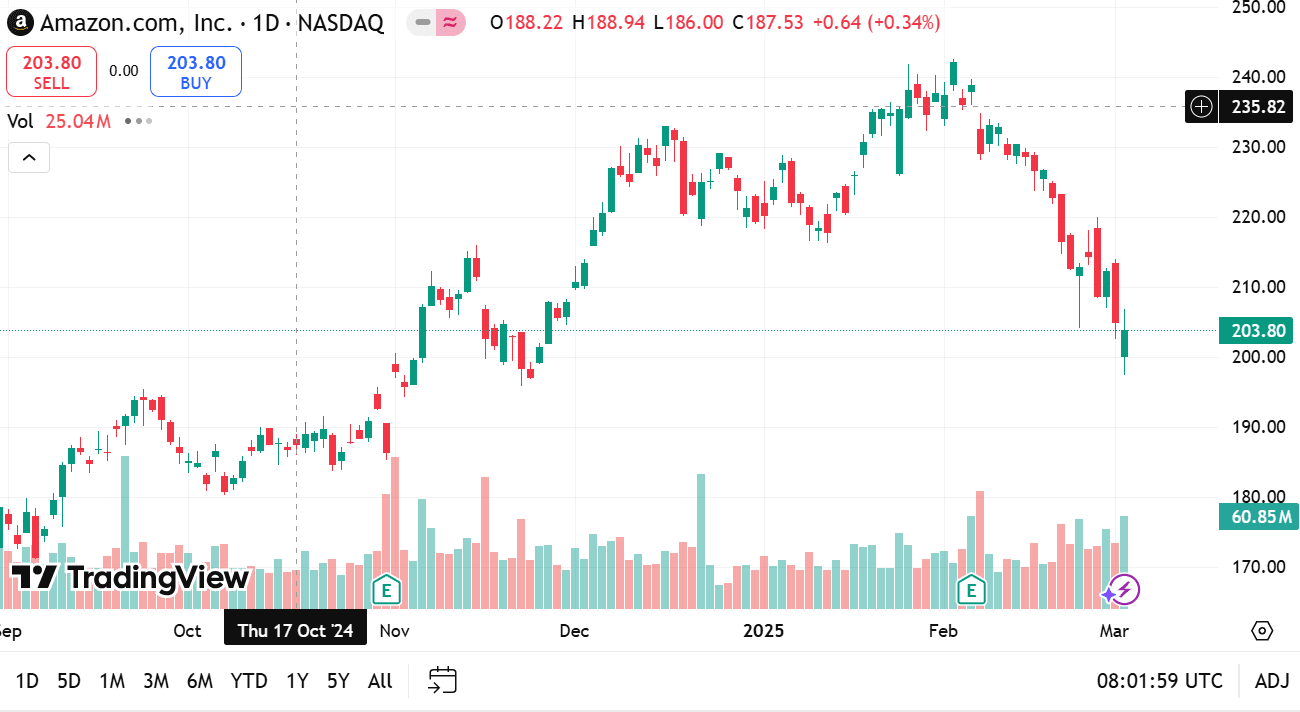
A Historical Perspective on AMZN’s Journey
Amazon’s stock history is a testament to long-term growth and resilience, punctuated by significant events that have shaped its trajectory. Since its IPO in 1997 at a split-adjusted price of $1.50 per share, AMZN has delivered monumental returns, demonstrating the power of disruptive innovation and compounding.
Milestones, Splits, and Growth Trajectory
- Early Growth (Late 90s – Early 2000s): Amazon survived the dot-com bubble burst, showcasing its resilience and long-term vision under Jeff Bezos’s leadership.
- AWS Launch (2006): The launch of Amazon Web Services marked a pivotal shift, laying the groundwork for its most profitable segment and transforming the company from a pure e-commerce player to a technology infrastructure giant.
- Prime Expansion: Continuous expansion of Prime benefits further solidified customer loyalty and boosted recurring revenue.
- Stock Splits: Amazon has executed multiple stock splits over its history (three 2-for-1 splits in the late 90s and a 20-for-1 split in 2022). Stock splits increase the number of shares outstanding and proportionally decrease the price per share, making the stock more accessible to individual investors without altering the company’s overall market capitalization. The 2022 split, in particular, made AMZN shares more affordable on a per-share basis, which can sometimes attract new retail investors.
- Pandemic Boost: The COVID-19 pandemic significantly accelerated e-commerce adoption and cloud computing demand, providing a substantial tailwind for Amazon’s business and stock price.
Navigating Volatility and Market Cycles
Despite its impressive long-term growth, Amazon’s stock has also experienced periods of significant volatility. Like any growth stock, it is susceptible to market corrections, sector rotations, and changes in investor sentiment. Understanding that stock prices don’t always move upwards in a straight line is crucial for investors. Market downturns, often triggered by economic slowdowns or shifts in monetary policy, can lead to substantial drawdowns. However, for long-term investors, these periods can sometimes present opportunities to acquire shares at more attractive valuations, provided the company’s underlying fundamentals remain strong.
Investing in Amazon: What Potential Investors Should Consider
Investing in individual stocks like Amazon requires careful consideration and a thorough understanding of the company’s financial health, market position, and future prospects. It is paramount to conduct your own due diligence and consider your personal financial goals and risk tolerance.
Fundamental Analysis: Revenue, Earnings, and Profitability
Before investing, examine Amazon’s core financial statements:
- Revenue Growth: Assess the rate at which Amazon’s various segments are growing. While overall revenue growth is important, scrutinize the growth trajectory of high-margin segments like AWS.
- Earnings Per Share (EPS): Track Amazon’s profitability. Remember that Amazon has historically prioritized reinvestment into growth over short-term profits, which can sometimes lead to lower EPS relative to its revenue. However, with increasing maturity, profitability becomes more of a focus.
- Operating Margins: Analyze how efficiently Amazon converts revenue into operating profit. AWS typically boasts significantly higher operating margins than the e-commerce segment.
- Cash Flow: Strong free cash flow is vital for funding growth, repurchasing shares, and potentially paying dividends in the future. Amazon’s ability to generate substantial cash from its operations is a key strength.
Valuation Metrics: P/E, Market Cap, and Growth Potential
Traditional valuation metrics often need to be interpreted carefully for a company like Amazon:
- Price-to-Earnings (P/E) Ratio: Amazon’s P/E ratio has historically been high, reflecting investor expectations of continued robust growth. Compare it to its historical average and industry peers, but always consider the growth story.
- Market Capitalization: This represents the total value of Amazon’s outstanding shares. Its enormous market cap reflects its global scale and dominance.
- PEG Ratio (P/E to Growth): This metric attempts to account for growth, offering a more nuanced view for growth stocks.
- Enterprise Value to Revenue/EBITDA: These metrics can be useful, especially when comparing Amazon to other capital-intensive businesses or during periods when earnings are depressed due to heavy investment.
Crucially, consider Amazon’s future growth potential. Investors are often willing to pay a premium for AMZN because of its ability to expand into new markets and innovate.
Risks and Competitive Landscape
No investment is without risk. For Amazon, these include:
- Intense Competition: While dominant, Amazon faces fierce competition from Walmart, Target, Shopify in e-commerce, Microsoft Azure and Google Cloud in cloud computing, and Meta and Google in advertising.
- Regulatory Environment: Increasing antitrust scrutiny and potential new regulations could impact Amazon’s business practices, particularly regarding its marketplace and data usage.
- Macroeconomic Headwinds: Economic downturns, supply chain disruptions, and inflation can significantly impact consumer spending and operational costs.
- Labor Relations: As one of the largest employers globally, labor disputes and unionization efforts can impact costs and public perception.
- Cybersecurity Risks: Given the vast amount of customer data and transactions, Amazon is a prime target for cyberattacks, which could lead to significant financial and reputational damage.
Diversification and Long-Term Strategy
Investing in Amazon should be part of a well-diversified portfolio. Concentrating too much wealth in a single stock, no matter how strong, exposes an investor to undue risk. Consider Amazon as a component within a broader investment strategy that includes other asset classes and sectors. For many, AMZN is a long-term growth play, betting on its continued innovation, market dominance, and expansion into new lucrative areas.
The Future Outlook for AMZN
The future for Amazon remains largely optimistic, though it faces increasing scrutiny and evolving market dynamics. Its diversified business model, robust cash flow, and culture of innovation position it well for continued relevance.
Innovation and Growth Catalysts
Amazon’s capacity for innovation is a cornerstone of its success. Future growth catalysts include:
- AI and Machine Learning: Deeper integration of AI across AWS services, personalized shopping experiences, logistics optimization, and new AI-powered devices.
- International Expansion: Continued penetration into high-growth international markets for both e-commerce and AWS.
- New Verticals: Successful scaling of emerging businesses in healthcare, satellite internet, and autonomous technology.
- Advertising Growth: Further expansion of its advertising business as brands seek to reach Amazon’s engaged customer base.
- Sustainability Efforts: Investments in renewable energy and sustainable logistics could appeal to a growing segment of environmentally conscious consumers and investors.

Regulatory Scrutiny and Market Evolution
The biggest potential headwinds for Amazon are regulatory. Governments worldwide are increasingly scrutinizing the power of large tech companies. How Amazon navigates this landscape, adapts to potential new regulations, and balances its growth ambitions with public and governmental expectations will be crucial. The market itself is also evolving, with increasing competition across all its core segments. Amazon’s ability to maintain its competitive edge through constant innovation and efficient execution will determine its long-term trajectory.
In conclusion, “what is Amazon stock at today?” is a question best answered by real-time financial data, but understanding why it’s at that price requires a deep dive into its multifaceted business, historical performance, and the myriad factors that influence market sentiment. For those considering an investment, a professional, insightful, and engaging approach involves rigorous research, understanding the risks, and aligning it with a broader financial strategy.
aViewFromTheCave is a participant in the Amazon Services LLC Associates Program, an affiliate advertising program designed to provide a means for sites to earn advertising fees by advertising and linking to Amazon.com. Amazon, the Amazon logo, AmazonSupply, and the AmazonSupply logo are trademarks of Amazon.com, Inc. or its affiliates. As an Amazon Associate we earn affiliate commissions from qualifying purchases.