
Purchasing a car is a significant financial decision for most individuals and families. While the excitement of a new vehicle can be intoxicating, the reality of managing monthly loan payments often brings a dose of sobriety. Understanding how these payments are calculated isn’t just about curiosity; it’s a fundamental aspect of financial literacy that empowers you to make informed decisions, negotiate better terms, and avoid potential financial pitfalls. A car loan is an amortized loan, meaning each monthly payment contributes to both the principal balance and the interest accrued. By mastering the calculation, you gain control over your budget and the total cost of your vehicle.

This comprehensive guide will demystify the process, breaking down the key components of a car loan, explaining the underlying formula, and offering practical tools and strategies to help you manage your automotive financing effectively. Whether you’re a first-time car buyer or looking to refinance, knowing how your payments are structured is your first step towards financial peace of mind.
Understanding the Fundamentals of Car Loans
Before diving into the mathematical formulas, it’s crucial to grasp the basic elements that collectively determine your monthly car loan payment. Each component plays a vital role, and understanding their individual impact allows for better financial planning and negotiation.
Principal Amount
The principal amount is the total sum of money you borrow to purchase the car. This isn’t necessarily the car’s sticker price. Instead, it’s the vehicle’s selling price minus any down payment, trade-in value, and rebates, plus any added costs like taxes, registration fees, and sometimes extended warranties or GAP insurance if rolled into the loan. A larger principal amount directly translates to higher monthly payments and more interest paid over the life of the loan. Conversely, reducing the principal through a substantial down payment or a valuable trade-in is one of the most effective ways to lower your monthly obligation and total cost.
Interest Rate (APR)
The interest rate, often expressed as an Annual Percentage Rate (APR), is essentially the cost of borrowing money. It’s the percentage charged by the lender for the privilege of using their funds. APR takes into account not only the nominal interest rate but also certain fees associated with the loan, providing a more comprehensive measure of its true cost. A lower APR significantly reduces both your monthly payments and the overall amount of interest you’ll pay throughout the loan term. Your credit score is the primary determinant of the interest rate you qualify for, with higher scores typically unlocking lower rates. Shopping around for pre-approval from multiple lenders can help you secure the most competitive APR.
Loan Term
The loan term, or repayment period, is the length of time you have to repay the borrowed principal and interest, typically expressed in months (e.g., 36, 48, 60, 72, or even 84 months). While a longer loan term reduces your monthly payment by spreading the total cost over more installments, it also means you’ll pay more in total interest over the life of the loan. This is a critical trade-off to consider: lower monthly payments versus a higher overall cost. Shorter terms, while resulting in higher monthly payments, can save you a substantial amount of money in interest and allow you to pay off your debt faster.
Down Payment and Trade-in
A down payment is an initial cash payment you make towards the purchase of the car, reducing the amount you need to borrow. Similarly, if you trade in your old vehicle, its agreed-upon value is applied towards the new car’s purchase price, functioning much like a down payment. Both strategies are incredibly powerful in lowering your principal amount, which in turn reduces your monthly payments and the total interest accrued. A substantial down payment not only makes your loan more affordable but can also help you secure a better interest rate, as lenders perceive less risk when you have more equity in the vehicle from the outset.
The Formula for Car Loan Payments
While many online calculators can crunch these numbers for you, understanding the underlying mathematical formula provides invaluable insight into how your payments are derived. The car loan payment calculation uses a standard amortization formula.
The Amortization Formula Explained
The formula for calculating a fixed monthly loan payment is as follows:
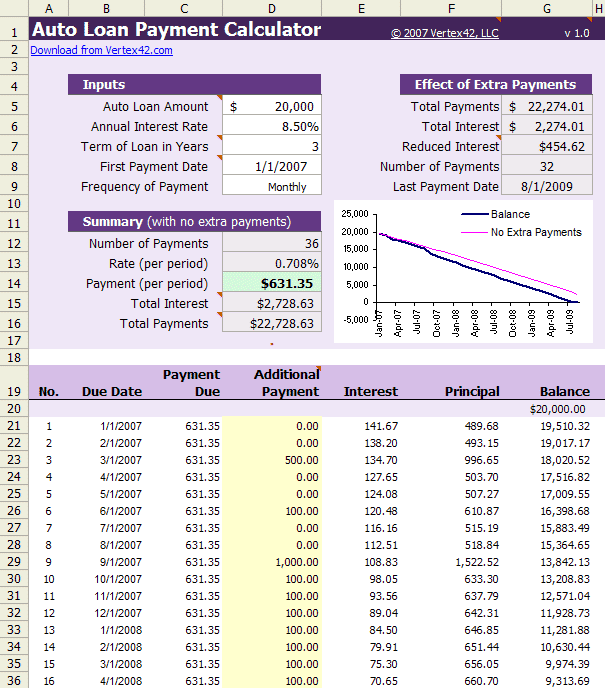
M = P [ i(1 + i)^n ] / [ (1 + i)^n – 1]
Where:
- M = Your monthly loan payment
- P = The principal loan amount (the amount you borrow)
- i = Your monthly interest rate (your annual interest rate divided by 12)
- n = Your total number of payments (your loan term in years multiplied by 12)
It’s crucial to correctly convert your annual interest rate to a monthly rate and your loan term to the total number of months before applying them to the formula.
Step-by-Step Calculation Example
Let’s walk through an example to illustrate how this formula works in practice.
Suppose you want to buy a car with the following terms:
- Car Price: $30,000
- Down Payment: $5,000
- Principal (P): $30,000 – $5,000 = $25,000
- Annual Interest Rate (APR): 6%
- Loan Term: 5 years (60 months)
Step 1: Calculate the monthly interest rate (i)
- Annual Interest Rate = 6% = 0.06
- Monthly Interest Rate (i) = 0.06 / 12 = 0.005
Step 2: Calculate the total number of payments (n)
- Loan Term in Years = 5
- Total Number of Payments (n) = 5 * 12 = 60
Step 3: Plug the values into the formula
- M = 25,000 [ 0.005(1 + 0.005)^60 ] / [ (1 + 0.005)^60 – 1]
- First, calculate (1 + i)^n = (1.005)^60
- (1.005)^60 ≈ 1.34885
- Now, substitute back into the formula:
- M = 25,000 [ 0.005 * 1.34885 ] / [ 1.34885 – 1 ]
- M = 25,000 [ 0.00674425 ] / [ 0.34885 ]
- M = 168.60625 / 0.34885
- M ≈ $483.24
So, your estimated monthly car loan payment would be approximately $483.24. This calculation demonstrates the precise impact of each variable, allowing you to project your financial commitments accurately.
Important Considerations for the Formula
When using the formula, always ensure:
- The interest rate is converted to a monthly decimal (APR/12/100).
- The loan term is converted to the total number of months (years * 12).
- Any additional fees or taxes rolled into the loan are included in the principal amount.
- The formula assumes fixed payments over the life of the loan, which is standard for car loans.
Tools and Resources for Calculation
While the manual calculation provides a solid understanding, practical tools make the process much faster and reduce the chance of errors. Leveraging these resources is a smart financial move.
Online Car Loan Calculators
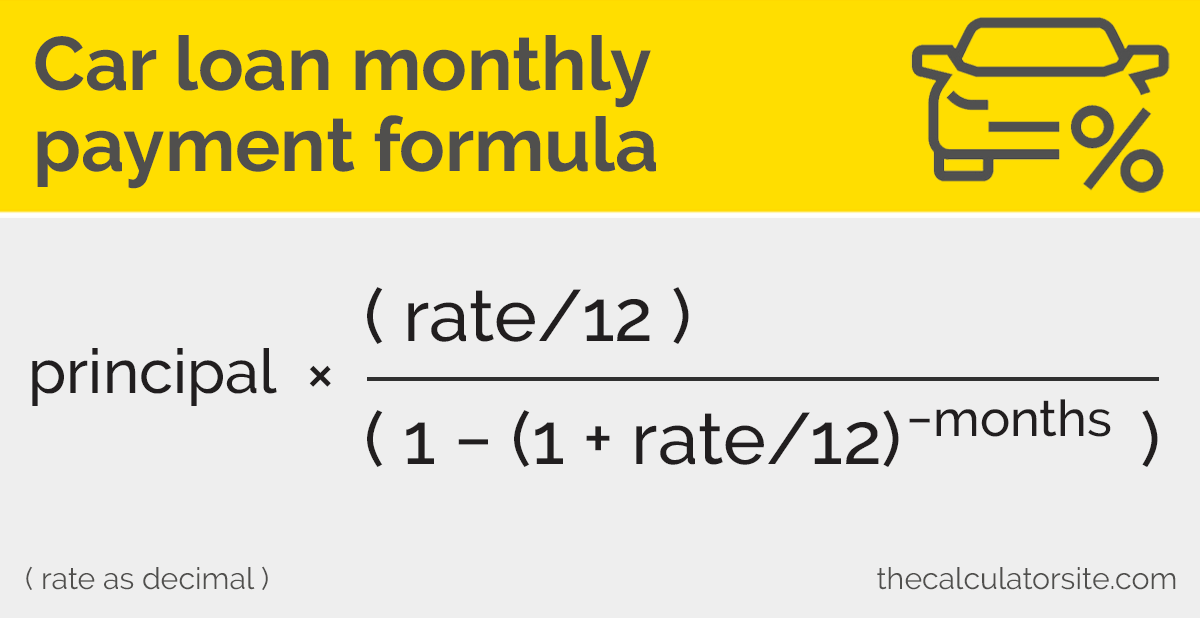
The most accessible and widely used tools are online car loan calculators. Websites of financial institutions, automotive dealerships, and independent financial planning platforms often provide free, user-friendly calculators. You simply input the principal amount, interest rate (APR), and loan term, and the calculator instantly provides your estimated monthly payment. Many also offer amortization schedules, showing how much principal and interest you pay each month over the life of the loan. This transparency helps you visualize the payment breakdown and understand how quickly you’re paying down the principal.
Spreadsheet Software (Excel/Google Sheets)
For those who prefer a more hands-on approach or need to compare multiple scenarios side-by-side, spreadsheet software like Microsoft Excel or Google Sheets is an invaluable tool. Both programs have a built-in PMT function that calculates loan payments.
The PMT function typically looks like this: PMT(rate, nper, pv, [fv], [type])
rate: The interest rate per period (monthly interest rate).nper: The total number of payments for the loan (total months).pv: The present value, or the total value of all loan payments now (the principal amount).fv(optional): The future value, or a cash balance you want to attain after the last payment is made (usually 0 for loans).type(optional): Indicates when payments are due (0 for end of period, 1 for beginning of period; usually 0).
Using the previous example: =PMT(0.005, 60, -25000) would yield approximately -$483.24. The negative sign indicates an outflow of money. Spreadsheets allow you to quickly change variables (e.g., trying different down payments or loan terms) to see their impact on your monthly payment, making them powerful for financial modeling.
Dealer vs. Bank Calculators
Be aware that calculators from different sources might yield slightly different results due to rounding conventions or how certain fees are incorporated. Dealerships often use their own calculators which might factor in additional costs, sometimes less transparently, than a bank or credit union’s calculator. Always cross-reference payments from multiple sources. It’s advisable to use an independent calculator (like one from a trusted financial website or your own bank) to verify the numbers presented by a dealership. This helps ensure you’re getting an accurate picture and can identify any discrepancies.
Factors Affecting Your Monthly Payment
Beyond the core components of principal, interest, and term, several other elements can significantly influence your car loan payment. Being aware of these can help you better prepare for your purchase and secure more favorable terms.
Credit Score’s Impact on Interest Rates
Your credit score is arguably one of the most powerful determinants of your loan’s interest rate. Lenders use credit scores to assess your creditworthiness and the risk associated with lending you money. A higher credit score (typically above 700) indicates a lower risk, allowing you to qualify for the most competitive interest rates (e.g., 3-5%). Conversely, a lower credit score might lead to significantly higher rates (e.g., 10-20% or more), which can dramatically increase both your monthly payment and the total cost of the loan. Prioritizing improving your credit score before applying for a car loan can save you thousands of dollars over the loan term.
Additional Costs (Taxes, Fees, Insurance)
While not directly part of the loan payment calculation itself, various additional costs can indirectly inflate your borrowing amount or create an illusion of affordability. Sales tax, registration fees, license plate fees, and dealer documentation fees are often rolled into the total financed amount if not paid upfront. Furthermore, comprehensive car insurance is typically a requirement for financed vehicles, and its cost should be factored into your monthly budget alongside your loan payment. Neglecting these “hidden” costs can lead to an underestimation of your true monthly automotive expenses, potentially straining your budget.
Early Payoff Strategies
While the amortization formula calculates fixed monthly payments, you’re usually not obligated to stick to that schedule strictly. Many lenders allow you to make extra payments or pay off your loan early without penalty. Making additional principal payments can significantly reduce the total interest paid over the life of the loan and shorten your repayment period. Even an extra $50-100 per month can make a substantial difference. Before pursuing an early payoff strategy, always confirm with your lender that there are no prepayment penalties.
Strategies for Lowering Your Car Loan Payments
Once you understand how car loan payments are calculated, you can strategically employ methods to reduce them, thereby making your vehicle more affordable and improving your overall financial health.
Increasing Your Down Payment
As previously discussed, a larger down payment directly reduces the principal amount you need to borrow. This is perhaps the most impactful strategy for lowering your monthly payment. For example, on a $25,000 loan at 6% over 60 months, a $5,000 down payment results in a monthly payment of approximately $483.24. If you could increase that down payment to $10,000, reducing the principal to $20,000, your monthly payment would drop to around $386.59 – a saving of nearly $100 per month. Additionally, a significant down payment reduces your loan-to-value (LTV) ratio, which can sometimes qualify you for a better interest rate.
Opting for a Shorter Loan Term (with caveats)
While counterintuitive to immediately lowering your monthly payment, selecting the shortest loan term you can comfortably afford is a wise financial move in the long run. A shorter term means fewer months for interest to accrue, significantly reducing the total interest paid. For instance, a $25,000 loan at 6% over 60 months costs $483.24 monthly, with total interest of approximately $3,994. The same loan over 48 months would be around $587.26 monthly, but the total interest drops to roughly $3,188, saving you over $800. The caveat is that your monthly payment will be higher, so ensure it fits within your budget without causing financial strain.
Improving Your Credit Score
Prior to applying for a car loan, take steps to improve your credit score. This could involve paying down existing debts, resolving any outstanding collections, disputing errors on your credit report, or simply waiting for old negative marks to age off your report. A higher credit score signals lower risk to lenders, making you eligible for lower interest rates. Even a difference of one or two percentage points in your APR can translate to hundreds or thousands of dollars saved over the life of the loan. Check your credit report regularly and address any issues proactively.
Refinancing Your Car Loan
If you’ve already purchased a car and your financial situation or credit score has improved since then, refinancing your car loan could be an excellent strategy to lower your monthly payments or total interest. Refinancing involves taking out a new loan to pay off your existing one, ideally with a lower interest rate or a more favorable term. This is particularly beneficial if interest rates have dropped, your credit score has improved, or if you initially received a higher rate due to a limited credit history. However, be cautious about extending the loan term too much when refinancing, as this could lead to paying more interest in the long run, even with a lower monthly payment.
In conclusion, calculating car loan payments is more than just a mathematical exercise; it’s a critical component of responsible financial management. By understanding the fundamentals, utilizing the correct formulas, and leveraging available tools, you empower yourself to make intelligent decisions that align with your financial goals. Proactive planning, strong credit management, and strategic negotiations are your allies in ensuring your dream car doesn’t become a financial burden.
aViewFromTheCave is a participant in the Amazon Services LLC Associates Program, an affiliate advertising program designed to provide a means for sites to earn advertising fees by advertising and linking to Amazon.com. Amazon, the Amazon logo, AmazonSupply, and the AmazonSupply logo are trademarks of Amazon.com, Inc. or its affiliates. As an Amazon Associate we earn affiliate commissions from qualifying purchases.