
Filing taxes can be a daunting task for many, and the thought of having to file taxes from a previous year can be even more intimidating. Whether it’s due to an oversight, a life-changing event, or simply a lack of understanding, finding yourself with unfiled tax returns from last year (or even earlier) is a situation that requires prompt and strategic action. Ignoring the issue will not make it disappear; in fact, it can lead to mounting penalties, interest, and potential legal complications with tax authorities.
This guide is designed to demystify the process of filing delinquent tax returns, offering a clear, professional, and insightful roadmap to bring your tax obligations up to date. We will delve into the implications of late filing, walk through the essential preparation steps, explain the filing process itself, and offer strategies to mitigate potential financial repercussions. Our goal is to empower you with the knowledge and confidence to address this critical financial task effectively and regain peace of mind regarding your tax compliance.

Understanding the Implications of Late Filing
The first step in addressing unfiled taxes is to fully comprehend the gravity of the situation and the potential consequences. While it might seem easier to simply ignore the problem, understanding the ramifications can provide the necessary motivation to act decisively.
The Urgency of Addressing Unfiled Taxes
The longer you delay filing a past-due tax return, the more complicated and expensive the situation can become. Tax authorities, such as the IRS in the United States, have a statute of limitations for assessing additional tax and penalties, which is generally three years from the date the return was filed or the due date, whichever is later. However, this statute of limitations does not begin until a return is actually filed. This means that if you never file a return, the IRS can audit you and assess taxes and penalties at any point in the future. Furthermore, failing to file can prevent you from receiving a refund you might be owed, as there’s typically a three-year window from the original due date to claim a refund. Beyond financial penalties, continuous non-filing can lead to more severe actions, including liens, levies, and, in rare cases of intentional evasion, criminal charges. Therefore, proactive engagement is not just advisable; it’s imperative.
Potential Penalties and Interest Explained
Tax authorities impose various penalties to encourage timely filing and payment. These typically include:
- Failure-to-File Penalty: This is often the most significant penalty. It’s usually 5% of the unpaid taxes for each month or part of a month that a tax return is late, capped at 25% of your unpaid tax. If the return is more than 60 days late, the minimum penalty is either $435 (for returns due in 2022) or 100% of the tax owed, whichever is smaller.
- Failure-to-Pay Penalty: This penalty is 0.5% of the unpaid taxes for each month or part of a month that taxes remain unpaid, also capped at 25% of your unpaid tax.
- Interest: In addition to penalties, interest is charged on underpayments and unpaid penalties. The interest rate is determined quarterly and can fluctuate, but it compounds daily, meaning the amount you owe can grow substantially over time.
It’s crucial to note that if both the failure-to-file and failure-to-pay penalties apply in the same month, the failure-to-file penalty is reduced by the failure-to-pay penalty. This is often misunderstood, leading to greater anxiety than necessary. Understanding these penalties is the first step toward strategically addressing them.
The Difference Between Owing and Being Owed
A common misconception is that if you haven’t filed, you automatically owe money. This isn’t always the case. Many individuals who fail to file actually qualify for a refund due to over-withholding from their paychecks or eligibility for various tax credits. The critical distinction is that while the failure-to-file penalty is based on your unpaid tax, if you are owed a refund, there is no unpaid tax, and thus, no failure-to-file or failure-to-pay penalties. However, you still need to file to claim that refund within the three-year window. Missing this deadline means forfeiting your rightful refund to the government. This difference highlights the importance of simply filing, regardless of your perceived tax liability.
Essential Steps to Prepare Your Late Return
Once you understand the ‘why,’ the next step is the ‘how.’ Preparing a late return follows many of the same principles as preparing a timely one, but with added emphasis on gathering specific historical documents.
Gathering Necessary Documentation
The most challenging part of filing a late return is often locating all the required financial documents from the past year(s). You’ll need documents proving your income, deductions, and credits. These typically include:
- Income Documents: W-2s (from employers), 1099 forms (1099-NEC for freelance income, 1099-INT for interest, 1099-DIV for dividends, 1099-B for stock sales, 1099-R for retirement distributions, etc.), K-1s (from partnerships, S corporations, or trusts). If you can’t locate these, you can often request transcripts from the tax authority (e.g., IRS Wage and Income Transcripts) or contact the issuer directly.
- Deduction and Credit Documents: Records of mortgage interest paid (Form 1098), student loan interest (Form 1098-E), tuition statements (Form 1098-T), charitable contributions, medical expenses, business expenses (if self-employed), property taxes, and other relevant receipts.
- Proof of Payments: If you made estimated tax payments, keep records of these.
- Previous Year’s Returns: Your prior year’s tax return is often a good reference point for recurring income sources, deductions, and personal information.
Begin by compiling everything you have. For missing documents, prioritize requesting transcripts from the tax authority as a reliable source of official income data reported to them.
Choosing Your Filing Method
Even for past-due returns, you have options for how you can prepare and submit them.
- Tax Software: For recent past years (typically up to two or three years back), many commercial tax software programs (e.g., TurboTax, H&R Block, TaxAct) still support filing for those years. You might need to purchase the desktop version for older years or use their online platform. This can be cost-effective and provides guided assistance. However, e-filing for prior years is often only available for the immediately preceding year. For older returns, you’ll likely need to print and mail the return.
- Tax Professionals: A qualified tax professional (CPA, Enrolled Agent, or tax attorney) is often the best choice for complex or multiple years of unfiled returns. They have expertise in navigating tax codes, accessing historical data, and often have strategies for penalty abatement. While more expensive, their expertise can save you money and stress in the long run.
- Paper Forms: You can download official tax forms and instructions directly from the tax authority’s website for any given year. This method requires careful attention to detail and a thorough understanding of the instructions, as you’ll be calculating everything manually.
Calculating Your Tax Liability
Once you have all your documents and have chosen a method, the next step is to accurately calculate your tax liability for each unfiled year. This involves:
- Determining Gross Income: Sum all income from W-2s, 1099s, and other sources.
- Adjustments to Income: Apply any eligible adjustments, such as student loan interest deduction or IRA contributions.
- Standard vs. Itemized Deductions: Decide whether to take the standard deduction for that specific year or itemize, choosing the option that results in lower taxable income.
- Taxable Income: Subtract adjustments and deductions from your gross income to arrive at your taxable income.
- Calculate Tax: Apply the tax rates for that specific tax year to your taxable income.
- Credits: Apply any eligible tax credits, which directly reduce your tax liability dollar-for-dollar.
- Payments: Subtract any taxes already withheld or estimated payments made.
The result will tell you if you owe additional tax or if you are due a refund. Be meticulous in this process, as errors can lead to further delays or audits.
Navigating the Filing Process
With your return(s) prepared, the focus shifts to submitting them correctly and addressing any tax liabilities.
Submitting Your Delinquent Return
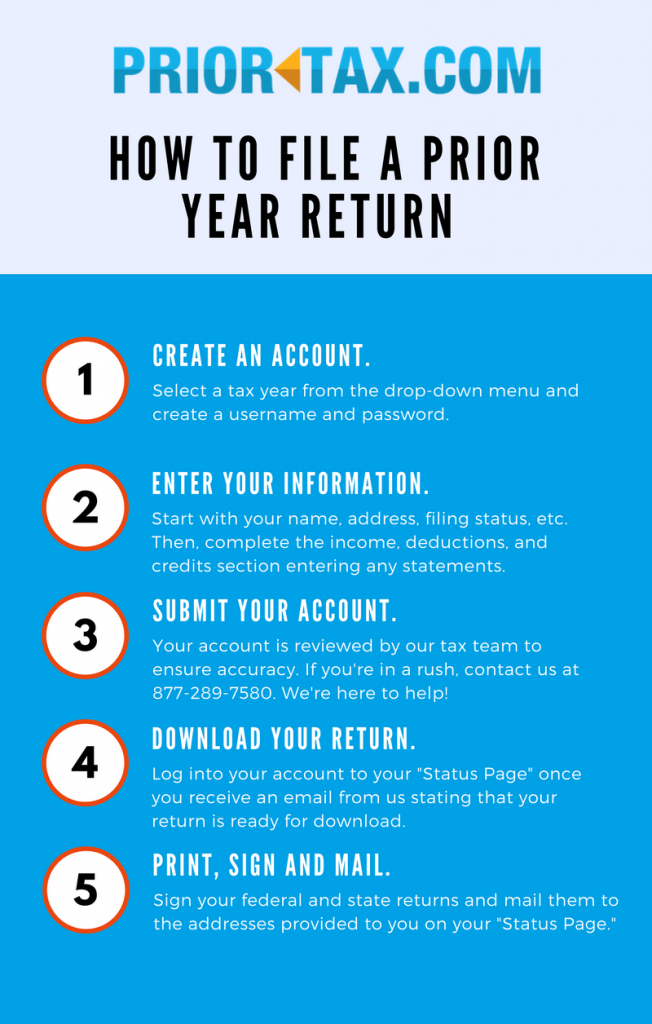
- Mail Each Year Separately: If you are filing multiple past-due returns, mail each tax year’s return in a separate envelope. Clearly mark the tax year on the envelope and on the return itself. This helps prevent processing delays.
- Certified Mail with Return Receipt: Always send your paper returns via certified mail with a return receipt requested. This provides irrefutable proof that you sent the return and that the tax authority received it, which can be crucial if there are any disputes later.
- E-filing Limitations: As mentioned, e-filing for prior years is generally limited. Most tax software only allows e-filing for the current year and sometimes the immediately preceding year. For older returns, paper filing is the standard procedure.
Ensure all required schedules and forms are attached, and that the return is signed and dated correctly. If it’s a joint return, both spouses must sign.
What If You Owe Taxes? Payment Options
If your calculation shows you owe tax, you must remit payment along with your return. Ignoring the payment aspect can lead to the failure-to-pay penalty and accumulating interest.
- Pay in Full: The ideal scenario is to pay your balance due in full when you file. You can often include a check or money order with your mailed return (using the corresponding payment voucher, if applicable) or pay online through the tax authority’s website.
- Payment Plans: If you cannot pay the full amount, do not let that deter you from filing. File your return anyway to stop the failure-to-file penalty from accruing. Then, explore payment options:
- Short-Term Payment Plan: Allows up to 180 additional days to pay your tax liability in full, though interest and penalties still apply.
- Offer in Compromise (OIC): Allows certain taxpayers to resolve their tax liability with the tax authority for a lower amount than what they originally owed. This is typically an option when you can prove that you cannot pay your full tax liability.
- Installment Agreement: Allows you to make monthly payments for up to 72 months. This is a common solution, but interest and penalties continue to accrue, albeit at a reduced failure-to-pay penalty rate once the agreement is in place.
It’s always best to communicate with the tax authority about your inability to pay. They are generally more willing to work with taxpayers who are transparent and proactive.
What If You’re Owed a Refund?
If your prepared return shows that you are due a refund, the good news is that there are no penalties for filing late when you are owed money. However, there is a strict deadline to claim that refund. Generally, you have three years from the original due date of the return to file and claim your refund. For example, to claim a refund for tax year 2020 (originally due April 15, 2021), you typically would have until April 15, 2024, to file the return. If you miss this deadline, the refund becomes the property of the government. So, even if you’re owed money, swift action is still beneficial.
Strategies for Minimizing Penalties and Interest
While penalties can seem inevitable, there are avenues for relief under certain circumstances. Understanding these can significantly reduce your financial burden.
Reasonable Cause Arguments
Tax authorities may waive penalties if you can demonstrate “reasonable cause” for your failure to file or pay on time. Reasonable cause is generally defined as circumstances beyond your control that prevented you from meeting your tax obligations. Examples include:
- Death or Serious Illness: Of the taxpayer or an immediate family member.
- Unavoidable Absence: Such as active military duty in a combat zone.
- Casualty, Disaster, or Civil Disturbance: That directly affects the taxpayer.
- Inability to Obtain Records: Due to circumstances beyond your control.
- Erroneous Advice: From a tax professional whom you reasonably relied upon.
To request penalty abatement based on reasonable cause, you’ll typically need to write a letter explaining your situation, providing dates and supporting documentation (e.g., doctor’s notes, police reports, death certificates). Be clear, concise, and provide all relevant facts.
First-Time Penalty Abatement
The IRS, for instance, offers an administrative waiver called “First-Time Penalty Abatement” (FTA) for failure-to-file, failure-to-pay, and failure-to-deposit penalties. To qualify, you generally must:
- Have a clean compliance history for the three preceding tax years (i.e., no prior penalties).
- Have filed or filed an extension for all currently required returns.
- Have paid, or arranged to pay, any tax due.
This is often the easiest way to get penalties waived if you meet the criteria. You can request FTA by calling the tax authority directly or writing a letter.
Setting Up Payment Plans
As discussed, establishing a payment plan (like an installment agreement) can mitigate the failure-to-pay penalty by reducing its rate while the agreement is in effect. It also prevents more aggressive collection actions like liens or levies. By proactively engaging and setting up a payment plan, you demonstrate a good-faith effort to resolve your tax debt, which can sometimes be viewed favorably if you later request penalty abatement. Always prioritize setting up a payment arrangement if you cannot pay in full.
Proactive Measures and Professional Assistance
Bringing your past tax filings up to date is a significant accomplishment. The final step is to ensure you stay compliant moving forward and know when to seek expert help.
Preventing Future Filing Delays
Once you’ve cleared your backlog, implement strategies to prevent future lapses:
- Automate Reminders: Set calendar reminders for key tax dates (e.g., quarterly estimated tax payments, filing deadlines).
- Organize Records Annually: Create a dedicated folder (physical or digital) for tax documents throughout the year. As soon as you receive a W-2 or 1099, file it away.
- Utilize Tax Software: Consistent use of reliable tax software can streamline the annual process.
- Understand Estimated Taxes: If you have income not subject to withholding (e.g., self-employment, investments), understand your obligation to make estimated quarterly payments.
- Regular Financial Review: A quick monthly or quarterly review of your finances can help identify tax-related issues before they become problems.
When to Seek Professional Tax Help
While self-filing is an option, there are several scenarios where professional assistance becomes invaluable:
- Multiple Years Unfiled: When dealing with several years of unfiled returns, the complexity multiplies. A professional can help reconstruct income and deductions for each year.
- Complex Financial Situations: If you have self-employment income, rental properties, significant investments, foreign income, or other intricate financial scenarios, a tax professional can ensure accuracy and optimize your tax position.
- Significant Tax Debt: If you owe a substantial amount, a professional can negotiate with the tax authority on your behalf, explore options like Offer in Compromise, and advise on the best payment strategies.
- Penalty Abatement Requests: Professionals are adept at crafting persuasive arguments for penalty relief and navigating the administrative appeals process.
- Stress and Time Constraints: If the thought of tackling past-due taxes is overwhelming or you simply lack the time, outsourcing to an expert can be a wise investment in your financial well-being and peace of mind.
Engaging a qualified CPA, Enrolled Agent, or tax attorney provides expertise, reduces stress, and offers a layer of protection, ensuring your tax affairs are handled correctly and efficiently.
Filing taxes from last year might feel like climbing a mountain, but by breaking the process down into manageable steps, understanding the implications, and leveraging available resources, you can successfully navigate this challenge. The key is to act promptly, gather information diligently, and not hesitate to seek professional guidance when necessary. Taking control of your past tax obligations is a crucial step towards robust financial health and a compliant future.
aViewFromTheCave is a participant in the Amazon Services LLC Associates Program, an affiliate advertising program designed to provide a means for sites to earn advertising fees by advertising and linking to Amazon.com. Amazon, the Amazon logo, AmazonSupply, and the AmazonSupply logo are trademarks of Amazon.com, Inc. or its affiliates. As an Amazon Associate we earn affiliate commissions from qualifying purchases.