
Nikola Tesla, a name synonymous with genius, innovation, and an almost mythical foresight, is widely acknowledged as one of history’s most pivotal figures in the advancement of electrical engineering and technology. Yet, despite his colossal contributions that laid the very foundations of our modern electrified world, the narrative of his life often veers into a tragic tale of unfulfilled visions, professional rivalries, and eventual obscurity. The question, “What happened to Nikola Tesla?” delves beyond his well-known inventions, seeking to understand the trajectory of a mind that envisioned a future decades, if not a century, ahead of its time, and the circumstances that led to the curtailment of many of his grandest technological ambitions.

To comprehend what truly “happened” to Tesla, one must navigate the confluence of his revolutionary technological breakthroughs, his often-misunderstood methodologies, the cutthroat industrial landscape of his era, and the personal struggles that ultimately shaped his legacy. This exploration will meticulously chart his journey from the inventor of the alternating current (AC) system to a visionary whose concepts continue to inspire contemporary technological paradigms, all while examining the forces that impacted his ability to fully realize his extraordinary potential. His story is a poignant reminder of the intricate interplay between technological brilliance, commercial viability, and the human element in the march of progress.
The Dawn of a Technological Revolution: Tesla’s Early Triumphs
Nikola Tesla’s early career was marked by a series of incandescent breakthroughs that not only challenged existing paradigms but fundamentally reshaped the course of industrial and domestic technology. His initial successes were not merely incremental improvements but radical departures, demonstrating an engineering acumen and theoretical grasp that few could rival.
Electrifying the World: The AC System Legacy
Tesla’s most undeniable and enduring contribution to technology is the development and promotion of the alternating current (AC) electrical system. In an era dominated by Thomas Edison’s direct current (DC) system, which suffered from significant power loss over distance and required numerous generating stations, Tesla’s AC induction motor and polyphase AC system offered a revolutionary solution. AC could be transmitted efficiently over vast distances at high voltages and then stepped down to safer levels for consumption, making widespread electrification feasible for the first time.
The “War of Currents” between AC and DC was a bitter technological and commercial battle. Edison, deeply invested in DC, engaged in aggressive public relations campaigns to demonize AC, often resorting to misinformation about its dangers. However, George Westinghouse, recognizing the superior engineering and economic advantages of Tesla’s system, championed AC. Their collaboration led to the spectacular illumination of the 1893 Chicago World’s Columbian Exposition, a dazzling display that proved AC’s viability. Two years later, the harnessing of Niagara Falls for power generation, transmitted to Buffalo, New York, via Westinghouse’s AC system utilizing Tesla’s patents, cemented AC’s triumph. This event was not merely a commercial victory; it was a technological watershed that enabled the mass production, industrialization, and urban development that characterized the 20th century, powering everything from factories to homes. The decision to adopt AC remains one of the most impactful technological choices in history, underpinning the global electrical grids we rely on today.
Beyond the Arc: Early Innovations in Radio and Remote Control
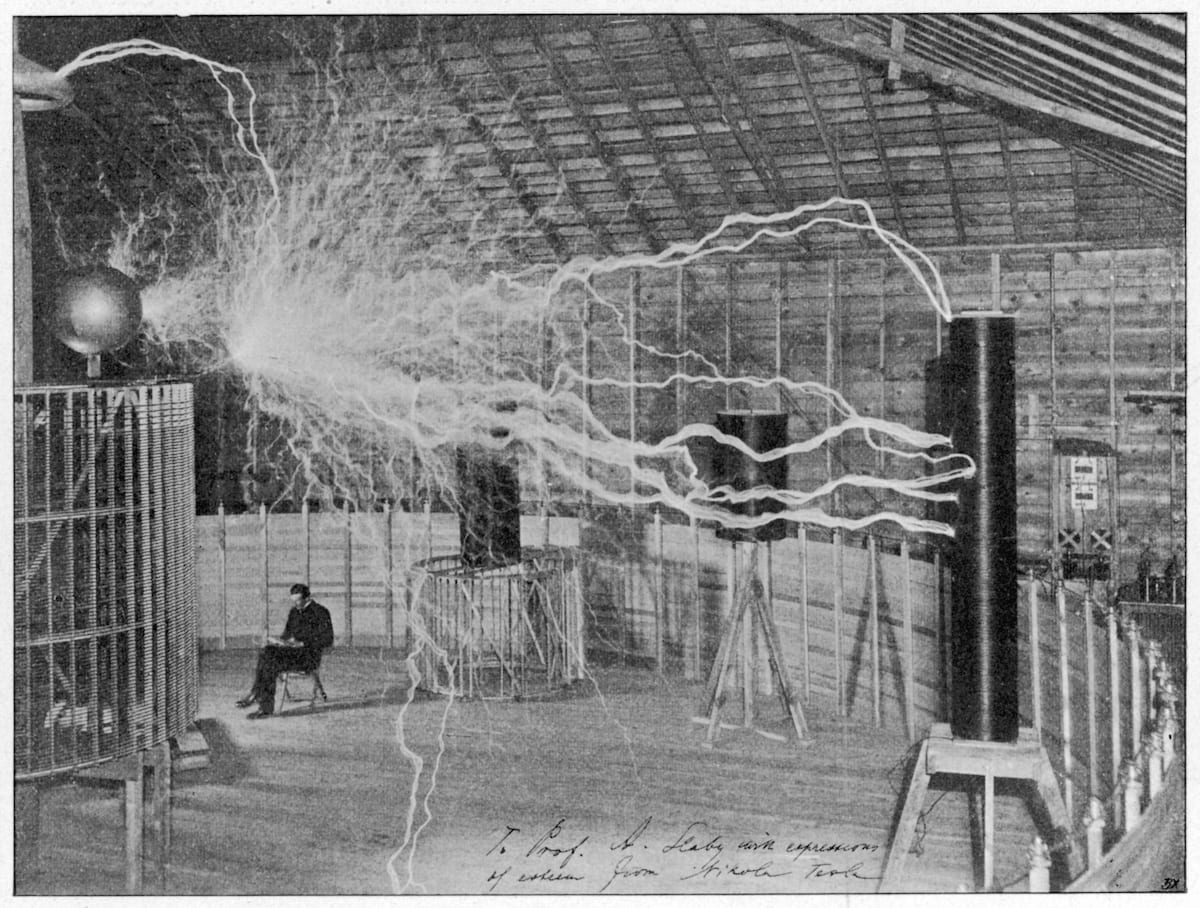
While the AC system often overshadows his other early inventions, Tesla’s prolific mind was already exploring a myriad of other groundbreaking technologies. His work on radio frequency oscillators and transformers, particularly the Tesla coil, demonstrated the principles necessary for wireless communication. While Guglielmo Marconi is often credited with the invention of radio, Tesla had demonstrated wireless transmission of energy and signals prior to Marconi’s successful transatlantic signal. The U.S. Supreme Court eventually upheld Tesla’s radio patents posthumously, acknowledging his foundational contributions.
Furthermore, in 1898, Tesla publicly demonstrated a radio-controlled boat at Madison Square Garden, an invention he dubbed “teleautomatics.” This was arguably the world’s first remote-controlled device, a precursor to modern robotics, drones, and wireless control systems. This demonstration of remote control via radio waves was astonishingly ahead of its time, showcasing the potential for machines to be guided without direct human contact—a concept that would only begin to be fully realized many decades later. These early ventures into wireless technology and automation underscored Tesla’s singular ability to envision future technological landscapes, far beyond the immediate applications of his primary work.
The Unfulfilled Promise: Visions Ahead of Their Time
Despite his foundational successes, a significant portion of what “happened” to Nikola Tesla involves the tragic unfulfillment of his most ambitious technological visions. His concepts were often so radical, so far-reaching, that they outstripped the understanding, investment capabilities, and even material science of his era.
Wireless Power and Global Communication: The Wardenclyffe Dream
Tesla’s magnum opus, and arguably his greatest professional heartbreak, was the Wardenclyffe Tower project. Conceived at the turn of the 20th century, Wardenclyffe was intended to be a global wireless communication and power transmission system. His vision was to create a “World System” that would transmit electricity and information without wires to any point on the globe, providing free, unlimited energy and communication. This wasn’t merely about radio communication; it was about broadcasting power through the Earth and atmosphere, a concept he believed was achievable through resonant frequencies.
Funded primarily by financier J.P. Morgan, who initially saw the potential for transatlantic telegraphy (competing with Marconi), Tesla’s true ambition for Wardenclyffe was far grander. He envisioned a future where homes, factories, and vehicles would draw power wirelessly from the Earth’s electrical resonance. However, Morgan withdrew funding when he realized Tesla’s plan included providing free energy, seeing no profit in a system that couldn’t be metered. The project was left incomplete, a skeletal tower standing as a monument to a dream too expansive for its time and the prevailing commercial models. The failure of Wardenclyffe was a profound setback, not just for Tesla personally, but for the trajectory of technological development, as many of his ideas for wireless power transmission have only recently begun to be explored with renewed interest in the context of modern wireless charging and energy efficiency.
The Enigmatic Patents: From Robotics to Resonance
Beyond Wardenclyffe, Tesla’s notebooks and patent applications reveal a mind teeming with ideas that were decades, if not a century, ahead of contemporary technological capabilities. His concept of “teleautomatics,” first demonstrated with his remote-controlled boat, laid theoretical groundwork for modern robotics and autonomous systems. He imagined intelligent machines capable of performing complex tasks, a precursor to artificial intelligence and automation.
Tesla also delved into the realm of advanced energy technologies, envisioning devices that could tap into ambient energy, though often couched in terms that bordered on the esoteric for his contemporaries. His research into resonant frequencies led him to experiment with “earthquake machines” (mechanical oscillators), which, while often sensationalized, were explorations into the powerful effects of resonance on physical structures. He also envisioned vertical take-off and landing aircraft and explored concepts related to particle beam weapons, often sensationalized as “death rays,” but which in essence involved directed energy principles that resonate with modern defense research.
The sheer breadth and futurism of these ideas meant that many remained theoretical or in early experimental stages. The lack of funding, the skepticism of peers, and the limitations of materials and manufacturing processes of his time prevented these visionary concepts from being fully developed or commercialized. Consequently, many of Tesla’s most radical technological blueprints remained largely in the realm of potential, waiting for future generations to rediscover and validate their underlying principles.
Navigating the Labyrinth of Innovation and Commerce
The story of “what happened to Nikola Tesla” is inseparable from the harsh realities of commercializing groundbreaking technology. Tesla, for all his scientific brilliance, struggled immensely with the business aspects of invention, a vulnerability that significantly hampered the widespread adoption of many of his later ideas.
Funding Failures and Commercial Hurdles
Tesla’s challenges in securing and maintaining funding for his increasingly ambitious projects were a critical factor in their eventual failure. Unlike inventors such as Edison, who were adept at self-promotion and establishing corporate structures, Tesla was primarily an engineer and a theorist. His grand visions, like Wardenclyffe, required enormous capital investment, and his inability to articulate a clear, profitable business model for concepts like “free energy” alienated potential investors like J.P. Morgan. Morgan’s withdrawal of support from Wardenclyffe after realizing Tesla’s aim to provide electricity without charge illustrates a fundamental clash between Tesla’s philanthropic technological vision and the capitalist imperatives of his financial backers.
Furthermore, Tesla often found himself entangled in patent disputes and was sometimes outmaneuvered by more commercially savvy rivals. His legal battles were costly and diverted his attention and resources from research and development. The commercial landscape of the late 19th and early 20th centuries was fiercely competitive, and an inventor, no matter how brilliant, needed strong financial backing and business acumen to translate inventions into marketable products. Tesla’s reluctance or inability to focus on immediate profitability meant that many of his long-term, transformative technologies never progressed beyond the prototype or conceptual stage, failing to cross the critical chasm from invention to market adoption.
The Isolation of Genius: Personalities and Progress
Tesla’s personal eccentricities and his increasingly solitary nature also played a significant role in his professional trajectory. He was known for his idiosyncratic habits, his aversion to physical contact, and his almost obsessive dedication to his work, often at the expense of social relationships and practical matters. While these traits might have fueled his singular focus on invention, they also isolated him from potential collaborators, business partners, and the broader scientific community.
His disdain for mundane details, coupled with his often-poor financial management, meant that he frequently squandered resources or failed to adequately document and protect his intellectual property. Towards the latter part of his life, his claims grew more outlandish, some bordering on pseudoscientific, which further eroded his credibility among those who might have otherwise supported his legitimate technological endeavors. This growing isolation, combined with his inability to effectively communicate the immediate commercial value of his more futuristic inventions, meant that he lacked the champions and infrastructure necessary to bring his complex visions to fruition. His genius, therefore, remained largely inaccessible to the contemporary technological ecosystem, contributing to his gradual slide into relative obscurity in his later years.
The Twilight Years and Enduring Technological Legacy
As Nikola Tesla aged, his financial situation deteriorated, and his grand technological visions remained largely unbuilt. Yet, even in his final years, his mind continued to explore scientific and engineering problems, leaving behind a legacy that would only truly be appreciated decades after his death.
A Solitary Pursuit: Continued Research Amidst Hardship
In his later life, Tesla resided in various New York hotels, often moving due to unpaid bills. Despite his diminished circumstances, he continued to pursue his scientific inquiries, albeit in a more theoretical capacity due to a lack of resources for practical experimentation. His research during this period often focused on concepts like radiant energy, the propagation of waves through the Earth, and further refinements of his ideas on wireless power and communication. While many of these later theories were not rigorously documented or experimentally validated in a manner that satisfied mainstream science, they demonstrate a persistent intellectual curiosity and an unwavering belief in the principles he had championed throughout his career.
He often spent his days feeding pigeons in Bryant Park, a poignant symbol of a man whose brilliant mind once conceived of systems to power the entire world, now finding solace in a simple, repetitive act. Despite the hardships, he never truly stopped thinking about technology and its potential to uplift humanity, often sketching designs and writing theoretical notes until his very end. His final significant public act was a press conference for his 78th birthday, where he made several startling claims about new inventions, including a “teleforce” weapon (death ray) and a new system for discovering planets, further cementing his image as an eccentric genius rather than a practical inventor in the public eye.
Posthumous Recognition and the Tesla Revival
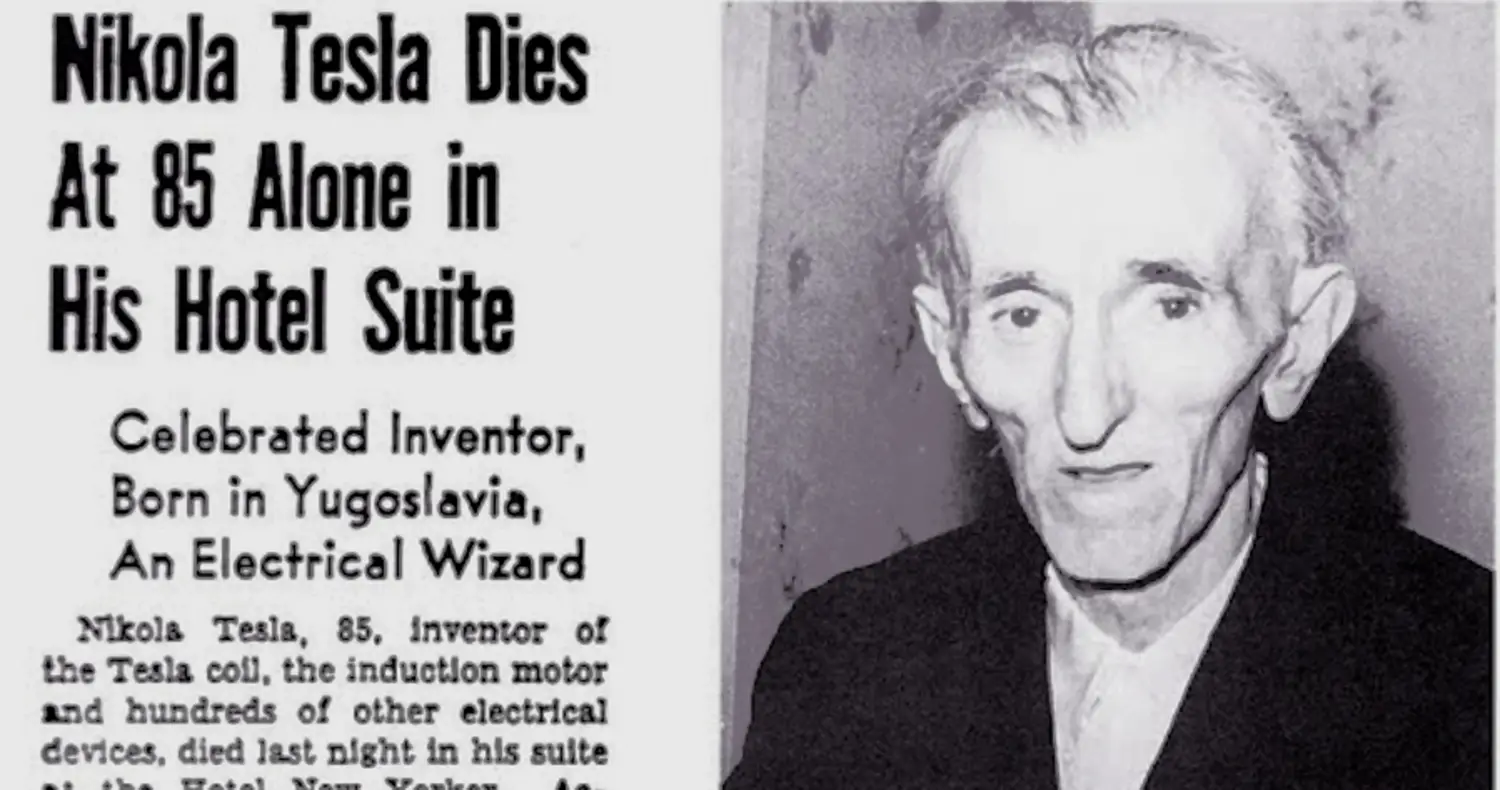
Nikola Tesla died penniless and alone in his hotel room in New York City in 1943, at the age of 86. His passing, like much of his later life, went largely unnoticed by the wider world. However, the true “happening” to Nikola Tesla after his death was a gradual, yet profound, re-evaluation and recognition of his immense contributions to technology.
His legacy began to be revived in earnest in the latter half of the 20th century, as advancements in physics and engineering started to catch up with his earlier visions. Scientists and engineers rediscovered his patents and notes, realizing the depth of his foresight. The scientific community increasingly acknowledged his foundational work in AC electricity, radio technology, and even early concepts of radar and robotics. In 1960, the General Conference on Weights and Measures named the unit of magnetic flux density the “tesla” (T) in his honor, a fitting tribute that cemented his name in the international scientific lexicon.
The late 20th and early 21st centuries saw an explosion of interest in Tesla, fueled by popular culture, biographical works, and a renewed appreciation for his radical ideas in an age of rapid technological advancement. This “Tesla revival” has transformed him from a forgotten genius into an icon of innovation, a symbol for disruptive technology, and an inspiration for engineers and entrepreneurs globally.
Tesla’s Ghost in the Machine: Contemporary Technological Echoes
The ultimate answer to “what happened to Nikola Tesla” isn’t a tragic end but an enduring, pervasive influence on contemporary technology. His ideas, once dismissed as impractical or too futuristic, are now actively being pursued and realized, proving his prophetic vision.
Wireless Power Reimagined: From Induction to Resonance
Perhaps the most direct echo of Tesla’s unfulfilled vision is the resurgence of interest in wireless power transmission. While current consumer applications, such as smartphone charging pads, primarily utilize inductive coupling over short distances, researchers are actively exploring resonant inductive coupling and other methods to achieve mid-range and long-range wireless power, akin to Tesla’s Wardenclyffe dream. Companies and academic institutions are investing heavily in technologies that can power devices across rooms or even charge electric vehicles dynamically as they drive. This re-exploration of efficient, long-range wireless energy transfer is a direct validation of Tesla’s century-old premise that electricity could be transmitted through the air or earth without physical conduits, promising a future of untethered power.
AI, Robotics, and the Quest for Sustainable Energy
Beyond wireless power, Tesla’s influence permeates other cutting-edge technological fields. His concept of “teleautomatics” foreshadowed the entire discipline of robotics and automation. Modern industrial robots, autonomous vehicles, and sophisticated drones are direct descendants of his vision for machines controlled remotely or, eventually, operating with a degree of intelligence. Furthermore, his relentless pursuit of efficiency and his belief in harnessing natural forces for energy resonate deeply with the contemporary global quest for sustainable and renewable energy sources. While his specific methods for “free energy” remain debated, his underlying philosophy of abundant, accessible energy for all continues to inspire research into advanced renewables, smart grids, and energy harvesting technologies.
His legacy also extends to the very spirit of innovation that drives Silicon Valley and tech hubs worldwide. Tesla represents the archetype of the independent inventor, the visionary who dares to challenge conventional wisdom and imagine possibilities beyond the current technological horizon. The sheer scale of his ambition and the foundational nature of his contributions continue to inspire new generations of engineers and scientists to push the boundaries of what is technologically feasible, ensuring that Nikola Tesla’s “happening” is a perpetual evolution of his technological dreams.
In conclusion, “what happened to Nikola Tesla” is a story not just of a man, but of the intricate, often brutal, process of technological advancement. It chronicles the triumphs and tribulations of an extraordinary mind whose inventions literally powered the 20th century, whose visions foresaw the 21st, and whose struggles highlight the human challenges inherent in transforming radical ideas into widespread reality. His eventual posthumous rise to iconic status is a testament to the timeless relevance of his technological contributions and the enduring power of a vision truly ahead of its time.
aViewFromTheCave is a participant in the Amazon Services LLC Associates Program, an affiliate advertising program designed to provide a means for sites to earn advertising fees by advertising and linking to Amazon.com. Amazon, the Amazon logo, AmazonSupply, and the AmazonSupply logo are trademarks of Amazon.com, Inc. or its affiliates. As an Amazon Associate we earn affiliate commissions from qualifying purchases.