
The Dow Jones Industrial Average (DJIA), often simply referred to as “the Dow,” is arguably the most recognized and frequently cited stock market index in the world. For over a century, its daily movements have served as a significant barometer for the health of the U.S. economy and the broader global financial markets. Yet, despite its omnipresence in financial news and casual conversations, the precise methodology behind its calculation often remains a mystery to many. Understanding how the Dow is calculated is not just a matter of academic curiosity; it provides crucial insights into its strengths, limitations, and its unique role in the financial landscape. Unlike many modern indices that employ market-capitalization weighting, the Dow adheres to a price-weighted average, a distinction that significantly impacts its behavior and interpretation.

The Dow’s Enduring Legacy: A Brief History and Purpose
To truly appreciate the Dow’s calculation, one must first grasp its historical context and the purpose it was designed to serve. Its longevity is a testament to its foundational role in tracking American economic progress.
Origins and Evolution: From a Handful of Industrials to a Modern Benchmark
The Dow Jones Industrial Average was conceived by Charles Dow, a co-founder of Dow Jones & Company, and first published on May 26, 1896. Initially, it comprised just 12 industrial stocks, representing prominent American industries of the era such as cotton, sugar, tobacco, and gas. These were the titans that fueled the burgeoning industrial revolution. Over the decades, the index expanded, reflecting the growth and diversification of the American economy. It grew to 20 stocks in 1916 and finally to its current 30 components in 1928, a number it has maintained ever since. This evolution wasn’t just about adding more companies; it was about ensuring the index remained relevant and representative of the nation’s leading publicly traded enterprises.
What the Dow Represents: A Barometer for the U.S. Industrial Economy
At its core, the Dow was, and to a significant extent still is, designed to provide a snapshot of the performance of large, publicly owned U.S. companies. While the term “industrial” in its name might suggest a narrow focus on manufacturing, its components today encompass a broad array of sectors, including technology, finance, healthcare, and consumer goods. However, the underlying principle remains: to capture the collective sentiment and economic performance of established, influential American corporations. Its movements are often interpreted as an indicator of broader market sentiment and economic health, making it a closely watched figure by investors, economists, and policymakers alike.
Why the Dow Matters: Its Role in Investor Sentiment and Economic Analysis
The Dow’s prominence stems from several factors. Historically, it was one of the first widely disseminated market indices, establishing an early lead in public awareness. Its straightforward nature, at least superficially, makes it easy to understand and communicate. A 100-point rise or fall is a tangible headline. For many individual investors, the Dow serves as a proxy for “the market,” influencing confidence and investment decisions. Economists often use its performance, alongside other key indicators, to gauge economic cycles and consumer spending trends. Its enduring legacy ensures its inclusion in almost any discussion about market performance, even as more complex indices have emerged.
Deconstructing the Calculation: Price-Weighted Methodology
The most distinctive feature of the Dow, and the one that sets it apart from more contemporary indices like the S&P 500, is its price-weighted calculation method. This approach has profound implications for how the index reacts to price changes in its component stocks.
The Sum of the Prices: Initial Simplicity
In its purest, simplest form, the Dow was initially calculated by merely adding up the prices of its component stocks and dividing by the number of stocks. If it were still this simple today, the calculation would be straightforward: sum the prices of the 30 component stocks and divide by 30. However, the financial markets are not static. Events like stock splits, mergers, and company substitutions frequently alter individual stock prices without necessarily reflecting a true change in the overall market value of the underlying companies. To maintain continuity and ensure the index accurately reflects market trends rather than mere corporate actions, a crucial adjustment factor was introduced.
Introducing the Dow Divisor: The Critical Adjustment Factor
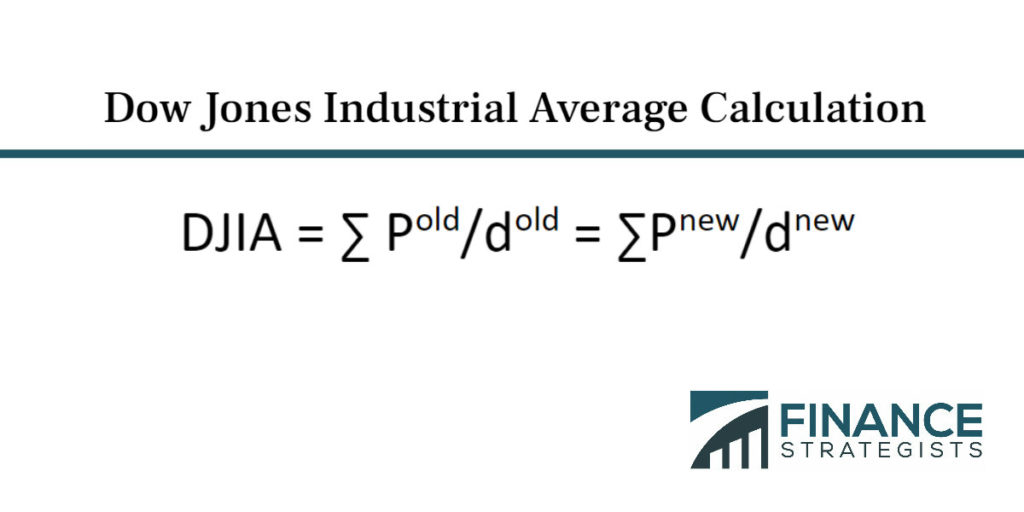
This adjustment factor is known as the Dow Divisor. Instead of dividing the sum of the stock prices by the number of stocks (30), the sum is divided by this ever-changing divisor. The divisor’s primary function is to normalize the index’s value when corporate actions occur that would otherwise artificially inflate or deflate the index. Without the divisor, a stock split (which reduces a stock’s price) would make the Dow appear to fall, even if the company’s total market value and the broader market remained unchanged. Conversely, a reverse stock split would make the Dow appear to rise. The divisor ensures that such events do not distort the index’s historical continuity or its reflection of overall market performance.
The Impact of Stock Splits and Dividends: How the Divisor Maintains Continuity
The Dow Divisor is most frequently adjusted in response to stock splits. When a company listed in the Dow undergoes a stock split (e.g., a 2-for-1 split), its share price is halved, but the number of shares doubles, leaving the total market capitalization unchanged. To prevent this price reduction from causing an artificial drop in the Dow, the divisor is adjusted downwards. The new divisor is calculated such that the index value remains the same immediately after the split as it was immediately before, using the new, lower stock price. Similarly, if a stock distribution like a spin-off occurs, the divisor will be adjusted. Regular cash dividends, however, do not trigger a divisor adjustment because they represent a distribution of capital, not a change in the underlying company’s value for the purpose of the index.
Corporate Changes and Replacements: Keeping the Index Relevant
Beyond stock splits, the Dow Divisor is also adjusted when a company is added to or removed from the index. The selection of companies is made by the editors of The Wall Street Journal, and their choices are strategic, aiming to maintain the Dow as a relevant measure of the broader U.S. economy. When a company is replaced, the divisor is adjusted to ensure that the change in the index’s value reflects only the market performance of the new set of components, not the artificial impact of swapping out one stock for another. These adjustments are crucial for the Dow’s integrity and its ability to serve as a consistent benchmark over time.
The Dow Divisor: The Secret Sauce of Stability
The Dow Divisor is arguably the single most important element in understanding the Dow’s calculation and its unique behavior. It’s a dynamic number, constantly being updated to preserve the index’s continuity.
What is the Divisor and Why is it Necessary?
Simply put, the Dow Divisor is a single number that reflects all historical adjustments to the index’s components. It’s a value that, when divided into the sum of the prices of the 30 component stocks, yields the official DJIA value. Its necessity arises from the Dow’s price-weighted nature. If the index were merely an unadjusted average, any change in a component’s price due to corporate actions (like splits) would create misleading fluctuations. The divisor acts as a smoothing mechanism, absorbing these non-market-driven price changes and ensuring that a change in the Dow’s value genuinely reflects aggregate price movements in its constituent stocks. As of early 2024, the divisor hovers around 0.15, meaning that a $1 change in any single Dow stock’s price translates to roughly a 6.6-point change in the Dow.
How the Divisor Changes: Adjustments for Stock Splits, Mergers, Spin-offs, and Substitutions
The divisor is not static; it is a live number that is updated whenever an event occurs that alters the price structure of the index without reflecting a true change in underlying market value.
- Stock Splits: This is the most common reason for divisor adjustments. When a stock splits, its price decreases. The divisor is adjusted downward so that the index value remains the same before and after the split.
- Mergers and Acquisitions: If a Dow component is acquired, it might be removed and replaced, triggering a divisor adjustment.
- Spin-offs: When a company spins off a subsidiary into a new, separate company, the value of the original stock may change, necessitating a divisor adjustment.
- Company Substitutions: As mentioned, when one company is removed and another added to the 30 components, the divisor is recalculated to prevent an artificial jump or drop in the index. The goal in all these cases is to ensure that the index value moves only due to genuine market-driven price changes, not administrative actions.
Illustrative Example of Divisor Adjustment
Let’s imagine a simplified Dow with just two stocks: Stock A at $100 and Stock B at $200.
- Initial Sum: $100 + $200 = $300
- Initial Divisor (let’s say): 10
- Initial DJIA: $300 / 10 = 30
Now, suppose Stock A undergoes a 2-for-1 stock split. Its price drops to $50.
If we didn’t adjust the divisor:
- New Sum: $50 + $200 = $250
- DJIA (unadjusted): $250 / 10 = 25 (A drop, even though the company’s overall value didn’t change)
To avoid this artificial drop, we adjust the divisor. The index value before the split was 30. We want the index value after the split to also be 30, using the new sum of prices.
- New Sum of Prices: $50 (Stock A) + $200 (Stock B) = $250
- New Divisor Calculation: New Divisor = New Sum of Prices / Desired DJIA Value
- New Divisor: $250 / 30 = 8.333 (approx.)
So, the divisor would be adjusted from 10 to approximately 8.333. This ensures that the Dow reflects genuine market performance and remains a consistent time series.
Components of the Dow: A Glimpse into American Industry
The 30 companies that constitute the Dow are not static; they evolve to reflect changes in the American economic landscape. Their selection criteria and the implications of their individual stock prices are crucial to understanding the index.
Selection Criteria: Why Certain Companies are Chosen
Unlike indices that follow strict quantitative rules (like market capitalization for the S&P 500), the selection of Dow components is more qualitative and discretionary. The editors of The Wall Street Journal, who oversee the index, choose companies that meet several key criteria:
- Large, Established U.S. Companies: They must be significant players in their respective industries and generally have a history of sustained profitability and growth.
- Reputation and Broad Investor Interest: Companies that are widely recognized and frequently traded are preferred.
- Representative of the Broader U.S. Economy: The selection aims for a mix of industries that, collectively, offer a good cross-section of American economic activity.
- No Specific Market Cap Requirement (but usually large): While there’s no fixed market capitalization threshold, Dow components are invariably mega-cap companies.
The goal is to maintain the Dow as a relevant and insightful indicator of the overall market. Changes are made infrequently, typically only when a company’s business has significantly changed, it’s involved in a major merger or acquisition, or another company has become a more representative benchmark.
Diversification, Not Just “Industrial”: Modern Composition Beyond Traditional Manufacturing
While its name still includes “Industrial,” the Dow has long since shed its narrow focus on manufacturing. Today, the 30 companies represent a diversified cross-section of the modern U.S. economy. Tech giants like Apple and Microsoft, financial powerhouses like JPMorgan Chase, healthcare leaders like UnitedHealth Group, and consumer staples like Procter & Gamble all play pivotal roles. This evolution reflects the significant shift in the American economy from heavy industry to technology, services, and global trade. The broad representation helps ensure the index remains a relevant gauge of economic health, capturing trends across various critical sectors.
Influence of Individual Stocks: How Higher-Priced Stocks Have a Greater Impact
A critical implication of the Dow’s price-weighted calculation is that stocks with higher share prices have a greater influence on the index’s movements than those with lower share prices, regardless of their total market capitalization. For instance, if a stock priced at $400 moves by 1%, it will have twice the impact on the Dow as a stock priced at $200 moving by 1%. This contrasts sharply with market-capitalization-weighted indices, where a company’s influence is directly proportional to its total market value (share price multiplied by shares outstanding). This characteristic of the Dow means that a significant movement in a single high-priced component can disproportionately sway the entire index, even if other components remain relatively stable. Investors must be aware of this weighting anomaly when interpreting Dow movements.
Critiques and Alternatives: A Broader Perspective
While the Dow’s historical significance and ease of comprehension are undeniable, its unique calculation methodology has attracted significant criticism, leading to the development and widespread adoption of alternative indices.
Limitations of Price-Weighted Indices: Why Experts Sometimes Prefer Market-Cap Weighting
The primary criticism of the Dow’s price-weighted methodology is that it doesn’t accurately reflect the true economic scale of its constituent companies. A smaller company with a high stock price can have a greater impact than a larger company with a lower stock price. This can lead to a distortion where index movements are driven more by the nominal price of a share rather than the company’s overall market value, which is a more fundamental measure of its size and influence. Furthermore, the discretionary nature of component selection and the frequent adjustments to the divisor make it less transparent and rules-based than other indices. Critics argue that these factors make the Dow less representative of the broad market than market-capitalization-weighted indices.
The Rise of Market-Capitalization Weighted Indices: S&P 500 and Nasdaq Composite
In response to these perceived limitations, market-capitalization-weighted indices have become the de facto standard for institutional investors and many financial professionals. The S&P 500, for example, tracks 500 large U.S. companies, with each company’s weight in the index determined by its total market capitalization. This means that larger companies (in terms of market value) have a greater impact on the S&P 500’s movement, which many consider a more accurate reflection of their economic importance. Similarly, the Nasdaq Composite, while broader in its scope and focus on technology and growth companies, is also market-capitalization-weighted. These indices are generally seen as providing a more comprehensive and economically rational view of market performance.

The Dow’s Continued Relevance: Its Historical Significance and Ease of Understanding
Despite the critiques and the prevalence of market-cap-weighted alternatives, the Dow Jones Industrial Average maintains its prominent position. Its historical depth offers an unparalleled continuity, allowing for comparisons across generations of economic cycles. For the general public, its simplicity—a readily quoted number that goes up or down—makes it an accessible and easily understood benchmark. It holds significant psychological weight, often influencing public perception of economic health more than more complex indices. While sophisticated investors may turn to the S&P 500 or other broader indices for deeper analysis, the Dow’s legacy, iconic status, and its ability to capture a snapshot of leading American enterprises ensure its continued relevance as a crucial indicator in the world of finance. Understanding its calculation, with the pivotal role of the Dow Divisor, allows investors to interpret its movements with greater nuance and insight, appreciating both its unique strengths and its inherent limitations.
aViewFromTheCave is a participant in the Amazon Services LLC Associates Program, an affiliate advertising program designed to provide a means for sites to earn advertising fees by advertising and linking to Amazon.com. Amazon, the Amazon logo, AmazonSupply, and the AmazonSupply logo are trademarks of Amazon.com, Inc. or its affiliates. As an Amazon Associate we earn affiliate commissions from qualifying purchases.