
The journey through higher education often culminates not just in a degree, but also in the substantial obligation of student loans. For many graduates, the question of “how do I pay back my student loans” looms large, often accompanied by a mix of anxiety and uncertainty. Navigating the complex landscape of loan types, repayment plans, and financial strategies can feel daunting, but with a clear understanding and a proactive approach, managing this debt becomes an achievable goal. This article aims to demystify the process, offering insights and actionable strategies to help you confidently take control of your student loan repayment.

Understanding Your Student Loans: What You Need to Know Before You Pay
Before you can effectively tackle your student loans, you first need to understand the fundamental characteristics of your debt. This foundational knowledge is crucial for making informed decisions about your repayment strategy.
Identifying Your Loan Types: Federal vs. Private
The very first step is to distinguish between federal and private student loans. This distinction is paramount because each type comes with different protections, repayment options, and interest rate structures.
- Federal Student Loans: These are loans offered by the U.S. Department of Education. They typically come with a range of borrower protections, including income-driven repayment plans, deferment, forbearance, and potential for forgiveness programs. Common types include Direct Subsidized Loans, Direct Unsubsidized Loans, Direct PLUS Loans, and Perkins Loans (though Perkins Loans are no longer disbursed).
- Private Student Loans: These are non-federal loans offered by banks, credit unions, and other private lenders. They generally have fewer borrower protections and repayment flexibility compared to federal loans. Their terms, interest rates, and fees are determined by the lender and the borrower’s creditworthiness.
Knowing which type of loans you have dictates the options available to you. You can typically find information about your federal loans on the National Student Loan Data System (NSLDS) website. For private loans, you’ll need to check with your specific lender or review your credit report.
Knowing Your Loan Servicer
Once you know your loan types, identify your loan servicer. A loan servicer is a company that handles the billing and other services for your student loan. They are your primary point of contact for questions about your account, payment options, and any issues you might encounter. Common federal loan servicers include Nelnet, Great Lakes Educational Loan Services, MOHELA, and Aidvantage. Private loan servicers vary by lender. It’s essential to have their contact information readily available and to monitor communications from them.
Understanding Interest Rates and Accrual
Interest is the cost of borrowing money, and it significantly impacts the total amount you repay. Your loan’s interest rate can be fixed (stays the same throughout the loan term) or variable (fluctuates based on market indexes). Understanding how interest accrues on your loans is critical. For instance, unsubsidized federal loans and all private loans accrue interest while you’re in school, during grace periods, and during deferment or forbearance, which can lead to a larger principal balance if unpaid. Subsidized federal loans, on the other hand, do not accrue interest during specific periods, such as while you’re in school at least half-time. A higher interest rate generally means higher monthly payments and a greater overall cost over the life of the loan.
Reviewing Your Loan Terms and Conditions
Take the time to read the fine print of your loan agreements. This includes understanding your repayment start date, the length of your repayment term, any fees associated with your loans, and the consequences of late or missed payments. This comprehensive understanding forms the bedrock of an effective repayment plan.
Exploring Repayment Plans: Finding the Right Fit for Your Financial Situation
Once you’re clear on the specifics of your loans, the next step is to choose a repayment plan that aligns with your financial capacity and goals. Federal loans offer a variety of plans, while private loan options are more limited.
Federal Student Loan Repayment Plans
Federal loans offer several structured repayment plans designed to accommodate different financial circumstances:
- Standard Repayment Plan: This is the default plan for most federal loans. Payments are fixed and paid over a 10-year period (or 10 to 30 years for consolidated loans). While it typically results in the lowest total interest paid, the monthly payments can be higher.
- Graduated Repayment Plan: Payments start low and gradually increase, usually every two years, over a 10-year period. This plan is designed for borrowers whose income is expected to rise over time.
- Extended Repayment Plan: For borrowers with more than $30,000 in direct loans, this plan allows for fixed or graduated payments over a period of up to 25 years. It results in lower monthly payments but more interest paid over the life of the loan.
- Income-Driven Repayment (IDR) Plans: These plans are crucial for borrowers struggling with high monthly payments relative to their income. Payments are calculated based on your income and family size and are typically updated annually. After 20 or 25 years of payments (depending on the plan), any remaining balance may be forgiven, though it might be considered taxable income.
- Revised Pay As You Earn (REPAYE) Plan: Payments are generally 10% of your discretionary income.
- Pay As You Earn (PAYE) Plan: Payments are generally 10% of your discretionary income, but never more than the Standard Repayment Plan amount.
- Income-Based Repayment (IBR) Plan: Payments are generally 10% or 15% of your discretionary income, depending on when you took out your loans.
- Income-Contingent Repayment (ICR) Plan: Payments are the lesser of 20% of your discretionary income or what you’d pay on a fixed 12-year plan.
Comparing Federal vs. Private Loan Repayment Options
Private student loans offer far less flexibility. While some private lenders might offer temporary deferment or forbearance in cases of hardship, these are at the lender’s discretion and are not guaranteed like federal protections. Most private loans come with a standard repayment schedule, often with fixed monthly payments. If you’re struggling with private loans, your options are typically limited to negotiating with your lender or exploring refinancing.
Choosing the right plan involves carefully evaluating your current income, expected future earnings, and overall financial goals. Don’t hesitate to use the loan simulator tool on StudentAid.gov to compare different federal repayment plans.
Strategies for Accelerating Your Loan Repayment
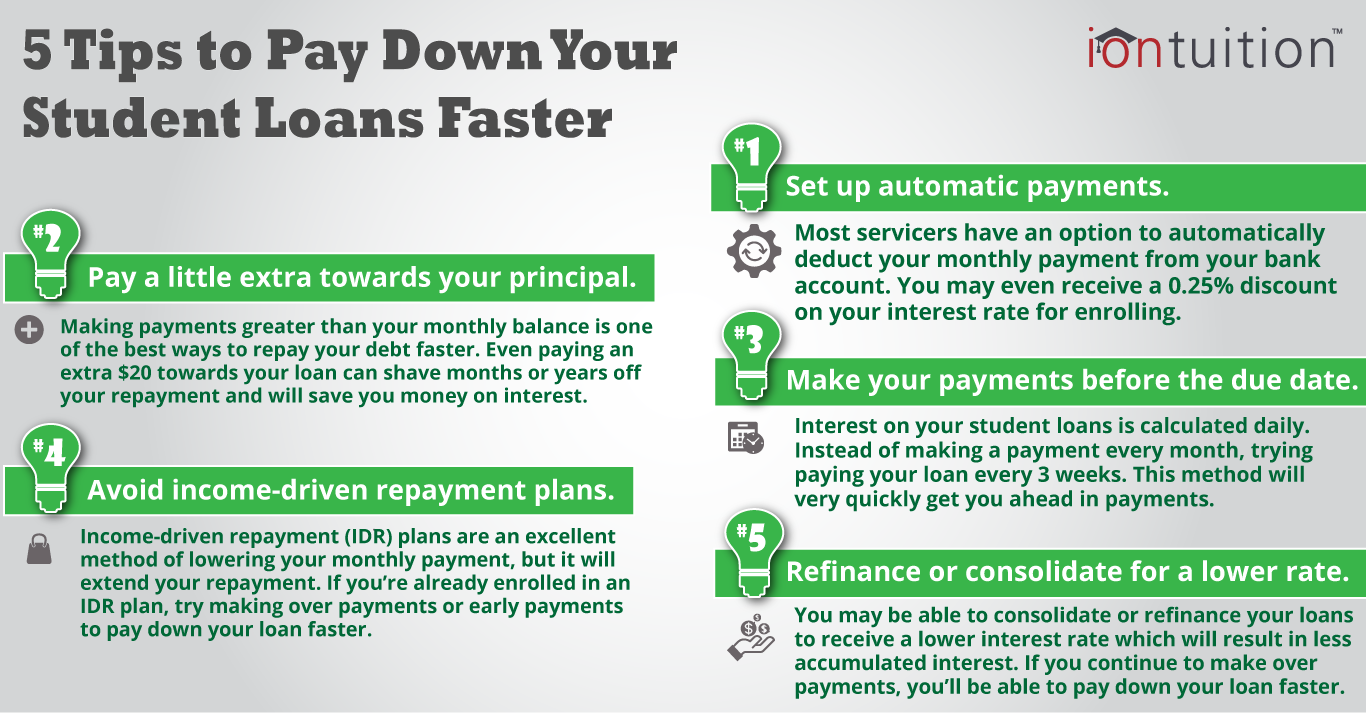
While choosing an appropriate repayment plan is essential, many borrowers also aim to pay off their student loans faster to minimize interest costs and achieve financial freedom sooner. Several strategies can help you accelerate your repayment journey.
Making Extra Payments
The most straightforward way to pay down your loans faster is to pay more than your minimum monthly payment whenever possible. Even small extra payments can make a significant difference over time, as they go directly towards reducing your principal balance, thus reducing the amount of interest that accrues.
Rounding Up Payments and Bi-Weekly Payments
Consider rounding up your monthly payment to the nearest $50 or $100. For instance, if your payment is $275, pay $300. This small increase adds up. Another effective strategy is to make bi-weekly payments. By dividing your monthly payment in half and paying that amount every two weeks, you’ll effectively make one extra full payment per year without feeling a dramatic increase in your budget.
Applying Windfalls (Bonuses, Tax Refunds)
Any unexpected influx of cash – such as a work bonus, a tax refund, or an inheritance – presents a prime opportunity to make a lump-sum payment on your student loans. Directing these windfalls towards your principal balance can significantly shorten your repayment timeline and save you a substantial amount in interest.
The Debt Avalanche vs. Debt Snowball Method
When you have multiple loans, you can prioritize which ones to pay down first using one of two popular methods:
- Debt Avalanche Method: This strategy focuses on paying off the loan with the highest interest rate first, while making minimum payments on all other loans. Once the highest-interest loan is paid off, you take the money you were paying on it and apply it to the next highest-interest loan. This method saves you the most money on interest over the long run.
- Debt Snowball Method: This strategy involves paying off the loan with the smallest balance first, regardless of its interest rate, while making minimum payments on the others. Once the smallest loan is gone, you “snowball” that payment amount into the next smallest loan. This method provides psychological wins early on, which can be motivating.
Choose the method that best suits your financial personality and goals.
Dealing with Repayment Challenges: Options for When Things Get Tough
Life happens, and sometimes even the best-laid financial plans go awry. If you find yourself struggling to make your student loan payments, it’s crucial to understand the available options before you fall behind.
Deferment and Forbearance
Both deferment and forbearance allow you to temporarily postpone or reduce your student loan payments.
- Deferment: This allows you to temporarily stop making payments for specific reasons, such as unemployment, enrollment in school, or economic hardship. For subsidized federal loans, interest does not accrue during deferment periods.
- Forbearance: This also allows you to temporarily stop or reduce your payments, typically for up to 12 months at a time. However, interest typically accrues on all types of loans (subsidized and unsubsidized) during forbearance, which can increase your total loan cost.
These options should be considered as temporary solutions for short-term financial hardship. Contact your loan servicer immediately if you anticipate difficulty making payments.
Loan Forgiveness Programs
Certain federal student loans may be eligible for forgiveness programs. These programs are generally tied to specific types of employment or public service.
- Public Service Loan Forgiveness (PSLF): This program forgives the remaining balance on Direct Loans after you’ve made 120 qualifying monthly payments while working full-time for a qualifying employer (government or non-profit organization).
- Teacher Loan Forgiveness: Eligible teachers who work for five complete and consecutive academic years in low-income schools can have up to $17,500 of their Direct Subsidized and Unsubsidized Loans (and certain FFEL Program loans) forgiven.
- Other Forgiveness Programs: There are also forgiveness, cancellation, or discharge options for specific circumstances, such as total and permanent disability, death, or school closure.
It’s vital to research the specific eligibility requirements for any forgiveness program carefully, as they often have strict criteria.
Default and Its Consequences
Failing to make your student loan payments can lead to severe consequences. For federal loans, default typically occurs after 270 days of non-payment. For private loans, default can happen much sooner, as specified in your loan agreement. Consequences of default include:
- Damage to your credit score.
- Wage garnishment (federal loans).
- Seizure of tax refunds or Social Security benefits (federal loans).
- Inability to receive future federal student aid.
- Increased collection fees.
- Difficulty getting approval for mortgages, car loans, or other credit.
If you are at risk of default, contacting your loan servicer to discuss repayment options or deferment/forbearance is critical.
Seeking Financial Counseling
If you’re overwhelmed or unsure about the best path forward, consider seeking guidance from a non-profit credit counseling agency. These agencies can offer personalized advice, help you understand your options, and even assist in negotiating with lenders if necessary.
Refinancing and Consolidation: Are They Right for You?
As you progress in your career and your financial situation evolves, you might consider options like consolidation or refinancing to streamline your loans or secure better terms.
Understanding Loan Consolidation (Federal Direct Consolidation Loan)
Federal loan consolidation allows you to combine multiple federal student loans into a single new loan with a single monthly payment. The interest rate for a Direct Consolidation Loan is the weighted average of the interest rates on the loans being consolidated, rounded up to the nearest one-eighth of a percentage point. The repayment period can be extended up to 30 years.
- Pros: Simplifies repayment with one monthly bill, potentially lowers your monthly payment (by extending the term), and can unlock eligibility for certain income-driven repayment plans or PSLF for some older federal loan types.
- Cons: You might pay more interest over time due to the extended repayment period, and any unpaid interest from your original loans may capitalize (be added to the principal balance) when you consolidate.
Consolidation does not typically lower your interest rate; it merely averages them.
Exploring Student Loan Refinancing (Private Lenders)
Refinancing involves taking out a new private loan to pay off one or more existing student loans, both federal and private. The goal is typically to secure a lower interest rate, reduce your monthly payment, or change your loan servicer.
- Pros: Potentially lower interest rates (especially if your credit score has improved since you took out your original loans), a simplified payment structure, and the ability to choose a new loan term that fits your budget.
- Cons: You forfeit all the valuable federal loan protections, such as income-driven repayment plans, deferment, forbearance, and access to federal forgiveness programs like PSLF. Once federal loans are refinanced into a private loan, they cannot be converted back. This is a significant consideration.
When to Consider Refinancing or Consolidation
- Consider Federal Consolidation if: You want to simplify payments, potentially gain access to certain IDR plans or PSLF for older FFEL or Perkins loans, or if you need to extend your repayment term.
- Consider Private Refinancing if: You have a stable income, an excellent credit score, a low debt-to-income ratio, and are confident you won’t need federal protections in the future. It’s often most beneficial for those with high-interest private loans or a mix of federal and private loans, where the federal loans being refinanced aren’t eligible for PSLF or other valuable benefits.
Deciding whether to consolidate or refinance is a personal financial decision that requires careful weighing of the potential benefits against the loss of federal protections.
Paying back student loans can feel like a marathon, but with a strategic approach, it doesn’t have to be an overwhelming burden. By understanding your loan details, choosing the right repayment plan, exploring acceleration strategies, and knowing your options when challenges arise, you can navigate your student loan debt effectively. Taking proactive steps and staying informed are key to achieving financial independence and moving forward confidently into your future.
aViewFromTheCave is a participant in the Amazon Services LLC Associates Program, an affiliate advertising program designed to provide a means for sites to earn advertising fees by advertising and linking to Amazon.com. Amazon, the Amazon logo, AmazonSupply, and the AmazonSupply logo are trademarks of Amazon.com, Inc. or its affiliates. As an Amazon Associate we earn affiliate commissions from qualifying purchases.