
In an era defined by digital giants, few companies command as much global influence and financial scrutiny as Google. Yet, the question of “who owns Google” is more nuanced than it appears at first glance, leading us deep into the intricate world of corporate finance, multi-class stock structures, and the delicate balance between founder control and shareholder interests. This article will delve into the financial realities behind Google’s ownership, revealing how its unique structure impacts everything from market valuation to long-term strategic decisions, all through the lens of a Money niche perspective.

Unpacking Alphabet’s Corporate Structure: More Than Just Shares
To understand who owns Google, we must first recognize that “Google” as a monolithic entity has evolved. In 2015, Google restructured under a new holding company, Alphabet Inc. (NASDAQ: GOOGL, GOOG). This move was a strategic financial decision, designed to create greater transparency and accountability for its diverse portfolio of businesses, separating the highly profitable core Google services from its riskier, experimental “Other Bets.” From a financial perspective, this meant investors could more clearly evaluate the performance of each segment, potentially optimizing capital allocation and valuation.
The Genesis of Ownership: From Startup to Public Giant
Google’s journey from a Stanford University project by Larry Page and Sergey Brin to a public juggernaut is a textbook example of venture capital success culminating in an IPO. Initially, ownership was concentrated among the founders, early employees, and key venture capital firms like Sequoia Capital and Kleiner Perkins. This private ownership phase allowed for rapid, unencumbered growth, fueled by private equity infusions. The pivotal shift came with its initial public offering (IPO) in August 2004. This event democratized ownership, allowing the broader public to invest, but also introduced the complexities of public market finance, including regulatory compliance, quarterly earnings pressure, and the need to manage shareholder expectations. For investors, the IPO was a golden opportunity, but it also laid the groundwork for a unique control mechanism that would define Alphabet’s financial governance for decades.
Decoding Alphabet’s Dual-Class Stock System
One of the most distinctive and financially significant aspects of Alphabet’s ownership is its multi-class share structure, a design choice deliberately made to preserve founder control even as the company went public and grew exponentially. Alphabet currently issues three classes of stock:
- Class A Shares (GOOGL): These are publicly traded shares, offering one vote per share. They represent the primary way most institutional and individual investors participate in Alphabet’s financial success and exercise limited governance.
- Class B Shares: These are not publicly traded and are held almost exclusively by Larry Page, Sergey Brin, and select insiders. Crucially, each Class B share carries ten votes. This super-voting power is the cornerstone of the founders’ control.
- Class C Shares (GOOG): These are also publicly traded but carry no voting rights. They were introduced in 2014 primarily as a mechanism for stock splits and employee compensation without diluting the voting power of Class A or B shares. For investors, Class C shares offer pure economic interest in Alphabet’s performance, but no say in corporate governance.
From a financial perspective, this dual-class structure is a powerful tool for maintaining long-term vision and insulating strategic decisions from short-term market pressures. While it can be seen as beneficial for stability and innovation, it also presents a governance challenge, where a significant portion of the company’s financial value is owned by public shareholders who have minimal influence over its direction. This setup ensures that, despite holding a minority of the economic equity, Page and Brin retain dominant voting power, a critical distinction for any investor evaluating Alphabet’s corporate governance.
The Architects of Control: Founders and Key Stakeholders
While millions of individuals and institutions “own” a piece of Alphabet, the true locus of control resides with a select few, primarily its visionary founders. This concentration of power has profound financial implications, shaping the company’s investment priorities, acquisition strategies, and executive compensation models.
The Enduring Influence of Larry Page and Sergey Brin
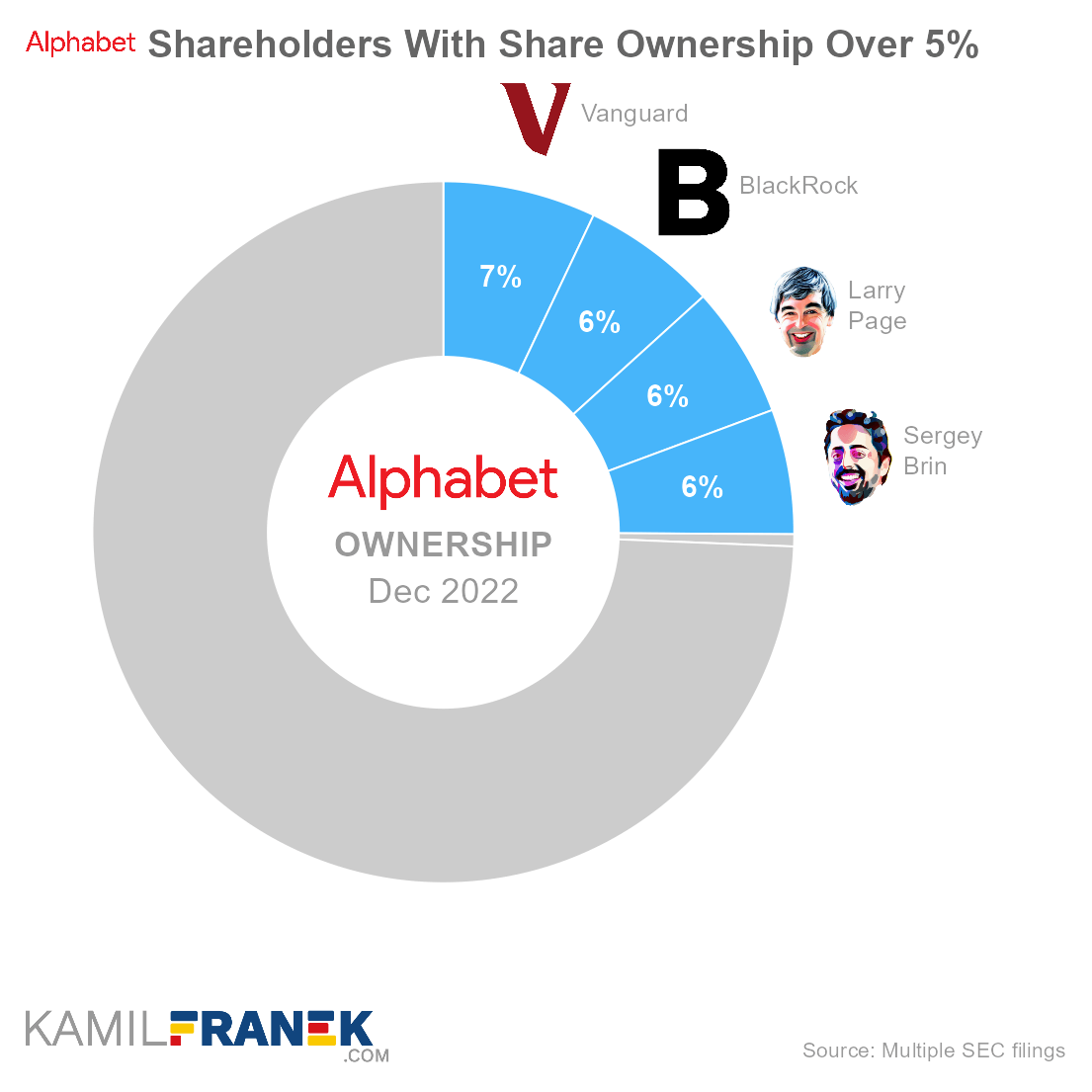
Larry Page and Sergey Brin, through their substantial holdings of Class B shares, maintain a majority of the voting power at Alphabet. Even after stepping down from their executive roles at Alphabet in 2019, transitioning to roles on the board and as controlling shareholders, their financial grip on the company’s strategic direction remains firm. Their ability to appoint board members, approve major corporate actions, and effectively veto shareholder proposals means that any investment in Alphabet is, in essence, an investment in a company whose ultimate trajectory is steered by its founders’ long-term vision. This structure is often celebrated by those who believe in the importance of founder-led companies for innovation and sustained growth, but it also raises questions about accountability to the broader shareholder base, a key consideration for financial analysts.
The Power of Institutional Investment
Beyond the founders, a significant portion of Alphabet’s publicly traded shares (Class A and Class C) is owned by institutional investors. These include massive mutual funds, pension funds, hedge funds, and sovereign wealth funds. Firms like Vanguard, BlackRock, and State Street Global Advisors often rank among the largest shareholders, managing trillions of dollars on behalf of their clients. While these institutional investors typically hold a large percentage of the market value, their combined voting power (derived from Class A shares) is still substantially less than that of the founders. Their influence usually comes through engagement with management, proxy voting on less critical issues, and their ability to move large blocks of stock, which can impact share price and market sentiment. For the average investor, understanding the top institutional holders provides insight into large-scale capital flows and professional investor sentiment regarding Alphabet’s financial health and prospects.
Diversified Ownership: The Role of Public Shareholders
The remaining shares are widely distributed among individual investors, smaller funds, and other public entities. These diverse shareholders, ranging from retirees saving for their future to day traders seeking short-term gains, collectively own a substantial portion of Alphabet’s economic value. Their investment decisions are driven by a myriad of factors, including Alphabet’s financial performance, market trends, dividend policies (or lack thereof), and growth prospects. While individual shareholders typically have minimal direct influence on corporate governance due to the dual-class structure, their aggregate buying and selling activity dictates market capitalization and share price volatility, directly impacting the wealth of all investors. Understanding this broad base of ownership is crucial for grasping the full financial ecosystem surrounding Google.
Financial Implications of Alphabet’s Ownership Model

The unique ownership structure of Alphabet has far-reaching financial implications, affecting everything from market perception to long-term strategic execution. It’s a model that balances concentrated control with diffuse economic ownership, leading to distinct advantages and potential drawbacks for different financial stakeholders.
Market Valuation and Investor Confidence
Alphabet’s multi-class stock structure often elicits mixed reactions from the financial community. On one hand, the stability afforded by founder control is often seen as a positive, fostering a long-term strategic outlook that prioritizes innovation over short-term earnings pressures. This can contribute to a premium valuation, as investors trust the continuity of leadership and vision. On the other hand, some investors and governance advocates view the limited voting rights for Class A and C shareholders as a discount factor, suggesting that companies with more democratic governance structures might command higher valuations due to increased accountability. Despite these debates, Alphabet’s consistent financial performance, robust revenue growth, and market dominance have largely outweighed governance concerns, maintaining its position as one of the world’s most valuable companies. Its sheer size and consistent profitability are strong indicators of investor confidence in its underlying business model, irrespective of its governance.
Governance, Control, and Strategic Direction
The concentrated voting power in the hands of the founders means that Alphabet’s board of directors and executive leadership are largely insulated from activist investor campaigns or proxy battles, which are common in companies with a single class of voting shares. This allows the company to pursue ambitious, long-term projects—such as Waymo (self-driving cars) or Verily (life sciences)—that might take years to become profitable, without immediate pressure from shareholders demanding quicker returns. From a financial management perspective, this means capital allocation decisions can be made with a longer time horizon, potentially leading to greater disruptive innovation but also potentially less responsiveness to immediate market demands. For investors, this structure implies a “trust-based” investment: trusting the founders’ vision will ultimately deliver superior long-term financial returns, even if it means sacrificing direct influence.
Shareholder Rights and Investor Engagement
The multi-class structure creates a tiered system of shareholder rights. Holders of Class A shares possess some voting power, primarily on routine matters and the election of a minority of independent directors, but their influence is limited when contrasted with the Class B holders. Class C shareholders, possessing no voting rights, are purely financial stakeholders, betting on the company’s economic performance without any say in its management. This disparity can lead to frustration among some public investors who desire more direct engagement and influence over corporate decisions, particularly regarding executive compensation or social responsibility initiatives. Financial tools like proxy advisory services often highlight these governance differences, guiding institutional investors on how to approach their limited voting rights within Alphabet’s unique framework.
Investing in Alphabet: Understanding the Landscape
For anyone considering an investment in Alphabet, understanding its ownership structure is not just an academic exercise; it’s fundamental to comprehending the financial landscape, potential risks, and long-term prospects.
Analyzing Alphabet’s Stock Performance and Outlook
Alphabet’s stock performance, reflected in its Class A (GOOGL) and Class C (GOOG) shares, has been historically strong, driven by consistent innovation, market leadership in digital advertising, cloud computing (Google Cloud), and emerging technologies. The stability provided by founder control is often cited as a factor in its long-term growth trajectory, enabling bold investments that have paid off handsomely for shareholders. When analyzing Alphabet, investors often look beyond traditional financial metrics like P/E ratios to consider its robust R&D spending, its dominance in key technological sectors, and its ability to consistently generate free cash flow. The dual-class structure, by allowing a long-term focus, arguably contributes to a consistent strategy that underpins this strong performance. Future outlook hinges on its continued ability to innovate, navigate regulatory challenges, and effectively monetize its vast user base and technological advancements.
Considerations for Prospective Investors
Prospective investors in Alphabet must weigh the benefits of investing in a financially powerful, innovative company against the implications of its governance model. Investing in Class A shares grants limited voting rights, while Class C shares offer pure economic exposure without any governance input. The price difference between GOOGL and GOOG shares can fluctuate based on market dynamics, but typically, the voting shares (GOOGL) trade at a slight premium, reflecting the value some investors place on even limited influence. Ultimately, an investment in Alphabet is a bet on the sustained vision and leadership of its founders and management team, supported by the company’s vast resources and market position. Understanding this unique blend of concentrated control and public financial interest is crucial for making informed investment decisions in one of the world’s most influential companies.
The Future of Alphabet’s Ownership and Governance
As Alphabet continues to evolve, the question of its ownership and governance will remain a critical point of discussion within the financial community. The long-term implications of founder-led control versus broader shareholder democracy are constantly debated, especially as the company’s market capitalization swells.
Potential Shifts in Control
While the current dual-class structure is robust, potential shifts in control could arise from various scenarios. Should Larry Page and Sergey Brin ever decide to divest a significant portion of their Class B shares or alter their voting arrangements, it would be a seismic event for Alphabet’s governance. Succession planning, though currently not an immediate concern for the founders, is another long-term factor. Any such changes would dramatically alter the company’s power dynamics, potentially leading to greater shareholder influence and a re-evaluation of its market valuation based on new governance standards. Such events would be closely watched by financial markets, impacting share price and investor sentiment.
Balancing Innovation with Shareholder Value
The ongoing challenge for Alphabet, and a key consideration for its financial health, is how to continually balance its foundational commitment to audacious innovation with the imperative to create shareholder value. The current ownership model facilitates long-term R&D and strategic bets, but also places a unique responsibility on the founders to steer the company in a way that ultimately benefits all shareholders economically. As Alphabet matures, pressures for dividends, stock buybacks, or increased transparency could grow from its vast public shareholder base. Navigating these financial expectations while maintaining its innovative edge will be critical for Alphabet’s continued success and its appeal to a diverse range of investors. The future of Alphabet’s ownership structure is not just about who holds the most votes, but how that power is leveraged to sustain growth and deliver consistent financial returns for every investor, from the smallest individual shareholder to the largest institutional fund.
aViewFromTheCave is a participant in the Amazon Services LLC Associates Program, an affiliate advertising program designed to provide a means for sites to earn advertising fees by advertising and linking to Amazon.com. Amazon, the Amazon logo, AmazonSupply, and the AmazonSupply logo are trademarks of Amazon.com, Inc. or its affiliates. As an Amazon Associate we earn affiliate commissions from qualifying purchases.