
In the intricate world of finance, percentages are not just mathematical constructs; they are the language through which we understand value, growth, debt, and opportunity. From calculating a discount on a new purchase to dissecting investment returns or understanding interest rates on a loan, a solid grasp of how to solve for percentages is an indispensable skill for anyone seeking financial acumen. This article will demystify percentages, providing a comprehensive guide to understanding, calculating, and applying them across various financial scenarios, empowering you to make more informed and strategic money decisions.
The Ubiquity of Percentages in Finance
Percentages permeate nearly every aspect of our financial lives, often dictating the terms of our transactions, the growth of our wealth, and the cost of our borrowing. Without a firm understanding, individuals and businesses alike risk misinterpreting crucial financial information and making suboptimal choices.

Understanding the Foundation: What is a Percentage?
At its core, a percentage is a way of expressing a number as a fraction of 100. The word “percent” literally means “per hundred.” It’s a standardized way to compare parts of a whole, making it easier to analyze and contrast different quantities. For instance, 50% means 50 out of 100, or one-half. This simple concept becomes incredibly powerful when applied to complex financial data. Whether you’re looking at a 15% interest rate, a 20% down payment, or a 3% inflation rate, these numbers are always relative to a base value.
Why Percentages Matter for Your Money
The significance of percentages in personal and business finance cannot be overstated. They provide a common metric for comparison, allowing us to:
- Evaluate Value: Is a 30% off sale genuinely a good deal compared to a competitor offering 25% off plus an additional 10% for members?
- Track Growth and Decline: How much did your investment portfolio grow this year? What was the percentage decrease in your expenses?
- Assess Risk and Reward: What percentage of your portfolio is allocated to high-risk assets? What is the expected return percentage?
- Understand Obligations: What percentage of your income goes towards debt repayment? What is the annual percentage rate (APR) on your credit card?
- Measure Performance: For businesses, profit margins, market share, and sales growth are almost always expressed as percentages.
Without percentages, comparing diverse financial metrics would be akin to comparing apples and oranges, leading to confusion and poor decision-making.
Everyday Financial Scenarios Involving Percentages
Consider these common situations where percentages are paramount:
- Shopping and Discounts: “Get 25% off all electronics!” or “Save an additional 10% on already reduced prices.”
- Taxes: Sales tax (e.g., 8%), income tax brackets (e.g., 22%), property tax rates (e.g., 1.5% of assessed value).
- Tips: Standard tipping percentages in restaurants (e.g., 15-20%).
- Loans and Mortgages: Interest rates (e.g., 6% APR), down payments (e.g., 20%).
- Investments: Annualized returns (e.g., 7% average annual return), dividend yields (e.g., 3.5%).
- Budgeting: Allocating a percentage of income to savings (e.g., 10%), housing (e.g., 30%), or entertainment (e.g., 5%).
Each of these scenarios requires a basic understanding of how to calculate and interpret percentages to manage your money effectively.
Mastering Basic Percentage Calculations for Financial Success
While calculators and software can handle complex computations, understanding the underlying mechanics of percentage calculations is crucial. It empowers you to verify results, spot errors, and intuitively grasp the financial implications.
Calculating a Percentage of a Number (e.g., Discounts, Taxes, Commissions)
This is perhaps the most frequent percentage calculation in daily finance. You know the whole amount and a percentage, and you want to find the part.
Formula: Part = Whole × (Percentage / 100)
Or, more simply, convert the percentage to a decimal by dividing by 100 and then multiply: Part = Whole × Decimal Percentage.
Examples:
- Discount: You want to buy a laptop that costs $1,200, and it’s on sale for 20% off.
- Discount amount = $1,200 × (20 / 100) = $1,200 × 0.20 = $240.
- Final price = $1,200 – $240 = $960.
- Sales Tax: Your bill is $85, and the sales tax is 7%.
- Tax amount = $85 × (7 / 100) = $85 × 0.07 = $5.95.
- Total cost = $85 + $5.95 = $90.95.
- Commission: A salesperson earns a 15% commission on sales of $5,000.
- Commission earned = $5,000 × (15 / 100) = $5,000 × 0.15 = $750.
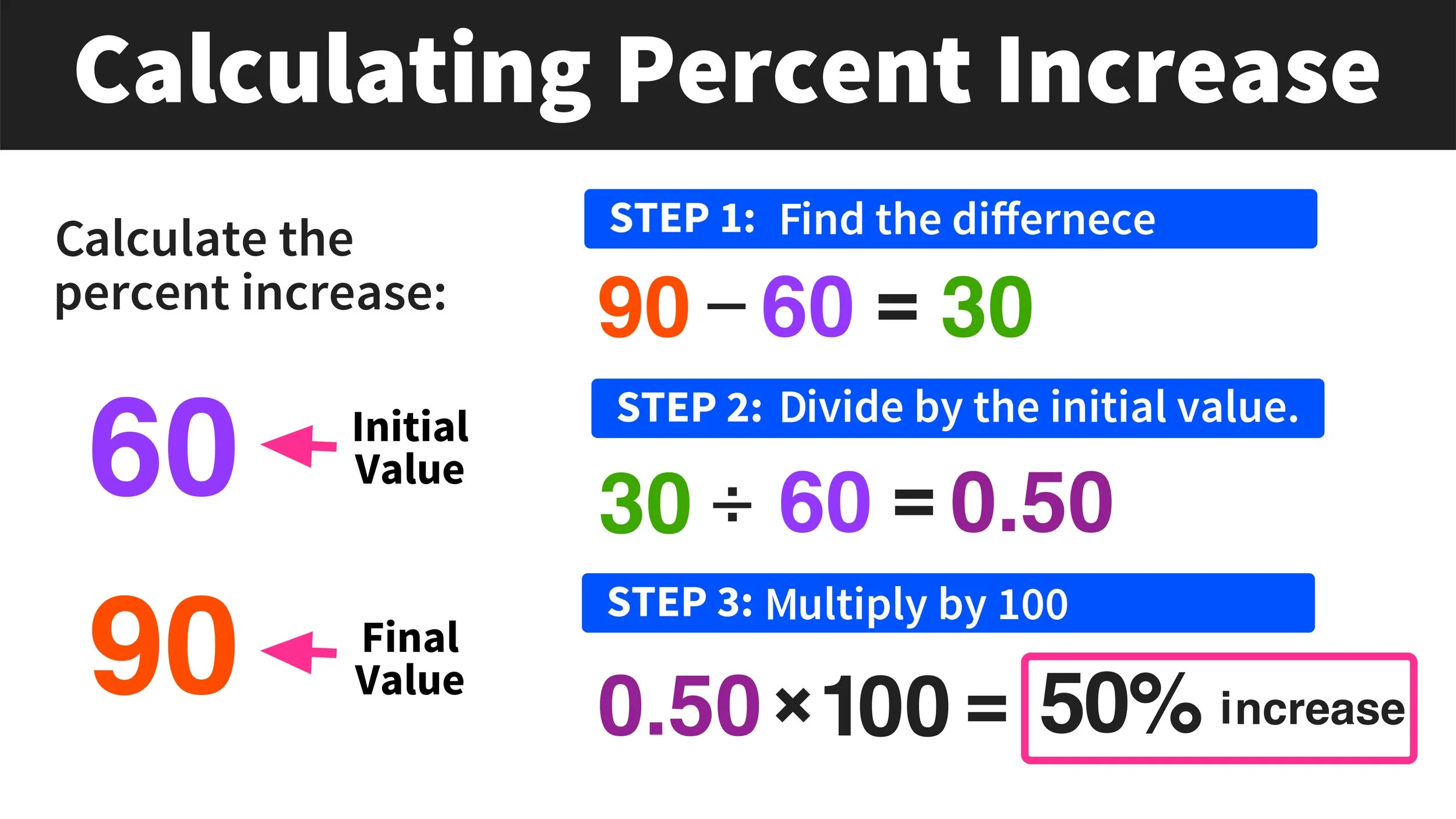
Finding the Percentage One Number Is of Another (e.g., Profit Margins, Growth Rates)
This calculation helps you understand the proportional relationship between two numbers, often used to express efficiency, change, or relative size.
Formula: Percentage = (Part / Whole) × 100
Examples:
- Profit Margin: A product sells for $150, and its cost to produce was $100. The profit is $50.
- Profit margin = ($50 / $150) × 100 = 0.3333… × 100 ≈ 33.33%.
- This means for every dollar of sales, 33.33 cents is profit.
- Investment Growth: Your investment portfolio started at $10,000 and grew to $11,500. The gain is $1,500.
- Percentage growth = ($1,500 / $10,000) × 100 = 0.15 × 100 = 15%.
- Budget Allocation: You earn $4,000 per month and spend $1,200 on rent.
- Percentage of income on rent = ($1,200 / $4,000) × 100 = 0.30 × 100 = 30%.
Determining the Whole When You Have the Part and the Percentage (e.g., Reversing Discounts, Original Price)
This calculation is useful when you know a portion and its percentage representation, and you need to find the original total.
Formula: Whole = Part / (Percentage / 100)
Or, Whole = Part / Decimal Percentage.
Examples:
- Original Price After Discount: You bought an item for $75 after a 25% discount. What was the original price?
- If there was a 25% discount, you paid 100% – 25% = 75% of the original price.
- Original price = $75 / (75 / 100) = $75 / 0.75 = $100.
- Income from a Commission: You earned a $300 commission, which represents 10% of your total sales. What were your total sales?
- Total sales = $300 / (10 / 100) = $300 / 0.10 = $3,000.
Advanced Applications: Percentages in Investing and Business
Moving beyond basic transactions, percentages become powerful analytical tools in more complex financial landscapes.
Investment Returns and Compounding
In investing, percentages are vital for understanding performance.
- Annualized Return: The average percentage return an investment earns per year over a specified period. This allows comparison across different investment vehicles.
- Compound Interest: The concept that interest is earned not only on the initial principal but also on the accumulated interest from previous periods. Understanding percentage growth in compound interest is key to long-term wealth building. A small percentage difference in an annual return can lead to massive differences over decades due to compounding.
- Yields: Dividend yield (dividends per share as a percentage of share price) or bond yield (interest rate paid as a percentage of the bond’s face value) help investors assess income potential.
Analyzing Business Performance: Margins, Growth, and Market Share
For businesses, percentages are the backbone of financial reporting and strategic planning.
- Gross Profit Margin: (Gross Profit / Revenue) × 100. Indicates the percentage of revenue left after deducting the cost of goods sold.
- Net Profit Margin: (Net Profit / Revenue) × 100. Shows the percentage of revenue left after all expenses, including taxes. These margins are critical indicators of operational efficiency and profitability.
- Revenue Growth Rate: ((Current Revenue – Previous Revenue) / Previous Revenue) × 100. Measures how quickly a company’s sales are increasing.
- Market Share: (Company Sales / Total Market Sales) × 100. Reveals a company’s proportion of the total sales in its industry.
Understanding Financial Ratios
Many crucial financial ratios are expressed as percentages, offering quick insights into a company’s health and efficiency.
- Debt-to-Equity Ratio: Often expressed as a percentage or decimal, this indicates how much debt a company uses to finance its assets relative to the value of shareholders’ equity.
- Return on Equity (ROE): (Net Income / Shareholder Equity) × 100. Shows how much profit a company generates for each dollar of shareholders’ equity.
- Current Ratio: While often a decimal, it’s about the percentage of current assets relative to current liabilities.
Common Pitfalls and How to Avoid Them
Even with a good grasp of the formulas, percentages can be tricky. Awareness of common mistakes is crucial for accuracy.
The Importance of the Base Value
One of the most common errors is misidentifying the “whole” or the “base” when calculating percentages. For example, if a stock drops 10% from $100 to $90, and then rises 10%, it does not return to $100. A 10% rise from $90 is $9, bringing it to $99. The base value for the percentage calculation changed, leading to a different absolute change. Always be clear about what number your percentage is being calculated of.
Percentage Points vs. Percentage Change
These terms are often confused, but they have distinct meanings.
- Percentage points refer to the absolute difference between two percentages. If an interest rate increases from 4% to 6%, it’s an increase of 2 percentage points.
- Percentage change refers to the relative change. An increase from 4% to 6% is a (2 / 4) × 100 = 50% increase in the interest rate itself.
Understanding this distinction is vital when interpreting financial news or reports.
Using Financial Tools and Calculators Wisely
While calculators, spreadsheets, and financial apps are invaluable for complex calculations, they are only as good as the input. Relying on them without understanding the underlying principles can lead to blind acceptance of potentially incorrect figures. Always double-check your inputs and, if possible, do a quick mental estimation to ensure the result is in the right ballpark. For critical financial decisions, consider using multiple methods or tools to verify calculations.
Leveraging Percentage Skills for Better Financial Decisions
A robust understanding of percentages is not merely academic; it’s a practical skill that directly translates into improved financial literacy and more effective decision-making.
Budgeting and Saving Effectively
Percentages are the bedrock of effective budgeting. By allocating a percentage of your income to various categories – savings, housing, food, transportation, debt repayment, and discretionary spending – you create a flexible and scalable budget. For example, the 50/30/20 rule suggests 50% for needs, 30% for wants, and 20% for savings and debt repayment. Understanding how to calculate these percentages for your specific income allows you to track progress, identify areas for adjustment, and consistently work towards your financial goals.
Evaluating Loans and Interest Rates
When borrowing money, interest rates, expressed as percentages, determine the true cost of the loan. Understanding how interest compounds (e.g., daily, monthly, annually) and the difference between nominal interest rates and the Annual Percentage Rate (APR) – which includes fees – is crucial. A seemingly small percentage difference in an interest rate can equate to thousands of dollars over the lifetime of a mortgage or car loan. Calculating the percentage of your income that goes towards debt service helps you assess affordability and avoid overextension.

Negotiating and Maximizing Value
Whether negotiating a salary increase (e.g., “I’d like a 10% raise”), evaluating a benefits package (e.g., “The company matches 401k contributions up to 5% of salary”), or comparing investment fees (e.g., “This fund has an expense ratio of 0.5% vs. 1.2%”), percentages are the language of value. Being able to quickly calculate the monetary impact of these percentages empowers you to negotiate effectively, identify hidden costs, and ultimately maximize your financial outcomes.
In conclusion, “how to solve for percentage” is more than a mathematical exercise; it is a foundational skill for financial empowerment. By mastering these calculations and understanding their practical implications across personal finance, investing, and business, you gain the clarity and confidence needed to navigate the financial landscape successfully, making smarter decisions that propel you towards your financial aspirations.
aViewFromTheCave is a participant in the Amazon Services LLC Associates Program, an affiliate advertising program designed to provide a means for sites to earn advertising fees by advertising and linking to Amazon.com. Amazon, the Amazon logo, AmazonSupply, and the AmazonSupply logo are trademarks of Amazon.com, Inc. or its affiliates. As an Amazon Associate we earn affiliate commissions from qualifying purchases.