
In the world of personal finance, business operations, and investment strategy, percentages are not just mathematical curiosities; they are the bedrock upon which crucial decisions are made. From understanding a discount on a new purchase to analyzing investment returns, calculating interest on a loan, or budgeting your monthly expenses, a solid grasp of percentages is an indispensable skill. It empowers you to interpret financial data accurately, compare different options effectively, and make informed choices that directly impact your financial well-being. This guide will demystify percentages, providing you with a clear, professional, and practical understanding of how to calculate them and, more importantly, how to apply them across various financial scenarios.

The Core Concept of Percentages in Finance
At its heart, a percentage is a way of expressing a number as a fraction of 100. The term “percent” literally means “per hundred” or “out of one hundred.” It provides a standardized way to compare parts of different wholes, making complex financial data more digestible and relatable. Instead of saying “15 out of 50 people got a raise,” we can say “30% of people got a raise,” which is instantly more impactful and comparable to other figures.
Understanding “Part,” “Whole,” and the 100-Fold Factor
The fundamental formula for calculating a percentage is straightforward:
Percentage = (Part / Whole) × 100
Let’s break down these components:
- Part: This is the specific amount or quantity you are interested in, which forms a portion of the larger total. In finance, this could be the discount amount, the interest paid, the profit earned, or the specific expense category.
- Whole: This represents the total amount or the entire quantity against which the “part” is being measured. Financially, this might be the original price, the principal loan amount, the initial investment, or your total monthly income.
- 100: Multiplying by 100 converts the decimal fraction (Part/Whole) into a percentage, making it easier to read and understand.
Consider a simple example: If your monthly income is $4,000 (the Whole) and you spend $1,200 on rent (the Part), what percentage of your income goes to rent?
($1,200 / $4,000) × 100 = 0.30 × 100 = 30%.
Why Percentages Matter in Your Financial Life
Percentages are the universal language of finance because they allow for direct comparison and scaling. A 10% interest rate on a small loan feels different from 10% on a massive mortgage, but the percentage itself provides a consistent metric for evaluation.
- Discounts and Sales: How much are you truly saving? Is a 20% discount on a $100 item better than a 15% discount on a $150 item?
- Interest Rates: Whether you’re earning interest on savings or paying it on debt, percentages dictate the financial impact. Understanding APR (Annual Percentage Rate) and APY (Annual Percentage Yield) is crucial.
- Taxes: Income tax rates, sales tax, property tax – all are expressed as percentages and significantly affect your disposable income and purchasing power.
- Investment Performance: The growth or decline of your investments is almost always reported as a percentage, enabling you to compare different assets or portfolios regardless of their initial value.
- Budgeting: Allocating a percentage of your income to different spending categories (e.g., 50/30/20 rule) is a common and effective budgeting strategy.
Essential Percentage Calculations for Personal Finance
Beyond the basic “part of a whole” calculation, several specific types of percentage calculations are vital for managing your money effectively.
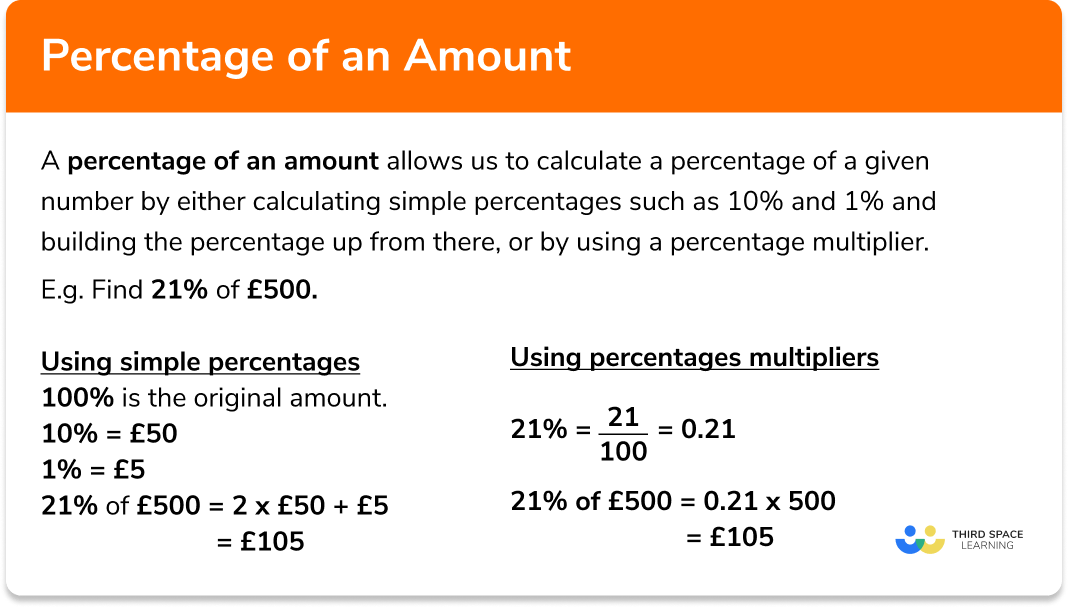
Calculating a Percentage of a Number (e.g., Sales Tax, Tip, Discount)
This is one of the most frequent financial applications. You know the percentage and the whole, and you need to find the part.
Formula: Part = (Percentage / 100) × Whole
- Example: Sales Tax. If an item costs $50 and the sales tax is 8%, what is the tax amount?
(8 / 100) × $50 = 0.08 × $50 = $4.
Your total cost would be $50 + $4 = $54. - Example: Tipping. If your restaurant bill is $75 and you want to leave a 15% tip, how much do you tip?
(15 / 100) × $75 = 0.15 × $75 = $11.25. - Example: Discount. A jacket originally priced at $120 is on sale for 25% off. What is the discount amount?
(25 / 100) × $120 = 0.25 × $120 = $30.
The sale price is $120 – $30 = $90.
Determining Percentage Change (e.g., Investment Growth, Inflation, Salary Increase/Decrease)
When you want to understand how much something has grown or shrunk relative to its original value, you calculate percentage change.
Formula: Percentage Change = ((New Value – Original Value) / Original Value) × 100
- Example: Investment Growth. You invested $1,000, and it grew to $1,200. What is the percentage growth?
(($1,200 – $1,000) / $1,000) × 100 = ($200 / $1,000) × 100 = 0.20 × 100 = 20%. - Example: Salary Increase. Your salary increased from $50,000 to $53,000. What is the percentage increase?
(($53,000 – $50,000) / $50,000) × 100 = ($3,000 / $50,000) × 100 = 0.06 × 100 = 6%. - Example: Price Decrease. A stock dropped from $150 to $120. What is the percentage decrease?
(($120 – $150) / $150) × 100 = (-$30 / $150) × 100 = -0.20 × 100 = -20%. (A negative sign indicates a decrease).
Finding the Whole from a Percentage (e.g., Original Price, Total Budget)
Sometimes you know a part and its percentage, and you need to find the original total (the whole).
Formula: Whole = Part / (Percentage / 100)
- Example: Original Price. You paid $75 for a shirt after a 25% discount. What was the original price?
First, if it’s a 25% discount, you paid 100% – 25% = 75% of the original price. So, the $75 is 75% of the original price.
Whole = $75 / (75 / 100) = $75 / 0.75 = $100.
The original price was $100. - Example: Total Income. You allocated $600 for groceries, which represents 15% of your total monthly budget. What is your total monthly budget?
Whole = $600 / (15 / 100) = $600 / 0.15 = $4,000.
Your total monthly budget is $4,000.
Understanding Basis Points (for More Granular Financial Contexts)
In professional finance, particularly in bond markets, interest rates, and investment fees, small percentage changes are often expressed in “basis points” (bps). One basis point is 0.01% or 1/100th of a percentage point.
- 1% = 100 basis points
- 0.50% = 50 basis points
- 0.01% = 1 basis point
This is used for precision and to avoid ambiguity when discussing minute changes in rates or yields. For instance, if an interest rate moves from 3.25% to 3.50%, that’s a 25-basis-point increase, not a 0.25% increase (which could be misconstrued as 0.25% of 3.25%).

Practical Applications: Percentages in Action for Your Money
The ability to calculate and interpret percentages is not just an academic exercise; it’s a critical life skill that directly translates into more effective financial management.
Budgeting and Expense Tracking
A common and highly effective budgeting strategy is the 50/30/20 rule: 50% of your after-tax income for needs, 30% for wants, and 20% for savings and debt repayment. Percentages make this possible:
- Needs: Rent, utilities, groceries, transportation. You track these expenses and divide by your income to ensure they stay within the 50% allocation.
- Wants: Dining out, entertainment, subscriptions. You monitor if these discretionary expenses are within 30% of your income.
- Savings & Debt: Contributions to retirement, emergency fund, extra debt payments. This should ideally be 20%.
By converting your spending into percentages of your income, you gain a clear, comparable snapshot of your financial health and can identify areas for adjustment.
Investing and Returns
Understanding investment performance relies almost entirely on percentages.
- Return on Investment (ROI): This is a key metric for evaluating the profitability of an investment. It’s calculated as ((Current Value – Original Cost) / Original Cost) × 100.
- Portfolio Allocation: Financial advisors often recommend a certain percentage allocation to different asset classes (e.g., 60% stocks, 30% bonds, 10% cash) based on your risk tolerance and age.
- Dividend Yield: The annual dividend per share divided by the share price, expressed as a percentage, tells you the income generated by a stock relative to its price.
- Expense Ratios: For mutual funds and ETFs, the expense ratio is the annual fee charged as a percentage of your investment. A seemingly small difference (e.g., 0.5% vs. 0.2%) can equate to thousands of dollars over decades.
Debt Management and Interest Rates
Percentages are at the forefront of understanding and managing debt.
- Annual Percentage Rate (APR): This is the annual rate of interest charged on loans or earned on investments, often used for credit cards and mortgages. It allows you to compare the cost of borrowing across different lenders.
- Interest Calculation: The interest you pay on a loan is a percentage of the principal balance. Whether it’s simple interest or compound interest, the calculation begins with a percentage.
- Debt-to-Income Ratio: Many lenders use this ratio (total monthly debt payments / gross monthly income) to assess your ability to repay a new loan. A lower percentage indicates less risk.
Taxes and Deductions
Taxes are inherently percentage-based.
- Income Tax Brackets: Your income is taxed at different percentage rates depending on which bracket it falls into.
- Effective Tax Rate: This is the actual percentage of your total income that you pay in taxes, taking into account all deductions, credits, and different tax brackets. It’s calculated as (Total Tax Paid / Total Gross Income) × 100.
- Sales Tax: Added as a percentage to most goods and services purchased.
- Property Tax: Calculated as a percentage of your property’s assessed value.
Retail and Discounts
Every time you see a “X% Off” sign, you’re interacting with percentages. Being able to quickly calculate the actual savings and the final price allows you to:
- Evaluate Deals: Determine if a discount is truly significant or just a marketing tactic.
- Compare Offers: Decide which store or product offers a better deal, especially when discounts are applied differently (e.g., “buy one get one 50% off” vs. “30% off total purchase”).
- Budget for Purchases: Know exactly how much you’ll spend after applying discounts and taxes.
Tools and Tips for Accurate Percentage Calculations
While the underlying math is simple, real-world financial scenarios can become complex. Leveraging the right tools and understanding common pitfalls can significantly enhance your accuracy and efficiency.
Leveraging Calculators and Spreadsheets (Excel/Google Sheets)
For all but the simplest calculations, relying on digital tools is advisable.
- Basic Calculators: Your phone’s calculator, scientific calculators, or online calculators are perfect for quick, one-off percentage calculations.
- Spreadsheets (Excel/Google Sheets): These are invaluable for more complex financial planning, budgeting, and investment analysis.
- Formula Entry: You can easily input formulas like
=(A2/B2)*100to calculate percentages. - Percentage Format: Cells can be formatted to automatically display numbers as percentages, simplifying data presentation.
- “What If” Scenarios: Spreadsheets allow you to quickly change variables (e.g., a different interest rate, a higher income) and see the immediate impact on your percentage-based calculations.
- Formula Entry: You can easily input formulas like
Common Pitfalls to Avoid
Even seasoned financial professionals can trip up on percentage calculations if not careful.
- Misinterpreting the “Whole”: Always be clear about what the base or original amount is. When calculating percentage change, for example, the denominator is always the original value, not the new one.
- Simple vs. Compound Interest: A 5% interest rate means different things depending on whether it’s simple (calculated only on the principal) or compound (calculated on the principal plus accumulated interest). Most financial products use compound interest.
- Percentage Points vs. Percentage Change: If an interest rate goes from 4% to 5%, that’s a one percentage point increase. But it’s a (1/4)*100 = 25% *percentage change* increase. The distinction is crucial.
- Order of Operations: When dealing with multiple operations (e.g., discounts and tax), apply them in the correct sequence. Usually, discounts are applied first, then taxes.
Developing Your “Percentage Intuition”
Beyond rote calculation, developing an intuitive feel for percentages is a powerful financial tool.
- Mental Benchmarks: Learn to estimate common percentages. For example, 10% is easy (just move the decimal one place left). 20% is double 10%. 50% is half.
- Practice with Real-World Examples: Actively calculate percentages in your daily life – sales, restaurant bills, budget breakdowns. The more you practice, the faster and more accurate you’ll become.
- Focus on the “Why”: Instead of just getting a number, ask yourself what that percentage means in your financial context. Is a 7% return good for your investment? Is 40% of your income on housing sustainable? This deeper understanding transforms calculation into insight.
In conclusion, finding the percentage of something is far more than a basic math problem; it’s a gateway to financial literacy and empowerment. By mastering these core calculations and understanding their applications across budgeting, investing, debt, and taxes, you equip yourself with the ability to navigate the financial world with confidence, make smarter decisions, and ultimately achieve your monetary goals.
aViewFromTheCave is a participant in the Amazon Services LLC Associates Program, an affiliate advertising program designed to provide a means for sites to earn advertising fees by advertising and linking to Amazon.com. Amazon, the Amazon logo, AmazonSupply, and the AmazonSupply logo are trademarks of Amazon.com, Inc. or its affiliates. As an Amazon Associate we earn affiliate commissions from qualifying purchases.