
In the intricate world of personal finance, investing, and business operations, numbers tell a story. But raw figures, while informative, often lack the comparative power needed to make truly insightful decisions. This is where percentages step in, transforming absolute values into meaningful, relatable metrics. Understanding “how to find the percent of money” is not merely a mathematical exercise; it’s a fundamental skill that empowers individuals and organizations to gauge performance, evaluate opportunities, manage debt, and plan for the future with greater precision and confidence. From calculating a discount on a purchase to assessing investment returns, or even understanding the breakdown of your monthly budget, percentages are the universal language of financial comparison and analysis.
This guide will demystify the process of calculating percentages in various financial contexts, providing you with the tools and understanding necessary to harness their power. By mastering these calculations, you’ll gain a clearer perspective on your financial health, enabling you to make more informed and strategic monetary decisions.
The Indispensable Role of Percentages in Financial Literacy
Percentages are far more than just mathematical symbols; they are the bedrock of financial understanding. They provide context, allowing us to compare different amounts, understand relative changes, and break down complex financial data into digestible insights. Without a grasp of percentages, navigating the modern financial landscape would be akin to sailing without a compass.
Why Percentages are More Than Just Numbers
At its core, a percentage is a fraction of 100. It allows us to express a part of a whole in a standardized way, making it easy to compare different situations, regardless of the initial amounts involved. For instance, a $100 gain on a $1,000 investment represents a 10% return, while a $100 gain on a $100 investment represents a 100% return. The absolute gain is identical, but the relative performance—the efficiency with which capital was used—is vastly different. This relative perspective is crucial. It helps us understand the true impact of changes, growth, or decline, irrespective of scale. It levels the playing field, making financial metrics comparable whether you’re dealing with hundreds or billions of dollars.
Furthermore, percentages help us simplify complex data. Instead of saying you spent $800 on rent out of a $4,000 income, stating that rent consumes 20% of your income instantly conveys a clearer picture of your spending allocation relative to your earnings. This ability to normalize data makes percentages an indispensable tool for analysis and communication in finance.
From Personal Budgets to Global Markets
The application of percentages permeates every facet of our financial lives. On a personal level, they inform our budgeting decisions, allowing us to allocate specific percentages of our income to savings, housing, and discretionary spending. They are integral to understanding the interest rates on our savings accounts, credit cards, and loans, helping us discern the true cost of borrowing or the potential for wealth accumulation.
In the realm of investing, percentages are paramount. Investment returns, portfolio allocations, and performance benchmarks are all expressed in percentages. An investor tracking their portfolio’s growth needs to understand percentage returns to evaluate success. Business owners use percentages to analyze profit margins, market share, and sales growth. Economists track inflation rates, GDP growth, and unemployment rates, all of which are quantified using percentages to understand the health and direction of national and global economies. Even something as commonplace as a sales discount or a tax rate relies entirely on percentage calculations. This widespread utility underscores why mastering percentage calculations is not optional, but essential, for anyone serious about managing their money effectively.
Practical Applications: Where Financial Percentages Come Alive
Understanding the theoretical basis of percentages is one thing; seeing them in action within your financial life is another. Percentages are not abstract concepts but dynamic tools that provide clarity and actionable insights across numerous financial scenarios.
Budgeting and Expense Analysis
One of the most immediate and impactful uses of percentages is in personal budgeting. By calculating the percentage of your income allocated to various expense categories, you gain profound insight into your spending habits. For example, if your monthly income is $5,000 and your housing costs are $1,500, you can quickly determine that 30% of your income goes towards housing ($1,500 / $5,000 * 100 = 30%). This allows you to evaluate if you’re adhering to financial guidelines like the popular 50/30/20 rule (50% for needs, 30% for wants, 20% for savings and debt repayment) or if adjustments are needed. Analyzing spending percentages can highlight areas where you might be overspending, such as dining out or subscriptions, enabling you to reallocate funds towards savings or debt reduction.
Understanding Loans and Debt
Percentages are at the heart of understanding debt. Interest rates, whether for a mortgage, car loan, or credit card, are almost universally expressed as Annual Percentage Rates (APR) or Annual Percentage Yields (APY). These percentages dictate the cost of borrowing money or the earnings from saving. For example, a credit card with a 20% APR means you’ll pay 20% of the outstanding balance in interest over a year. Calculating your debt-to-income (DTI) ratio, which is the percentage of your gross monthly income that goes towards paying your monthly debt payments, is crucial for assessing your financial health and qualifying for new loans. A high DTI percentage signals financial strain and potential difficulty in securing future credit.
Investment Growth and Performance
In the investment world, percentages are the primary metric for evaluating performance. When you invest in stocks, bonds, or mutual funds, your returns are typically expressed as a percentage. A 7% annual return on an investment clearly indicates its growth relative to the initial capital. Calculating compound interest, the interest on both the initial principal and the accumulated interest from previous periods, relies heavily on percentages to project future wealth accumulation. Furthermore, percentages are essential for portfolio allocation, determining what proportion of your investments should be in different asset classes (e.g., 60% stocks, 30% bonds, 10% cash) to manage risk and align with your financial goals.
Savings Goals and Progress
Setting and tracking savings goals become much more tangible with percentages. If you aim to save $10,000 for a down payment and have already accumulated $2,500, you’ve achieved 25% of your goal ($2,500 / $10,000 * 100 = 25%). This provides a clear benchmark of your progress and can serve as a powerful motivator. Similarly, deciding to save a certain percentage of each paycheck, rather than a fixed amount, ensures that your savings grow proportionally with any increases in your income, promoting consistent wealth building.
Discounts, Sales, and Taxes
Everyday financial interactions frequently involve percentages. When an item is on sale for “30% off,” understanding how to calculate that percentage allows you to determine the exact savings. Similarly, sales tax is calculated as a percentage of the purchase price, and income taxes are levied as a percentage of your earnings, often through various tax brackets. Proficiency in these calculations ensures you know the true cost of goods and services and can accurately estimate your tax liabilities.
The Core Formulas: Your Toolkit for Percentage Calculations
While the applications of percentages are diverse, the underlying mathematical formulas are surprisingly straightforward. Mastering these fundamental calculations will equip you to tackle almost any financial percentage problem.
The Basic Percentage Formula (Part / Whole * 100)
This is the foundational formula for finding what percentage one number (the “part”) is of another number (the “whole”).
Formula: Percentage = (Part / Whole) * 100
Example: You earned $5,000 in a month, and $1,500 went to rent. What percentage of your income is rent?
Percentage = ($1,500 / $5,000) * 100 = 0.30 * 100 = 30%
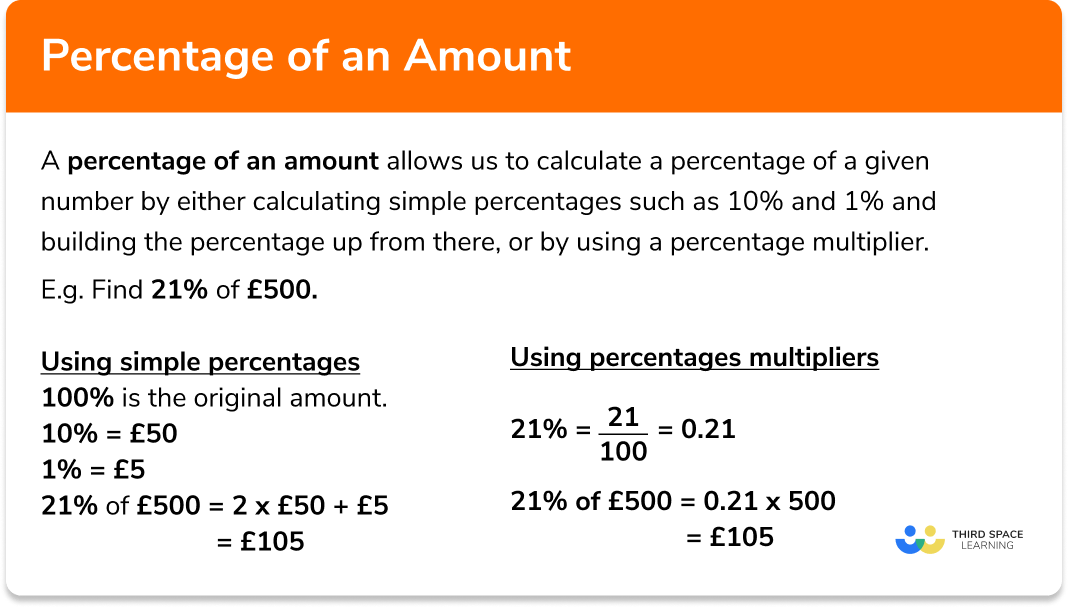
Finding a Percentage of a Number (Percentage / 100 * Whole)
This formula is used when you know the percentage and the total amount, and you want to find the specific value that represents that percentage.
Formula: Part = (Percentage / 100) * Whole
Example: You want to save 20% of your $5,000 monthly income. How much money should you save?
Part = (20 / 100) * $5,000 = 0.20 * $5,000 = $1,000
Calculating Percentage Change ((New Value – Old Value) / Old Value * 100)
This is crucial for understanding growth or decline over time, whether for investments, income, or expenses. A positive result indicates a percentage increase, while a negative result signifies a percentage decrease.
Formula: Percentage Change = ((New Value - Old Value) / Old Value) * 100
Example: Your investment portfolio grew from $10,000 to $11,500. What is the percentage increase?
Percentage Change = (($11,500 - $10,000) / $10,000) * 100 = ($1,500 / $10,000) * 100 = 0.15 * 100 = 15%
Working with Percentage Increase/Decrease (Original * (1 + or – Percent / 100))
This formula allows you to quickly calculate a new value after a percentage increase or decrease. Use + for increases and - for decreases.
Formula (Increase): New Value = Original Value * (1 + (Percentage Increase / 100))
Formula (Decrease): New Value = Original Value * (1 - (Percentage Decrease / 100))
Example 1 (Increase): Your salary of $60,000 receives a 5% raise. What is your new salary?
New Salary = $60,000 * (1 + (5 / 100)) = $60,000 * (1 + 0.05) = $60,000 * 1.05 = $63,000
Example 2 (Decrease): An item costing $200 is on sale for 25% off. What is the new price?
New Price = $200 * (1 - (25 / 100)) = $200 * (1 - 0.25) = $200 * 0.75 = $150
Leveraging Percentages for Strategic Financial Decision-Making
Beyond mere calculation, the true power of percentages lies in their ability to inform and guide strategic financial planning. They transform raw data into actionable intelligence, empowering individuals and businesses to make smarter choices.
Setting Realistic Financial Goals
Percentages provide a concrete framework for setting achievable financial goals. Instead of vaguely aiming to “save more,” you can set a target to “save 15% of your income each month” or “achieve an average annual investment return of 8%.” These percentage-based goals are measurable, allowing you to track progress consistently and make adjustments as needed. Whether it’s saving for a down payment, retirement, or a child’s education, defining goals in percentage terms makes them more tangible and motivates proactive planning.
Comparing Financial Products and Opportunities
In a market saturated with financial products, percentages act as an objective metric for comparison. When choosing between different savings accounts, their Annual Percentage Yield (APY) helps you identify which offers the highest return. For loans, comparing the Annual Percentage Rate (APR) allows you to find the most cost-effective borrowing option. Similarly, evaluating various investment funds often involves comparing their historical percentage returns over different periods. By focusing on these percentage metrics, you can cut through marketing hype and make data-driven decisions that align with your financial objectives.
Identifying Financial Strengths and Weaknesses
Analyzing your personal or business financial statements through the lens of percentages can reveal critical insights. If a disproportionately high percentage of your income is dedicated to non-essential spending, it flags an area for potential optimization. Conversely, a consistently high percentage of income going into savings or investments highlights a financial strength. Businesses use percentage-based metrics like profit margins (net income as a percentage of revenue) or operating expense ratios (operating expenses as a percentage of revenue) to identify inefficiencies or areas of competitive advantage, guiding strategic adjustments.
Projecting Future Financial Scenarios
Percentages are indispensable for financial forecasting and scenario planning. Using the concept of compound interest, you can project how your savings or investments will grow over time, assuming a certain percentage annual return. This helps in retirement planning, estimating how much you need to save to reach a desired nest egg. Similarly, understanding inflation rates (percentage increase in prices) allows you to adjust your financial plans to account for the eroding purchasing power of money over time. By modeling different percentage growth rates or interest rates, you can stress-test your financial plans and prepare for various potential futures.
Mastering Accuracy and Avoiding Common Pitfalls
While percentages are powerful, miscalculations or misinterpretations can lead to significant financial errors. A clear understanding of best practices and common pitfalls is crucial for leveraging percentages effectively.
The Importance of the “Whole”
A frequent mistake in percentage calculations is misidentifying the “whole” or the base number. For example, if your salary increased from $50,000 to $55,000, the percentage increase is based on the original salary: (($55,000 – $50,000) / $50,000) * 100 = 10%. However, if you were to calculate the decrease from $55,000 back to $50,000, the base changes: (($50,000 – $55,000) / $55,000) * 100 = -9.09%. Always ensure you’re using the correct base value for your calculation to avoid skewed results.
Distinguishing Between Percentage Points and Percentage Change
This is a subtle yet critical distinction, especially in discussions about interest rates or survey results. If an interest rate moves from 4% to 5%, that’s an increase of 1 percentage point. However, it’s a 25% percentage change (relative increase) because ((5 – 4) / 4) * 100 = 25%. Confusing these two can lead to drastically different interpretations of the magnitude of change. Always clarify whether a stated change refers to percentage points or a percentage increase/decrease relative to the original value.
Utilizing Financial Calculators and Tools
While understanding the manual formulas is essential, for complex or repetitive calculations, leveraging technology is wise. Modern financial calculators, spreadsheet software like Microsoft Excel or Google Sheets, and dedicated financial apps often have built-in functions for percentage calculations. These tools not only speed up the process but also reduce the likelihood of human error. However, always ensure you input the correct values and understand the underlying logic of the calculation, rather than blindly trusting the output.
Double-Checking Your Calculations
Given the potential impact of financial decisions, it’s always prudent to double-check your percentage calculations. A small error in calculating an interest rate or an investment return can have significant long-term consequences. If possible, perform the calculation in a different way or use an online calculator to verify your results. This extra step can save you from costly mistakes and ensure the integrity of your financial planning.
By understanding these common pitfalls and adopting best practices, you can ensure that your use of percentages in financial matters is always accurate, insightful, and supportive of your overarching monetary goals.

Conclusion
The ability to “find the percent of money” is an indispensable skill in today’s financially driven world. From the most basic personal budget to the intricacies of investment analysis and global economic trends, percentages provide the crucial context, clarity, and comparability that raw numbers often lack. They empower individuals to evaluate spending habits, assess investment performance, understand the true cost of debt, and plan effectively for future financial milestones.
Mastering the core formulas and understanding their practical applications unlocks a deeper level of financial literacy, transforming you from a passive observer of your money into an active, informed decision-maker. By embracing these calculations, recognizing their strategic utility, and diligently avoiding common pitfalls, you can navigate your financial journey with greater confidence, accuracy, and ultimately, success. The percentages of your money aren’t just figures; they’re the story of your financial life, waiting to be understood and optimized.
aViewFromTheCave is a participant in the Amazon Services LLC Associates Program, an affiliate advertising program designed to provide a means for sites to earn advertising fees by advertising and linking to Amazon.com. Amazon, the Amazon logo, AmazonSupply, and the AmazonSupply logo are trademarks of Amazon.com, Inc. or its affiliates. As an Amazon Associate we earn affiliate commissions from qualifying purchases.