
Understanding how interest is calculated on your savings account is a fundamental aspect of personal finance, empowering you to make informed decisions and optimize your financial growth. Far from being a mere banking formality, interest computation is the engine that drives your savings, allowing your money to work for you over time. In an era where financial literacy is paramount, demystifying this process is not just beneficial—it’s essential for anyone looking to build a secure financial future. This article delves into the mechanics of savings account interest, breaking down complex concepts into an accessible guide, complete with practical steps, influential factors, and strategies for maximizing your returns.

Understanding the Fundamentals of Savings Interest
At its core, savings account interest is the reward a financial institution pays you for depositing your money with them. It’s essentially the cost of borrowing your money, which the bank then lends out to others or invests. For you, the saver, it represents a passive income stream, a gradual accumulation of wealth that doesn’t require active trading or significant effort beyond the initial deposit.
What is Savings Account Interest?
Savings account interest is the percentage return you earn on the principal amount held in your savings account over a specified period. This interest is typically expressed as an annual percentage rate (APR) or, more commonly for savings, an annual percentage yield (APY), which accounts for the effect of compounding. It’s the reason why leaving money in a savings account allows your balance to grow incrementally, rather than just sitting stagnant. This growth, however modest it might seem initially, is a crucial component of any long-term financial strategy.
Key Terminology: Principal, Interest Rate, Compounding Period
To truly grasp interest computation, familiarity with a few key terms is vital:
- Principal: This is the initial amount of money you deposit into your savings account, or the current balance on which interest is calculated. If you open an account with $1,000, that $1,000 is your principal. As you add more money or earn interest, your principal grows.
- Interest Rate: Expressed as a percentage, this is the rate at which your principal earns interest over a year. For example, a 1.00% interest rate means you earn 1% of your principal annually.
- Compounding Period: This refers to how frequently your earned interest is added back to your principal. Common compounding periods include daily, monthly, quarterly, or annually. The more frequently interest compounds, the faster your money grows, as you start earning interest on your previously earned interest.
The Importance of Interest in Wealth Building
While the interest rate on a standard savings account might seem low compared to other investment vehicles, its role in wealth building, especially through the power of compound interest, cannot be overstated. Even small amounts of interest, compounded over many years, can lead to substantial growth. It encourages consistent saving habits and provides a low-risk avenue for wealth preservation and gradual accumulation. For emergency funds, short-term goals, or simply as a foundational component of your financial portfolio, understanding and leveraging savings account interest is indispensable. It’s the bedrock upon which more complex investment strategies are often built, ensuring that even your most liquid assets are working for you.
Types of Interest Calculation Methods
Understanding how interest is calculated is not a one-size-fits-all concept. Banks employ different methods, and knowing the distinction between them can significantly impact your overall earnings. The primary methods revolve around simple interest versus compound interest, with the latter being the more prevalent and powerful for savings accounts.
Simple Interest Calculation
Simple interest is the most straightforward method of calculating interest. It is computed only on the original principal amount deposited, and it does not take into account any interest earned in previous periods. While less common for standard savings accounts today, it’s foundational to understanding more complex calculations and might be seen in specific short-term loans or bonds.
The formula for simple interest is:
Simple Interest (I) = Principal (P) × Rate (R) × Time (T)
Where:
- P is the principal amount (initial deposit).
- R is the annual interest rate (as a decimal, e.g., 5% becomes 0.05).
- T is the time period in years (or a fraction of a year).
For example, if you deposit $1,000 at a 2% simple interest rate for 1 year, your interest would be $1,000 × 0.02 × 1 = $20. After one year, your total balance would be $1,020. If you kept it for another year, you’d earn another $20, still based on the original $1,000 principal.
Compound Interest: The Power of Earning on Earnings
Compound interest is where the magic truly happens for savers. Unlike simple interest, compound interest is calculated on the initial principal and also on the accumulated interest from previous periods. This means your interest earns interest, leading to exponential growth over time. Most modern savings accounts utilize compound interest, and its frequency (daily, monthly, quarterly, annually) greatly influences your total earnings.
The general formula for compound interest is:
A = P (1 + r/n)^(nt)
Where:
- A is the future value of the investment/loan, including interest.
- P is the principal investment amount (the initial deposit).
- r is the annual interest rate (as a decimal).
- n is the number of times that interest is compounded per year.
- t is the number of years the money is invested or borrowed for.
This formula highlights why a higher compounding frequency (e.g., daily vs. annually) can lead to greater returns, even with the same stated interest rate. The interest is added back to the principal more often, giving it more opportunities to earn further interest.
Annual Percentage Yield (APY) vs. Annual Percentage Rate (APR)
When comparing savings accounts, you’ll frequently encounter APY and APR. It’s crucial to understand the distinction:
- Annual Percentage Rate (APR): This is the simple annual interest rate without taking into account the effect of compounding. It’s the straightforward percentage applied to your principal over a year. APR is more commonly used for loans and credit cards to represent the cost of borrowing.
- Annual Percentage Yield (APY): This is the effective annual rate of return, taking into account the effect of compounding. APY reflects the total amount of interest you will earn on your deposit over a year, assuming the interest is compounded. For savings accounts, APY is the more accurate figure to compare, as it provides a clearer picture of your actual earnings. A savings account with a 1.00% APR that compounds daily will have a slightly higher APY, perhaps 1.005%, because the daily compounding provides a tiny boost. Always look for the APY when comparing savings products to understand your true earning potential.
Step-by-Step Guide to Calculating Savings Interest
While understanding the formulas is important, applying them in a practical sense is what empowers you to track and project your savings growth. Whether you prefer manual calculations or leverage modern financial tools, knowing the steps ensures accuracy.
Gathering Necessary Information
Before you begin any calculation, you’ll need the following details from your bank or account statement:
- Current Principal Balance: The total amount of money currently in your savings account.
- Annual Interest Rate (APR): The stated interest rate from your bank.
- Compounding Frequency: How often the interest is added to your principal (e.g., daily, monthly, quarterly, annually).
- Time Period: The duration for which you want to calculate the interest (e.g., one month, one year, five years).
Calculating Simple Interest Manually
Though less common for savings, it’s a good starting point.
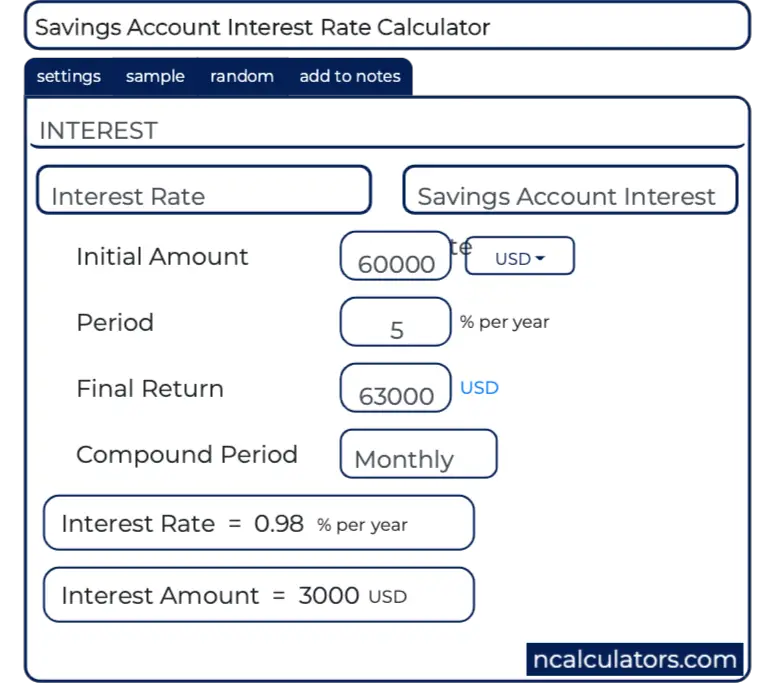
Let’s say you have an average daily balance of $5,000 in a savings account with a 0.50% APR, and for some reason, the bank only applies simple interest annually.
- Principal (P): $5,000
- Annual Rate (R): 0.50% or 0.005
- Time (T): 1 year
Interest = P × R × T = $5,000 × 0.005 × 1 = $25.
Your balance after one year would be $5,025.
Calculating Compound Interest Manually (and Approximations)
Calculating compound interest manually can be more complex, especially with frequent compounding. Let’s use the formula: A = P (1 + r/n)^(nt)
Suppose you deposit $10,000 into a savings account with a 1.00% APR, compounded monthly. You want to know your balance after 3 years.
- P (Principal): $10,000
- r (Annual Rate): 1.00% or 0.01
- n (Compounding Frequency per year): 12 (monthly)
- t (Time in years): 3
First, calculate r/n: 0.01 / 12 = 0.0008333…
Then, calculate nt: 12 × 3 = 36
Now, plug into the formula:
A = $10,000 * (1 + 0.0008333)^36
A = $10,000 * (1.0008333)^36
A ≈ $10,000 * 1.03046
A ≈ $10,304.60
After 3 years, your balance would be approximately $10,304.60. The interest earned would be $304.60.
For daily compounding, ‘n’ would be 365, making manual calculation even more tedious. This is where approximations or tools become useful.
Utilizing Online Calculators and Financial Tools
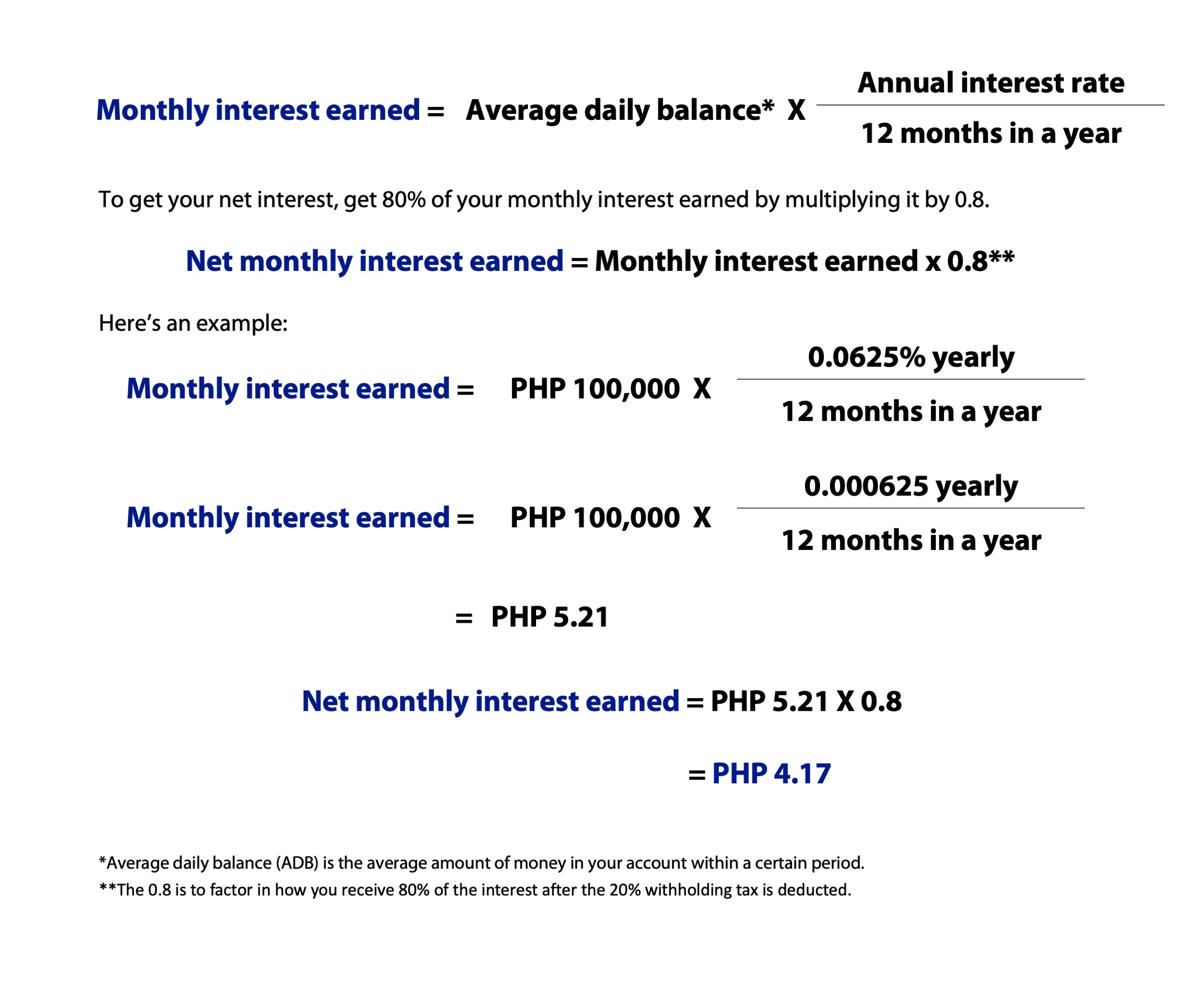
For ease and accuracy, especially with daily compounding or varied deposit schedules, online savings calculators are invaluable. Most banks and financial websites offer free tools where you can input your principal, interest rate, compounding frequency, and desired time frame. These calculators instantly provide the projected future value of your savings, often showing the total interest earned over time. Many personal finance apps and software also include similar functionalities, integrating with your actual bank accounts to provide real-time tracking and projections. These tools save time, reduce the chance of manual error, and allow for quick scenario planning (“what if I save an extra $50 per month?”).
Factors Influencing Your Savings Interest Earnings
The amount of interest you earn isn’t solely dependent on the stated interest rate. Several other factors play a crucial role, and understanding them allows you to make more strategic decisions about where and how you save.
The Impact of Interest Rates
This is the most obvious factor. A higher Annual Percentage Yield (APY) directly translates to more interest earned on your principal. Even a seemingly small difference, like 0.10% (e.g., 0.50% vs. 0.60%), can result in a significant disparity in earnings over a long period or with a large principal. Market conditions, central bank policies (like the federal funds rate), and competitive pressures among financial institutions all influence the prevailing interest rates offered on savings accounts. It pays to shop around and compare rates from various banks and credit unions, especially online-only banks which often offer higher APYs due to lower overheads.
Frequency of Compounding
As discussed, the more frequently your interest compounds, the faster your money grows. Daily compounding is generally superior to monthly, quarterly, or annual compounding, assuming the same stated APR. Even if two accounts offer the same APR, the one with more frequent compounding will have a slightly higher APY and, thus, generate more interest over the year. When comparing accounts, always look at the APY, as it already incorporates the compounding frequency, providing a true like-for-like comparison.
Account Balance and Deposits
Simply put, a larger principal balance will generate more interest. If you have $10,000 at 1.00% APY, you’ll earn $100 in interest per year. If you have $50,000 at the same rate, you’ll earn $500. Regularly contributing to your savings account, even small amounts, can significantly boost your overall interest earnings over time. Each new deposit immediately becomes part of the principal that earns interest, accelerating the compounding effect. The more money you feed into the interest-earning machine, the more it produces.
Fees and Withdrawal Limitations
Hidden fees can erode your interest earnings. Some savings accounts might charge monthly maintenance fees if your balance falls below a certain threshold or if you don’t meet specific activity requirements. Transaction fees for excessive withdrawals can also eat into your principal. Similarly, some accounts may have withdrawal limitations that, while not directly impacting interest calculation, can hinder your access to funds and potentially lead to charges if violated. Always read the fine print regarding fees and account terms before opening a savings account to ensure that the net interest you earn isn’t offset by avoidable charges.
Maximizing Your Savings Interest Potential
Simply having a savings account is a good start, but actively managing it to maximize interest earnings is where true financial savvy comes into play. By being proactive and strategic, you can significantly enhance your wealth accumulation.
Choosing the Right Savings Account
Not all savings accounts are created equal. High-yield online savings accounts typically offer significantly better APYs compared to traditional brick-and-mortar bank accounts. This is because online banks often have lower operating costs, which they pass on to customers in the form of higher interest rates. When evaluating options, consider:
- APY: Always prioritize accounts with the highest Annual Percentage Yield.
- Fees: Look for accounts with no monthly maintenance fees or those where fees are easily waived (e.g., by maintaining a minimum balance).
- Minimum Balance Requirements: Ensure the minimum balance required to earn the stated APY or avoid fees is achievable for you.
- Accessibility: While less critical for long-term savings, consider how easily you can access your funds if needed (e.g., linking to checking, ATM access).
Exploring credit unions can also be beneficial, as they are non-profit organizations that often return profits to members in the form of better rates and lower fees.
Strategies for Higher Interest Earnings
Beyond just picking the right account, adopt strategies that amplify your interest:
- Automate Savings: Set up automatic transfers from your checking account to your savings account on a regular basis (e.g., weekly or bi-weekly). This consistent contribution ensures your principal grows steadily, leading to more interest.
- Build a Larger Principal: The more money you have in savings, the more interest you earn. Focus on reducing unnecessary expenses and directing those freed-up funds into your high-yield savings account.
- Laddering CDs (Certificates of Deposit): For funds you won’t need for a specific period, consider CD ladders. This involves splitting your savings into multiple CDs with varying maturity dates (e.g., 1-year, 2-year, 3-year). As each CD matures, you can reinvest it into a new, longer-term CD at current rates, often higher than standard savings accounts, while maintaining liquidity as different CDs mature throughout the year.
Regular Contributions and Long-Term Vision
The true power of compound interest is unleashed over time. Regular contributions, no matter how small, coupled with a long-term vision, can transform modest savings into substantial wealth. Starting early allows your money more time to compound, and consistency ensures the growth engine never stops. View your savings account not just as a temporary holding place for cash, but as a strategic component of your overall financial architecture, designed for sustained growth.
Monitoring and Adjusting Your Savings Strategy
The financial landscape is dynamic, with interest rates fluctuating and new financial products emerging. Regularly review your savings account performance and compare it against current market offerings. If your bank’s APY drops significantly or a competitor offers a much higher rate with similar terms, don’t hesitate to switch accounts. Staying informed about economic trends and central bank policies can also give you an edge in anticipating rate changes. Adjusting your savings strategy as your financial goals evolve or as market conditions shift ensures that your money is always working as hard as possible for you. This proactive approach ensures you’re continually optimizing your interest earnings and accelerating your journey towards financial security.
aViewFromTheCave is a participant in the Amazon Services LLC Associates Program, an affiliate advertising program designed to provide a means for sites to earn advertising fees by advertising and linking to Amazon.com. Amazon, the Amazon logo, AmazonSupply, and the AmazonSupply logo are trademarks of Amazon.com, Inc. or its affiliates. As an Amazon Associate we earn affiliate commissions from qualifying purchases.