
Understanding how interest is calculated on your savings account is a fundamental skill for anyone looking to grow their wealth. Far from being a mere banking formality, grasping these mechanics empowers you to make informed financial decisions, compare different savings products, and ultimately accelerate your journey toward financial goals. This comprehensive guide will demystify the process, breaking down the essential concepts, formulas, and practical steps to calculate savings account interest, ensuring you can confidently project and maximize your earnings.
Understanding the Fundamentals of Savings Account Interest
Before diving into calculations, it’s crucial to establish a solid understanding of what savings account interest truly represents and the key terms associated with it. This foundational knowledge will make the subsequent calculations far more intuitive and meaningful.

What is a Savings Account and Why Does Interest Matter?
A savings account is a deposit account held at a financial institution that allows you to store your money securely while typically earning a small amount of interest. Unlike checking accounts, savings accounts are designed for accumulating funds over time, often for specific goals like a down payment, an emergency fund, or a future purchase. The interest earned is essentially the bank’s way of paying you for the privilege of holding and using your money. For individuals, this interest is a passive income stream, a “return” on your money that helps it grow without any active effort on your part. Over long periods, especially with the magic of compounding, even seemingly small interest rates can lead to substantial gains.
Key Terminology in Savings Interest Calculation
To effectively calculate and understand your interest earnings, familiarizing yourself with specific terms is essential:
- Principal: This is the initial amount of money you deposit into your savings account, or the current balance on which interest is calculated. If you deposit $1,000, your principal is $1,000.
- Interest Rate: Expressed as a percentage, this is the rate at which your principal grows over a year. It’s often quoted as an Annual Percentage Rate (APR). For example, a 1% interest rate means your money will grow by 1% of the principal over one year.
- Annual Percentage Yield (APY): While APR only considers the simple annual interest rate, APY takes into account the effect of compounding. It represents the actual annual rate of return you earn on your investment, assuming interest is compounded more than once a year. APY is almost always higher than the APR when compounding occurs. Banks are legally required to disclose the APY for savings accounts, making it a crucial metric for comparing different products.
- Compounding Frequency: This refers to how often the interest earned is added back to your principal. Common frequencies include annually, semi-annually, quarterly, monthly, daily, or even continuously. The more frequently interest is compounded, the faster your money grows, as you start earning interest on your previously earned interest sooner.
- Term: While more common in Certificates of Deposit (CDs), the concept of a term can apply to how long you plan to keep your money in the savings account, influencing the total interest earned over that period.
Demystifying Simple vs. Compound Interest
The two primary methods by which interest is calculated are simple interest and compound interest. Understanding the distinction is vital, as compound interest is the driving force behind significant long-term wealth accumulation.
The Basics of Simple Interest Calculation
Simple interest is the most straightforward form of interest calculation. It is calculated only on the initial principal amount. This means you earn the same amount of interest each period, regardless of any interest already accumulated. While less common for standard savings accounts today (which almost universally use compound interest), understanding simple interest is a good starting point for grasping the fundamentals.
The formula for simple interest is:
Simple Interest (SI) = Principal (P) × Interest Rate (R) × Time (T)
Where:
- P = Principal amount (the initial deposit)
- R = Annual interest rate (as a decimal, e.g., 5% becomes 0.05)
- T = Time period (in years)
Example:
If you deposit $1,000 into an account with a 3% simple annual interest rate for 5 years:
SI = $1,000 × 0.03 × 5
SI = $150
After 5 years, you would have $1,000 (principal) + $150 (interest) = $1,150.
Unlocking the Power of Compound Interest
Compound interest is often referred to as the “eighth wonder of the world” because it allows your money to grow exponentially. With compound interest, the interest you earn is added back to your principal, and then future interest is calculated on this new, larger principal. In essence, you earn “interest on interest.” This continuous reinvestment of earnings is what supercharges your savings over time.
The general formula for compound interest, assuming interest is compounded once per year, is:
A = P (1 + R)^T
Where:
- A = The future value of the investment/loan, including interest
- P = The principal investment amount (the initial deposit)
- R = The annual interest rate (as a decimal)
- T = The number of years the money is invested or borrowed for
Example (Annual Compounding):
Using the same $1,000 deposit at a 3% annual interest rate for 5 years, but now compounded annually:
Year 1: P = $1,000, R = 0.03, T = 1
A = $1,000 (1 + 0.03)^1 = $1,030
Interest earned = $30
Year 2: New P = $1,030, R = 0.03, T = 1
A = $1,030 (1 + 0.03)^1 = $1,060.90
Interest earned = $30.90 (note it’s higher than year 1)
Or, using the formula for the full 5 years:
A = $1,000 (1 + 0.03)^5
A = $1,000 (1.15927)
A = $1,159.27
The total interest earned is $159.27, which is $9.27 more than with simple interest. This difference grows significantly over longer periods and with higher rates.
The Role of Compounding Frequency
Most savings accounts compound interest more frequently than annually. This is where the magic truly happens. The more often interest is compounded, the faster your principal grows, and the more interest you earn.
The formula for compound interest when compounded multiple times per year is:
A = P (1 + R/n)^(nT)
Where:
- A = The future value of the investment/loan, including interest
- P = The principal investment amount
- R = The annual interest rate (as a decimal)
- n = The number of times that interest is compounded per year
- T = The number of years the money is invested or borrowed for
Example (Monthly Compounding):
Let’s use the same $1,000 principal at a 3% annual interest rate for 5 years, but now compounded monthly (n=12):
A = $1,000 (1 + 0.03/12)^(12*5)
A = $1,000 (1 + 0.0025)^60
A = $1,000 (1.0025)^60
A = $1,000 (1.161616)
A = $1,161.62
In this scenario, with monthly compounding, you earn $1,161.62 – $1,000 = $161.62 in interest. This is slightly more than annual compounding ($159.27) and significantly more than simple interest ($150). The higher the ‘n’ (compounding frequency), the greater the final amount. This is why banks often quote APY (Annual Percentage Yield), as it reflects the true annual return considering compounding.
Practical Steps to Calculate Your Savings Interest
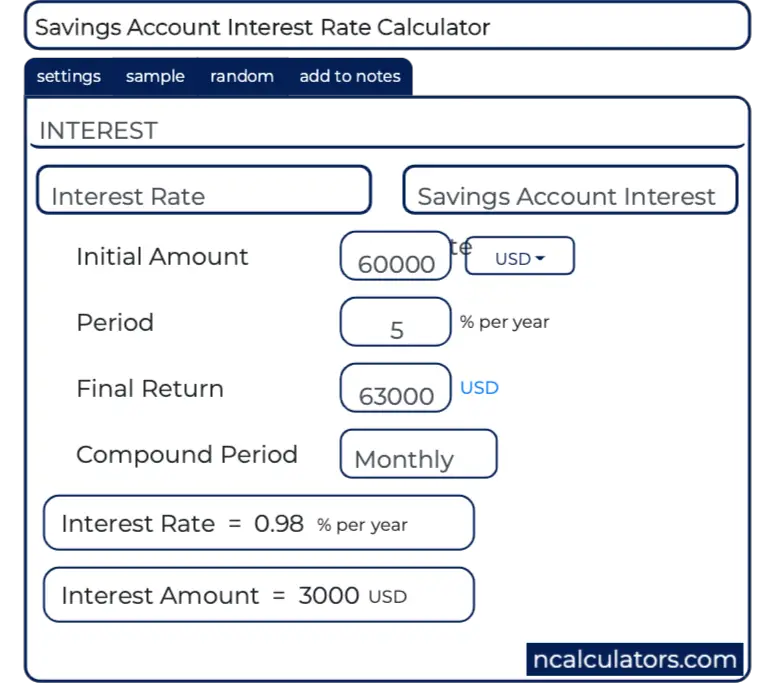
While the formulas provide the theoretical basis, practical application often involves a mix of manual checks and leveraging readily available tools.
Manual Calculation with Formulas
For quick estimations or to truly understand the mechanics, using the formulas discussed above is invaluable.
- Identify Your Variables: Determine your principal (P), annual interest rate (R, as a decimal), number of compounding periods per year (n), and the number of years (T). This information is usually found in your bank’s account terms and conditions.
- Apply the Compound Interest Formula: Plug these values into the formula:
A = P (1 + R/n)^(nT). - Calculate Total Interest: Subtract your initial principal (P) from the final amount (A) to find the total interest earned:
Total Interest = A - P.
Pro-Tip: For calculating interest over shorter periods (e.g., one month), you might use a modified approach. Divide the annual interest rate by the number of compounding periods (R/n) to get the periodic interest rate. Then, multiply your current principal by this periodic rate to find the interest for that period. Add this to your principal, and repeat for subsequent periods.
Leveraging Online Calculators and Financial Tools
For most people, online calculators are the most convenient and error-free way to estimate savings interest.
- Bank Websites: Many financial institutions offer their own savings interest calculators directly on their websites. These are often tailored to their specific products and compounding frequencies.
- Financial Aggregators: Websites like NerdWallet, Bankrate, and Investopedia provide robust compound interest calculators where you can input your principal, rate, compounding frequency, and time horizon.
- Spreadsheets (Excel/Google Sheets): For more complex scenarios, such as varying deposits or withdrawals, a spreadsheet is indispensable. You can set up columns for date, deposit/withdrawal, principal balance, interest earned, and new balance, using formulas to automate the calculations month by month or day by day. This allows for a dynamic view of your savings growth.
Interpreting Your Bank Statements
Your monthly or quarterly bank statements are your official record of interest earned.
- Look for “Interest Paid” or “Interest Earned”: Most statements will clearly itemize the interest credited to your account for that period.
- Verify the Rate: Compare the interest rate implied by your statement with the advertised APY. While your statement will show the actual dollar amount, understanding the underlying rate helps in comparison.
- Check for Fees: Ensure that any fees mentioned are not eroding your interest earnings more than expected.
Factors Influencing Your Interest Earnings
While the calculation formulas are static, several dynamic factors can significantly impact the amount of interest you actually earn.
The Impact of Interest Rates and Account Balances
These are arguably the two most critical drivers of interest earnings:
- Higher Interest Rates: A higher annual interest rate (APY) directly translates to more interest earned. Even a difference of 0.5% or 1% can add up to hundreds or thousands of dollars over many years. This underscores the importance of shopping around for competitive rates.
- Larger Account Balances (Principal): The more money you have in your savings account, the more interest you will earn, assuming the same rate. This is why consistent contributions are so powerful; they increase your principal, which then earns more interest, creating a virtuous cycle.
Navigating Fees and Minimum Balance Requirements
Some savings accounts come with conditions that can subtly erode your interest earnings:
- Monthly Maintenance Fees: If your account charges a monthly fee (e.g., $5), and your interest earned is less than that, you could actually lose money. Many banks waive these fees if you maintain a certain minimum balance or set up direct deposit.
- Minimum Balance Requirements: To earn the advertised APY, some accounts require you to maintain a specific minimum balance. Falling below this threshold might result in a lower interest rate or even fees. Always read the fine print.
- Withdrawal Limits: While not directly affecting interest calculation, exceeding transaction limits (e.g., more than 6 “convenient” withdrawals per month for Reg D accounts) can sometimes incur fees, indirectly reducing your net earnings.
Understanding Tax Implications of Interest Income
Interest earned on savings accounts is generally considered taxable income by the IRS and most state tax authorities.
- Form 1099-INT: If you earn $10 or more in interest from a bank or financial institution in a calendar year, they will send you Form 1099-INT. This form reports your total interest income for the year, which you must include on your tax return.
- Marginal Tax Rate: The interest income will be taxed at your ordinary income tax rate. It’s crucial to factor this into your overall financial planning, especially if you have significant savings that generate substantial interest.
- Tax-Advantaged Accounts: For long-term savings, consider tax-advantaged accounts like IRAs or 401(k)s (though these are investment accounts, not standard savings accounts) where growth can be tax-deferred or tax-free, offering a more efficient way to accumulate wealth. While traditional savings accounts don’t offer the same tax benefits, understanding the tax implications helps you calculate your net earnings.
Strategies to Maximize Your Savings Growth
Calculating interest is just the first step; actively strategies to increase that interest is where true financial savvy comes into play.
Choosing the Right Savings Account
Not all savings accounts are created equal. Taking the time to research and select the best fit for your needs can significantly boost your earnings.
- High-Yield Savings Accounts (HYSAs): Online banks typically offer significantly higher interest rates (APYs) compared to traditional brick-and-mortar banks, as they have lower overhead costs. HYSAs are an excellent choice for emergency funds and short-to-medium term savings goals.
- Money Market Accounts (MMAs): These accounts offer competitive interest rates, often with some check-writing privileges, but may require higher minimum balances.
- Certificates of Deposit (CDs): For money you won’t need for a specific period (e.g., 6 months to 5 years), CDs offer guaranteed interest rates, often higher than standard savings accounts. However, they come with penalties for early withdrawal.
- Consider Credit Unions: Credit unions are member-owned and often offer competitive rates and lower fees than traditional banks.
The Power of Regular Contributions
The simplest and most effective way to accelerate your interest earnings is to consistently add more money to your savings account.
- Automate Your Savings: Set up automatic transfers from your checking account to your savings account each payday. Even small, consistent contributions significantly increase your principal, giving your interest more money to compound on.
- Windfalls and Bonuses: Direct any unexpected income, tax refunds, or work bonuses directly into your savings.
- “Pay Yourself First”: Treat your savings contributions as a non-negotiable expense in your budget, ensuring you save before you spend.

Reviewing and Adapting Your Savings Strategy
The financial landscape is dynamic, so your savings strategy should be too.
- Monitor Interest Rates: Interest rates can change. Periodically check if your current savings account is still offering a competitive APY. If not, don’t hesitate to transfer your funds to an account with a better rate.
- Revisit Financial Goals: As your life circumstances change, so might your financial goals. Adjust your savings contributions and strategies accordingly.
- Understand Bank Policies: Banks can change their fee structures, minimum balance requirements, or compounding frequencies. Stay informed about any updates to your account terms.
By mastering the art of calculating savings account interest and implementing smart strategies, you transform yourself from a passive saver into an active participant in your financial growth. This knowledge is not just about numbers; it’s about building a robust financial future, one compounded dollar at a time.
aViewFromTheCave is a participant in the Amazon Services LLC Associates Program, an affiliate advertising program designed to provide a means for sites to earn advertising fees by advertising and linking to Amazon.com. Amazon, the Amazon logo, AmazonSupply, and the AmazonSupply logo are trademarks of Amazon.com, Inc. or its affiliates. As an Amazon Associate we earn affiliate commissions from qualifying purchases.