
In the intricate world of personal finance, investments, and business, numbers tell a story. But raw numbers alone often lack context. It’s percentages that provide the crucial lens through which we interpret financial data, enabling informed decisions and strategic planning. From deciphering a discount at your favorite store to evaluating the performance of your investment portfolio, understanding how to calculate and interpret percentages isn’t just a mathematical exercise; it’s a fundamental pillar of financial literacy and empowerment.
Many people find themselves intimidated by numbers, viewing percentages as a complex arithmetic challenge. However, at its core, figuring out a percentage is a straightforward process built upon a simple formula. Once mastered, this skill unlocks a deeper comprehension of your financial landscape, allowing you to optimize spending, maximize savings, and make astute investment choices. This article aims to demystify percentage calculations, grounding them firmly in real-world financial applications, and equipping you with the knowledge to navigate your monetary journey with confidence and insight.
The Indispensable Role of Percentages in Your Financial Life
Percentages are more than just numerical representations; they are a universal language in finance, providing context, comparison, and clarity. Without a solid grasp of how they work, you’re essentially navigating the financial world blindfolded, missing crucial nuances that can impact your wealth and well-being.
Beyond Basic Math: Why Percentages Matter for Your Wallet
At its heart, a percentage represents a proportion or a fraction of a whole, expressed as a number out of 100. The term “percent” literally means “per one hundred.” This standardized way of expressing parts of a whole allows for easy comparison, regardless of the size of the total amount. For instance, knowing that your utility bill increased by $50 this month might seem significant. But knowing it increased by 20% against an overall 5% inflation rate provides far more actionable insight. It tells you whether that increase is consistent with broader economic trends or if it’s an unusually high surge specific to your consumption.
In personal finance, percentages help us benchmark, evaluate, and forecast. They allow us to compare interest rates from different lenders, assess the return on various investment options, or understand the impact of inflation on our purchasing power. Without them, financial comparisons would be cumbersome, requiring mental gymnastics to normalize diverse figures.
Everyday Financial Scenarios Where Percentages Dominate
Think about the sheer number of times percentages cross your path in a typical day or week. You might see a “30% off” sign at a retail store, receive an email from your bank detailing a “0.5% APY” on your savings account, or review your pay stub where various deductions are listed as percentages of your gross income. When applying for a loan, the Annual Percentage Rate (APR) is paramount. When considering a stock, its dividend yield, expressed as a percentage, helps you understand its income-generating potential relative to its price. From budgeting your monthly income to allocating assets in your retirement portfolio, percentages are the silent workhorses that quantify and simplify complex financial relationships. They are not merely an academic concept but an integral tool for everyday financial management and long-term wealth building.
Mastering the Fundamentals: Calculating Percentages with Ease
The core mechanics of calculating a percentage are remarkably simple, yet their application is incredibly versatile across all facets of finance. Understanding this fundamental formula is the gateway to unlocking deeper financial insights.
The Universal Formula: Part Over Whole, Multiplied by 100
The most fundamental way to calculate a percentage is to understand the relationship between a “part” and a “whole.” The formula is as follows:
Percentage = (Part / Whole) * 100
Let’s break down each component:
- Part: This is the specific amount or quantity you want to express as a percentage of the total.
- Whole: This is the total amount or the base figure against which you are comparing the part.
- 100: Multiplying by 100 converts the decimal fraction into a percentage, making it easier to read and understand.
For example, if you spend $300 on groceries in a month and your total monthly income is $3,000, you can calculate what percentage of your income goes to groceries:
- Part = $300 (groceries)
- Whole = $3,000 (total income)
- Percentage = ($300 / $3,000) * 100 = 0.1 * 100 = 10%
So, 10% of your income is spent on groceries.
Practical Examples: From Discounts to Budget Allocation
The versatility of this formula truly shines in practical financial scenarios:
-
Calculating a Discount: Suppose a jacket originally costs $150 and is on sale for $120. To find the percentage discount:
- First, find the discount amount: $150 – $120 = $30 (This is your ‘Part’).
- The original price is your ‘Whole’: $150.
- Percentage Discount = ($30 / $150) * 100 = 0.2 * 100 = 20%.
The jacket is 20% off.
-
Determining a Tip: If your restaurant bill is $85 and you want to leave a 15% tip:
- Here, you’re finding a ‘Part’ (the tip amount) when you know the ‘Whole’ (the bill) and the ‘Percentage’.
- Convert the percentage to a decimal: 15% = 0.15.
- Tip Amount = $85 * 0.15 = $12.75.
Your tip would be $12.75.
-
Budget Allocation: If you aim to save 15% of your $4,000 monthly income:
- Savings Amount = $4,000 * 0.15 = $600.
You should save $600 each month.
- Savings Amount = $4,000 * 0.15 = $600.
These examples illustrate how the simple “part over whole” principle underpins a wide array of essential financial calculations, making it an invaluable tool for managing your money effectively.
Percentages in Personal Finance: Your Daily Money Navigator
For individuals, percentages are not abstract figures; they are the bedrock of everyday financial decisions, dictating everything from how much you pay for goods to how quickly your debt accumulates or your savings grow.
Decoding Sales, Discounts, and Cashbacks
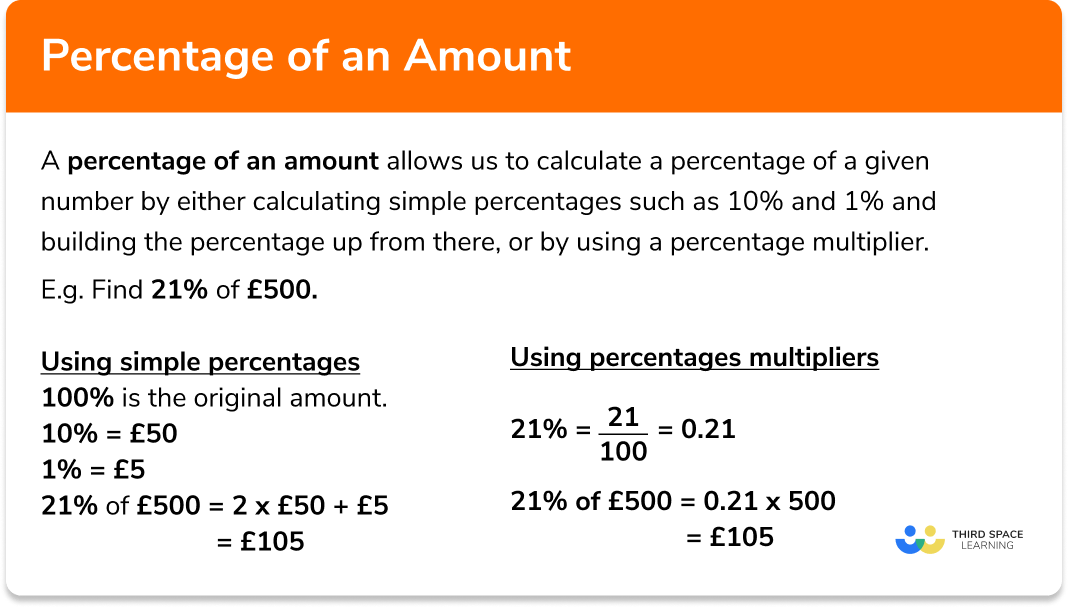
Retail is a prime example of percentages in action. When you see a “25% off” sign, understanding what that means for the final price is crucial for smart shopping. A 25% discount on a $200 item means you save $50 ($200 * 0.25), paying only $150. Similarly, cashback rewards on credit cards or loyalty programs often offer a percentage back on purchases (e.g., “2% cashback on groceries”). Calculating these helps you maximize your savings and understand the true cost or benefit of your transactions. Being able to quickly calculate these percentages allows you to compare deals, determine the best value, and avoid marketing ploys that might exaggerate actual savings.
Understanding Interest Rates: Savings, Loans, and Credit Cards
Perhaps no area of personal finance is more dominated by percentages than interest rates.
- Savings Accounts: The Annual Percentage Yield (APY) tells you how much your money will grow over a year, taking into account compounding interest. A 1% APY on $10,000 means you’ll earn $100 in interest over a year.
- Loans and Mortgages: The interest rate (often expressed as an Annual Percentage Rate or APR) is the cost of borrowing money. A 5% interest rate on a $200,000 mortgage over 30 years means a substantial portion of your monthly payment goes towards interest, especially in the early years. Understanding this percentage helps you compare lenders and gauge the true cost of your debt.
- Credit Cards: Credit cards often carry high APRs, sometimes ranging from 15% to 25% or more. If you carry a balance, that percentage dictates how quickly your debt can spiral. Calculating the interest charged on an outstanding balance highlights the importance of paying off high-interest debt promptly.
Budgeting and Expense Allocation: Crafting Your Financial Blueprint
Effective budgeting is fundamentally a percentage exercise. Financial advisors often recommend allocating income using percentages:
- The 50/30/20 Rule: 50% for needs (housing, groceries), 30% for wants (entertainment, dining out), and 20% for savings and debt repayment.
- Housing Costs: Many recommend spending no more than 30% of your gross income on housing.
By converting your income and expenses into percentages, you gain a clear, visual representation of where your money is going and where adjustments can be made. This approach fosters discipline and helps ensure you’re on track to meet your financial goals.
Navigating Taxes and Payroll Deductions
Your paycheck is a testament to the power of percentages. Federal, state, and local income taxes are calculated as percentages of your taxable income. Social Security and Medicare taxes (FICA) are fixed percentages of your gross wages up to a certain limit. Understanding these percentages helps you comprehend your take-home pay, anticipate tax liabilities, and even plan for tax season. Similarly, retirement contributions (e.g., 401(k) contributions) are often expressed as a percentage of your salary, directly impacting your future financial security.
Leveraging Percentages for Investment Growth and Wealth Building
Beyond daily spending, percentages are the compass for long-term financial strategy, particularly in the realm of investing and wealth accumulation.
Measuring Return on Investment (ROI) and Portfolio Performance
For investors, ROI is the holy grail, and it’s always expressed as a percentage.
ROI = [(Current Value – Initial Investment) / Initial Investment] * 100
If you invest $1,000 in a stock that grows to $1,200, your ROI is (($1,200 – $1,000) / $1,000) * 100 = 20%. This percentage allows you to compare the profitability of different investments over different periods, providing a standardized metric for success. Similarly, monitoring your overall investment portfolio’s annual return as a percentage helps you track progress toward your financial goals and compare it against market benchmarks or inflation.
Asset Allocation: Strategizing Your Investment Mix
Diversification is key to managing investment risk, and asset allocation is the strategy of dividing your investment portfolio among different asset categories—such as stocks, bonds, and cash. This is invariably done using percentages. For instance, a common recommendation for younger investors might be “80% stocks, 20% bonds,” while someone closer to retirement might shift to “40% stocks, 60% bonds.” These percentages reflect your risk tolerance and time horizon. Regularly rebalancing your portfolio to maintain these target percentages ensures your investment strategy remains aligned with your financial objectives.
Analyzing Investment Costs: Expense Ratios and Yields
When investing in mutual funds or Exchange Traded Funds (ETFs), expense ratios are critical. These are annual fees charged by the fund, expressed as a percentage of your total investment. A seemingly small 0.5% expense ratio can significantly erode your returns over decades due to compounding. For example, a 0.5% difference in fees on a $100,000 investment over 30 years could cost you tens of thousands of dollars. Similarly, dividend yields (annual dividends per share as a percentage of the share price) help income-focused investors identify investments that provide regular cash flow. Understanding these percentages is vital for maximizing net returns and minimizing costs in your investment journey.
Tools, Tips, and Common Pitfalls to Avoid
While the basic percentage formula is simple, its application can sometimes be tricky. Understanding common tools and potential pitfalls ensures accuracy and deeper comprehension.
From Basic Calculators to Spreadsheet Power
- Basic Calculators: For simple percentage calculations (like a discount or tip), a standard calculator or the one on your phone is perfectly adequate. Most have a “%” button that can quickly perform these calculations. For example, to find 20% of 150, you might type “150 * 20 %” or “150 * 0.20”.
- Spreadsheets (Excel, Google Sheets): For more complex financial analysis, budgeting, or investment tracking, spreadsheets are indispensable. They allow you to set up formulas that automatically calculate percentages as inputs change. For example, if your income is in cell A1 and your grocery spending in B1, you can use the formula
=(B1/A1)*100in another cell to instantly see the percentage of income spent on groceries. This is incredibly powerful for financial modeling and scenario planning. - Online Calculators and Financial Apps: Numerous websites and apps offer specialized percentage calculators for mortgages, loan amortization, compound interest, and more, simplifying complex calculations.
Understanding Percentage Increases vs. Decreases
A common source of confusion is distinguishing between a percentage increase and a percentage decrease.
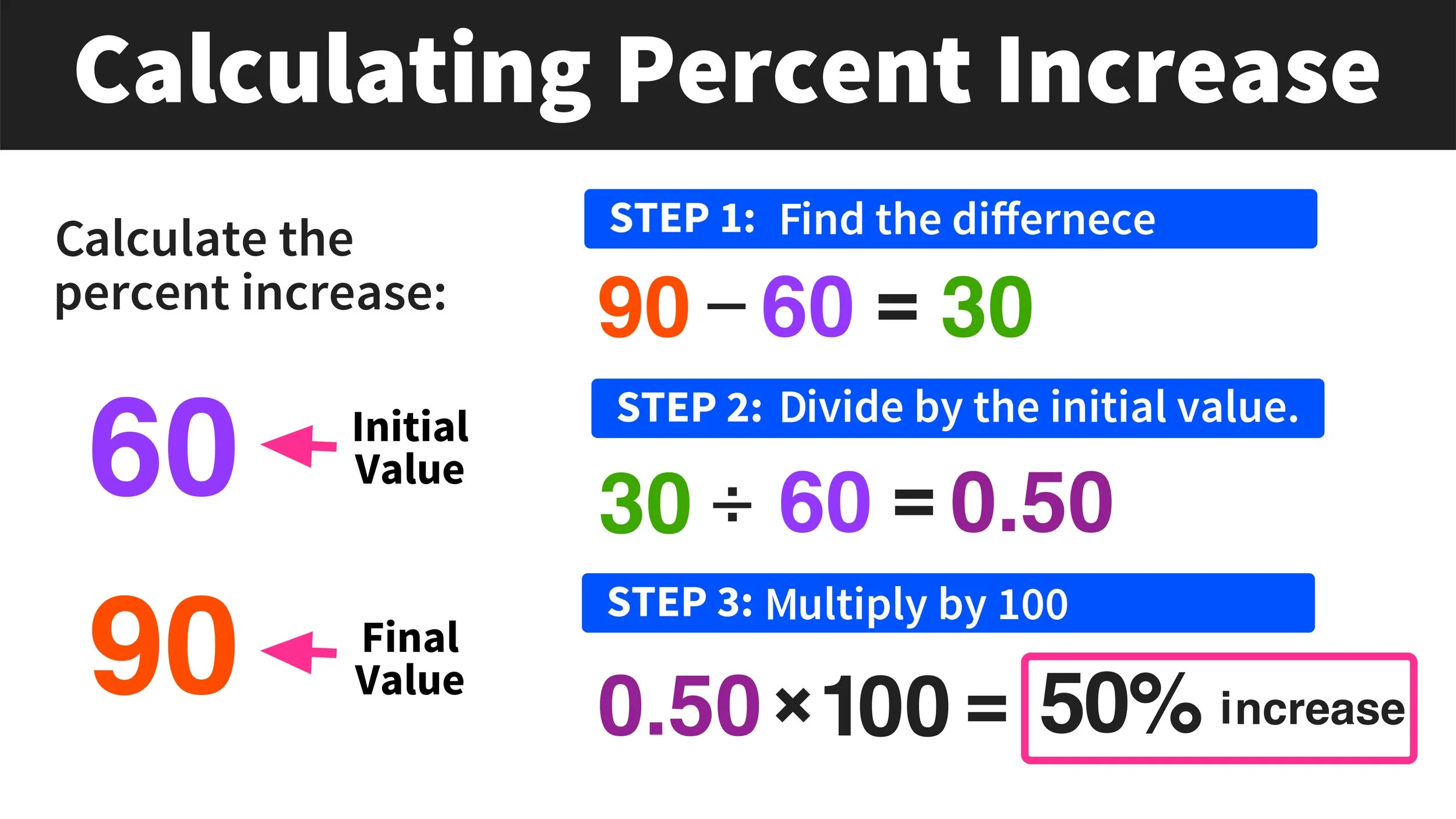
- Percentage Increase: To calculate an increase, the formula is
[(New Value - Old Value) / Old Value] * 100. If a stock rises from $50 to $60, the increase is (($60 – $50) / $50) * 100 = 20%. - Percentage Decrease: For a decrease, it’s
[(Old Value - New Value) / Old Value] * 100. If a stock falls from $60 to $50, the decrease is (($60 – $50) / $60) * 100 = 16.67%.
Notice that a 20% increase from $50 leads to $60, but a 20% decrease from $60 does not lead back to $50. This distinction is crucial for accurate financial analysis.
The Power of Compounding: A Percentage Phenomenon
Compound interest, often called the “eighth wonder of the world,” is a powerful concept entirely reliant on percentages. It’s interest earned on both the initial principal and the accumulated interest from previous periods. Understanding how interest rates (percentages) compound over time is fundamental to appreciating long-term savings growth, retirement planning, and the true cost of debt. A 7% annual return compounded over 30 years will grow your money exponentially more than simple interest, highlighting why small percentage differences in investment returns or interest rates can have massive implications over the long run.

Conclusion
The ability to figure out a percentage is not merely a mathematical trick; it’s a foundational skill for financial literacy and effective money management. From savvy shopping and informed budgeting to strategic investing and debt reduction, percentages provide the indispensable framework for understanding, evaluating, and optimizing your financial decisions. By mastering the simple formula of “part over whole multiplied by 100” and applying it diligently across various financial scenarios, you empower yourself to navigate the complexities of personal finance with clarity and confidence. In a world saturated with financial figures and data, the individual who understands percentages is the one truly equipped to build wealth, achieve financial freedom, and make every dollar count. Embrace this essential skill, and transform your relationship with money from one of apprehension to one of mastery.
aViewFromTheCave is a participant in the Amazon Services LLC Associates Program, an affiliate advertising program designed to provide a means for sites to earn advertising fees by advertising and linking to Amazon.com. Amazon, the Amazon logo, AmazonSupply, and the AmazonSupply logo are trademarks of Amazon.com, Inc. or its affiliates. As an Amazon Associate we earn affiliate commissions from qualifying purchases.