
In the world of personal finance, business, and investing, percentages are not just mathematical curiosities; they are the lingua franca of financial understanding. From calculating discounts on a new purchase to dissecting interest rates on a mortgage, or evaluating the return on an investment, percentages provide a standardized and easily comparable way to express proportions, changes, and relationships between numbers. For anyone seeking to master their money, grasp financial news, or make informed economic decisions, a firm understanding of how to find and interpret percentages is absolutely indispensable. This article will demystify percentage calculations, specifically through the lens of financial applications, empowering you to navigate your monetary landscape with greater confidence and precision.

Understanding the Fundamentals: What is a Percentage?
At its core, a percentage is simply a way to express a number as a fraction of 100. The word “percentage” itself comes from the Latin “per centum,” meaning “by the hundred.” When we say “25 percent,” we literally mean 25 out of every 100 parts, or 25/100, which can also be expressed as the decimal 0.25. This standardized representation makes percentages incredibly powerful for comparing different quantities or changes, regardless of their original scale.
The Basic Definition
A percentage is a dimensionless number, meaning it has no unit of measurement attached to it (like dollars or pounds), which is precisely what makes it so useful for comparisons. It converts a part-to-whole relationship into a scale of 100. For instance, if you earn $500 and save $100, expressing your savings as a percentage ($100 out of $500) immediately tells you that you saved 20%, a figure easily comparable to someone else’s savings rate, even if their income and savings amounts are entirely different.
The fundamental formula for converting a fraction or decimal into a percentage is:
$$ text{Percentage} = left( frac{text{Part}}{text{Whole}} right) times 100 $$
Understanding this simple relationship is the bedrock upon which all more complex financial percentage calculations are built.
Why Percentages Matter in Finance
In finance, percentages serve multiple critical functions:
- Comparability: They allow for easy comparison of rates, growth, or decline across different assets, timeframes, or companies. For example, comparing a 5% interest rate on one savings account to a 3% rate on another is straightforward.
- Standardization: They provide a universal language for financial reporting, making it easier to understand annual reports, economic indicators, and market trends.
- Decision Making: From evaluating loan offers to setting budgets or analyzing investment performance, percentages offer crucial insights that drive informed financial decisions.
- Forecasting and Planning: Understanding historical percentage changes in inflation, investment returns, or expenses helps in financial planning and setting realistic future expectations.
Without the ability to calculate and interpret percentages, navigating the complexities of personal finance, investing, and business would be significantly more challenging, if not impossible.
Core Calculation Methods: The Building Blocks
While the basic percentage formula is simple, its application can vary depending on what you’re trying to find. There are three primary scenarios you’ll encounter when dealing with percentages in finance.
Calculating a Percentage of a Whole
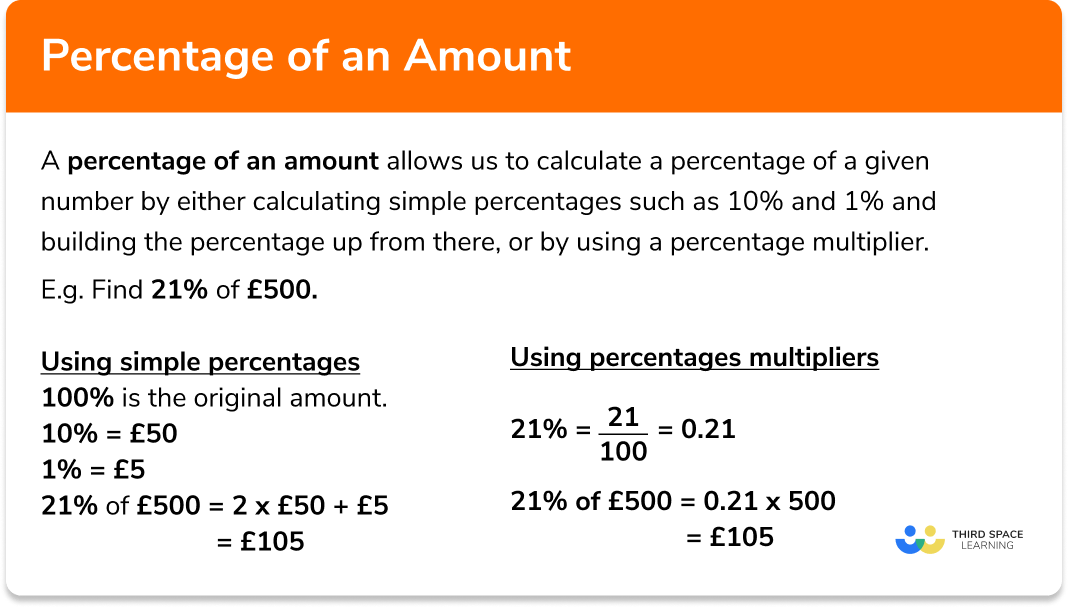
This is perhaps the most common application: finding a specific portion of a total amount. This is vital for calculating discounts, sales tax, tips, or allocating budget categories.
Formula:
$$ text{Part} = text{Percentage (as decimal)} times text{Whole} $$
Example 1: Calculating a Discount
You want to buy a new financial software package that costs $250, and it’s currently on sale for 20% off. To find out how much money you save:
- Convert 20% to a decimal: $20 / 100 = 0.20$
- Multiply the decimal by the whole price: $0.20 times $250 = $50$
You save $50, meaning the final price is $250 – $50 = $200.
Example 2: Calculating Sales Tax
You purchase an item for $100, and the sales tax is 8%.
- Convert 8% to a decimal: $8 / 100 = 0.08$
- Multiply the decimal by the item price: $0.08 times $100 = $8$
The sales tax is $8, making the total cost $100 + $8 = $108.
Finding the Percentage One Number Is of Another
This method is used when you know two numbers (a part and a whole) and want to determine what percentage the part represents of the whole. This is useful for calculating profit margins, expense ratios, or how much of your income goes towards a specific category.
Formula:
$$ text{Percentage} = left( frac{text{Part}}{text{Whole}} right) times 100 $$
Example 1: Determining Expense Ratio
Your monthly income is $4,000, and you spend $800 on rent. To find out what percentage of your income goes to rent:
- Divide the part (rent) by the whole (income): $800 / $4,000 = 0.20$
- Multiply by 100 to get the percentage: $0.20 times 100 = 20%$
20% of your income is allocated to rent.
Example 2: Calculating Profit Margin
A small business sells a product for $50 that cost them $30 to produce. The profit is $50 – $30 = $20. To find the profit margin (profit as a percentage of revenue):
- Divide the profit by the revenue: $20 / $50 = 0.40$
- Multiply by 100: $0.40 times 100 = 40%$
The profit margin on that product is 40%.
Determining Percentage Increase or Decrease
This calculation measures the relative change between two values over time or in different scenarios. It’s crucial for tracking investment growth, inflation rates, or changes in income/expenses.
Formula:
$$ text{Percentage Change} = left( frac{text{New Value} – text{Old Value}}{text{Old Value}} right) times 100 $$
- A positive result indicates a percentage increase.
- A negative result indicates a percentage decrease.
Example 1: Investment Growth
You invested $1,000 in a stock, and it grew to $1,200 after a year.
- New Value: $1,200
- Old Value: $1,000
- Calculate the change: $$1,200 – $1,000 = $200$
- Divide the change by the old value: $200 / $1,000 = 0.20$
- Multiply by 100: $0.20 times 100 = 20%$
Your investment saw a 20% increase.
Example 2: Decrease in a Bill
Your electricity bill was $150 last month and $120 this month.
- New Value: $120
- Old Value: $150
- Calculate the change: $$120 – $150 = -$30$
- Divide the change by the old value: $-30 / $150 = -0.20$
- Multiply by 100: $-0.20 times 100 = -20%$
Your electricity bill decreased by 20%.
Practical Applications in Personal Finance
Mastering these core calculations allows for practical application across numerous personal finance scenarios.
Decoding Discounts and Sales Prices
Shopping strategically often involves understanding discounts. Whether it’s “25% off” or “an additional 15% off sale items,” knowing how to calculate the final price is key to smart spending. Remember to apply multiple discounts sequentially, not add them together, as each subsequent discount is applied to the reduced price.

- Example: A $100 item is 20% off, plus an extra 10% for loyalty members.
- First discount: $100 times 0.20 = $20$. Price is now $100 – $20 = $80$.
- Second discount: $80 times 0.10 = $8$. Final price is $80 – $8 = $72$.
(Not $100 – (0.20+0.10) times 100 = $70$)
Navigating Interest Rates: Loans, Savings, and Credit Cards
Interest rates are a critical percentage in finance, representing the cost of borrowing money or the return on saving/lending money.
- Savings Accounts: A 1% annual interest rate on $1,000 means you earn $10 in interest per year ($1,000 times 0.01$).
- Loans/Mortgages: A 5% interest rate on a $200,000 mortgage means a significant portion of your monthly payment goes towards interest, especially in the early years. Understanding the effective annual rate (EAR) is crucial for loans with compounding interest.
- Credit Cards: High annual percentage rates (APRs) of 15-25% mean that carrying a balance can be extremely costly. If you have a $1,000 balance at 20% APR, you’d owe approximately $200 in interest over a year if you didn’t pay it down, not even considering monthly compounding.
Mastering Your Budget: Allocating Income with Percentages
Budgeting often involves allocating specific percentages of your income to different categories (e.g., 50% for needs, 30% for wants, 20% for savings and debt repayment, known as the 50/30/20 rule).
- Example: If your monthly take-home pay is $3,500, and you follow the 50/30/20 rule:
- Needs: $3,500 times 0.50 = $1,750$
- Wants: $3,500 times 0.30 = $1,050$
- Savings/Debt: $3,500 times 0.20 = $700$
This percentage-based approach makes budgeting adaptable to any income level.
Understanding Taxes and Tips
Taxes (income tax, sales tax, property tax) and tips for service workers are common percentage calculations you encounter daily.
- Sales Tax: As shown earlier, if sales tax is 7.5% on a $50 item, you pay $50 times 0.075 = $3.75$ in tax.
- Tipping: When dining out, a standard tip is often 15-20% of the bill. For a $60 meal, a 15% tip is $60 times 0.15 = $9$.
Business and Investment Insights Through Percentages
Beyond personal finance, percentages are foundational to understanding business performance and investment growth.
Gauging Profit Margins and Markups
Businesses rely heavily on percentages to analyze their financial health.
- Gross Profit Margin: (Gross Profit / Revenue) x 100. This indicates how much revenue is left after accounting for the cost of goods sold. A 30% gross profit margin means 30 cents of every dollar of sales revenue is profit before operating expenses.
- Net Profit Margin: (Net Profit / Revenue) x 100. This is the ultimate measure of a company’s profitability, showing how much profit is generated for every dollar of sales after all expenses, including taxes, are accounted for.
- Markup: The percentage added to a product’s cost to arrive at its selling price. If an item costs $20 and sells for $30, the markup is $10. As a percentage of cost: $(10/20) times 100 = 50%$.
Measuring Investment Returns and Portfolio Growth
Investors constantly use percentages to evaluate performance.
- Return on Investment (ROI): ($(text{Current Value} – text{Original Cost}) / text{Original Cost}) times 100$. This measures the profitability of an investment relative to its cost. If you buy a stock for $1,000 and sell it for $1,300, your ROI is 30%.
- Annualized Returns: This converts investment returns over different periods into an annual percentage, making them comparable.
- Portfolio Allocation: Investors often use percentages to determine the weighting of different asset classes (e.g., 60% stocks, 30% bonds, 10% cash) within their portfolio. Rebalancing involves adjusting these percentages to maintain the desired allocation.
Analyzing Financial Ratios
Many key financial ratios used in business analysis are expressed as percentages:
- Debt-to-Equity Ratio: (Total Debt / Shareholder Equity) x 100. Indicates how much debt a company is using to finance its assets relative to the value of shareholders’ equity.
- Current Ratio: (Current Assets / Current Liabilities). Often expressed as a ratio (e.g., 2:1 or 200%), it measures a company’s ability to pay off its short-term obligations.
These ratios help analysts and investors quickly assess a company’s liquidity, solvency, efficiency, and profitability, all communicated effectively through the power of percentages.
Tools and Tips for Accurate Percentage Calculations
While the underlying math is simple, accuracy is paramount in financial calculations. Fortunately, several tools can help.
Leveraging Calculators and Spreadsheets
- Basic Calculators: Most scientific and even simple calculators have a “%” button, which can simplify some percentage calculations. However, understanding the underlying formula is always best to avoid errors.
- Spreadsheets (Excel, Google Sheets): These are invaluable for financial analysis.
- To calculate a percentage of a number:
=A1*0.20(for 20% of the value in cell A1). - To find what percentage one number is of another:
=(A1/B1)*100(where A1 is the part and B1 is the whole). - To calculate percentage change:
=( (A2-A1)/A1 ) * 100(A2 is new value, A1 is old value). - Spreadsheets can automatically format results as percentages, making data presentation cleaner.
- To calculate a percentage of a number:
Quick Mental Math Strategies
For simple scenarios like tips or basic discounts, mental math can be a time-saver.
- 10% Rule: To find 10% of any number, just move the decimal point one place to the left. (e.g., 10% of $75 is $7.50). From 10%, you can easily find 5% (half of 10%) or 20% (double of 10%).
- Combining 10% and 5%: For a 15% tip on a $60 bill: 10% is $6.00, 5% is $3.00. Total tip: $6.00 + $3.00 = $9.00.
- Estimating: For more complex percentages, rounding numbers can give you a quick estimate.
Avoiding Common Pitfalls
- Decimal Conversion: Always remember to convert percentages to decimals (divide by 100) before multiplying them in formulas. (e.g., 25% is 0.25, not 25).
- Base Value Confusion: When calculating percentage change, always divide by the original or old value. A common mistake is using the new value as the base.
- Sequential vs. Additive Discounts: As noted with discounts, percentages often apply to the current value, not the original, in multi-step calculations. Do not add percentage discounts together.
- Annual vs. Periodic Rates: Be mindful if an interest rate is annual (APR) or for a shorter period (e.g., monthly). This can significantly impact total costs or earnings due to compounding.
By understanding the mechanics of percentage calculations and employing these practical tools and strategies, you gain a significant advantage in managing and interpreting financial information.
Conclusion
The question “how do I find out the percentage of something?” is far more profound than a simple arithmetic query in the realm of finance. It’s an inquiry into understanding the very fabric of monetary relationships, growth, cost, and value. From personal budgeting and smart shopping to evaluating complex investment strategies and dissecting corporate financial reports, percentages are the indispensable tools that provide clarity, comparability, and actionable insights. By mastering the core calculation methods – finding a percentage of a whole, determining what percentage one number is of another, and calculating percentage increase or decrease – you equip yourself with a fundamental financial literacy that empowers better decision-making. Embrace the power of percentages, and you will unlock a deeper, more confident understanding of your financial world.
aViewFromTheCave is a participant in the Amazon Services LLC Associates Program, an affiliate advertising program designed to provide a means for sites to earn advertising fees by advertising and linking to Amazon.com. Amazon, the Amazon logo, AmazonSupply, and the AmazonSupply logo are trademarks of Amazon.com, Inc. or its affiliates. As an Amazon Associate we earn affiliate commissions from qualifying purchases.