
In the intricate world of personal finance and business, few concepts are as ubiquitous and critical as percentages. From calculating a discount on a new purchase to understanding the returns on an investment, deciphering interest rates on a loan, or analyzing your budget’s allocation, percentages are the universal language of financial comparison and change. Mastering how to calculate and interpret percentages isn’t just a mathematical exercise; it’s a fundamental skill that empowers you to make informed decisions, optimize your financial health, and navigate the complexities of economic landscapes with confidence. This guide will demystify the process, providing you with a robust understanding and practical applications across various financial scenarios.

Understanding the Essence of Percentages in Finance
Before diving into calculations, it’s crucial to grasp what a percentage fundamentally represents and why it holds such sway in financial discourse.
What Exactly is a Percentage?
At its core, a percentage is a way of expressing a number as a fraction of 100. The word “percent” originates from the Latin “per centum,” meaning “by the hundred.” It’s a standardized way to compare parts to a whole, regardless of the actual size of the whole. For instance, whether you’re talking about 10 apples out of 100 or 10,000 apples out of 100,000, both represent 10% of the total. This standardization makes percentages incredibly powerful for comparative analysis. The symbol “%” is used to denote a percentage.
The Fundamental Formula: Part/Whole x 100
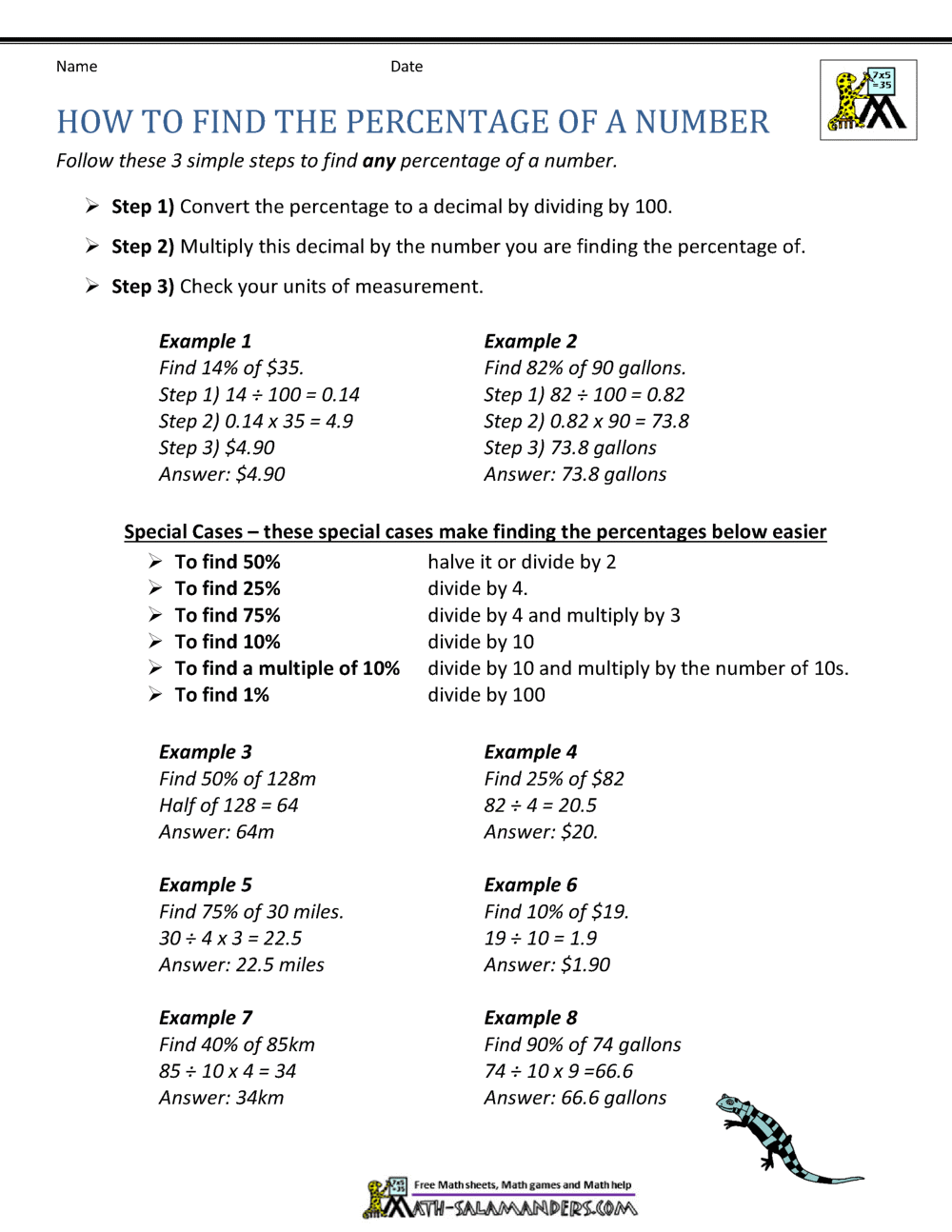
While there are various scenarios for percentage calculations, they all derive from a single, foundational formula. To find what percentage a “part” is of a “whole,” you simply divide the part by the whole and then multiply the result by 100.
Percentage = (Part / Whole) × 100
Let’s break down the components:
- Part: This is the specific amount or quantity you are interested in.
- Whole: This is the total amount, the base against which the part is being compared.
- × 100: This step converts the decimal result of the division into a percentage.
For example, if you spent $300 on groceries from a total monthly budget of $2,000, the “part” is $300, and the “whole” is $2,000.
(300 / 2000) × 100 = 0.15 × 100 = 15%.
This tells you that 15% of your monthly budget was allocated to groceries.
Why Percentages Reign Supreme in Personal and Business Finance
Percentages are indispensable in finance for several key reasons:
- Comparability: They allow for easy comparison of different figures, even when the underlying totals are vastly different. You can compare the profit margin of a small business to that of a multinational corporation, or your personal savings rate to a national average.
- Standardization: They provide a universal metric. A 5% interest rate is understandable whether the loan is $1,000 or $1,000,000.
- Clarity: They simplify complex data, making it easier to digest and communicate. Saying “profit increased by 15%” is more impactful and easier to grasp than “profit increased by $150,000 on a base of $1,000,000.”
- Decision-Making: They are crucial for assessing performance, growth, risk, and value, which directly informs financial decisions, from purchasing decisions to investment strategies.
Practical Percentage Calculations for Everyday Money Management
Understanding the basic formula is just the beginning. The real power of percentages comes from applying them to various financial scenarios.
Calculating a Percentage of a Number: Discounts, Sales Tax, and Commissions
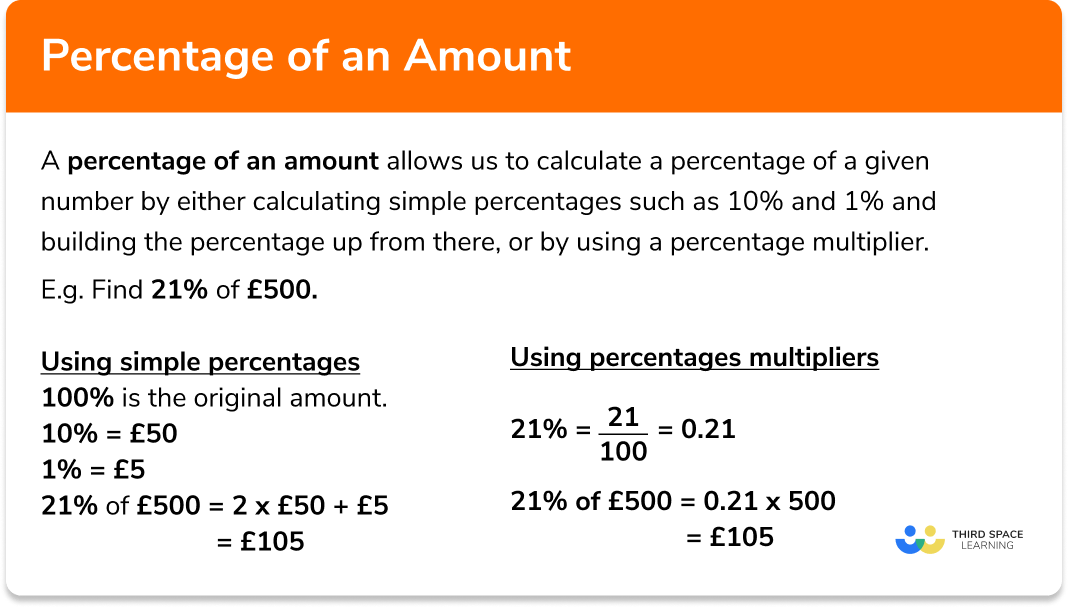
One of the most frequent uses of percentages is to determine a portion of a given total. This is essential for calculating discounts, sales tax, tips, and commissions.
Formula: Percentage (as decimal) × Whole = Part
To use this, you first convert the percentage into a decimal by dividing it by 100 (e.g., 20% becomes 0.20).
- Discounts: If an item costs $250 and is on sale for 20% off, you calculate the discount amount: 0.20 × $250 = $50. The new price is $250 – $50 = $200.
- Sales Tax: If you buy something for $100 and the sales tax is 7%, the tax amount is: 0.07 × $100 = $7. The total cost is $100 + $7 = $107.
- Commissions: If a salesperson earns a 10% commission on a $5,000 sale, their commission is: 0.10 × $5,000 = $500.
Determining One Number as a Percentage of Another: Budget Allocation and Expense Ratios
This application helps you understand the composition of a larger whole, providing insight into where your money goes or how resources are distributed.
Formula: (Part / Whole) × 100 = Percentage
- Budget Allocation: As seen earlier, if your monthly rent is $1,000 and your total take-home income is $4,000, your rent consumes: ($1,000 / $4,000) × 100 = 25% of your income. This helps you adhere to budgeting rules (e.g., the 50/30/20 rule).
- Expense Ratios: If a mutual fund has $100,000,000 under management and annual operating expenses of $500,000, its expense ratio is: ($500,000 / $100,000,000) × 100 = 0.5%. This small percentage can significantly impact long-term returns.
Mastering Percentage Change: Investment Growth, Inflation, and Price Fluctuations
Understanding how values change over time is crucial for assessing growth, inflation, and investment performance. Percentage change can be an increase or a decrease.
Formula: ((New Value – Old Value) / Old Value) × 100 = Percentage Change
- Investment Growth: If your stock portfolio was worth $10,000 at the start of the year and $12,000 at the end, the percentage increase is: (($12,000 – $10,000) / $10,000) × 100 = ($2,000 / $10,000) × 100 = 0.20 × 100 = 20% gain.
- Inflation: If a basket of goods cost $100 last year and $103 this year, the inflation rate is: (($103 – $100) / $100) × 100 = ($3 / $100) × 100 = 3% inflation.
- Price Decreases: If a car depreciates from $30,000 to $24,000 in a year, the percentage decrease is: (($24,000 – $30,000) / $30,000) × 100 = (-$6,000 / $30,000) × 100 = -0.20 × 100 = -20% depreciation. Note the negative sign indicates a decrease.
Real-World Financial Applications of Percentages
The ability to calculate percentages translates directly into tangible financial benefits and clearer understanding across numerous domains.
Navigating Savings, Loans, and Interest Rates
Interest is essentially the “cost of money,” and it’s almost always expressed as a percentage.
- Savings Accounts: A 1% Annual Percentage Yield (APY) means your savings will grow by 1% over a year.
- Loans (Mortgages, Car Loans, Credit Cards): The Annual Percentage Rate (APR) dictates how much interest you’ll pay on the principal. A 5% mortgage rate on a $200,000 loan means you’ll pay 5% of the outstanding principal in interest each year. Understanding how interest compounds (interest on interest) requires a firm grasp of percentages over time.
- Credit Card Interest: Often the highest, understanding how a 20% APR compounds daily or monthly is critical to avoiding spiraling debt.
Analyzing Investment Performance and Portfolio Allocation
Percentages are the bedrock of investment analysis.
- Return on Investment (ROI): This is a key metric for assessing the profitability of an investment. If you invest $1,000 and it grows to $1,200, your ROI is 20%.
- Portfolio Allocation: Financial advisors often recommend allocating assets based on percentages (e.g., 60% stocks, 30% bonds, 10% cash). This strategy depends on knowing what percentage of your total portfolio each asset class represents and rebalancing when these percentages drift.
- Dividend Yields: Expressed as a percentage, this indicates the annual dividend payments relative to the stock’s price.
- Expense Ratios of Funds: As mentioned, this percentage can significantly eat into your returns over the long term.
Understanding Taxes, Deductions, and Net Income
Taxes are inherently percentage-based, and knowing how they work is vital for financial planning.
- Income Tax Brackets: Your income is taxed at different percentage rates depending on the bracket it falls into.
- Sales Tax, Property Tax: These are percentages applied to purchases or property values.
- Tax Deductions and Credits: These reduce your taxable income or tax liability, often by a certain percentage or a specific calculation using percentages.
- Net Income: Understanding what percentage of your gross income is lost to taxes and deductions helps you determine your true take-home pay and plan your budget accordingly.
Budgeting and Expense Control Through Percentage Analysis
Effective budgeting relies heavily on percentages to create a balanced financial picture.
- Budget Rules (e.g., 50/30/20): These popular rules suggest allocating 50% of your income to needs, 30% to wants, and 20% to savings and debt repayment. Regularly checking if your spending aligns with these percentages is key to financial discipline.
- Expense Tracking: By categorizing expenses and calculating each category as a percentage of your total spending or income, you can identify areas where you might be overspending and make adjustments. For example, if “eating out” accounts for 25% of your discretionary spending, you might decide to cut back.
Tools and Techniques for Accurate Percentage Calculation
While the formulas are straightforward, practical execution can be aided by various tools and techniques.
Mental Math Shortcuts for Quick Estimates
For simple percentages, a quick mental estimate can be incredibly useful.
- 10% Rule: To find 10% of a number, simply move the decimal one place to the left (e.g., 10% of $500 is $50).
- 1% Rule: To find 1% of a number, move the decimal two places to the left (e.g., 1% of $500 is $5).
- Combining Rules: You can often break down more complex percentages. To find 15% of $500: 10% is $50, 5% (half of 10%) is $25. So, 15% is $50 + $25 = $75. These shortcuts are excellent for quickly checking discounts or calculating tips.
Leveraging Calculators and Spreadsheet Functions
For precision and more complex calculations, standard calculators and spreadsheet software are invaluable.
- Basic Calculators: Most calculators have a “%” button, which can simplify some operations, though understanding the underlying formula is always better for accuracy and flexibility.
- Spreadsheets (e.g., Excel, Google Sheets): These are powerful tools for financial analysis. You can set up columns for “Part” and “Whole” and use formulas like
=(A2/B2)*100to automatically calculate percentages for entire datasets. This is essential for tracking budgets, investment portfolios, or business performance over time.
Avoiding Common Percentage Pitfalls
- Understanding the Base: Always be clear about what the “whole” or “old value” is. A 10% increase from a low base is different from a 10% increase from a high base.
- Percentage Points vs. Percentages: Be mindful of the distinction. If an interest rate goes from 4% to 5%, that’s an increase of 1 percentage point, but a 25% percentage increase ( (5-4)/4 * 100 ). This distinction is crucial in financial reporting.
- Compounding: Remember that percentages, especially interest rates, often compound. A 10% annual return doesn’t mean you simply earn 10% of your initial investment each year if the earnings are reinvested; you earn 10% on the growing principal.
The Lifelong Value of Percentage Proficiency in Your Financial Journey
The ability to figure out the percentage of something is far more than a simple arithmetic skill; it’s a critical component of financial literacy that profoundly impacts your daily decisions and long-term financial strategy.
Empowering Informed Financial Decisions
Every financial product, every sale, every economic headline is replete with percentages. From deciding which savings account offers the best APY to negotiating a car loan with a favorable APR, or evaluating the real cost of a bundled service, understanding percentages enables you to critically assess options and make choices that align with your financial goals. It allows you to see beyond marketing jargon and understand the true implications of numbers.
Building Confidence in Your Money Management Skills
When you can confidently calculate and interpret percentages, you gain a sense of control over your finances. Budgeting becomes clearer, investment reports become comprehensible, and financial news gains context. This confidence translates into greater engagement with your financial planning, leading to better outcomes, reduced financial stress, and a more secure future.
In conclusion, “how do I figure the percentage of something” is a gateway to a deeper understanding of your financial world. By mastering the core formulas and applying them across various scenarios, you equip yourself with an invaluable skill that will serve you throughout your personal and professional financial journey. Embrace the power of percentages, and unlock a clearer, more confident path to financial success.
aViewFromTheCave is a participant in the Amazon Services LLC Associates Program, an affiliate advertising program designed to provide a means for sites to earn advertising fees by advertising and linking to Amazon.com. Amazon, the Amazon logo, AmazonSupply, and the AmazonSupply logo are trademarks of Amazon.com, Inc. or its affiliates. As an Amazon Associate we earn affiliate commissions from qualifying purchases.