
The sight of a crimson-streaked brokerage account is enough to unsettle even the most seasoned investors. When the major indices—the S&P 500, the Dow Jones Industrial Average, and the Nasdaq Composite—stumble simultaneously, the immediate question on everyone’s mind is: “Why did stocks fall today?”
Market declines are rarely the result of a single isolated event. Instead, they are typically the product of a complex interplay between macroeconomic data, corporate performance, geopolitical shifts, and the collective psychology of millions of participants. For the disciplined investor, understanding the “why” behind a market downturn is the first step in moving from emotional reaction to strategic action. To demystify the downward pressure on equity prices, we must examine the fundamental pillars that support—or destabilize—the financial markets.
The Macroeconomic Drivers: Interest Rates and Inflation
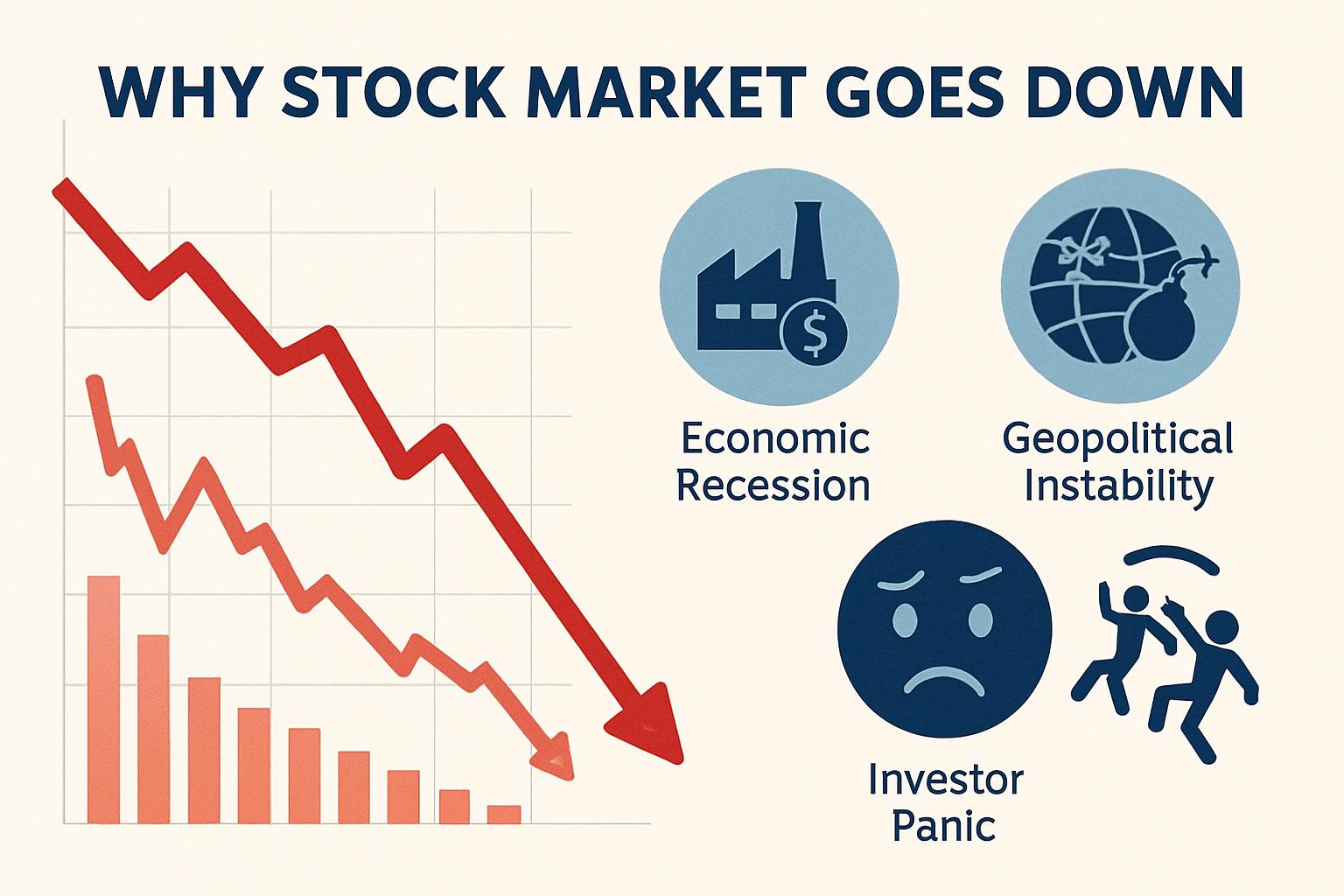
At the heart of almost every significant market sell-off is the macroeconomic environment, specifically the twin forces of inflation and interest rates. In the modern financial era, the relationship between these two variables and stock valuations is the primary engine of market movement.
The Federal Reserve’s “Higher for Longer” Shadow
The Federal Reserve, acting as the nation’s central bank, has a dual mandate: to promote maximum employment and maintain stable prices. When inflation creeps above the target 2% threshold, the Fed typically raises the federal funds rate. This increase in interest rates makes borrowing more expensive for corporations and consumers alike.
When stocks fall today, it is often because the market has priced in a more aggressive stance from the Fed. Higher interest rates increase the “discount rate” used in financial models to value future cash flows. Since a stock’s value is essentially the present value of all its future earnings, a higher discount rate mathematically lowers the current price of that stock. Growth stocks, particularly in the tech sector, are especially sensitive to this because their value is heavily weighted toward earnings expected far into the future.
Consumer Price Index (CPI) and Producer Price Index (PPI) Data
Investors watch inflation reports with hawk-like intensity. If a Consumer Price Index (CPI) report comes in “hotter” than expected, it signals to the market that inflation is not cooling as quickly as hoped. This triggers an immediate sell-off as investors anticipate that the central bank will keep rates high for a longer period. Today’s decline may very well be a reaction to data suggesting that the cost of living remains stubbornly high, squeezing profit margins and reducing the disposable income that fuels consumer spending.
Corporate Earnings and the Reality of Valuations
While macroeconomics sets the stage, corporate earnings are the actual performance on that stage. Stocks represent ownership in businesses, and if those businesses are not performing—or if their future performance looks bleak—investors will divest.
The Gap Between Expectations and Reality
Wall Street operates on expectations. Often, a company can report a profit, but if that profit is lower than what analysts predicted, the stock price will plummet. Furthermore, “forward guidance” is often more important than past performance. If a CEO suggests during an earnings call that the upcoming quarter will be challenging due to slowing demand or rising input costs, the stock will likely fall today regardless of how well it did yesterday.
When several bellwether companies—large, influential firms like Apple, Microsoft, or Walmart—report disappointing numbers or cautious outlooks, it can trigger a sector-wide or market-wide decline. This is known as “earnings contagion,” where the weakness in one major player leads investors to fear that the entire industry is facing a systemic slowdown.
Valuation Contraction and P/E Ratios
Sometimes stocks fall not because the companies are doing poorly, but because they have become too expensive. The Price-to-Earnings (P/E) ratio is a common metric used to judge whether a stock is overvalued. During periods of irrational exuberance, P/E ratios can swell to unsustainable levels. When the market finally realizes that prices have decoupled from fundamental reality, a “valuation contraction” occurs. This is a healthy, albeit painful, process where prices fall to align more closely with the actual earning power of the underlying businesses.
Geopolitical Tensions and Global Economic Health
The financial markets do not exist in a vacuum. They are deeply integrated with global events, and instability in one corner of the world can lead to a sell-off in New York, London, or Tokyo.

The Impact of Geopolitical Uncertainty
Geopolitical conflict is a major driver of market volatility. Whether it is a trade war between major economies, unrest in oil-producing regions, or localized conflicts, uncertainty is the enemy of the stock market. Investors hate uncertainty because it makes it impossible to accurately price risk.
When a geopolitical event occurs, there is often a “flight to quality.” Investors sell “risk assets” like stocks and move their capital into “safe-haven assets” like U.S. Treasury bonds, gold, or the U.S. dollar. This mass exit from equities causes prices to drop sharply as the supply of shares for sale outweighs the demand from buyers.
Supply Chain Disruptions and Energy Costs
Global markets are also highly sensitive to the cost of energy. A spike in oil or natural gas prices—often caused by geopolitical tensions—acts as a “stealth tax” on both businesses and consumers. It raises the cost of manufacturing, shipping, and heating, leaving less capital for investment and consumption. If today’s market is down, a significant rise in energy futures or news of a disrupted supply chain in a critical manufacturing hub could be the culprit.
Market Psychology: Fear, Greed, and the Sell-Off Loop
While numbers and data are important, the stock market is also a reflection of human emotion. Psychology plays a massive role in why stocks fall, often magnifying a small decline into a significant rout.
The Role of Algorithmic Trading and Stop-Loss Orders
In the modern era, a large percentage of market trades are executed by algorithms rather than humans. These high-frequency trading (HFT) systems are programmed to sell when certain technical levels are breached. If a stock falls below a key “support level,” it can trigger a cascade of automated sell orders.
Similarly, many retail and institutional investors use “stop-loss” orders to limit their downside. When a stock price hits a certain predetermined level, it automatically converts to a market order to sell. During a downturn, these automated triggers can create a feedback loop: falling prices trigger more selling, which causes prices to fall even further, leading to a “flash” style decline that feels disconnected from any specific news event.
The Fear Index (VIX) and Panic Selling
The CBOE Volatility Index, or VIX, is often called the “Fear Gauge.” It measures the market’s expectation of 30-day volatility. When the VIX spikes, it indicates that investors are becoming anxious and are buying “put options” to hedge their portfolios.
Panic selling occurs when fear takes over. Investors, seeing their portfolios shrink, decide to “sell at any price” to prevent further losses. This emotional response often leads to stocks being sold far below their intrinsic value. Understanding that today’s fall might be driven by fear rather than fundamentals is crucial for maintaining a long-term perspective.
Navigating Downturns: Strategies for the Disciplined Investor
Knowing why stocks fell today is only half the battle; knowing how to respond is what separates successful investors from those who consistently lose money.
The Importance of Diversification
If your portfolio is heavily weighted in a single sector—such as technology or energy—you are more vulnerable to specific “why” factors. A diversified portfolio, spread across different asset classes (stocks, bonds, real estate) and sectors, helps cushion the blow. While diversification does not prevent losses, it ensures that a downturn in one area doesn’t wipe out your entire net worth.
Dollar-Cost Averaging: Turning Volatility into Opportunity
For the long-term investor, a falling market can actually be a gift. Through dollar-cost averaging—investing a fixed amount of money at regular intervals—you naturally buy more shares when prices are low and fewer shares when prices are high. This strategy removes the emotional burden of trying to “time the market.” When stocks fall today, the dollar-cost averager sees it as a “sale” on the world’s greatest companies.
Maintaining a Long-Term Perspective
The history of the stock market is a history of resilience. Despite crashes, recessions, wars, and pandemics, the long-term trajectory of the equity market has historically been upward. Market corrections (a decline of 10%) and bear markets (a decline of 20%) are a natural and necessary part of the economic cycle. They flush out excess and set the stage for the next period of growth.
When you ask “why did stocks fall today,” use the answer to inform your understanding of the world, but do not let it dictate your long-term strategy. The investors who build true wealth are those who can withstand the temporary discomfort of a “red day” by focusing on the fundamental strength of their investments and the long-term power of compounding. Market volatility is the price of admission for the superior returns that equities can provide over time. To succeed, one must be willing to pay that price with patience and discipline.
aViewFromTheCave is a participant in the Amazon Services LLC Associates Program, an affiliate advertising program designed to provide a means for sites to earn advertising fees by advertising and linking to Amazon.com. Amazon, the Amazon logo, AmazonSupply, and the AmazonSupply logo are trademarks of Amazon.com, Inc. or its affiliates. As an Amazon Associate we earn affiliate commissions from qualifying purchases.