
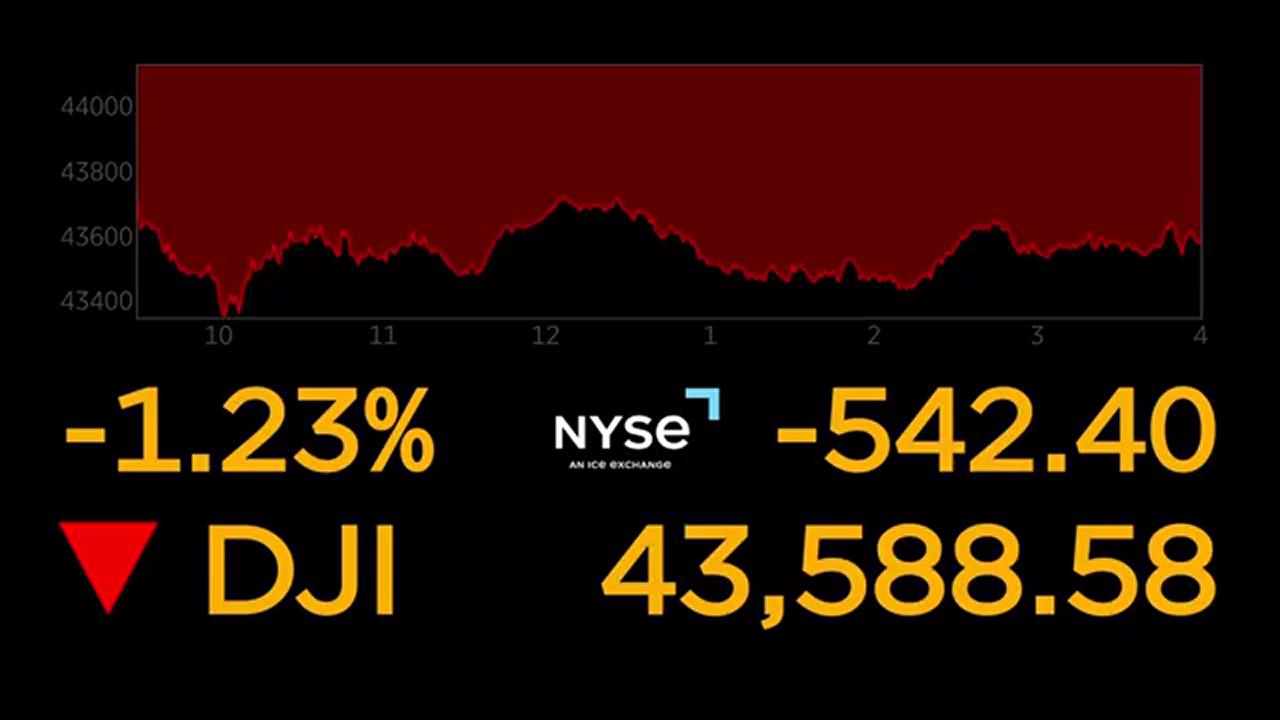
The Dow Jones Industrial Average (DJIA), a barometer for the health of the U.S. stock market and broader economy, frequently experiences daily fluctuations. While a drop on any given day can trigger immediate concern among investors, it’s crucial to understand the multifaceted factors that contribute to such movements and contextualize them within the larger financial landscape. Today’s decline, like many before it, is not an isolated event but rather a confluence of specific immediate triggers and underlying economic currents. For those navigating personal finance, investing, or business strategy, dissecting these elements is essential for informed decision-making and maintaining a resilient financial outlook.

The Pulse of the Market: Understanding the Dow Jones Industrial Average
Before delving into the specifics of today’s drop, it’s imperative to establish a foundational understanding of what the Dow Jones Industrial Average represents and why its daily movements command such significant attention from financial professionals, policymakers, and individual investors alike.
What is the Dow Jones?
The Dow Jones Industrial Average is a stock market index that tracks the performance of 30 large, publicly traded companies listed on stock exchanges in the United States. Founded in 1896 by Charles Dow and Edward Jones, it is one of the oldest and most frequently cited market indices globally. Unlike market-capitalization-weighted indices such as the S&P 500, the DJIA is a price-weighted index, meaning companies with higher stock prices have a greater impact on the index’s value than those with lower prices, regardless of their total market value. The 30 companies comprising the Dow are chosen to represent significant sectors of the U.S. economy, ranging from technology and finance to healthcare and industrials, making it a proxy for the overall health and direction of the American industrial sector. Its composition is periodically reviewed and adjusted by an index committee to ensure it remains relevant and reflective of the evolving economic landscape.
Why Does Its Movement Matter?
The Dow Jones Industrial Average serves as more than just a numerical indicator; it’s a powerful psychological benchmark and a critical gauge of investor sentiment. When the Dow rises, it often signals optimism about corporate earnings, economic growth, and overall market stability. Conversely, a significant drop, such as today’s, can spark concerns about potential economic headwinds, corporate profitability, or even broader financial instability. For individual investors, the Dow’s movement can influence portfolio valuations, retirement savings, and investment strategies. Businesses often monitor the Dow as an indicator of consumer confidence and future demand. Furthermore, policymakers and economists use the index as one of several vital metrics to assess the efficacy of economic policies and predict future economic trends. Its visibility and historical significance make it a key narrative point in financial news, shaping public perception of economic health even among those who do not actively participate in the stock market.
Immediate Triggers: Pinpointing Today’s Downturn
Market movements, especially significant drops, are rarely attributable to a single factor. Instead, they often result from a complex interplay of macroeconomic data, geopolitical developments, and company-specific news. Pinpointing the immediate triggers behind today’s Dow decline requires a look at recent economic releases, global events, and the performance of its constituent companies.
Macroeconomic Headwinds
One of the most potent forces driving market sentiment is the macroeconomic environment. Today’s drop could be a direct response to several recent economic data points that suggest tightening financial conditions or slowing growth.
- Inflationary Pressures and Interest Rate Hikes: Persistent inflation remains a primary concern for central banks worldwide. If recent Consumer Price Index (CPI) or Producer Price Index (PPI) reports indicated inflation is hotter than expected, it could signal that central banks, particularly the U.S. Federal Reserve, will maintain an aggressive stance on interest rate hikes. Higher interest rates increase borrowing costs for businesses and consumers, potentially slowing economic activity and reducing corporate profits, making stocks less attractive.
- Economic Data Releases: Other key economic indicators, such as a weaker-than-anticipated jobs report (e.g., non-farm payrolls, unemployment rate), a contraction in manufacturing or services Purchasing Managers’ Index (PMI), or disappointing retail sales figures, can all signal a decelerating economy. Such data can dampen investor confidence, leading to a broad sell-off as participants adjust their expectations for future corporate earnings and economic growth. A surprisingly hawkish statement from a central bank following a policy meeting could also have similar effects, as investors anticipate a more constrained liquidity environment.
Geopolitical and Global Events
Beyond domestic economic concerns, global events can exert significant influence on the Dow. In an increasingly interconnected world, conflicts, trade disputes, or even natural disasters far from U.S. borders can ripple through financial markets.
- International Conflicts or Trade Disputes: Escalating geopolitical tensions, such as a new conflict or the intensification of an existing one, can create uncertainty, disrupt supply chains, and impact commodity prices. Similarly, the announcement of new tariffs or trade barriers between major economic powers could trigger fears of reduced global trade and economic interconnectedness, leading to market unease.
- Commodity Price Volatility (e.g., Oil): A sharp surge in oil prices, perhaps due to supply disruptions or geopolitical factors, can act as a tax on consumers and businesses, increasing production costs and squeezing profit margins. Conversely, a sudden drop in oil prices could signal fears of a global economic slowdown and reduced demand, also impacting investor sentiment negatively. Both scenarios can contribute to market volatility and a downward trend for the Dow.
Corporate Earnings and Sector-Specific Concerns
While macroeconomic factors paint a broad picture, the individual performance of companies within the Dow and specific sectors can significantly contribute to an overall index decline.
- Disappointing Earnings Reports from Index Components: If several major Dow components release earnings reports that miss analyst expectations or provide weaker-than-anticipated forward guidance, it can disproportionately drag down the entire index. Investors often react swiftly to such news, selling off shares of underperforming companies and sometimes extending that pessimism to related sectors.
- Sectoral Weakness Spreading: Sometimes, weakness in a particular sector—perhaps due to regulatory changes, disruptive technology, or changing consumer preferences—can spread. For instance, if the financial sector faces challenges due to rising loan defaults, or if the technology sector experiences a downturn due to increased competition or slower innovation, these issues can create broader market jitters, affecting companies across the Dow’s diverse composition.
Broader Economic Landscape: Contextualizing Market Declines
While immediate triggers explain today’s specific drop, it’s crucial for investors to understand how these events fit into the broader economic landscape. Market declines are often not isolated incidents but symptoms of larger, ongoing economic shifts or persistent investor concerns.
The Shadow of Recession

One of the most significant overarching concerns for investors is the potential for an economic recession. Periods of sustained economic contraction, characterized by declining GDP, rising unemployment, and reduced consumer spending, are inherently bearish for stock markets. Today’s drop, especially if linked to weak economic data or hawkish central bank rhetoric, could be interpreted as increasing the probability of a recession. Fears of an impending recession cause investors to de-risk, moving capital out of equities and into safer assets like government bonds or cash, thereby putting downward pressure on indices like the Dow. Monitoring leading economic indicators, such as inverted yield curves, manufacturing orders, and consumer confidence, becomes paramount in such environments.
Central Bank Policies and Monetary Tightening
The policies enacted by central banks, particularly the U.S. Federal Reserve, are foundational drivers of market sentiment and asset prices. A sustained period of monetary tightening, involving interest rate hikes and quantitative tightening (reducing the money supply by selling off assets), impacts market liquidity and the cost of capital. Higher rates make it more expensive for companies to borrow for expansion and for consumers to finance purchases, potentially slowing growth. They also make risk-free assets, like government bonds, more attractive relative to equities, drawing capital away from the stock market. Today’s decline might be a reflection of investors fully internalizing the implications of an extended period of tight monetary policy, leading to a re-evaluation of asset valuations based on a higher discount rate for future earnings.
Investor Sentiment and Market Psychology
Beyond tangible economic data, market psychology plays an enormous role in daily fluctuations. Fear and greed are powerful emotions that can amplify market movements. Negative news, whether real or perceived, can trigger a wave of panic selling, where investors sell assets out of fear of further losses, regardless of underlying fundamentals. This herd mentality can lead to self-fulfilling prophecies, where initial drops are exacerbated by widespread selling, creating further downward momentum. Indices like the VIX, often called the “fear index,” measure market volatility and can indicate elevated levels of investor anxiety. Today’s Dow drop might be partly a result of such psychological contagion, where initial selling triggered by specific news then spreads as fear takes hold across the market.
Navigating Volatility: Strategies for Investors
Market drops, while unsettling, are an inherent part of investing. For long-term financial success, it is crucial for investors to adopt strategies that enable them to navigate volatility rather than succumb to panic. This involves a blend of perspective, tactical adjustments, and a clear understanding of personal financial goals.
Long-Term Perspective vs. Short-Term Noise
One of the most critical aspects of successful investing is maintaining a long-term perspective. Daily market movements, including significant drops in indices like the Dow, are often short-term “noise” when viewed over decades. Historically, major market corrections and even bear markets have always been followed by recoveries and new highs. Investors who react emotionally to short-term declines by selling off their holdings often lock in losses and miss out on subsequent recoveries. Instead, a focus on one’s long-term financial goals – retirement, education, wealth accumulation – allows for a more rational approach, understanding that market volatility is a normal part of the investment cycle. Dollar-cost averaging, where investors contribute a fixed amount regularly regardless of market conditions, can also help mitigate the impact of short-term drops, as more shares are purchased when prices are low.
Diversification and Portfolio Resilience
A well-diversified portfolio is an investor’s best defense against market downturns. By spreading investments across various asset classes (equities, bonds, real estate, commodities), geographies, and sectors, investors can reduce the impact of a single asset or sector performing poorly. While the Dow may drop, other parts of a diversified portfolio – perhaps bonds or defensive stocks – might hold up better, cushioning the overall impact. Regular rebalancing ensures that the portfolio maintains its target asset allocation, preventing overexposure to overly successful (and potentially overvalued) assets and forcing the investor to buy assets that have underperformed, which may now be undervalued. This strategic allocation helps build resilience against the inherent uncertainties of the market.
Identifying Opportunities Amidst Drawdowns
Market downturns, though uncomfortable, often present significant buying opportunities for long-term investors. When the Dow drops, many high-quality companies may see their stock prices fall below their intrinsic value. For investors with a long-term horizon and available capital, these periods can be opportune times to acquire shares in fundamentally sound companies at a discount. This requires careful research, a clear understanding of one’s risk tolerance, and the discipline to invest when others are fearful. Identifying companies with strong balance sheets, consistent earnings, and competitive advantages, which are temporarily undervalued due to broader market sentiment, can lead to substantial returns once the market recovers. This strategy is famously encapsulated in Warren Buffett’s advice: “Be fearful when others are greedy and greedy when others are fearful.”
The Path Forward: What to Expect After a Drop
After a notable market decline, the natural inclination is to wonder what comes next. While predicting exact market movements is impossible, understanding the typical dynamics that follow such events can help investors prepare and make informed decisions.
Reassessing Economic Indicators
Following a significant Dow drop, market participants and analysts will intensely scrutinize upcoming economic data releases. Inflation reports, employment figures, consumer confidence surveys, and manufacturing data will be dissected for any signs of improvement or further deterioration. Positive surprises in these indicators could spark a market rebound, signaling that the initial fears were overblown or that the economy is more resilient than expected. Conversely, continued negative data could reinforce bearish sentiment and potentially lead to further declines. Central bank communications, speeches from policymakers, and updates on geopolitical situations will also be closely watched for clues about future policy direction and global stability.
The Inevitable Cycle of Markets
Ultimately, today’s drop in the Dow Jones Industrial Average is a reminder of the inevitable cyclical nature of financial markets. Periods of growth and prosperity are often interspersed with corrections and downturns. This ebb and flow is a healthy and normal part of capitalism, reflecting changing economic conditions, technological advancements, and evolving investor sentiment. For those committed to their financial plans, these cycles underscore the importance of discipline, patience, and a well-thought-out strategy. While short-term volatility can be jarring, a focus on long-term goals and adherence to sound financial principles will enable investors to weather market storms and emerge stronger. The Dow, despite its periodic declines, has historically always trended upwards over the long run, reflecting the enduring growth and innovation of the U.S. economy.
aViewFromTheCave is a participant in the Amazon Services LLC Associates Program, an affiliate advertising program designed to provide a means for sites to earn advertising fees by advertising and linking to Amazon.com. Amazon, the Amazon logo, AmazonSupply, and the AmazonSupply logo are trademarks of Amazon.com, Inc. or its affiliates. As an Amazon Associate we earn affiliate commissions from qualifying purchases.