
In an increasingly data-driven world, organizations grapple with an explosion of information, often trapped in disparate systems and siloed databases. This deluge, rather than empowering decision-makers, can lead to confusion, inefficiency, and missed opportunities. Enter Palantir Foundry – a powerful and comprehensive software platform engineered to transform raw, disconnected data into a cohesive, actionable operational picture. Developed by Palantir Technologies, Foundry is designed not just to analyze data, but to operationalize it, enabling users across an enterprise to build applications, make informed decisions, and drive real-world outcomes at scale. At its core, Foundry is a data integration, analysis, and operationalization platform that allows organizations to create a unified digital twin of their operations, facilitating sophisticated analytics and dynamic, data-backed actions.
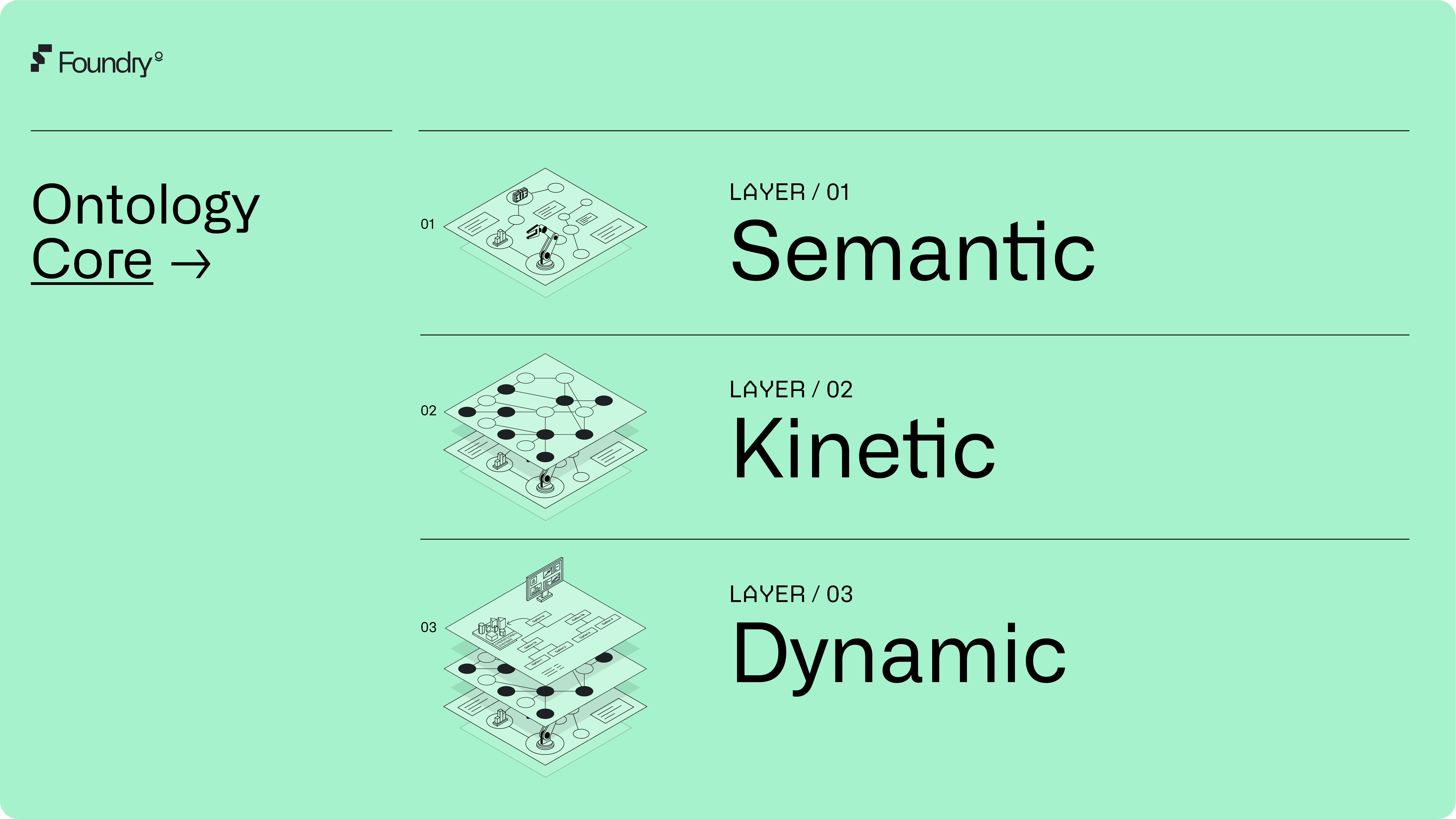
The Foundational Architecture of Foundry: Bridging Data Silos
At the heart of Foundry’s power lies its unique architectural approach, which systematically tackles the pervasive problem of data fragmentation. Traditional enterprise data systems often struggle with the sheer volume and variety of data sources, leading to a complex and often contradictory view of an organization’s operations. Foundry is engineered from the ground up to overcome these challenges, providing a robust framework for data integration, transformation, and semantic modeling.
Data Integration and Unification
Palantir Foundry excels at connecting to virtually any data source, regardless of its format, location, or schema. This capability extends to structured databases (SQL, NoSQL), unstructured files (documents, images, videos), streaming data feeds, and third-party APIs. The platform’s sophisticated Extract, Transform, Load (ETL) and Extract, Load, Transform (ELT) capabilities allow organizations to ingest vast quantities of data, cleanse it, and unify it within a single environment.
Foundry provides a suite of tools for data engineers and analysts to build resilient data pipelines, ensuring data quality and consistency. It automates many of the laborious tasks associated with data preparation, from schema mapping and data type standardization to de-duplication and error handling. This unification process isn’t merely about bringing data together; it’s about creating a single source of truth, eliminating discrepancies and providing a reliable foundation for all subsequent analysis and application development. The platform’s ability to handle diverse data types – from real-time sensor data in manufacturing to historical financial records or unstructured text from customer feedback – makes it incredibly versatile, serving as the central nervous system for an organization’s digital intelligence. Furthermore, its incremental processing capabilities ensure that data pipelines are efficient, updating only what’s changed, rather than re-processing entire datasets, which is crucial for managing large-scale, dynamic data environments.
The Ontology as a Digital Twin
Perhaps the most distinctive and revolutionary aspect of Palantir Foundry is its robust Ontology. Unlike traditional data warehouses or data lakes, which store data in tables or files, Foundry builds a dynamic, semantic model of an organization’s entire operational landscape. This ontology acts as a “digital twin” of the real world, representing real-world entities (e.g., customers, products, machines, employees, events, locations) and defining the complex relationships and properties between them.
For instance, in a manufacturing context, the ontology would map specific machines to their maintenance schedules, production lines, operators, and the parts they produce. It would understand that a “machine failure event” impacts “production output,” which in turn affects “supply chain delivery times.” This isn’t just a static data model; it’s a living, breathing representation that continually updates as new data flows into the system. The ontology provides a common language and contextual framework for all data within the platform. It allows users, regardless of their technical proficiency, to understand complex data relationships intuitively, ask sophisticated questions in a human-understandable way, and build applications that reflect the true dynamics of their operations. This semantic layer abstracts away the underlying technical complexities of data storage and access, empowering domain experts to interact directly with their operational data in a meaningful way, without needing to write complex SQL queries or understand intricate database schemas.
Empowering Decision-Making Through Applications
The ultimate goal of any data platform is to translate raw data into actionable insights that drive better decisions. Palantir Foundry achieves this by providing powerful tools for application development, allowing organizations to operationalize their unified data and the insights derived from it. These applications are not merely dashboards; they are interactive tools designed to support specific operational workflows and decision points.
Low-Code/No-Code Application Development
Foundry significantly lowers the barrier to entry for developing powerful, data-driven applications through its low-code/no-code interface. This capability empowers business users, domain experts, and data analysts – not just professional software developers – to design and deploy custom applications tailored to their specific operational needs. These applications leverage the underlying ontology, meaning they inherit the rich contextual understanding and interconnectedness of the modeled data.
Users can drag-and-drop components, configure workflows, and build interactive dashboards, alerts, and decision support tools without writing extensive lines of code. For example, a supply chain manager could build an application to monitor supplier performance, predict potential disruptions, and simulate the impact of alternative shipping routes. A financial analyst might create an application to visualize risk exposures across different portfolios and model various market scenarios. This democratized approach to application development accelerates innovation, allowing organizations to rapidly respond to changing business requirements and embed data-driven decision-making directly into their daily operations. The applications built on Foundry are dynamic, reacting to real-time data updates and providing immediate feedback, making them invaluable for critical operational control and management.
AI/ML Integration and Advanced Analytics
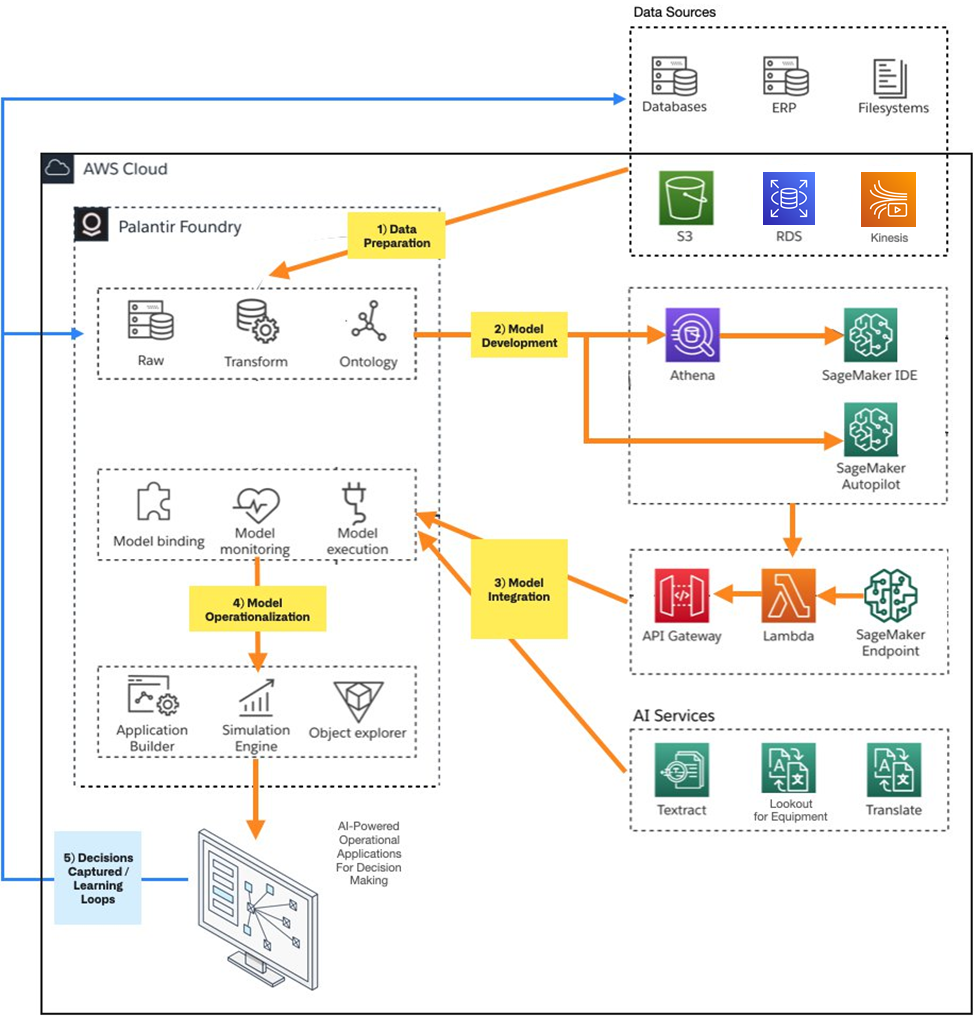
Beyond simple data visualization and operational applications, Foundry is deeply integrated with advanced analytics and machine learning capabilities. The platform provides a collaborative environment where data scientists can build, train, deploy, and manage sophisticated AI/ML models directly on the unified and ontologized data. This integration is seamless, allowing models to directly leverage the rich, contextual data provided by the ontology, leading to more accurate and relevant predictions.
Data scientists can use a variety of tools and languages (e.g., Python, R) within Foundry to develop predictive models for scenarios like equipment failure, customer churn, fraud detection, or demand forecasting. Once models are trained, Foundry facilitates their operationalization, integrating them directly into the custom applications built by business users. This means that a production manager’s application for machine monitoring could automatically display predictions of potential failures, alongside recommended preventative actions, derived from an AI model. Furthermore, Foundry provides tools for model monitoring, ensuring that deployed models remain accurate and performant over time, and for retraining them as new data becomes available. This end-to-end capability transforms AI from a research endeavor into a core operational asset, directly influencing and improving decision-making across the enterprise. The platform supports explainable AI, helping users understand why a model made a particular prediction, fostering trust and enabling informed human oversight.
Key Capabilities and Operational Impact
Palantir Foundry’s strength lies not just in its individual features, but in how these features coalesce to deliver comprehensive operational capabilities that drive significant impact across diverse sectors. It’s designed to be an enterprise-grade solution, handling the complexities of large organizations with robust security and governance frameworks.
Data Governance and Security
For any platform handling sensitive operational and strategic data, robust data governance and security are paramount. Palantir Foundry is built with enterprise-level security and compliance as core tenets. It offers granular access controls, allowing administrators to define who can see what data, under what conditions, and what actions they can perform. This fine-grained permissions system extends down to individual rows, columns, and even specific properties within the ontology.
Beyond access control, Foundry provides comprehensive auditing capabilities, logging every interaction with data and applications. This ensures accountability, facilitates compliance with regulatory requirements (such as GDPR, HIPAA, or industry-specific regulations), and enables organizations to track data lineage from its source through various transformations to its use in applications. Data encryption, both at rest and in transit, is standard, protecting against unauthorized access and breaches. The platform also supports data anonymization and pseudonymization techniques, allowing for analysis while protecting sensitive personal or proprietary information. This meticulous approach to governance and security builds trust and ensures that organizations can leverage their data assets responsibly and securely, even in highly regulated environments.
Collaboration and Operational Efficiency
One of Foundry’s most profound impacts is its ability to foster unprecedented collaboration across diverse teams and departments within an organization. By providing a unified view of operational data and a common platform for application development, it breaks down traditional departmental silos. Teams that previously operated in isolation can now share insights, collaborate on analyses, and collectively contribute to a holistic understanding of the organization’s challenges and opportunities.
For example, in a manufacturing plant, production, logistics, and maintenance teams can all access and build upon the same ontological model of the factory floor. They can develop interconnected applications that optimize production schedules based on predicted machine failures, manage inventory levels dynamically, and streamline supply chain operations, all within the same environment. This shared operational picture leads to more synchronized efforts, faster problem-solving, and a significant increase in overall operational efficiency. Decisions are no longer made in isolation but are informed by the most current and comprehensive data available across the entire enterprise. This leads to reduced redundancies, optimized resource allocation, and a more agile response to market changes or operational disruptions.
Who Uses Foundry and Why?
Palantir Foundry is primarily adopted by large enterprises, government agencies, and complex organizations facing significant data challenges and requiring sophisticated operational intelligence. These are entities where traditional IT solutions have often fallen short in providing a truly integrated and actionable view of their operations.
Foundry’s clientele spans a wide array of industries, including defense and intelligence agencies, financial services, healthcare, manufacturing, automotive, energy, and life sciences. For instance, in defense, it’s used for national security missions, supply chain optimization, and predictive maintenance for military assets. In healthcare, it helps manage patient data, optimize hospital operations, and accelerate drug discovery. Manufacturers leverage Foundry for production optimization, predictive quality control, and managing complex global supply chains. Financial institutions use it for fraud detection, risk management, and regulatory compliance.
The “why” behind its adoption boils down to several key benefits:
- Unlocking Trapped Value from Data: Foundry transforms dormant data into a strategic asset, enabling organizations to derive deep insights that were previously impossible due to data fragmentation and complexity.
- Empowering Every User: It democratizes data access and application development, allowing non-technical domain experts to build tools relevant to their specific roles, accelerating innovation and problem-solving.
- Driving Operational Efficiency and Resilience: By providing a unified, real-time operational picture, organizations can optimize processes, predict and mitigate disruptions, and make more agile decisions, leading to significant cost savings and improved performance.
- Enhanced Decision Accuracy: With a comprehensive and semantically rich view of their operations, coupled with advanced analytics and AI, decision-makers can act with greater confidence and precision.
- Competitive Advantage: Organizations using Foundry can move faster, adapt more effectively to market changes, and innovate more rapidly than their competitors, solidifying their market position.
Conclusion
Palantir Foundry stands as a testament to the evolving landscape of enterprise software, moving beyond mere data storage and analysis to full-scale operational intelligence. By providing a robust platform for data integration, semantic modeling through its unique ontology, and flexible application development, Foundry empowers organizations to transform their complex data environments into dynamic, actionable systems. It breaks down data silos, fosters collaboration, and embeds AI/ML-driven insights directly into daily workflows. For large enterprises navigating the complexities of modern operations, Foundry offers a strategic advantage, enabling them to not only understand their world but to actively shape it, turning intricate data challenges into opportunities for unprecedented efficiency, resilience, and growth. Its promise lies in its ability to bridge the gap between data and decisive action, making it an indispensable tool for organizations aiming to truly operationalize their digital future.
aViewFromTheCave is a participant in the Amazon Services LLC Associates Program, an affiliate advertising program designed to provide a means for sites to earn advertising fees by advertising and linking to Amazon.com. Amazon, the Amazon logo, AmazonSupply, and the AmazonSupply logo are trademarks of Amazon.com, Inc. or its affiliates. As an Amazon Associate we earn affiliate commissions from qualifying purchases.