
The seemingly simple question, “What is on T.V.?” has evolved from a straightforward query about scheduled broadcasts into a complex exploration of a vast, interconnected technological ecosystem. In an era defined by digital transformation, the television is no longer a passive receiver of linear programming but a dynamic hub for an ever-expanding universe of content, accessible through an intricate web of technologies. This article delves into the technological underpinnings that define modern television, exploring how innovation has revolutionized content delivery, viewing experiences, and the very concept of “what’s on.”
The Evolution of Content Delivery: From Broadcast to Broadband
The journey of television content delivery is a testament to relentless technological progress. What began as a local over-the-air signal has morphed into a global digital stream, offering unparalleled choice and convenience.

The Legacy of Terrestrial and Cable Television
For decades, the answer to “what is on T.V.?” was dictated by terrestrial broadcast signals and later, the structured offerings of cable television. Terrestrial broadcasting, using electromagnetic waves to transmit signals from ground-based transmitters to antennas, represented the earliest form of mass media distribution. While limited in channel count and susceptible to signal interference, it laid the foundational technology for television’s ubiquity.
The advent of cable television in the mid-20th century marked a significant technological leap. By delivering signals via coaxial cables, cable providers could offer a greater number of channels, improved picture quality, and specialized programming. This infrastructure not only expanded content options but also established a subscription model that would foreshadow future premium content services. The transition from analog to digital cable further enhanced channel capacity and introduced features like Electronic Program Guides (EPGs) and Video On Demand (VOD) services, bridging the gap between scheduled viewing and user-initiated consumption.
Satellite TV’s Reach and Early Digital Innovations
Satellite television pushed the boundaries of reach and channel capacity even further. Geostationary satellites orbiting Earth receive signals from ground stations and retransmit them over vast geographical areas, enabling television access in remote regions where cable infrastructure was impractical. This technology introduced hundreds of channels, pioneering the concept of niche programming and truly global content distribution. Early satellite systems required large dishes and specialized receivers, but subsequent advancements led to smaller, more discreet equipment and improved signal reliability.
The shift to digital satellite broadcasting brought about significant enhancements in picture and sound quality, often introducing higher definition (HD) content before its widespread adoption elsewhere. It also popularized interactive services and Pay-Per-View options, giving viewers more control over their entertainment choices, even within a largely scheduled environment.
The Rise of Streaming and On-Demand Entertainment
The internet fundamentally reshaped the television landscape. Broadband internet connectivity paved the way for streaming services, which leverage internet protocols to deliver video content directly to devices. This marked a paradigm shift from linear broadcasting to an on-demand, user-centric model. Companies like Netflix, Hulu, and Amazon Prime Video disrupted traditional media by offering vast libraries of content accessible anytime, anywhere, on a multitude of devices.
The technology behind streaming involves complex compression algorithms (like H.264, H.265/HEVC, AV1) to efficiently transmit high-quality video over varying internet speeds, adaptive bitrate streaming to adjust quality dynamically, and sophisticated content delivery networks (CDNs) to minimize latency and buffering. This technological leap has given viewers unprecedented control, effectively making the answer to “what is on T.V.?” entirely personalized and boundless.
Smart TVs and the Connected Home Ecosystem
The modern television isn’t just a screen; it’s a sophisticated computing device, a central component of the connected home, and a gateway to digital content.
Integrated Platforms and Operating Systems
Today’s Smart TVs are essentially large-format computers with integrated operating systems (OS) like Google TV (Android TV), WebOS (LG), Tizen (Samsung), and Roku OS. These platforms provide a user-friendly interface for navigating content, downloading apps, and customizing settings. They come equipped with powerful processors, ample memory, and network connectivity (Wi-Fi and Ethernet) to handle high-resolution video streaming, gaming, and multitasking. The integration of these OS allows for seamless access to a multitude of streaming services, often pre-installed or easily downloadable from dedicated app stores, effectively making external set-top boxes optional for many users.
The Role of Apps and Digital Assistants
Apps are the lifeblood of the Smart TV experience, transforming the device into a versatile entertainment hub. From video streaming platforms and music services to news aggregators and casual games, apps extend the TV’s functionality far beyond traditional broadcasting. The ability to switch effortlessly between watching a live football match, binging a series on Netflix, or listening to Spotify on the same device highlights the power of this app-centric model.
Furthermore, the integration of digital assistants like Google Assistant, Amazon Alexa, and Apple Siri has revolutionized TV interaction. Voice commands allow users to search for content, control playback, switch inputs, and even manage other smart home devices directly through their TV remote or built-in microphones. This natural language processing capability simplifies navigation and enhances accessibility, making the “what’s on” query a vocal command rather than a manual search.
Interoperability with Smart Home Devices
Smart TVs are increasingly designed to be integral parts of a broader smart home ecosystem. They can act as central display hubs for security camera feeds, smart doorbells, and energy management systems. Connectivity standards like Wi-Fi, Bluetooth, and sometimes even Zigbee or Z-Wave, enable seamless communication with other smart devices. For example, a TV might dim the lights automatically when a movie starts, or display a notification when a smart doorbell is pressed. This interoperability creates a more unified and automated living experience, extending the TV’s utility beyond pure entertainment into home management and automation.
The Technology Behind Personalized Viewing Experiences
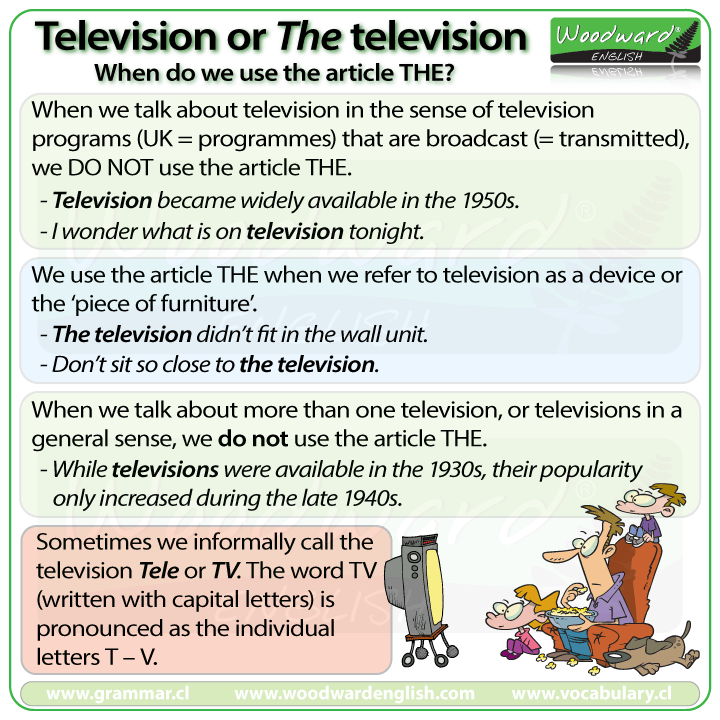
Beyond just delivering content, modern TV technology focuses on optimizing and personalizing the viewing experience, making every interaction more engaging and tailored.
AI-Driven Recommendations and Content Curation
The sheer volume of content available today necessitates intelligent filtering. Artificial Intelligence (AI) and machine learning algorithms are at the heart of personalized recommendations across streaming platforms. These algorithms analyze viewing history, watch patterns, search queries, and even interactions like ‘likes’ or ‘dislikes’ to suggest content that aligns with user preferences. They can identify subtle thematic connections, actor commonalities, or genre overlaps, often surfacing obscure titles a user might genuinely enjoy but would never have found through traditional browsing. This sophisticated content curation transforms the daunting task of finding “what’s on” into a curated, intuitive discovery process, keeping viewers engaged and reducing decision fatigue.
Advanced Codecs and Picture Quality (4K, HDR, 8K)
The quest for ever-more realistic and immersive visuals is a continuous driver of technological innovation in television. High-Resolution displays, starting with Full HD (1080p), rapidly progressed to Ultra HD (4K), offering four times the pixel count, leading to sharper details and more immersive imagery. More recently, 8K TVs have emerged, pushing resolution even further.
Crucially, picture quality isn’t just about pixels. High Dynamic Range (HDR) technologies like Dolby Vision, HDR10+, and HLG dramatically expand the range of brightness and color that a TV can display. This results in more vibrant colors, deeper blacks, brighter whites, and greater detail in both shadows and highlights, mirroring what the human eye perceives more closely. Advanced video codecs, such as HEVC (H.265) and the newer AV1, are vital in making these high-resolution and HDR streams feasible over internet bandwidth, efficiently compressing vast amounts of data without significant loss in visual fidelity.
Immersive Audio Technologies (Dolby Atmos, DTS:X)
Sound is as critical as visuals for an immersive viewing experience. Traditional stereo or even 5.1 surround sound systems are being superseded by object-based audio technologies like Dolby Atmos and DTS:X. These systems create a three-dimensional soundscape by placing individual sounds (objects) in specific points in a virtual space, including overhead. This allows sound to move around and above the viewer, rather than being confined to horizontal channels. For instance, a helicopter flying overhead in a movie will sound like it’s actually flying above you, adding an unparalleled layer of realism and immersion. Modern Smart TVs often incorporate built-in decoding for these formats, and when paired with compatible soundbars or home theater systems, they deliver a cinematic audio experience directly into the living room.
Future Trends: The Next Frontier of Television
The rapid pace of technological innovation ensures that “what’s on T.V.” will continue to evolve in exciting and unexpected ways.
Interactive Content and Gamification
The line between passive viewing and active participation is blurring. Interactive content, ranging from choose-your-own-adventure narratives (like Netflix’s Bandersnatch) to real-time polls during live events, is gaining traction. This gamification of television transforms viewers into participants, offering personalized story paths or allowing them to influence outcomes. Technologies enabling this include sophisticated metadata tagging, branching narrative tools, and robust backend infrastructure to handle real-time user input from millions of viewers. As these technologies mature, interactive television could become a staple, making every viewing session a unique experience.
Cloud Gaming and TV Integration
The powerful processors and high-speed internet connectivity of modern Smart TVs make them ideal platforms for cloud gaming. Services like Xbox Cloud Gaming, GeForce Now, and Amazon Luna stream high-quality video games directly to the TV, eliminating the need for expensive consoles. Users simply connect a compatible controller and stream games over the internet, much like streaming a movie. This integration not only expands the entertainment options available on a TV but also democratizes access to high-fidelity gaming, further solidifying the TV’s role as a multi-faceted entertainment hub.
Virtual and Augmented Reality in Television
While still nascent, Virtual Reality (VR) and Augmented Reality (AR) hold immense potential for the future of television. Imagine watching a live sports event where you can virtually sit courtside or access real-time player stats overlaid on your screen. AR applications could transform your living room into a scene from a movie, while VR could offer fully immersive, 360-degree cinematic experiences. The technological challenges include higher bandwidth requirements, sophisticated rendering capabilities, and user interface innovations, but as these technologies mature, they promise to redefine “what’s on T.V.” into an experience that transcends the screen and envelops the viewer.
Digital Security and Privacy in the Connected TV Era
As Smart TVs become increasingly interconnected and intelligent, concerns around digital security and user privacy have grown commensurately.
Safeguarding Personal Data on Smart TVs
Smart TVs collect a vast amount of data, including viewing habits, app usage, voice commands, and even demographic information, often shared with third-party advertisers. This data is crucial for powering personalized recommendations and targeted advertising, but it also raises significant privacy implications. Securing this data from breaches and ensuring transparent data handling practices are paramount. Technologies like robust encryption for data transmission and storage, secure boot processes, and stringent access controls are employed by manufacturers to protect user information. However, users must also be proactive in understanding privacy policies, managing privacy settings, and being cautious about the permissions they grant to apps.

The Importance of Software Updates and Network Security
Like any connected computer, Smart TVs are vulnerable to cyber threats. Exploits, malware, and other vulnerabilities can be introduced through malicious apps or network attacks. Regular software updates provided by manufacturers are critical for patching security flaws, adding new features, and improving overall system stability. Users should ensure their TVs are set to receive automatic updates or manually check for them regularly. Furthermore, securing the home network, through strong Wi-Fi passwords, firewalls, and keeping router firmware updated, is crucial as the TV’s security is intrinsically linked to the security of the entire home network. Ignoring these aspects can expose not only the TV but also other connected devices to potential risks.
In conclusion, “what is on T.V.” is no longer a question of schedules but a reflection of a technologically advanced, interconnected, and highly personalized entertainment ecosystem. From the fundamental shifts in content delivery to the intricate technologies driving immersive experiences and the crucial considerations of digital security, the television continues to evolve at a breathtaking pace, promising an even more dynamic and engaging future.
aViewFromTheCave is a participant in the Amazon Services LLC Associates Program, an affiliate advertising program designed to provide a means for sites to earn advertising fees by advertising and linking to Amazon.com. Amazon, the Amazon logo, AmazonSupply, and the AmazonSupply logo are trademarks of Amazon.com, Inc. or its affiliates. As an Amazon Associate we earn affiliate commissions from qualifying purchases.