
The question “What channel is Paramount Plus on DTV?” is a common one, yet it stems from a fundamental misunderstanding of modern media distribution technology. In an era increasingly defined by digital transformation, the lines between traditional linear television and internet-based streaming services have blurred, creating both opportunities and complexities for consumers. This article will dissect the technological frameworks governing both DirecTV and Paramount Plus, elucidating why the latter is not accessible via a traditional “channel number” and how DirecTV subscribers can nevertheless tap into the vast library of Paramount Plus content. Our focus will remain strictly on the underlying technology, its implications, and the practical steps for navigation within this evolving digital ecosystem.
Understanding the Landscape: Linear TV vs. Streaming Technology
To grasp why Paramount Plus isn’t a DirecTV channel, it’s crucial to understand the distinct technological architectures that define linear television and over-the-top (OTT) streaming. These are not merely different content delivery methods; they represent fundamentally divergent paradigms of media transmission and consumption.
The Mechanics of Traditional Television Broadcasting
Traditional television, exemplified by satellite providers like DirecTV, operates on a linear broadcasting model. Content is scheduled and transmitted via a fixed frequency band, typically from satellites or terrestrial broadcast towers, to designated receiving devices—like DirecTV’s set-top boxes. These signals are then demodulated and displayed on a television screen. Each “channel” corresponds to a specific frequency allocation within this broadcast spectrum, acting as a dedicated conduit for scheduled programming. The user experience is largely passive: viewers tune into a channel at a set time to watch what’s being broadcast. This system relies on a one-to-many distribution model, where a single signal is sent simultaneously to all subscribers tuned to that frequency. The technology involves complex satellite uplink and downlink infrastructures, sophisticated compression algorithms (like MPEG-2 or MPEG-4 for standard and high-definition), and robust error correction mechanisms to ensure signal integrity across vast geographical areas. The interaction is primarily channel navigation, often tied to a proprietary electronic programming guide (EPG) built into the set-top box hardware.
The Rise of Over-the-Top (OTT) Streaming Platforms
In stark contrast, OTT streaming platforms like Paramount Plus leverage the internet’s infrastructure for content delivery. “Over-the-Top” signifies that content is delivered “over” the existing internet service provider (ISP) network, bypassing traditional broadcast, cable, or satellite providers as the primary content conduit. Technically, this involves several key components:
- Content Delivery Networks (CDNs): Instead of broadcasting from a central point, streaming services utilize geographically distributed servers (CDNs) to cache content closer to end-users, minimizing latency and buffering. When you request a show, data streams from the nearest server directly to your device.
- Adaptive Bitrate Streaming (ABS): Technologies like HLS (HTTP Live Streaming) and DASH (Dynamic Adaptive Streaming over HTTP) allow the video stream’s quality to adjust dynamically based on the user’s internet bandwidth and device capabilities. This ensures a smoother viewing experience, reducing interruptions.
- Client Applications: Access to Paramount Plus is exclusively through dedicated software applications (apps) installed on compatible internet-connected devices (smart TVs, smartphones, tablets, streaming sticks, gaming consoles). These apps communicate directly with the streaming service’s servers, authenticate user subscriptions, and render the content.
- IP-based Transmission: All data, including video, audio, and metadata, is transmitted over the internet using standard IP protocols. This is a point-to-point or point-to-multi-point connection, where each user’s device establishes a unique session with the service.
The fundamental distinction lies in this architectural difference: linear TV is about broadcasting signals to channels, while streaming is about delivering data on demand over the internet to specific applications.
Deconstructing Paramount Plus: A Pure-Play Streaming Service
Paramount Plus is a prime example of a pure-play, subscription-based OTT streaming service. It embodies the modern shift towards on-demand content consumption, distinct from traditional broadcasting models in both its technological design and user experience.
Paramount Plus: More Than Just a Channel
At its core, Paramount Plus is an application and a digital content library, not a linear channel. It’s a vast repository of on-demand movies, TV shows, and original programming from the CBS, Paramount Pictures, Comedy Central, MTV, Nickelodeon, and Smithsonian Channel libraries, along with live news and sports. Its technological infrastructure allows users to browse, select, and play content whenever they choose, offering a personalized, non-linear viewing experience. The “channel” concept is entirely absent here; instead, users navigate an interactive interface within the app, similar to how one might browse files on a computer or select music from a digital library. The service’s intelligence lies in its recommendation algorithms, user profiles, and ability to track viewing progress across devices, none of which are inherent features of traditional linear channels. It operates on a subscription-based access model, requiring users to pay a monthly or annual fee for digital access rather than being bundled as part of a fixed channel package.
Core Technological Requirements for Accessing Paramount Plus
Accessing Paramount Plus hinges entirely on a set of technological prerequisites that underscore its internet-centric nature:
- High-Speed Internet Connection: A stable and sufficiently fast broadband internet connection is non-negotiable. Recommended speeds vary, but generally, 5 Mbps for HD content and 25 Mbps or higher for 4K UHD content are advised to prevent buffering and ensure optimal video quality, which is dynamically managed by ABS technology.
- Compatible Streaming Device: Paramount Plus applications are developed for a wide array of smart devices. This includes:
- Smart TVs: Modern smart TVs (e.g., Samsung, LG, Vizio, Sony) with built-in app stores.
- Streaming Media Players: Dedicated devices like Roku, Amazon Fire TV, Apple TV, and Google Chromecast.
- Gaming Consoles: PlayStation and Xbox systems.
- Mobile Devices: Smartphones and tablets running iOS or Android.
- Web Browsers: Personal computers via supported web browsers (Chrome, Firefox, Edge, Safari).
These devices must have the capacity to download and run the Paramount Plus application, decode various video codecs (like H.264/AVC, H.265/HEVC), and manage DRM (Digital Rights Management) protocols to protect content.
- Paramount Plus Subscription: A valid, active subscription is required for authentication. This involves creating an account, providing payment information, and logging into the app on any chosen device. The authentication process is handled digitally, verifying user credentials against the service’s backend servers.
DirecTV’s Ecosystem: A Gateway, Not an Integrated Platform for All Streaming Apps
DirecTV, as a satellite television provider, operates within its own defined technological ecosystem. While it is a sophisticated system for delivering linear programming, its integration with the broader universe of third-party streaming applications is often limited by design and technological constraints.
DirecTV’s Primary Function: Satellite Broadcast Delivery
DirecTV’s core technological function is the reception and distribution of television signals beamed from satellites in geostationary orbit. This involves highly specialized hardware:
- Satellite Dish: A parabolic antenna designed to receive faint microwave signals from distant satellites. Its precise alignment is critical for signal acquisition.
- Low-Noise Block Downconverter (LNB): Mounted on the dish, the LNB amplifies and down-converts the high-frequency satellite signals into a lower frequency range suitable for transmission through coaxial cables.
- DirecTV Set-Top Boxes (Receivers/DVRs): Devices like the Genie DVRs are designed to receive these satellite signals, decrypt encrypted content (using smart card technology or integrated conditional access modules), decode the video and audio streams, and output them to a television. These boxes are essentially dedicated appliances for satellite TV reception, optimized for channel tuning, recording, and displaying EPG information. They operate on proprietary operating systems and hardware architectures.
The entire DirecTV infrastructure is optimized for this linear broadcast model. Its primary purpose is to deliver hundreds of scheduled channels directly to subscribers’ homes via satellite.
The Limited Integration of Third-Party Streaming Apps on DirecTV Hardware
While some modern DirecTV set-top boxes and services (like the DirecTV Stream platform) offer a degree of internet connectivity and a limited selection of integrated streaming apps, they are generally not designed as open-platform smart hubs for all internet-based streaming services.
- Proprietary Hardware and Software: DirecTV receivers run proprietary software and hardware. Adding a third-party app like Paramount Plus would require significant development, integration, and ongoing maintenance efforts by DirecTV, as well as licensing agreements with Paramount. This isn’t DirecTV’s core business model or technological strength.
- Resource Constraints: The processing power, memory, and networking capabilities of many older DirecTV set-top boxes are optimized for decoding broadcast signals, not for running a multitude of resource-intensive streaming applications that demand constant internet access and complex user interfaces. Newer boxes, especially those for DirecTV Stream (which is an IP-based service, blurring the lines), may have more robust app support, but this is a different service model than traditional satellite DirecTV.
- Competitive Dynamics: Traditional pay-TV providers and streaming services are often in a competitive landscape. While some partnerships exist, a pay-TV provider might not prioritize making it universally easy to access every competing streaming service directly through their core hardware, preferring to drive usage of their own internet-connected content or specific bundles.
Therefore, for the majority of traditional DirecTV satellite subscribers, their set-top box is a gateway to satellite channels, not an all-encompassing smart media hub for every streaming app.
Navigating Access: How DirecTV Subscribers Can Watch Paramount Plus
Given the technological distinctions, DirecTV subscribers cannot tune into Paramount Plus on a specific channel number. Instead, they must access it through compatible internet-connected devices, essentially bypassing the DirecTV set-top box for the purpose of streaming Paramount Plus content.
Direct App Access on Smart TVs and Streaming Devices
This is the most common and straightforward method. If you have a DirecTV subscription, you likely also have a modern television setup that supports streaming.
- Smart TVs: Most smart TVs manufactured in recent years include app stores (e.g., LG Content Store, Samsung Smart Hub, Google TV, Roku TV) where you can search for and download the Paramount Plus application. Once downloaded, you launch the app, log in with your Paramount Plus credentials, and start streaming. The TV’s integrated Wi-Fi or Ethernet connection provides the necessary internet access.
- Streaming Media Players: Devices like Roku, Amazon Fire TV Stick, Apple TV, and Google Chromecast (including Google TV variants) are purpose-built for streaming. They connect to your TV via an HDMI port and provide access to a vast ecosystem of apps. Simply navigate to the device’s app store, download Paramount Plus, and log in. These devices handle the internet connection, video decoding, and user interface for streaming.
- Gaming Consoles: PlayStation and Xbox consoles, which are powerful multimedia machines, also offer the Paramount Plus app through their respective digital stores.
These devices act as independent conduits for internet-delivered content, entirely separate from your DirecTV satellite signal chain.
Leveraging Mobile Devices and Casting Technologies
For those without a dedicated streaming device or a smart TV with app support, mobile devices coupled with casting technologies offer a flexible alternative.
- Mobile App: Download the Paramount Plus app onto your smartphone or tablet (iOS or Android). With a valid subscription, you can stream content directly on your mobile device over Wi-Fi or cellular data.
- Casting (Chromecast/AirPlay): If you have a Google Chromecast device plugged into your TV, or an Apple TV (which supports AirPlay), you can “cast” content from the Paramount Plus mobile app to your television screen. The mobile device acts as a remote control, initiating the stream, but the actual video data is typically streamed directly from Paramount Plus servers to the Chromecast/Apple TV device (not through your phone), optimizing bandwidth and battery life. This technology allows a smart device to “hand off” a stream to a larger display.
The Distinction: Paramount Network on DirecTV vs. Paramount Plus
It’s critical to differentiate between “Paramount Network” and “Paramount Plus.”
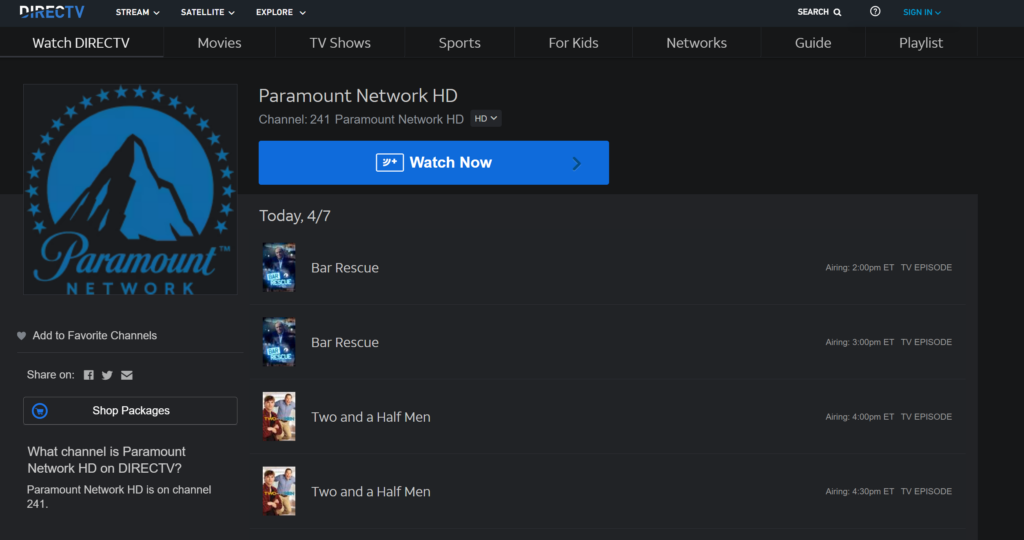
- Paramount Network (Linear TV Channel): This is a traditional cable/satellite television channel that DirecTV does carry (typically on Channel 241). It broadcasts a schedule of movies, original series (like Yellowstone), and reality shows. Access to Paramount Network is part of specific DirecTV programming packages. However, watching Paramount Network via DirecTV does not grant you access to the full Paramount Plus streaming library.
- Paramount Plus (Streaming Service): As discussed, this is an internet-based, on-demand streaming platform. While it includes content from the Paramount Network, it also offers a much larger exclusive library, additional live channels (like CBS News), and often features content earlier or exclusively. A separate subscription is required.
While DirecTV subscribers can watch some Paramount-branded content on Channel 241 (Paramount Network), this is an entirely different technological service than the Paramount Plus app. Some content might overlap, but the delivery mechanism, access model, and content breadth are distinct.
The Evolving Tech Convergence: Future of TV and Streaming
The clear distinction between linear TV and streaming is slowly eroding as technology advances and consumer preferences shift. The future of media consumption points towards greater convergence, presenting both challenges and opportunities for traditional providers like DirecTV and pure-play streamers like Paramount Plus.
Hybrid Models and Unified Interfaces
The trend is towards hybrid models that attempt to integrate the best of both worlds.
- IP-Enabled Set-Top Boxes: Newer generations of set-top boxes, including some from DirecTV (especially with DirecTV Stream), are essentially sophisticated internet-connected devices. They can receive traditional broadcast/satellite signals and run a selection of streaming apps, aiming to provide a single interface for all content. This requires powerful processors, ample memory, and robust network connectivity, moving them closer to being full-fledged streaming media players.
- Aggregator Platforms: Companies like Roku, Amazon Fire TV, and Apple TV are becoming de facto aggregators, providing unified search functionalities and universal watchlists across multiple streaming services, regardless of the underlying content provider. Some smart TVs are also integrating these aggregator platforms directly.
- “Virtual” Pay-TV Services: Services like YouTube TV, Hulu + Live TV, and DirecTV Stream itself are internet-delivered “virtual” multichannel video programming distributors (vMVPDs). They offer a traditional channel lineup delivered over IP, often alongside on-demand libraries and integrated streaming apps, blurring the lines further.
Challenges and Opportunities for Traditional Pay-TV Providers
For legacy providers like DirecTV, this convergence presents a complex strategic landscape.
- Technological Debt: Upgrading legacy satellite infrastructure and set-top boxes to fully support a vast array of streaming applications is an immense undertaking, burdened by existing hardware, software, and operational models.
- Competition and Churn: The rise of direct-to-consumer streaming services means DirecTV faces intense competition. Offering seamless integration with these services, or even pivoting to IP-based delivery (as with DirecTV Stream), is crucial to retaining subscribers.
- Data and Personalization: Streaming services excel at data collection, enabling highly personalized recommendations and advertising. Traditional linear TV has lagged in this area, though advanced advertising initiatives are changing this. The opportunity for DirecTV lies in leveraging its customer relationships and potentially integrating more deeply with streaming platforms to offer a truly unified and personalized entertainment experience, bridging the gap between scheduled broadcasts and on-demand digital libraries.
In conclusion, while Paramount Plus isn’t on a DirecTV channel in the traditional sense, the technological pathways to access its rich content library are numerous and accessible to any DirecTV subscriber with an internet connection and a compatible streaming device. Understanding the distinct technological underpinnings of linear TV and OTT streaming is key to navigating the modern media landscape effectively. As technology continues to evolve, we can expect even greater integration, offering consumers increasingly seamless access to all forms of digital content.
aViewFromTheCave is a participant in the Amazon Services LLC Associates Program, an affiliate advertising program designed to provide a means for sites to earn advertising fees by advertising and linking to Amazon.com. Amazon, the Amazon logo, AmazonSupply, and the AmazonSupply logo are trademarks of Amazon.com, Inc. or its affiliates. As an Amazon Associate we earn affiliate commissions from qualifying purchases.