
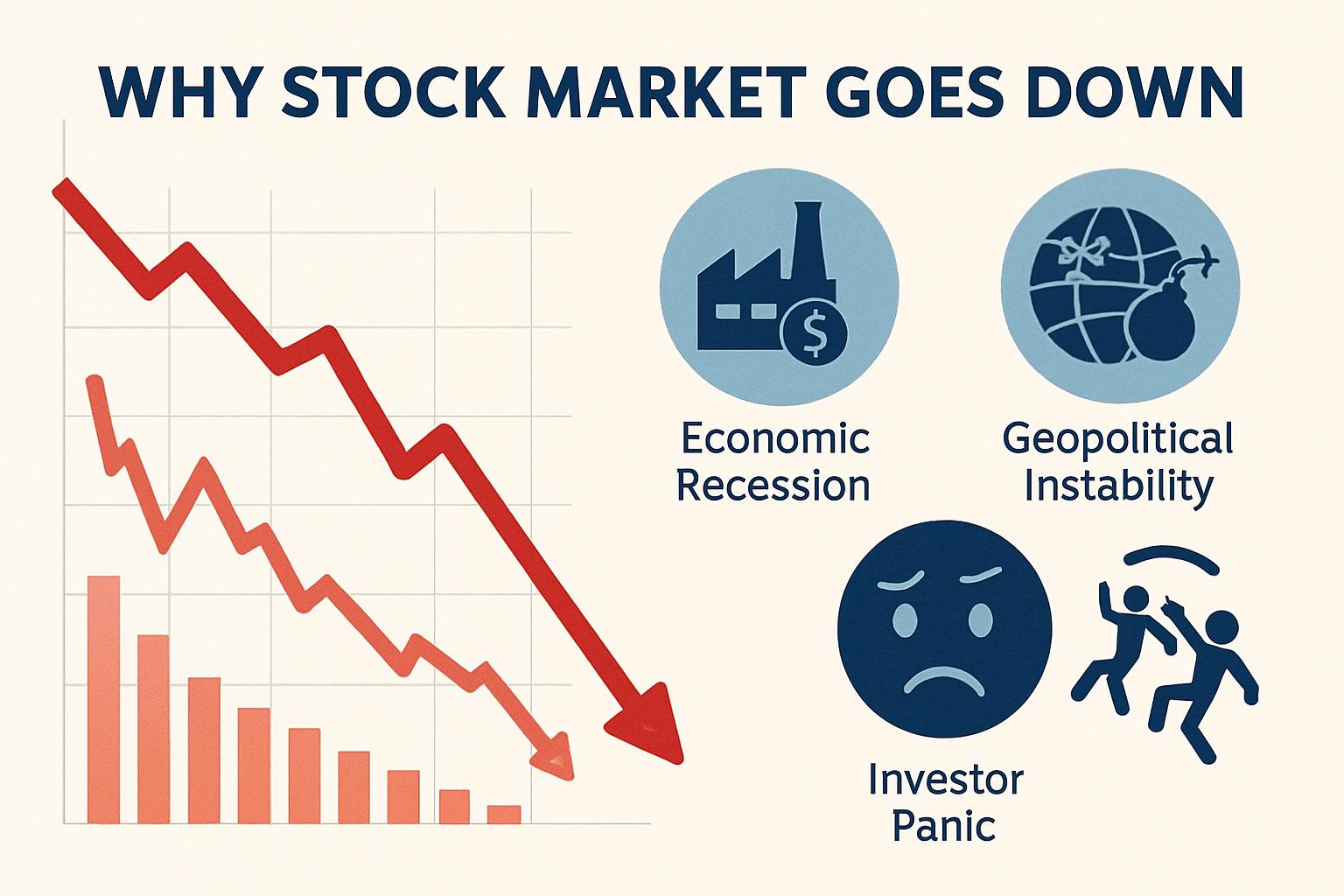
The stock market’s daily gyrations can be a source of both excitement and anxiety for investors. When the indices flash red, signaling a broad market decline, the natural question that arises is, “Why are the stocks down today?” While market volatility is an inherent characteristic of investing, sudden downturns often stem from a confluence of identifiable macroeconomic forces, geopolitical events, corporate performance issues, and shifting investor sentiment. Understanding these underlying drivers is crucial not only for making informed investment decisions but also for maintaining a long-term perspective amidst short-term turbulence. Today’s dip, much like any other, is rarely attributable to a single factor but rather a complex interplay of forces that collectively shape the market’s trajectory.
Understanding the Market’s Fluctuations: A Daily Reality
The stock market is a dynamic entity, constantly adjusting to new information, economic data, and investor expectations. A daily decline, while often unsettling, is a normal and expected part of this cycle. It’s important for investors to distinguish between everyday volatility and more significant downturns that might signal a deeper shift in market sentiment or economic fundamentals.
The Nature of Market Volatility
Market volatility refers to the rate at which the price of a security, or an index, increases or decreases over a given period. It’s often measured by the standard deviation of price movements. High volatility implies that the price can change dramatically over a short period in either direction. Several factors contribute to this inherent volatility. News events, whether positive or negative, can trigger rapid responses as traders and investors adjust their positions. Economic reports, corporate earnings announcements, or even political statements can send ripples through the market. Furthermore, the sheer volume of participants, from individual retail investors to large institutional funds, each with varying objectives and time horizons, contributes to the market’s often unpredictable nature. This daily ebb and flow is not a bug, but a feature of an efficient, information-driven market.
Differentiating Between Corrections and Crashes
When stocks are down, it’s vital to put the movement into perspective. A “correction” is typically defined as a market decline of 10% or more from a recent peak. These are relatively common occurrences, happening roughly once every two years on average, and are often healthy, helping to reset valuations and clear out excessive speculation. They are generally short-lived, with markets often recovering within months. In contrast, a “bear market” refers to a more significant and prolonged decline, usually defined as a drop of 20% or more. These often coincide with economic recessions or significant structural shifts. A “market crash” is an even more severe and sudden decline, often characterized by panic selling and a rapid loss of confidence, as seen during the 1929 crash or the 2008 financial crisis. Understanding which type of downturn the market is experiencing helps investors calibrate their response and avoid reactive, potentially detrimental decisions.
Macroeconomic Headwinds: The Big Picture Drivers
Often, the primary culprits behind a broad market downturn are macroeconomic in nature. These are the large-scale economic factors that influence the performance of nearly all companies and, consequently, the entire stock market.
Inflationary Pressures and Central Bank Responses
One of the most potent forces influencing markets today is inflation. When the cost of goods and services rises persistently, it erodes purchasing power for consumers and increases operational costs for businesses, potentially squeezing profit margins.
The Federal Reserve’s Stance and Interest Rate Hikes
Central banks, like the U.S. Federal Reserve, are tasked with maintaining price stability. To combat high inflation, they typically resort to raising interest rates. Higher interest rates make borrowing more expensive for businesses, potentially slowing down expansion plans, and can make equities less attractive compared to safer, higher-yielding bonds. The market often reacts negatively to aggressive rate hike cycles because they signal a potential slowdown in economic activity and corporate earnings. Uncertainty about the future trajectory of interest rates can also lead to increased market volatility.
Economic Growth Concerns and Recession Fears
The prospect of a slowing economy or a full-blown recession is another major driver of market declines. When economic growth stalls, corporate profits tend to suffer.
GDP Projections and Consumer Spending Trends
Gross Domestic Product (GDP) is a key indicator of economic health. When GDP projections are revised downwards, it signals to investors that the overall economic pie is shrinking, which in turn means less revenue and profit for companies. Consumer spending, which accounts for a significant portion of GDP in many developed economies, is particularly scrutinized. If consumers are cutting back due to inflation, job insecurity, or reduced confidence, businesses that rely on discretionary spending face significant headwinds. Market downturns often anticipate future economic weakness, with investors selling off shares in expectation of reduced corporate performance.
Employment Data and Its Market Implications
The labor market is a critical barometer of economic health. Robust job growth and low unemployment typically signal a strong economy, while rising unemployment or slowing job creation can be a red flag. However, the market’s reaction can be nuanced. For example, exceptionally strong job growth might concern investors if it indicates an overheating economy that could prompt the central bank to raise interest rates more aggressively. Conversely, weakening employment figures might signal an impending recession, leading to a market sell-off. The balance between full employment and stable prices is a delicate one, and deviations from this balance often trigger market adjustments.
Geopolitical Landscape and Global Interconnections
Beyond purely economic factors, geopolitical events can introduce significant uncertainty and risk, causing investors to pull back from the market. The interconnectedness of the global economy means that conflicts or policy shifts in one region can have ripple effects worldwide.
International Conflicts and Trade Tensions
Major international conflicts, such as wars or significant political instability in key regions, can trigger market declines. These events often disrupt global trade, create uncertainty about future economic stability, and can lead to increased defense spending or sanctions that impact specific industries or countries. Similarly, escalating trade tensions between major economic powers, involving tariffs or trade barriers, can dampen global growth prospects. Companies that rely on international supply chains or export markets can see their profitability threatened, leading to a reassessment of their stock valuations.
Supply Chain Disruptions and Commodity Prices
Geopolitical events or natural disasters can severely disrupt global supply chains. When the flow of goods and raw materials is hindered, it leads to increased production costs for businesses and potential shortages for consumers. This can fuel inflation and reduce corporate profitability. Closely related are commodity prices. Geopolitical tensions often lead to spikes in prices for essential commodities like oil, natural gas, and key metals. Higher energy costs, for example, impact nearly every sector of the economy, from transportation to manufacturing, ultimately weighing on corporate earnings and consumer discretionary spending. When the market perceives these disruptions as significant and prolonged, it often reacts with a sell-off.
Corporate Performance and Sector-Specific Challenges
While macroeconomic forces paint a broad picture, company-specific performance and challenges within particular sectors can also drive market downturns, especially if key industry leaders or bellwether stocks are affected.
Earnings Season Disappointments and Guidance Revisions
During earnings season, companies report their financial results for the previous quarter and often provide “guidance” for future performance. When a significant number of major companies miss analyst expectations for earnings or revenue, or worse, issue a pessimistic outlook for the coming quarters, it can trigger a broad market sell-off. Poor earnings reports suggest that the underlying economic conditions are deteriorating or that competition is intensifying, impacting profitability. A downgrade in guidance signals that management expects future challenges, leading investors to re-evaluate the company’s prospects and often its share price.
Industry-Specific Headwinds (e.g., Tech Slowdown, Energy Volatility)
Certain sectors may face unique challenges that cause their stocks to decline, even if the broader market is stable. For instance, a “tech slowdown” might occur if growth in software subscriptions or hardware sales decelerates, perhaps due to higher interest rates making future earnings less valuable or increased regulatory scrutiny. Conversely, the energy sector might experience extreme volatility due to geopolitical events, changes in global demand, or shifts in environmental policy. When a major sector that constitutes a large portion of the overall market capitalization experiences significant headwinds, it can drag down the entire index.
Impact of Consumer Sentiment on Retail and Discretionary Spending
Consumer sentiment is a critical factor for sectors like retail, automotive, hospitality, and luxury goods. If consumers are feeling pessimistic about their financial future, job security, or the broader economy, they tend to cut back on non-essential purchases. This reduction in discretionary spending directly impacts the revenues and profits of companies in these sectors. A series of weak sales reports from major retailers or a significant drop in consumer confidence indices can signal a challenging environment for a large portion of the market, contributing to a general stock downturn.
Market Sentiment, Technical Factors, and Investor Psychology
Beyond fundamental economic and corporate data, the collective psychology of investors and technical market indicators play a significant role in daily price movements. Sometimes, the market moves less on new information and more on how investors interpret existing information or on automated trading strategies.
Fear, Uncertainty, and Herd Mentality
Fear and uncertainty are powerful drivers in financial markets. When there’s a lack of clarity about economic prospects, corporate earnings, or geopolitical stability, investors tend to become risk-averse, opting to sell off stocks and move into safer assets. This can lead to a “herd mentality,” where initial selling triggers more selling as other investors fear being left behind in a falling market. This self-reinforcing cycle can exacerbate downturns, pushing prices below what might be justified by underlying fundamentals alone. Panic selling, driven by emotion rather than rational analysis, is a common feature of significant market declines.
Technical Sell-offs and Support Levels
Technical analysis involves studying past market data, primarily price and volume, to identify patterns and predict future price movements. “Technical sell-offs” occur when key price levels, known as “support levels,” are broken. A support level is a price point where buying interest has historically been strong enough to prevent the price from falling further. When a stock or index breaks below a significant support level, it can trigger automated sell orders and convince technical traders that further declines are likely, accelerating the downtrend. Similarly, hitting “resistance levels” on the way up, or breaking “trend lines” can signal shifts in momentum.
The Role of Algorithmic Trading
Modern financial markets are heavily influenced by algorithmic trading, where computer programs execute trades based on pre-programmed instructions. These algorithms can react to market events, news, or technical indicators much faster than human traders. While they can contribute to market efficiency, they can also exacerbate volatility. If a large number of algorithms are programmed to sell when certain conditions are met (e.g., a specific price drop, a negative news headline), they can collectively trigger a rapid and significant sell-off in a very short amount of time, amplifying market movements and sometimes creating “flash crashes.”
Navigating the Downturn: Strategies for Investors
When stocks are down, it’s natural to feel concerned. However, successful investors understand that market downturns are an inevitable part of the investment cycle and present opportunities for those who maintain a disciplined approach.
The Importance of a Long-Term Perspective
One of the most crucial strategies during a market downturn is to maintain a long-term perspective. Historically, stock markets have recovered from every major decline, eventually reaching new highs. Focusing on daily or even monthly fluctuations can lead to emotional decisions. For investors with a time horizon of many years or decades, short-term dips are often just noise in the broader upward trend of wealth creation. Panicking and selling at the bottom locks in losses and prevents participation in the inevitable rebound.
Diversification as a Risk Management Tool
Diversification is the practice of spreading investments across various asset classes (stocks, bonds, real estate), industries, geographies, and company sizes. When one part of your portfolio is underperforming, another might be holding steady or even gaining. A well-diversified portfolio helps to cushion the blow of market downturns because not all investments move in the same direction simultaneously. While diversification doesn’t guarantee profits or protect against losses, it significantly reduces the risk associated with any single investment or market segment.
Rebalancing Portfolios and Identifying Opportunities
Market downturns provide an excellent opportunity to rebalance your portfolio. Rebalancing involves adjusting your asset allocation back to your original target percentages. For example, if stocks have fallen significantly, they might now represent a smaller percentage of your portfolio than you intended. Rebalancing would involve selling some of your outperforming assets (e.g., bonds) and buying more of the underperforming ones (stocks) to restore your target allocation. This disciplined approach means “buying low” without trying to time the market, taking advantage of lower prices for quality assets.
Avoiding Emotional Decisions and Panic Selling
Perhaps the hardest, yet most critical, strategy during a market decline is to avoid making emotional decisions. Fear can be a powerful motivator, leading investors to panic sell their holdings at the worst possible time. Before making any sudden moves, take a step back and revisit your original investment thesis. Are the fundamentals of the companies you own still strong? Has your personal financial situation changed? Often, the best course of action during a downturn is to do nothing, or to even opportunistically add to positions if your financial plan allows. Stick to your pre-determined investment plan and remember that market volatility is a feature, not a bug, of long-term investing success.
aViewFromTheCave is a participant in the Amazon Services LLC Associates Program, an affiliate advertising program designed to provide a means for sites to earn advertising fees by advertising and linking to Amazon.com. Amazon, the Amazon logo, AmazonSupply, and the AmazonSupply logo are trademarks of Amazon.com, Inc. or its affiliates. As an Amazon Associate we earn affiliate commissions from qualifying purchases.