
For any business employing staff, understanding and meticulously managing payroll taxes is not just a matter of compliance; it’s a cornerstone of financial stability and legal integrity. Payroll taxes encompass a range of withholdings and employer contributions, funding vital programs like Social Security, Medicare, and unemployment benefits. Failing to remit these taxes accurately and on time can lead to severe penalties, interest charges, and even legal complications that threaten a business’s very existence. This comprehensive guide delves into the intricate world of payroll tax due dates, offering insights and strategies to ensure your business remains compliant, avoids costly mistakes, and maintains robust financial health.
The landscape of payroll taxes can appear daunting, with federal, state, and sometimes local requirements, each with its own set of rules and deadlines. However, by breaking down these obligations into manageable components and adopting best practices, businesses can navigate this complexity with confidence. Our exploration will cover the different types of payroll taxes, the critical federal deposit schedules, the variability of state requirements, and the indispensable tools and strategies for accurate and timely payments.
Understanding the Fundamentals of Payroll Taxes
Before delving into the “when,” it’s crucial to grasp the “what” and “who” of payroll taxes. These are not merely administrative burdens; they are fundamental contributions to the social safety net and essential components of public finance.
What Constitutes Payroll Taxes?
Payroll taxes are generally categorized into two main types:
- Withheld Taxes: These are amounts deducted directly from an employee’s gross pay. They primarily include federal income tax withholding, state income tax withholding (in applicable states), and the employee’s share of Federal Insurance Contributions Act (FICA) taxes, which fund Social Security and Medicare.
- Employer Contributions: These are taxes paid directly by the employer, over and above the employee’s gross wages. They include the employer’s share of FICA taxes, Federal Unemployment Tax Act (FUTA) contributions, and State Unemployment Insurance (SUI) or State Unemployment Tax Act (SUTA) contributions. Some states may also require additional employer-paid taxes.
A Closer Look at Key Federal Payroll Taxes:
- FICA Taxes (Social Security and Medicare): These are perhaps the most universally recognized federal payroll taxes. For Social Security, both employees and employers typically pay 6.2% each on wages up to an annual limit (which adjusts annually). For Medicare, both pay 1.45% each on all wages, with no wage limit. An additional Medicare tax of 0.9% applies to high-income earners above certain thresholds, which is withheld from the employee’s pay by the employer.
- Federal Income Tax Withholding: Employers are legally required to withhold federal income tax from each employee’s wages based on the information provided on their W-4 form. The amount withheld depends on the employee’s marital status, number of allowances claimed, and gross pay.
- Federal Unemployment Tax Act (FUTA): This is an employer-only tax that contributes to a federal fund providing unemployment benefits. The standard FUTA tax rate is 6.0% on the first $7,000 of each employee’s wages, though most employers receive a significant credit for timely state unemployment tax payments, effectively reducing the federal rate.
Who is Responsible for Payroll Tax Remittance?
The employer bears the primary responsibility for collecting, reporting, and remitting all payroll taxes to the appropriate federal and state agencies. Even for the taxes withheld from employee wages, the employer acts as a trustee, holding these funds until they are due to the government. This fiduciary responsibility underscores the severe consequences for mismanaging payroll taxes, as these are not considered the employer’s funds but rather monies held in trust for the government and the employee.
Navigating Federal Payroll Tax Due Dates: A Detailed Guide
The Internal Revenue Service (IRS) governs federal payroll tax obligations. The timing of federal payroll tax deposits is primarily determined by an employer’s total tax liability during a “lookback period.” This period helps categorize employers into different deposit schedules.
Determining Your Federal Deposit Schedule: Monthly vs. Semiweekly
The IRS mandates one of two primary deposit schedules for most employers:
- Monthly Schedule: You are a monthly depositor for the current year if your total payroll tax liability during the lookback period was $50,000 or less.
- Semiweekly Schedule: You are a semiweekly depositor for the current year if your total payroll tax liability during the lookback period was more than $50,000.
The lookback period for a calendar year is the 12-month period ending June 30 of the preceding year. For instance, for calendar year 2024, the lookback period is July 1, 2022, to June 30, 2023. New employers generally start as monthly depositors for their first calendar year.
Specific Deadlines for Monthly Depositors
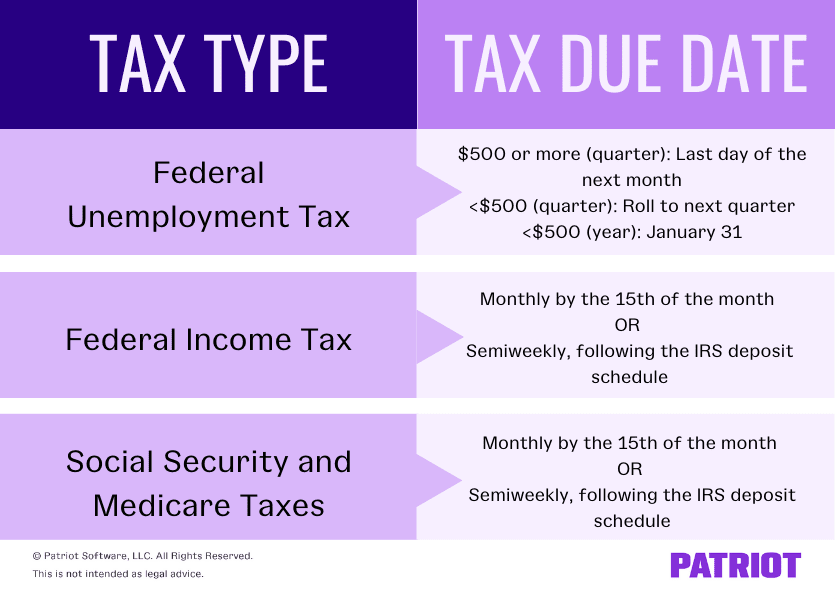
If you are a monthly depositor, you must deposit your payroll taxes (FICA and federal income tax withholding) by the 15th day of the following month. For example, taxes for wages paid in January are due by February 15th. If the 15th falls on a weekend or holiday, the due date shifts to the next business day.
Specific Deadlines for Semiweekly Depositors
Semiweekly depositors have a more frequent and complex schedule:
- Payments for paydays on Wednesday, Thursday, or Friday are due by the following Wednesday.
- Payments for paydays on Saturday, Sunday, Monday, or Tuesday are due by the following Friday.
This means that depending on when your payroll cycles end, you might have two deposit dates in a single week. This schedule requires meticulous planning and prompt action to avoid missing deadlines.
Special Rules for Large Accumulations: The $100,000 Rule
A critical exception to the monthly/semiweekly rules is the $100,000 rule. If an employer accumulates $100,000 or more in payroll tax liability on any day during a deposit period (monthly or semiweekly), the taxes must be deposited by the next business day. This rule overrides all other deposit schedules and ensures that large amounts of withheld taxes are remitted to the Treasury almost immediately. Once this rule is triggered, the employer automatically becomes a semiweekly depositor for the remainder of the current year and for the following calendar year.
Annual Federal Unemployment Tax (FUTA) Deadlines
FUTA taxes are reported annually on Form 940, Employer’s Annual Federal Unemployment (FUTA) Tax Return, which is due by January 31st of the following year. However, FUTA tax payments are generally due quarterly. If your accumulated FUTA liability exceeds $500 in any quarter, you must deposit that amount by the last day of the month following the end of the quarter:
- Quarter 1 (Jan 1 – Mar 31): Due April 30
- Quarter 2 (Apr 1 – Jun 30): Due July 31
- Quarter 3 (Jul 1 – Sep 30): Due October 31
- Quarter 4 (Oct 1 – Dec 31): Due January 31 of the next year
If the liability is $500 or less, you carry it over to the next quarter until it exceeds $500 or is due on January 31st.

State Payroll Taxes: A Necessary Consideration
While federal payroll taxes apply uniformly across the U.S., state payroll tax obligations introduce a layer of complexity. Each state has its own set of rules, rates, and deadlines, which can vary significantly.
State Income Tax Withholding
Most states (41 states plus the District of Columbia) require employers to withhold state income tax from employee wages. The frequency of these deposits often mirrors federal schedules (monthly, semiweekly, or even daily for large employers), but the specific thresholds and lookback periods can differ. Employers must register with each state’s tax agency where they have employees and adhere to their unique withholding guidelines and remittance schedules.
State Unemployment Insurance (SUI/SUTA)
All states operate their own unemployment insurance programs, funded by employer contributions (SUI/SUTA). The rates vary widely by state and depend on factors like an employer’s industry, the size of their payroll, and their experience rating (how many former employees have claimed unemployment benefits). SUI taxes are generally reported and paid quarterly, though specific due dates can vary. It’s crucial for businesses to understand their specific state’s SUI laws, as these contributions directly impact the federal FUTA credit.
Local Payroll Taxes and Other State-Specific Contributions
Some localities and states may impose additional payroll-related taxes. For example, some cities have local income taxes or wage taxes that employers must withhold. States like New Jersey, New York, and California have state disability insurance (SDI) programs, which often involve employee contributions withheld from wages. Employers must thoroughly research all state and local payroll tax requirements for every jurisdiction in which they operate.
Mitigating Risks: Avoiding Penalties and Ensuring Compliance
The IRS and state tax authorities take payroll tax compliance very seriously. Failure to meet deposit deadlines or accurately report information can result in significant financial penalties.
Common Penalties for Non-Compliance
- Failure to Deposit Penalties: The most common penalties relate to late deposits of federal payroll taxes. These penalties are tiered based on how late the deposit is:
- 2% for deposits made 1 to 5 days late.
- 5% for deposits made 6 to 15 days late.
- 10% for deposits made 16 or more days late.
- 15% for taxes not deposited within 10 days of the first notice of demand for payment.
- Failure to File Penalties: Penalties also apply for late filing of required forms, such as Form 941 (Employer’s Quarterly Federal Tax Return) or Form 940 (FUTA).
- Accuracy-Related Penalties: Errors in reporting can also lead to penalties.
- Trust Fund Recovery Penalty (TFRP): This is perhaps the most severe penalty. If the withheld employee income and FICA taxes (the “trust fund” portion) are not remitted, the IRS can impose a 100% penalty on the “responsible person” within the business. This can be an owner, officer, or anyone with the authority to direct the payment of payroll taxes. This penalty is personal and cannot be discharged in bankruptcy.
Strategies for Timely Payments and Accuracy
- Understand Your Deposit Schedule: Clearly identify whether you are a monthly or semiweekly depositor and remain vigilant for any changes (like triggering the $100,000 rule).
- Calendar and Reminders: Implement a robust system for tracking all federal, state, and local payroll tax due dates. Use digital calendars, reminder apps, or dedicated payroll dashboards.
- Automate with Payroll Software: Modern payroll software is invaluable. It automatically calculates withholdings and employer contributions, alerts you to upcoming deadlines, and can even initiate electronic payments.
- Use EFTPS for Federal Deposits: The Electronic Federal Tax Payment System (EFTPS) is the mandatory method for most federal tax deposits. It’s free, secure, and provides immediate confirmation, helping to avoid late payments and documentation issues. Enroll well in advance.
- Maintain Meticulous Records: Keep comprehensive records of all payroll calculations, tax deposits, and filings. This is crucial for audit purposes and for resolving any discrepancies.
- Reconcile Regularly: Reconcile your payroll records with your general ledger and bank statements frequently to catch errors early.
- Stay Informed: Tax laws and rates can change. Regularly check IRS publications and state tax agency websites for updates.
Leveraging Technology for Seamless Payroll Tax Management
In today’s fast-paced business environment, relying on manual processes for payroll tax management is not only inefficient but also highly risky. Technology offers powerful solutions to streamline processes, enhance accuracy, and ensure timely compliance.
The Indispensable Role of Payroll Software
Modern payroll software solutions are designed to automate nearly every aspect of payroll and tax management. From calculating gross wages, deductions, and withholdings to preparing tax forms and facilitating direct deposits, these tools are game-changers for businesses of all sizes.
- Automated Calculations: Software automatically applies current tax rates and rules, minimizing calculation errors.
- Deadline Reminders: Many systems provide proactive alerts for upcoming federal and state tax deposit and filing deadlines.
- Form Generation: They simplify the creation of W-2s, 1099s, and quarterly forms like Form 941.
- Electronic Filing and Payment: Most software integrates with federal and state systems for electronic filing and direct payment of taxes, often directly through EFTPS.
- Record-Keeping: Centralized digital records make it easy to access past payroll data and tax filings.
Popular options range from comprehensive human capital management (HCM) suites for larger enterprises to user-friendly cloud-based solutions tailored for small and medium-sized businesses, such as QuickBooks Payroll, ADP Run, Gusto, and Paychex Flex.
The Advantage of Working with Payroll Services
For businesses that prefer to offload the complexity entirely, outsourcing payroll to a dedicated payroll service provider is an excellent option. These companies specialize in payroll processing and tax compliance.
- Expertise: They employ specialists who stay current with ever-changing tax laws at all levels.
- Reduced Risk: They assume much of the compliance burden, often guaranteeing accuracy and timely payments, taking liability off the business owner.
- Time Savings: Frees up valuable internal resources to focus on core business activities.
- Comprehensive Services: Many offer additional HR services, such as benefits administration, onboarding, and compliance with labor laws.
Digital Payment Methods: EFTPS and State Portals
For federal taxes, the Electronic Federal Tax Payment System (EFTPS) is not just a convenience; it’s a mandatory requirement for most employers. It allows businesses to make federal tax payments electronically, quickly, and securely. Similarly, most states offer their own online portals for remitting state income tax withholding and SUI contributions. Embracing these digital platforms is crucial for efficiency, accuracy, and meeting strict deadlines.

Conclusion
The question “when are payroll taxes due” opens a gateway to one of the most critical aspects of business finance and operational compliance. The labyrinth of federal, state, and potentially local payroll tax deadlines demands a meticulous approach, but the consequences of neglect can be dire. By understanding the different types of taxes, adhering to the specific deposit schedules – whether monthly, semiweekly, or under the $100,000 rule – and proactively managing state-specific requirements, businesses can safeguard their financial standing.
Leveraging modern payroll software and considering the benefits of professional payroll services are no longer luxuries but essential strategies for effective risk mitigation. In an era where penalties for non-compliance are severe and personal liability can extend to business owners, a proactive, organized, and technology-driven approach to payroll tax management is paramount for sustainable growth and peace of mind. Ensuring timely and accurate payroll tax remittances is not just about avoiding penalties; it’s about fulfilling a fundamental responsibility that contributes to both employee well-being and the broader economic framework.
aViewFromTheCave is a participant in the Amazon Services LLC Associates Program, an affiliate advertising program designed to provide a means for sites to earn advertising fees by advertising and linking to Amazon.com. Amazon, the Amazon logo, AmazonSupply, and the AmazonSupply logo are trademarks of Amazon.com, Inc. or its affiliates. As an Amazon Associate we earn affiliate commissions from qualifying purchases.