
In the intricate world of finance, where transactions often demand clarity and legal enforceability, the promissory note stands as a cornerstone. Whether you’re lending money to a friend, financing a small business venture, or formalizing a personal loan, a well-crafted promissory note is more than just a piece of paper; it’s a legally binding promise. It delineates the terms of repayment, interest rates, and the obligations of both borrower and lender, offering protection and peace of mind. Without it, even the most well-intentioned agreements can dissolve into disputes and misunderstandings.
This comprehensive guide will walk you through the essential elements of creating a robust promissory note, ensuring your financial agreements are clear, secure, and legally sound. By understanding its components and the legal landscape surrounding it, you can navigate lending and borrowing with confidence and professionalism.
Understanding the Fundamentals of a Promissory Note
Before diving into the mechanics of writing one, it’s crucial to grasp what a promissory note is, its purpose, and the various forms it can take. This foundational understanding ensures you choose the right type of note for your specific financial arrangement and appreciate its significance.
What is a Promissory Note?
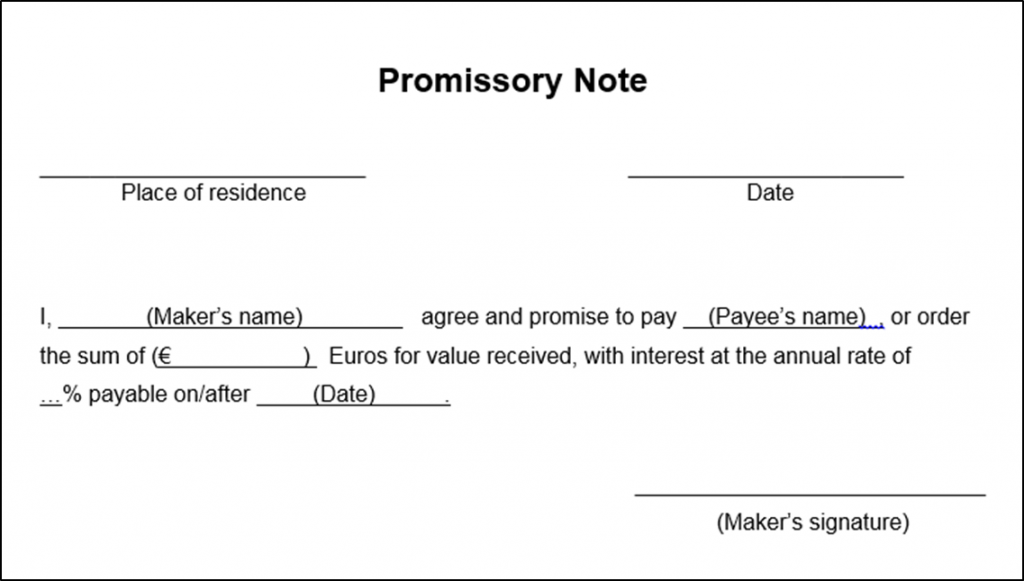
At its core, a promissory note is a written agreement between two parties – the maker (borrower) and the payee (lender) – where the maker unconditionally promises to pay a specific sum of money to the payee on demand or at a specified future date. It’s essentially a formal IOU, but with legally binding terms that go far beyond a casual agreement. This document serves as undeniable proof of a debt and the agreed-upon conditions for its repayment, making it a critical tool in both personal and business finance. It brings clarity and accountability to lending, safeguarding the interests of both parties involved.
Why Use a Promissory Note?
The primary reason for employing a promissory note is to formalize a loan, thereby mitigating risks and preventing future disputes. For the lender, it provides a legal recourse should the borrower default on their payments, serving as evidence of the debt and the agreed-upon repayment terms. This can be invaluable in court if collection becomes necessary. For the borrower, it clarifies their obligations, ensuring they understand the terms of the loan, including the principal amount, interest rate, and payment schedule. This transparency fosters trust and avoids misunderstandings. Beyond legal protection, a promissory note also helps in maintaining records for financial accounting and tax purposes, offering a professional framework for financial transactions that might otherwise be overlooked in informal arrangements.
Types of Promissory Notes
Promissory notes aren’t one-size-fits-all. Different financial scenarios call for different structures. Understanding the common types can help you select the most appropriate note for your situation:
- Simple Promissory Note (Demand Note): This type requires the borrower to repay the loan when the lender “demands” payment. There’s no fixed repayment schedule, offering flexibility but also potential uncertainty for the borrower.
- Installment Promissory Note: The most common type, where the loan is repaid in regular, scheduled payments (e.g., monthly, quarterly) over a set period. Each payment typically includes both principal and interest. This is frequently used for personal loans, car loans, or mortgages.
- Balloon Promissory Note: This note features smaller, regular payments over a period, culminating in a large “balloon” payment at the end of the loan term that covers the remaining principal balance. This can be attractive to borrowers who anticipate a future lump sum of money.
- Secured Promissory Note: A secured note is backed by collateral (e.g., real estate, a vehicle, or other assets). If the borrower defaults, the lender has the right to seize and sell the collateral to recover their losses. This provides greater security for the lender but imposes a higher risk on the borrower.
- Unsecured Promissory Note: Unlike a secured note, an unsecured note is not backed by any collateral. The lender relies solely on the borrower’s promise to repay. These are riskier for the lender and often used when there is a high degree of trust between parties or for smaller loan amounts.
Key Components of an Effective Promissory Note
Crafting a promissory note requires careful attention to detail. Each component plays a crucial role in defining the loan terms and ensuring the document is legally enforceable. Missing or vague information can render the note useless in a dispute, so precision is paramount.
Identifying Parties and Date
Every promissory note must clearly identify the maker (borrower) and the payee (lender). Include their full legal names and current addresses. This unambiguous identification is essential for legal purposes. Additionally, the effective date of the note must be stated prominently. This date marks when the agreement officially begins and is critical for calculating interest accrual and payment schedules. Accuracy in these initial details sets the stage for a legally sound document.
Specifying the Principal Amount
This is the exact sum of money being loaned. It must be written clearly in both numerical and word format to prevent any ambiguity or alteration. For example, “$5,000.00 (Five Thousand U.S. Dollars).” Any discrepancy could invalidate the note or lead to disputes, so double-checking this figure is critical.
Defining Interest Rates and Calculation
If interest is to be charged, the interest rate must be explicitly stated. This can be a fixed rate or a variable rate, and the method of calculation (e.g., annually, compounded monthly) should be clear. It’s also important to note whether simple or compound interest applies. Be aware of state usury laws, which set maximum allowable interest rates. Charging an interest rate above the legal limit can make the note unenforceable. If no interest is charged, the note should explicitly state this.
Outlining the Payment Schedule
This section details how and when the principal and interest will be repaid. Common payment schedules include:
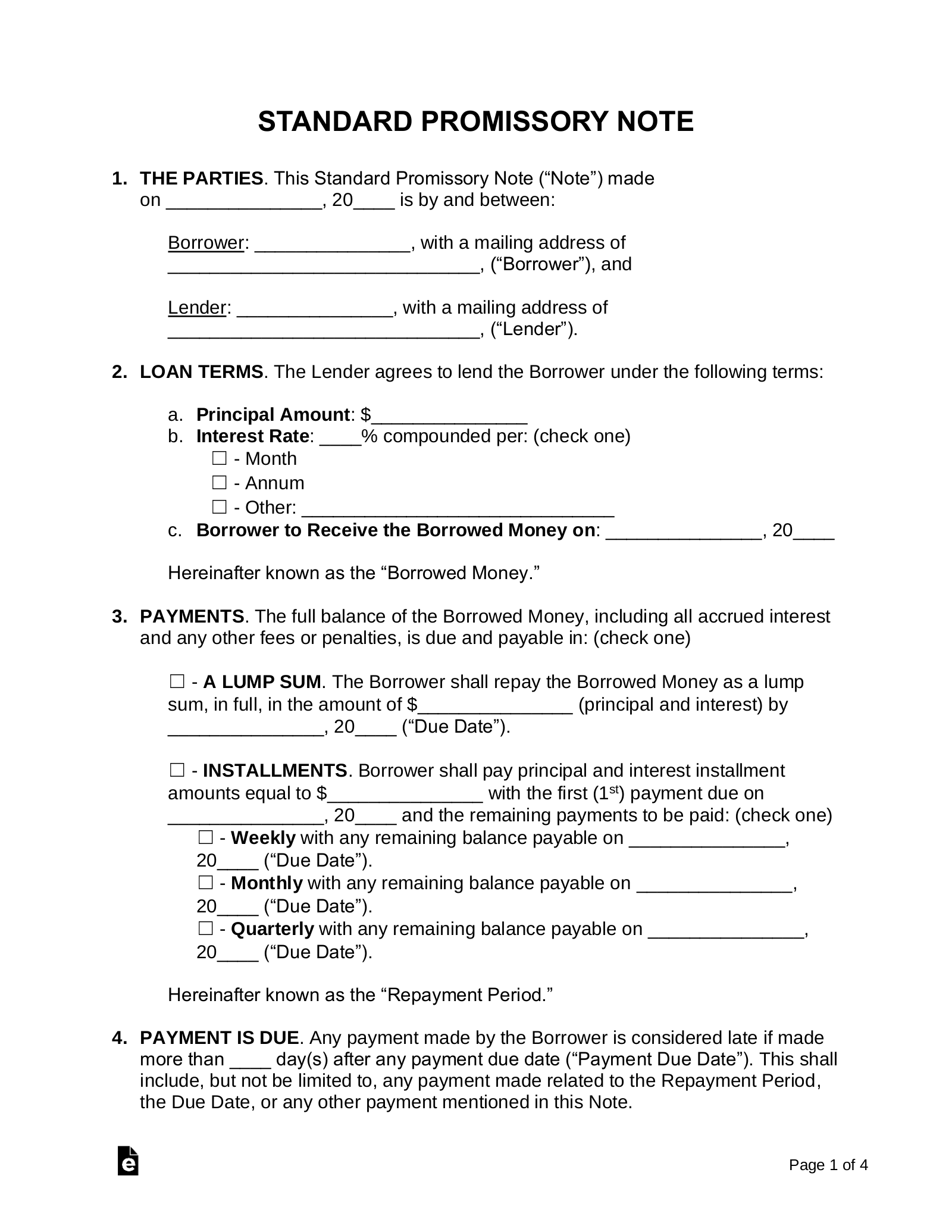
- Lump-Sum Payment: The entire amount (principal plus interest) is due on a specific future date.
- Installment Payments: Regular, fixed payments made over a period (e.g., monthly, quarterly), each payment typically covering both principal and interest. Specify the amount of each payment, the frequency, and the total number of payments.
- On-Demand Payment: As mentioned with demand notes, repayment is due when the lender requests it.
- Balloon Payment: A series of smaller payments followed by a single, larger final payment.
Whatever the schedule, it must be clearly articulated, including the exact due dates for each payment.
Detailing Default Terms and Consequences
This is a critical section for the lender. It outlines what constitutes a default (e.g., missing a payment, filing for bankruptcy) and the consequences of such an event. Common consequences include:
- Acceleration Clause: Allows the lender to demand immediate repayment of the entire outstanding balance (principal and accrued interest) if the borrower defaults.
- Late Fees: Specifies charges for overdue payments.
- Collection Costs: Stipulates that the borrower is responsible for any legal fees or collection costs incurred by the lender in case of default.
- Guarantor Clause: If a third party (guarantor) is involved, this clause defines their responsibility to repay the debt if the primary borrower defaults.
Specifying Governing Law
The promissory note should state which state’s laws will govern the agreement. This is important because laws regarding contracts, interest rates, and debt collection can vary significantly from state to state. Choosing a specific jurisdiction provides legal clarity in case of a dispute.
Signatures and Execution
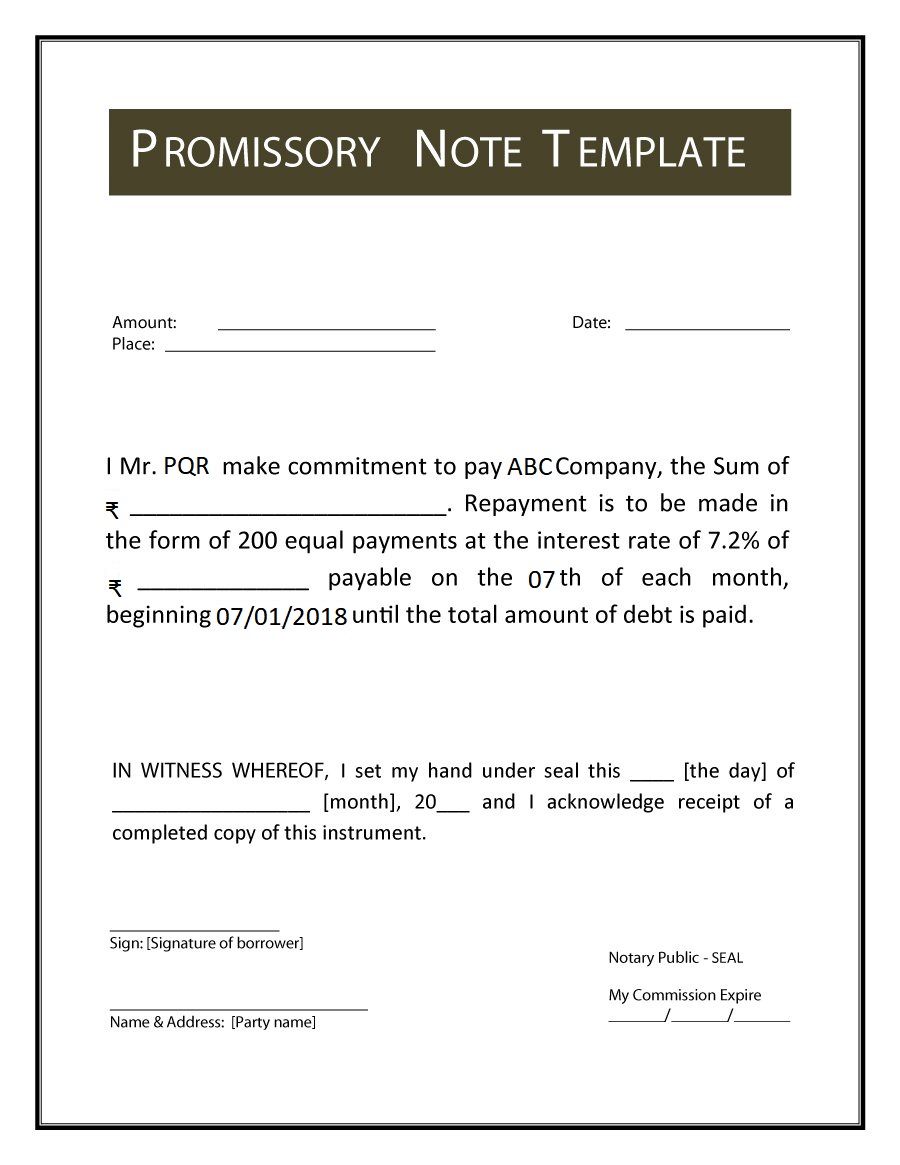
Both the maker (borrower) and the payee (lender) must sign the promissory note. Their signatures acknowledge their agreement to the terms outlined in the document. While not always legally required, it is highly recommended to have the signatures witnessed by one or two impartial parties and/or notarized by a public notary. Notarization adds an extra layer of authenticity and can be crucial for enforceability in court. Each party should receive an original copy of the signed note.
Steps to Draft and Execute Your Promissory Note
The process of creating and formalizing a promissory note is straightforward but demands meticulous attention to detail at each stage. Following these steps will help ensure your note is robust and legally sound.
1. Gather All Necessary Information
Before putting pen to paper (or fingers to keyboard), collect all pertinent details:
- Full legal names and addresses of both the borrower (maker) and lender (payee).
- The exact principal amount of the loan.
- Agreed-upon interest rate (if any) and how it will be calculated.
- Detailed repayment schedule (payment amounts, due dates, frequency).
- Any collateral involved for a secured note.
- Specific conditions for default and associated penalties.
- Chosen state for governing law.
Having all this information readily available will streamline the drafting process and minimize errors.
2. Draft the Promissory Note
You can use a template as a starting point, but always customize it to fit your specific agreement. Many reputable legal and financial websites offer templates, but be cautious and ensure they are compliant with your chosen governing law. Alternatively, financial software or online legal services can assist in generating a compliant note. Ensure all the key components discussed above are included clearly and unambiguously. Use plain, professional language and avoid jargon where possible, but ensure legal accuracy.
3. Review and Seek Legal Counsel (If Needed)
Once drafted, thoroughly review the entire document. Check for accuracy in names, dates, amounts, and all numerical figures. Ensure that all terms are clearly defined and that there are no ambiguities. If the loan involves a significant sum, complex terms, or if you are unsure about any legal implications, it is highly advisable to consult with an attorney specializing in contract or financial law. A lawyer can review the note, suggest necessary revisions, and ensure it complies with all relevant state and federal laws, especially regarding usury limits and consumer protection. While an upfront cost, legal counsel can save considerable expense and heartache down the road.
4. Execute and Maintain Records
After all parties agree to the terms and any legal reviews are complete, the promissory note should be formally signed. As previously mentioned, consider having signatures witnessed and/or notarized to enhance the document’s legal standing. Each party involved—the borrower, the lender, and any guarantors—should receive an original, signed copy of the promissory note for their records. Keep these documents in a safe and accessible place, such as a fireproof safe or a secure digital storage system. Maintaining meticulous records of all payments made and received, along with any amendments to the note, is crucial for tracking the loan’s progress and for resolving any potential disputes efficiently.
Legal Considerations and Best Practices
While a well-drafted promissory note provides a strong foundation, understanding its legal context and adhering to best practices can further solidify its enforceability and safeguard your financial interests.
Enforceability and Statutes of Limitations
A promissory note is a legally binding contract, meaning it can be enforced in a court of law. However, its enforceability can depend on several factors, including proper execution, clarity of terms, and adherence to state laws. Crucially, every state has a statute of limitations for enforcing contracts, including promissory notes. This is a time limit within which legal action must be taken to collect on the debt from the date of default or the last payment. Missing this window can result in the inability to legally pursue the debt, regardless of how strong your note is. Be aware of your state’s specific statute of limitations and act accordingly.
The Role of Witnesses and Notarization
While not universally required for a promissory note to be valid, having witnesses present during the signing and getting the document notarized adds significant weight and credibility. Witnesses can attest that the parties willingly signed the document and were of sound mind. A notary public verifies the identities of the signatories and confirms that they signed voluntarily. This additional layer of authentication makes it much harder for a party to later claim their signature was forged or that they were coerced, thereby strengthening the note’s legal standing should it ever be challenged in court.
Amendments and Modifications
Life circumstances can change, and sometimes the terms of a promissory note need to be adjusted. Any amendments or modifications to the original note must be done in writing and signed by all original parties involved. Verbal agreements to change the terms are generally not legally enforceable and can lead to confusion and disputes. Always create an addendum or a new, superseding promissory note that clearly outlines the changes and is executed with the same formality as the original document.
When to Seek Professional Legal Advice
While this guide provides a comprehensive overview, certain situations warrant professional legal advice. Always consult an attorney if:
- The loan amount is substantial.
- The terms of the loan are complex or unusual.
- One of the parties has a history of financial instability or legal issues.
- You are dealing with collateral, especially real estate.
- You are unsure about state-specific laws regarding interest rates or debt collection.
- There’s a potential for conflict or misunderstanding between the parties.
Investing in legal counsel upfront can prevent costly litigation and protracted disputes in the future, ensuring your promissory note is airtight and legally compliant.
Conclusion
The promissory note, though seemingly simple, is a powerful financial tool that underpins countless personal and business transactions. By taking the time to understand its components, meticulously draft its terms, and adhere to best practices for execution and record-keeping, you transform a casual promise into a legally enforceable commitment. Whether you are the lender or the borrower, a well-written promissory note provides clarity, minimizes risk, and fosters trust, allowing financial agreements to proceed smoothly and securely. It is an indispensable element in responsible financial management, ensuring that promises made are indeed promises kept.
aViewFromTheCave is a participant in the Amazon Services LLC Associates Program, an affiliate advertising program designed to provide a means for sites to earn advertising fees by advertising and linking to Amazon.com. Amazon, the Amazon logo, AmazonSupply, and the AmazonSupply logo are trademarks of Amazon.com, Inc. or its affiliates. As an Amazon Associate we earn affiliate commissions from qualifying purchases.