
In an increasingly digital world, subscription services have become a cornerstone of our daily lives, and few are as ubiquitous and deeply integrated as Amazon Prime. From expedited shipping to an expansive library of streaming content, the allure of Prime is undeniable. However, for the financially savvy consumer, the primary question often isn’t just about what you get, but “how much does it really cost?” This isn’t merely a query about the sticker price; it’s a profound exploration into its financial value, its impact on personal budgeting, and whether the investment truly pays dividends for your individual needs and habits. Understanding the nuanced costs, benefits, and alternative pathways is crucial for making an informed financial decision in today’s subscription economy.
Unpacking the Standard Amazon Prime Membership Costs
The journey to understanding Prime’s financial implications begins with its baseline pricing structure. Amazon, a master of consumer psychology, offers a seemingly straightforward membership model that, upon closer inspection, reveals layers designed to optimize value for different user segments and encourage long-term commitment.
Annual vs. Monthly Subscriptions: The Core Pricing Strategy
At its heart, Amazon Prime presents two fundamental payment options: annual and monthly. Currently, the standard annual membership is priced at $139, representing a single upfront payment for a full year of access. Conversely, the monthly option stands at $14.99 per month. A quick calculation reveals the immediate financial discrepancy: twelve monthly payments total $179.88 per year. This stark difference – a saving of nearly $41 per year by opting for the annual plan – is Amazon’s direct incentive for commitment. From a personal finance perspective, committing to the annual plan is a clear strategy to maximize savings if you anticipate needing Prime for the full year. It’s an immediate financial win, provided your budget can comfortably accommodate the larger lump sum payment. This upfront saving is a critical consideration for budgeting, as it effectively locks in a lower cost for a prolonged period, reducing recurring monthly outflows.
The Hidden Value: More Than Just Expedited Shipping
While expedited, often free, two-day shipping (and increasingly, same-day or one-day delivery in many regions) is the flagship benefit that draws most users, the true financial value of Prime extends far beyond the logistics. Members gain access to Prime Video, a vast streaming library competing with standalone services; Prime Music, offering ad-free listening; Prime Reading, a rotating selection of ebooks and magazines; Amazon Photos, unlimited full-resolution photo storage; exclusive deals and discounts, particularly during events like Prime Day; and even prescription savings at select pharmacies. Each of these services, if purchased à la carte from other providers, would accrue significant monthly or annual costs. For example, a premium video streaming service alone can easily cost $10-20 per month. Unlimited cloud photo storage can be another $5-10. When viewed through this lens, the $139 annual fee begins to look less like an expense and more like a bundled package deal that offers considerable aggregate savings. The financial insight here is to tally the value of the services you would actually use or would otherwise pay for to truly assess the membership’s worth.
Prime’s Price Evolution: A Historical Perspective on Cost Adjustments
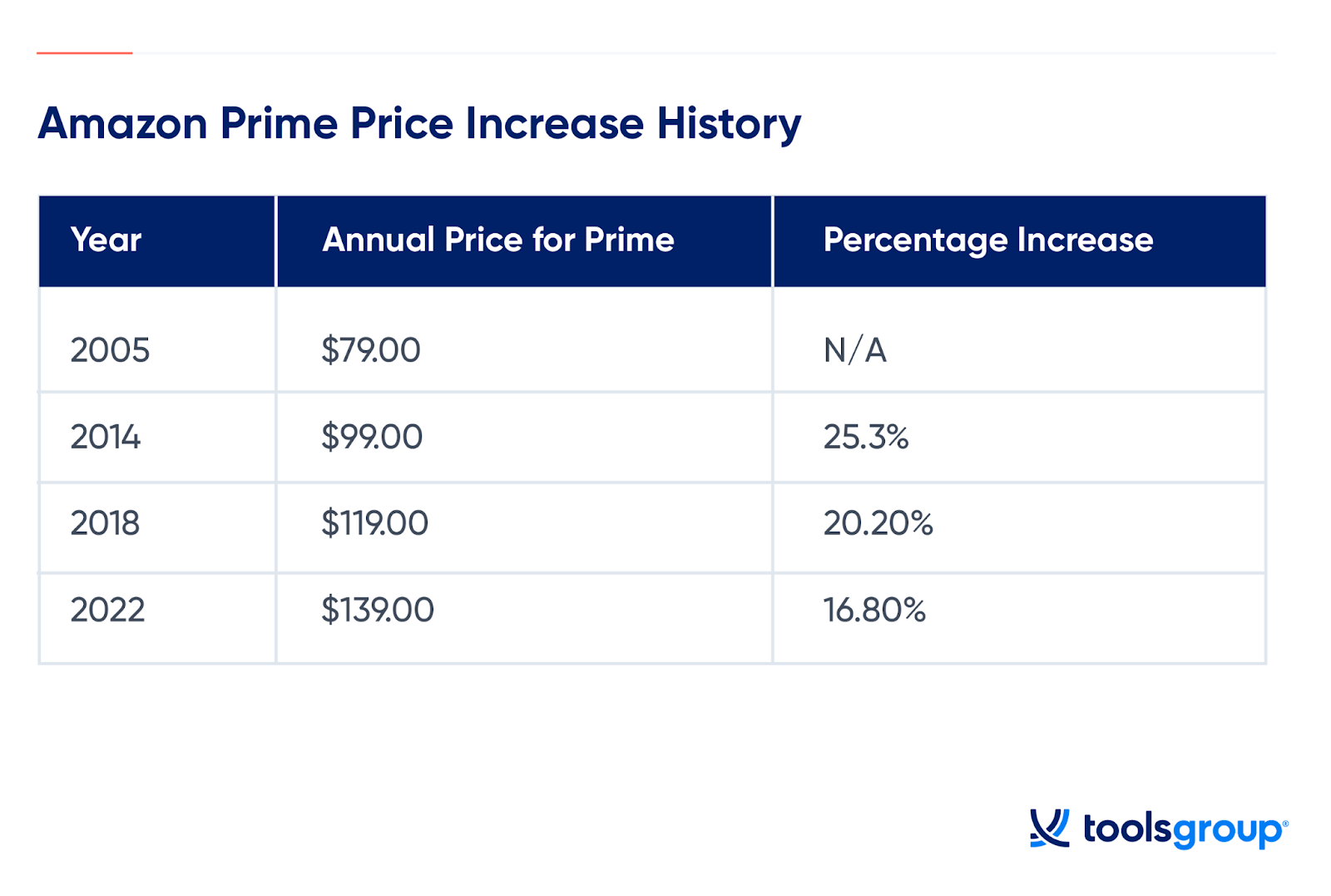
Amazon Prime’s pricing has not remained static since its inception. Launched in 2005 at $79 per year, the cost has steadily climbed, reaching $99 in 2014, then $119 in 2018, and most recently $139 in early 2022. These increases reflect a combination of factors: rising operational costs (fuel, labor, infrastructure), the continuous expansion of Prime’s benefit portfolio (more streaming content, faster delivery options, new digital services), and Amazon’s sustained market dominance. From a financial planning standpoint, understanding this historical trajectory is important. It suggests that future price adjustments are probable, and consumers should factor this potential inflationary pressure into their long-term budgeting for subscription services. Each increase necessitates a re-evaluation of the cost-benefit analysis, ensuring that the perceived value continues to outweigh the rising expenditure.
Exploring Discounted Prime Options: Maximizing Your Savings
Amazon understands that a one-size-fits-all pricing model doesn’t capture the entire market. To broaden its reach and provide equitable access, the company offers several discounted programs that significantly reduce the financial barrier to entry for specific demographics. For those eligible, these options represent substantial savings and demonstrate a savvy way to access premium services without the premium price.
Student Prime: An Investment in Education (and Savings)
For eligible college students, Amazon offers Prime Student, a membership tier that provides a substantial discount. Typically, Prime Student comes with a six-month free trial, followed by a discounted annual rate, currently $69 per year, which is half the standard annual fee. This program is a financial boon for students, a demographic often managing tight budgets. Beyond the monetary savings, students also frequently gain access to exclusive student-centric deals and promotions. From an investment perspective, this discount can free up crucial funds for textbooks, tuition, or other living expenses, while still providing the convenience of Prime for academic supplies, personal items, and entertainment during study breaks. Verifying student status usually involves providing an edu email address or other academic credentials, a small hurdle for significant financial benefit.
Government Assistance Programs: Bridging the Digital Divide Affordably
In a commendable move towards inclusivity, Amazon extends a discounted Prime membership to individuals who receive qualifying government assistance benefits, such as EBT or Medicaid. For these eligible customers, the monthly Prime membership is offered at a significantly reduced rate, often around $6.99 per month. This initiative is pivotal in bridging the digital divide, making essential services like fast shipping (crucial for those with limited mobility or access to physical stores), streaming entertainment, and prescription savings accessible to lower-income households. From a personal finance angle, this discount transforms Prime from a luxury into an affordable convenience, allowing individuals to stretch their budgets further while still enjoying the benefits that improve daily life. It represents a targeted financial intervention that empowers underserved communities.
Amazon Household: Sharing the Wealth (and the Cost)
While not a direct discount on the membership fee itself, Amazon Household is a powerful feature for financial optimization. It allows two adults and up to four children in the same household to share Prime benefits, including free shipping, Prime Video, Prime Reading, and Amazon Photos. This means a single $139 annual membership can effectively serve two separate adult accounts, halving the per-person cost to roughly $69.50 annually. For couples, roommates, or family members living together, this is an ingenious way to maximize the utility of one subscription. Instead of two individuals each paying for Prime, they can pool their resources, significantly reducing their collective expenditure without sacrificing any benefits. This strategy is a prime example of smart household budgeting and leveraging shared resources for mutual financial gain.
Beyond the Sticker Price: A Financial Cost-Benefit Analysis
Determining the true financial value of an Amazon Prime membership requires moving beyond simply looking at the annual fee. A comprehensive cost-benefit analysis involves quantifying both the tangible savings and the less tangible benefits, weighing them against the expenditure, and considering the opportunity cost.

Quantifying the Savings: Shipping, Streaming, and More
The most straightforward way to quantify Prime’s financial benefit is to calculate the savings it provides. Consider shipping: if you make frequent Amazon purchases, the cost of standard shipping (often around $5-10 per order) can quickly add up. Just 14-28 orders in a year could theoretically offset the entire annual fee in shipping costs alone, especially if you opt for faster delivery methods which are typically more expensive. Add to this the value of Prime Video, which could replace a standalone streaming service, potentially saving another $120-240 annually. The ad-free music, cloud storage for photos, and exclusive discounts, particularly during Prime Day, further contribute to this cumulative saving. For a heavy Amazon user, the aggregate savings across these categories can easily surpass the annual membership fee, making it a sound financial decision. The key is to be realistic about your usage patterns rather than overestimating potential savings.
The Opportunity Cost: What Else Could That Money Buy?
Every dollar spent on an Amazon Prime membership is a dollar that cannot be spent elsewhere. This is the concept of opportunity cost. If the $139 annual fee doesn’t translate into tangible savings for your specific consumption habits, then that money could potentially be invested, saved, or spent on other priorities. Could it contribute to an emergency fund, a retirement account, pay down debt, or fund a different subscription service that you value more? For individuals who make infrequent Amazon purchases, rarely stream video, or already have alternative solutions for music and photo storage, the opportunity cost might be too high. The “convenience” may not justify diverting funds from more critical financial goals. A critical financial assessment involves comparing the utility and savings from Prime against the value derived from alternative uses of that same capital.
The Convenience Premium: Is Your Time Worth the Price?
Beyond direct financial savings, Prime offers an undeniable convenience premium. The ability to order almost anything and have it delivered quickly, often to your doorstep, saves time, gas, and effort that would otherwise be spent shopping in physical stores. The seamless access to entertainment, reading material, and cloud storage adds another layer of effortless living. While difficult to quantify in dollar terms, the value of time saved and stress reduced can be significant. For busy professionals, parents, or individuals with limited mobility, this convenience might be worth a substantial premium. However, it’s essential to critically evaluate this “premium.” Are you truly saving time, or is the ease of access leading to impulse purchases that ultimately drain your finances? The convenience factor should be weighed judiciously against its potential to encourage less mindful spending, transforming a financial benefit into a subtle financial drain.
Making an Informed Financial Decision: Is Prime Worth It for You?
Ultimately, the decision to subscribe to Amazon Prime, or to renew an existing membership, is a highly personal financial one. It requires introspection, a clear understanding of your habits, and a willingness to evaluate alternatives.
Assessing Your Usage Habits
The single most important factor in determining Prime’s worth is your actual usage. Do you order from Amazon frequently enough that shipping costs would exceed the membership fee? Do you regularly use Prime Video, Music, or Reading, replacing other paid services? Do you take advantage of Prime Day deals? If your answer to most of these questions is “no,” or “rarely,” then the financial justification for Prime diminishes significantly. Consider reviewing your past Amazon orders to calculate how much you would have paid in shipping without Prime. Track your streaming and media consumption habits. A honest assessment of your actual engagement with all Prime benefits is paramount. This objective data provides a solid foundation for a financial decision, preventing an emotional or habitual subscription.
Alternative Solutions for Specific Prime Benefits
It’s also crucial to remember that virtually all Prime benefits have alternative, often cheaper, solutions. If your primary reason for Prime is shipping, consider Amazon’s “Subscribe & Save” for regular purchases, or simply consolidating orders to reach the free shipping threshold for non-Prime members. For streaming, free services like Pluto TV or Tubi, or more specialized, cheaper niche streaming platforms, might suffice. Public libraries offer free ebooks, audiobooks, and even streaming services like Kanopy. Cloud storage for photos is available from Google Photos (with certain limitations), Microsoft OneDrive, or Apple iCloud, often at competitive prices. By piecing together alternative solutions for the specific benefits you actually need, you might discover that you can replicate much of Prime’s utility at a fraction of the cost, or even for free, thus optimizing your personal finance strategy.
Strategic Trial Periods and Cancellation
Amazon often offers free trial periods for Prime, especially for new users or during promotional events. Leveraging these trials strategically is an excellent financial move. Use the trial period to genuinely assess your usage and the value you derive from the services. If you find yourself barely scratching the surface of Prime’s offerings, or if the convenience doesn’t outweigh the cost, be disciplined in canceling before the trial period ends to avoid being charged. Even if you’ve been a long-time member, you can always cancel your membership and re-evaluate later. Amazon allows for pro-rated refunds for annual memberships if you haven’t used many benefits. This flexibility empowers consumers to take control of their subscription spending and ensures they are only paying for services they actively use and value.
The Future of Prime Membership: Anticipating Financial Changes
The landscape of subscription services is dynamic, and Amazon Prime is no exception. As a forward-thinking financial consumer, it’s wise to consider the potential future trajectory of Prime membership and its implications for your budget.
Inflationary Pressures and Subscription Services
In an era of rising inflation, subscription services, like almost every other consumer good, are susceptible to price increases. Amazon has already demonstrated a willingness to adjust Prime’s cost upwards in response to operating expenses and market conditions. It’s not unreasonable to anticipate further price adjustments in the coming years. From a personal finance perspective, this means regularly auditing your subscription expenses. What was a good value at $79 or even $119 might become less so at $159 or $179. Budgeting for potential increases or having a clear exit strategy if the value proposition erodes is a prudent financial practice.

Expanding Benefits and Potential Price Adjustments
Conversely, Amazon consistently invests in expanding Prime’s feature set. This could include new streaming content, enhanced delivery options, integration with new Amazon services, or entirely new digital perks. Each new benefit theoretically adds to the membership’s value. However, the question remains whether these new additions genuinely enhance your experience or merely add to an unused roster of features. Financially, an expanding service might justify a higher price point for some users, but for others, it could simply mean paying more for capabilities they don’t utilize. Staying informed about new benefits and re-evaluating their relevance to your life will be key to making financially astute decisions about your Prime membership in the future.
In conclusion, the question “how much does Amazon Prime membership cost?” transcends a simple numerical answer. It requires a holistic financial assessment that considers direct costs, hidden values, potential discounts, individual usage patterns, opportunity costs, and the ever-evolving nature of subscription services. By applying diligent personal finance principles, every consumer can determine whether Amazon Prime is a worthwhile investment or an avoidable expenditure, ensuring their money is spent wisely in the vast digital marketplace.
aViewFromTheCave is a participant in the Amazon Services LLC Associates Program, an affiliate advertising program designed to provide a means for sites to earn advertising fees by advertising and linking to Amazon.com. Amazon, the Amazon logo, AmazonSupply, and the AmazonSupply logo are trademarks of Amazon.com, Inc. or its affiliates. As an Amazon Associate we earn affiliate commissions from qualifying purchases.