
In the history of human progress, certain technological breakthroughs serve as the “operating systems” for entire centuries. Just as the development of the transistor laid the groundwork for the digital age, the invention of the Bessemer process by Sir Henry Bessemer in the mid-19th century provided the material foundation for the modern industrial world. To understand what Henry Bessemer invented is to understand the birth of scalable technology—a shift from artisanal, small-batch craftsmanship to high-output, standardized engineering.
This article explores the technical intricacies of Bessemer’s most famous invention, its role as a disruptive technological force, and how it paved the way for the sophisticated manufacturing and infrastructure technologies we rely on today.

The Engineering Breakthrough: The Mechanics of the Bessemer Process
Before Henry Bessemer’s intervention, the production of steel was a slow, expensive, and technically arduous process. Steel was produced in small quantities and used primarily for high-end items like swords and watch springs. The dominant structural material of the time was wrought iron or cast iron, both of which lacked the specific tensile strength and durability required for large-scale technological advancement.
From Pig Iron to High-Quality Steel
The core problem Bessemer sought to solve was the presence of excess carbon in pig iron. High carbon levels make iron brittle, while low carbon levels result in wrought iron, which is tough but too soft for many heavy-duty applications. Steel sits in the “Goldilocks zone”—a precise carbon content that offers both strength and flexibility.
Bessemer’s revolutionary insight was not the addition of heat, but the application of air. He realized that by blowing air through molten pig iron, the oxygen in the air would react with the carbon and other impurities, burning them off through oxidation. This process was exothermic, meaning it generated its own heat, keeping the metal molten without the need for additional fuel.
The Bessemer Converter: A Masterpiece of Functional Design
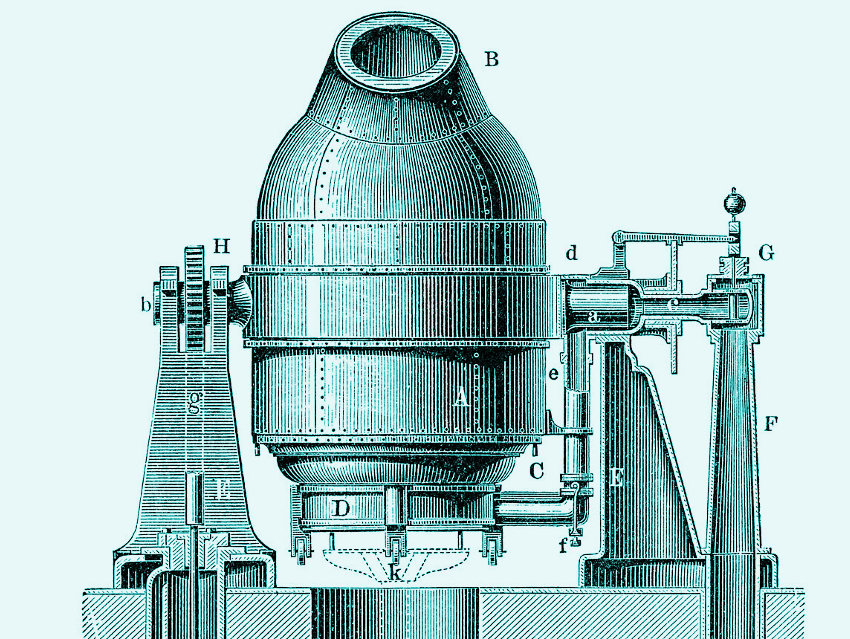
The physical apparatus invented by Bessemer—the Bessemer Converter—is an iconic piece of industrial technology. It was a large, pear-shaped vessel lined with refractory material. The design allowed the vessel to tilt for charging (filling with molten iron) and pouring.
At the bottom of the converter were “tuyeres,” or small holes through which a high-pressure blast of air was injected. As the air surged through the liquid metal, a spectacular display of sparks and flames erupted from the mouth of the converter—a visual representation of the chemical transition from raw iron to refined steel. This was the first “automated” chemical engineering process on a massive scale, reducing the time to produce five tons of steel from several days to approximately 20 minutes.
Disrupting the Industrial Era: A Case Study in Scalable Tech
In modern tech terminology, we often speak of “scalability”—the ability of a system to handle a growing amount of work. Henry Bessemer was perhaps the first great scaler of hardware. By drastically reducing the cost and time required to produce steel, he turned a luxury material into a commodity, effectively disrupting the entire metallurgy industry.
Solving the Efficiency Bottleneck
Prior to the Bessemer process, the “puddling” process was the industry standard. It required skilled laborers to manually stir molten iron in a furnace to remove impurities. It was labor-intensive, dangerous, and inherently limited by human physical capacity.
Bessemer’s invention removed the human bottleneck. His process was a “technological multiplier,” allowing a small crew of workers to produce hundreds of times more output than a traditional forge. This shift mirrors the transition in software development from manual data entry to automated processing; it was an optimization of the “industrial algorithm” of the 19th century.
Mass Production and the Standardization of Materials
The Bessemer process introduced a level of consistency that had never been seen before. In any technological ecosystem, standardization is key. Without standardized steel, the massive expansion of railways and the construction of skyscrapers would have been impossible.
Bessemer’s invention allowed for the creation of “specification-grade” steel. For the first time, engineers could rely on the predictable physical properties of their materials. This predictability is the ancestor of modern Quality Assurance (QA) and technical standards (such as ISO) that govern today’s manufacturing of everything from smartphone frames to jet engines.
From Steel Rails to Silicon Chips: The Technological Lineage
It is tempting to view the Bessemer process as a relic of the “Steam Age,” but its technological lineage connects directly to the digital and aerospace technologies of the 21st century. The invention of mass-produced steel was the catalyst for a series of “tech stacks” that built our current world.
Enabling the Infrastructure for Global Connectivity
The primary “app” for Bessemer’s steel was the railway. Before his process, iron rails wore out rapidly under the weight of heavy locomotives. Steel rails lasted ten times longer and could support much heavier loads. This technological leap created the first high-speed data and logistics network: the transcontinental railroads.
This physical connectivity was the precursor to the digital connectivity we enjoy today. The logistics of the 19th-century rail system required the invention of the telegraph for coordination, which in turn led to the development of telecommunications and eventually the internet. In a very real sense, the fiber-optic cables of today follow the paths laid by Bessemer’s steel rails.
The Precursor to Modern Precision Engineering
The availability of cheap, high-quality steel allowed for the development of more powerful steam engines, larger ships, and, eventually, internal combustion engines. These machines required precision-engineered parts that could withstand high heat and pressure—properties that only steel could provide.
The evolution of machine tools (lathes, mills, and grinders) was driven by the need to shape Bessemer’s steel. These precision tools eventually evolved into the CNC (Computer Numerical Control) machines used today to carve the aluminum bodies of laptops and the intricate components of medical devices. Henry Bessemer didn’t just invent a process; he triggered a hardware evolution.
The Legacy of Innovation in Modern Manufacturing Tech
Today, the Bessemer process has been largely superseded by the Basic Oxygen Process and Electric Arc Furnaces. However, the principles Bessemer established—rapid oxidation, thermal efficiency, and mass-scale automation—remain the heart of modern metallurgy and manufacturing technology.
Automation and AI in Steel Fabrication
In modern “Smart Factories,” the spirit of Bessemer lives on through Industry 4.0. Today’s steel mills use sophisticated sensors and AI algorithms to monitor the chemical composition of molten metal in real-time, adjusting oxygen flow and alloy additions with a level of precision Bessemer could only dream of.
The move from the Bessemer Converter to an AI-driven furnace is a logical progression in the history of tech. We have moved from mechanical control to chemical control, and now to digital control. Each step is an optimization of the fundamental goal: transforming raw materials into high-performance technology with maximum efficiency.
Sustainable Technology and the Future of Metallurgy
As we look toward the future of tech, the focus has shifted from mere production to “Green Tech” and sustainability. The steel industry is currently undergoing a “Green Steel” revolution, utilizing hydrogen instead of carbon-heavy fuels to reduce the carbon footprint.
Even in this new era, the legacy of Henry Bessemer is relevant. He was an inventor who looked at a wasteful, slow, and inefficient system and found a way to use the laws of physics and chemistry to make it faster and cleaner (at the time, by eliminating the need for extra fuel). Modern tech innovators are following the same path, seeking “elegant” solutions to complex engineering problems.

Conclusion: The Man Who Hardware-Hacked the World
Henry Bessemer was more than just a Victorian inventor; he was a pioneer of the technological mindset. By inventing the Bessemer process, he solved a fundamental material science problem that had capped human potential for centuries. He provided the “hardware” that allowed for the “software” of modern civilization—cities, global transport, and heavy machinery—to be written.
What Henry Bessemer invented was not just a way to make steel; he invented the possibility of the modern world. His work reminds us that every digital advancement we enjoy today sits atop a physical foundation of engineering excellence. As we continue to push the boundaries of AI, quantum computing, and space travel, we do so using tools and structures that owe their existence to the sparks that first flew from a Bessemer Converter in 1856. In the grand timeline of technology, Bessemer remains a titan who taught us how to build at scale.
aViewFromTheCave is a participant in the Amazon Services LLC Associates Program, an affiliate advertising program designed to provide a means for sites to earn advertising fees by advertising and linking to Amazon.com. Amazon, the Amazon logo, AmazonSupply, and the AmazonSupply logo are trademarks of Amazon.com, Inc. or its affiliates. As an Amazon Associate we earn affiliate commissions from qualifying purchases.