
The Zoot Suit Riots of 1943 are often analyzed through the lens of social history or wartime tensions, but from a strategic perspective, they represent one of the most volatile “brand collisions” in American history. In the world of branding, a product or a visual style is never just an object; it is a vessel for values, a signal of belonging, and a declaration of intent. The Zoot Suit was not merely a garment—it was a disruptive personal brand adopted by marginalized youth to reclaim space in a society that sought to render them invisible.

To understand what caused the Zoot Suit Riots, we must look past the physical skirmishes and examine the clash of two diametrically opposed brand identities: the “Patriotic Sacrifice” brand of wartime America and the “Radical Individualism” brand of the Pachuco subculture. When these two identities occupied the same physical and psychological territory in Los Angeles, the resulting friction triggered a systemic breakdown that changed the landscape of cultural branding forever.
The Anatomy of a Cultural Brand: Defining the Zoot Suit Aesthetic
Every successful brand relies on a distinct visual language that separates it from the competition. In the early 1940s, the Zoot Suit was a masterclass in avant-garde design and social signaling. Characterized by high-waisted, wide-legged, tight-cuffed “tapered” trousers and long coats with wide lapels and padded shoulders, the suit was a radical departure from the conservative silhouettes of the era.
The Visual Language of Rebellion
In branding terms, the Zoot Suit served as a “Badge of Membership.” For Mexican American, African American, and Filipino youth, the suit was a way to communicate status and dignity in an environment that offered them little of either. By exaggerating the proportions of traditional menswear, the wearers were performing an act of “Brand Stretching”—taking the existing corporate/formal attire of the white middle class and reconfiguring it into something flamboyant, expensive-looking, and undeniably urban.
This was not accidental fashion; it was a curated identity. The long watch chains and felt hats with feathers were “brand assets” that signaled a specific lifestyle of jazz, nightlife, and defiance.
Subversion of Mainstream Luxury
The Zoot Suit also functioned as a subversion of the “Luxury Brand” archetype. In a period where these young men were often relegated to low-wage labor, the suit represented an investment in a “Self-Brand” that projected wealth and leisure. By adopting a look that required significant fabric and tailoring, the youth were asserting their right to participate in the American Dream of consumption, even as they were socially excluded from its benefits. This created a cognitive dissonance for the mainstream public, who viewed the “excess” of the brand as an affront to the status quo.
Brand Collision: The Conflict Between War-Time Nationalism and Minority Identity
What ultimately ignited the Zoot Suit Riots was not just the style itself, but how that style interacted with a new, federally mandated brand: The “Victory Brand” of World War II. After the entry of the United States into the war, the government launched a massive branding campaign centered on austerity, rationing, and collective sacrifice.
The “Slacker” Brand vs. the Patriotism Narrative
In 1942, the War Production Board (WPB) issued Limitation Order L-85, which restricted the amount of fabric used in suits to conserve wool for the military. Suddenly, the Zoot Suit—with its voluminous pleats and long coats—became the visual antithesis of the “Patriotic Brand.”
To the mainstream public and the thousands of sailors and soldiers stationed in Los Angeles, the Zoot Suit was no longer just a fashion choice; it was a “Brand Violation.” The wearers were labeled as “un-American” and “slackers” because their visual identity signaled a refusal to adhere to the national rationing strategy. This is a classic example of “Brand Misinterpretation,” where the intended meaning of the wearer (dignity and subcultural pride) was overwritten by the dominant culture’s perception (disloyalty and wastefulness).
Media Framing as a Brand Erasure Tool
The role of the media in the lead-up to the riots cannot be overstated. Local newspapers, particularly the Los Angeles Times, engaged in a “Negative Branding” campaign. They consistently linked the Zoot Suit aesthetic with criminality and “pachuco” gangs.

By repeatedly associating the visual markers of the Zoot Suit with reports of crime, the media successfully rebranded an entire demographic as a public threat. This created a permission structure for violence. When a brand is successfully demonized in the public consciousness, the “consumers” of that brand (the wearers) lose their human agency in the eyes of the aggressor. The riots were, in essence, an attempt by the dominant culture to “force-rebrand” the city by erasing the visual presence of the Zoot Suiters.
Scaling the Riot: How Social Signaling Led to Systemic Conflict
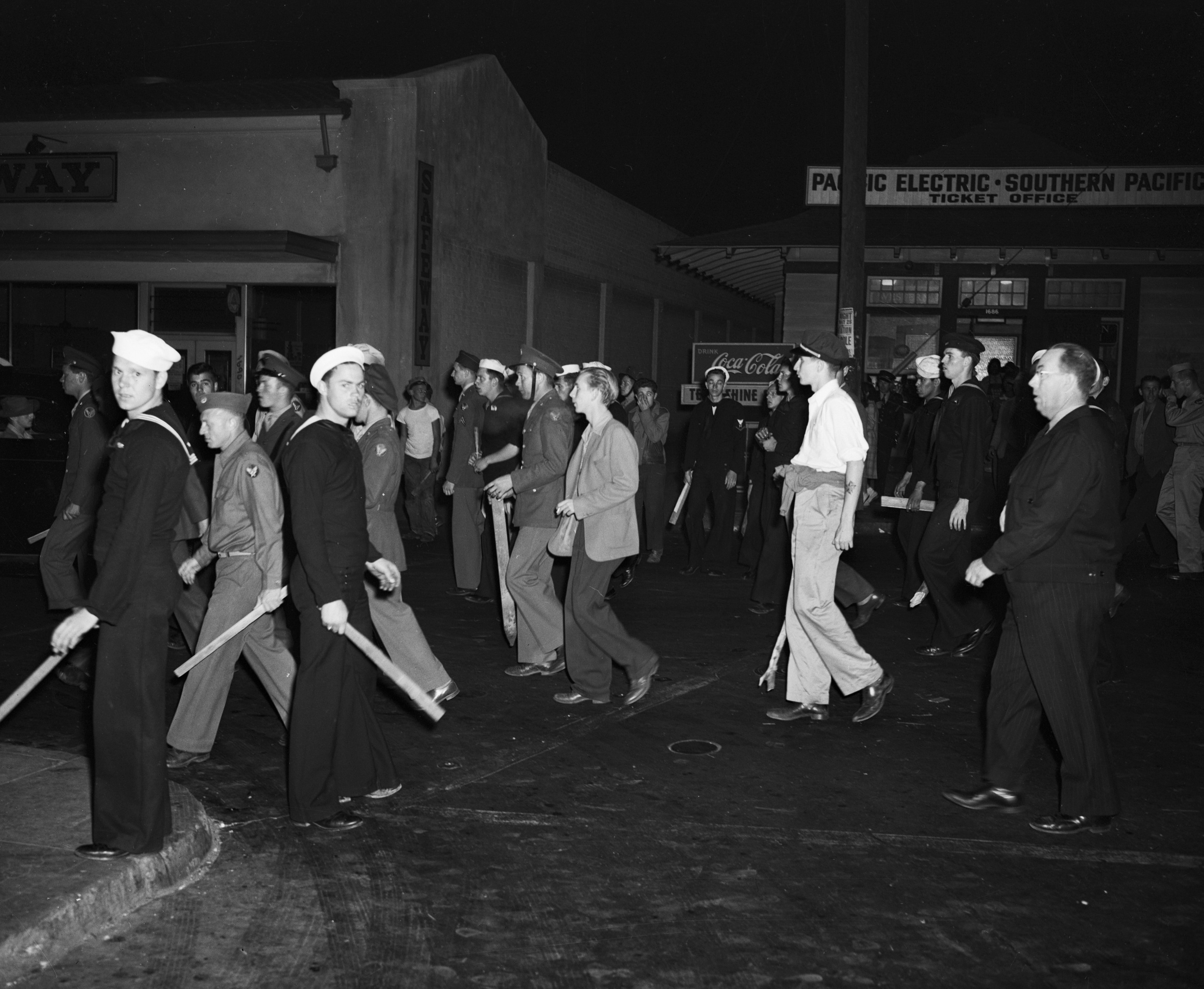
Branding is most powerful when it evokes an emotional response. By June 1943, the emotional resonance of the Zoot Suit had reached a boiling point. The riots began when groups of sailors claimed they had been insulted or attacked by “Zoot Suiters.” What followed was a week of targeted violence where mobs of servicemen and civilians roamed the streets of Los Angeles, stripping youth of their suits and burning the garments in the street.
The Uniform as a Target
In this conflict, both sides were identified by their “Uniforms”—the ultimate expression of a corporate or group brand. The sailors represented the “State Brand,” backed by the power and morality of the war effort. The Zoot Suiters represented the “Subculture Brand.”
The act of stripping the suits was a literal and symbolic “De-Branding.” By removing the clothes, the mobs were attempting to strip the youth of their chosen identity and force them back into a state of invisibility. This highlights a dark truth in brand strategy: when a visual identity becomes too effective at challenging the status quo, the dominant power structure will often attempt to dismantle the brand by force rather than through competition.
Brand Association and the “Pachuco” Identity
The riots were not just about the clothes; they were about what the clothes signified—the Pachuco identity. For the Mexican American community, the Pachuco brand was a way to navigate the “in-between” space of being neither fully Mexican nor fully accepted as American. It was a brand of resistance.
However, because this brand was so distinct and “loud,” it became a lightning rod. In marketing terms, the Zoot Suiters had “High Brand Salience”—they were impossible to ignore. In a tense, racially charged environment, high salience without the protection of institutional power makes a brand a target. The riots were the result of a “Market Correction” where the dominant culture used violence to suppress a competing identity that it could not assimilate.
The Legacy of Radical Branding: Lessons for Modern Identity Marketing
The Zoot Suit Riots eventually ended when military officials declared Los Angeles off-limits to sailors and the city council banned the wearing of zoot suits in public. However, the “Brand” of the Zoot Suit did not die; it evolved.
Authenticity and Resistance in Visual Branding
One of the most important takeaways for modern brand strategists is the resilience of “Authentic Identity Brands.” Despite the violence and the bans, the Zoot Suit became an enduring symbol of Chicano pride and civil rights. The riots proved that a brand built on genuine cultural experience is much harder to eliminate than a manufactured corporate brand. The Zoot Suit shifted from a “Fashion Brand” to a “Martyr Brand,” gaining even more cultural capital in the decades that followed.
Reclaiming the Narrative: Modern Iterations of the Zoot Suit
Today, we see the echoes of the Zoot Suit in how modern subcultures use fashion to signal identity and resistance. From the “Power Dressing” of the 1980s to the “Streetwear” movements of the 2000s, the mechanics remain the same: using visual excess and distinct silhouettes to claim space.
The Zoot Suit Riots teach us that branding is a high-stakes game of perception. What one group sees as “Style,” another may see as “Subversion.” For companies and personal brands today, the lesson is clear: your visual identity is never neutral. It exists within a broader ecosystem of cultural meanings, and the “causes” of conflict are often found in the gap between how a brand sees itself and how the world chooses to interpret it.
By analyzing the Zoot Suit Riots through the lens of brand strategy, we see that the conflict was more than a series of street fights; it was a battle over the right to define one’s own image in the face of a national narrative that demanded conformity. The Zoot Suit remains a powerful case study in the power of visual identity to disrupt, provoke, and ultimately, endure.
aViewFromTheCave is a participant in the Amazon Services LLC Associates Program, an affiliate advertising program designed to provide a means for sites to earn advertising fees by advertising and linking to Amazon.com. Amazon, the Amazon logo, AmazonSupply, and the AmazonSupply logo are trademarks of Amazon.com, Inc. or its affiliates. As an Amazon Associate we earn affiliate commissions from qualifying purchases.