
Germany has long been dubbed the “Exportweltmeister” (Export World Champion), a title it has held or closely contested for decades. As the largest economy in Europe and the third-largest in the world by nominal GDP, Germany’s financial health is inextricably linked to its ability to sell high-value goods and services across borders. For investors, financial analysts, and business leaders, understanding what Germany exports is not merely a lesson in geography—it is a study of global demand, industrial efficiency, and capital allocation.
The German export model is built on a foundation of high-value manufacturing and precision engineering. Unlike economies that rely heavily on raw materials or volatile service sectors, Germany’s wealth is generated through the transformation of raw inputs into complex, high-margin capital goods. This article explores the core sectors that drive Germany’s trade surplus, the financial structures that support them, and the emerging shifts in the global marketplace that are redefining German trade.

The Pillars of German Export Wealth: Identifying the Key Sectors
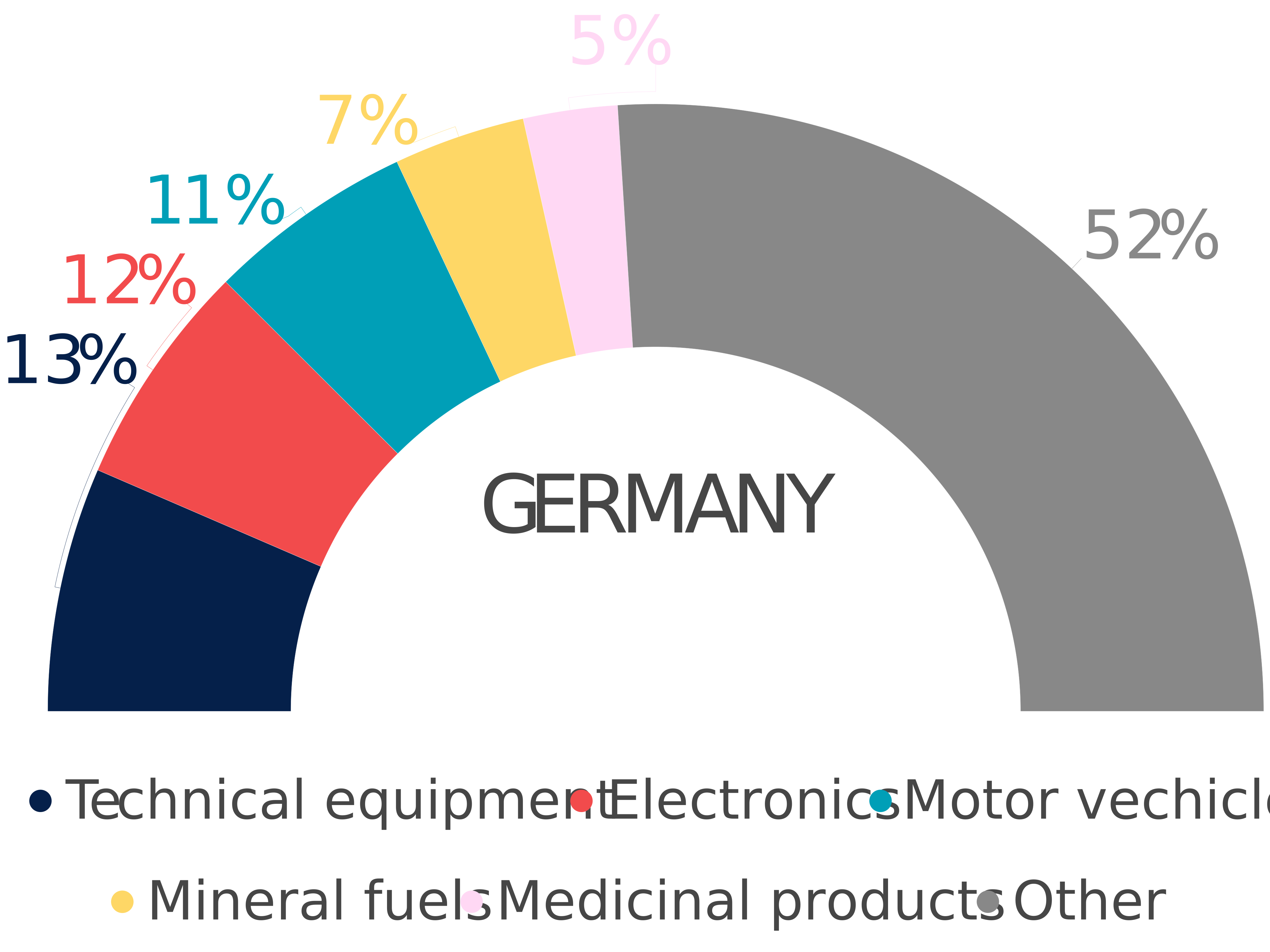
Germany’s export portfolio is remarkably diversified, yet it is anchored by three primary industrial pillars: automotive, machinery, and chemical products. These sectors represent the bulk of the country’s annual export revenue, which often exceeds €1.5 trillion. From a business finance perspective, these industries are characterized by high research and development (R&D) reinvestment rates and sophisticated supply chains.
The Automotive Hegemony
The automotive industry is the undisputed crown jewel of the German economy. Vehicles and vehicle parts consistently rank as the nation’s top export by value. Brands like Volkswagen, BMW, and Mercedes-Benz are not just consumer names; they are massive corporate entities that drive significant portions of the DAX (the German stock index).
Germany’s automotive exports are valued for their engineering excellence and premium pricing. From a financial standpoint, the strength of this sector lies in its high value-added production. Germany doesn’t just export “cars”; it exports advanced technology, safety systems, and prestige. This allows German firms to maintain higher profit margins than many of their global competitors. However, the shift toward electric vehicles (EVs) is currently forcing a massive reallocation of capital within these firms, as they transition from internal combustion engine dominance to battery-technology investments.
Industrial Machinery and Precision Engineering
Often referred to as the “hidden champions,” Germany’s machinery and equipment sector is perhaps the most vital component of its export economy. While cars are more visible, it is the specialized machinery—ranging from industrial robots to advanced printing presses—that fuels global manufacturing.
The “Mittelstand” (Germany’s unique class of small-to-mid-sized enterprises) dominates this niche. These companies often hold 70% to 90% of global market share in very specific categories. For an investor, these companies represent a stable, cash-flow-positive segment of the economy. They export the “tools that make the tools,” making them essential to the industrialization of emerging markets like India and Southeast Asia.
Chemical and Pharmaceutical Dominance
The third pillar is the chemical and pharmaceutical industry. Companies like BASF and Bayer are global leaders in chemical production, agriculture, and healthcare. This sector is characterized by high barriers to entry and intense capital requirements. Germany exports a vast array of chemical intermediates, specialized plastics, and life-saving medications. This sector provides a hedge against economic volatility; while car sales might dip during a recession, the global demand for pharmaceuticals and essential chemicals tends to remain inelastic.
The Macroeconomics of the Trade Surplus: Why It Matters for Investors
Germany is famous (and occasionally criticized) for its massive trade surplus—meaning it consistently exports more than it imports. In the world of international finance, this surplus is a double-edged sword that dictates the country’s relationship with the rest of the world and its internal financial policies.
Understanding the Current Account Balance
A trade surplus contributes to a positive current account balance, which indicates that Germany is a net lender to the rest of the world. For the German government and private sector, this results in a significant accumulation of foreign assets. From an investment perspective, this surplus provides a cushion of liquidity that allows German firms to acquire foreign competitors and invest in overseas production facilities.
However, the surplus also attracts scrutiny from international financial organizations like the IMF. Critics argue that Germany’s high export-to-import ratio suggests under-investment at home and a reliance on the demand of other nations. For those analyzing the Eurozone, the German trade surplus is a critical indicator of the Euro’s valuation and the overall stability of the European monetary union.

Foreign Direct Investment (FDI) and the Export Cycle
The relationship between exports and Foreign Direct Investment (FDI) is a cornerstone of German business finance. German companies do not just ship goods from Hamburg or Bremen; they reinvest their export profits into localized production hubs. For example, some of the largest BMW and Mercedes-Benz factories are located in the United States and China.
This strategy serves two financial purposes: it hedges against currency fluctuations (specifically the USD/EUR exchange rate) and reduces logistical costs. Investors looking at German equities must distinguish between “exported value” produced in Germany and “global sales” generated by German brands. The health of the German export model is increasingly dependent on these globalized financial structures rather than domestic production alone.
Future-Proofing the Economy: Transitions in Global Trade
The global economic landscape is shifting, and Germany is in the midst of a significant pivot to ensure its export model remains relevant in a decarbonized and digitized world. This transition requires a massive influx of private and public capital.
The Shift Toward Green Energy Exports
Germany’s “Energiewende” (energy transition) has positioned the country as a pioneer in green technology. While the domestic transition has been complex, the export potential for green hydrogen technology, wind turbine components, and energy-efficient building materials is immense.
Financial markets are increasingly valuing companies based on their ESG (Environmental, Social, and Governance) performance. German engineering firms are capitalizing on this by exporting “sustainability.” By selling the technology required for other nations to meet their Paris Agreement goals, Germany is creating a new, high-growth export category that complements its traditional industrial base.
Digital Services and the New Export Frontier
Historically, Germany has been slower to export software and digital services compared to the United States. However, there is a growing movement toward “Industry 4.0″—the integration of the Internet of Things (IoT) into manufacturing. Germany is now exporting the software and digital infrastructure that allows factories to become “smart.”
For the financial sector, this represents a shift from one-time hardware sales to recurring revenue models via software licenses and maintenance contracts. This evolution is vital for maintaining the trade surplus as global competition in physical manufacturing intensifies.
Challenges to the German Export Model
Despite its historical success, the German export-led growth model faces several structural headwinds that require careful financial navigation.
Geopolitical Volatility and Supply Chain Risks
The German economy is highly sensitive to geopolitical shifts. Because it relies on open markets and global trade routes, conflicts or trade wars can have an immediate impact on the bottom line of major German exporters. The disruption of energy supplies and the decoupling of certain trade relationships (such as with Russia or changing dynamics with China) have forced German firms to rethink their supply chain finance. “Reshoring” and “friend-shoring”—the practice of sourcing components from politically allied nations—are becoming expensive but necessary financial strategies to mitigate risk.
Demographic Shifts and Labor Costs
Germany faces a demographic challenge: an aging population and a shrinking labor force. From a business finance perspective, this leads to rising labor costs and a potential decline in manufacturing competitiveness. To counter this, German exporters are investing heavily in automation and AI. The goal is to maintain high export volumes with fewer workers, ensuring that the “Made in Germany” label remains profitable despite high domestic wages.
Conclusion: The Resilience of German Trade
What Germany exports is a reflection of its economic identity: high-quality, high-complexity, and high-value. From the luxury sedans on the streets of New York to the specialized robotic arms in a factory in Seoul, German exports are the lifeblood of the global industrial economy.
For those in the world of money—investors, business owners, and financial strategists—Germany represents a unique case study in how a nation can leverage engineering prowess into sustained financial dominance. While challenges like the EV transition and geopolitical instability loom, the structural advantages of the German export model—its high R&D reinvestment, the stability of the Mittelstand, and the pivot toward green technology—suggest that Germany will remain a central player in the global financial landscape for the foreseeable future. Understanding these export dynamics is essential for anyone looking to navigate the complexities of international business and investment.
aViewFromTheCave is a participant in the Amazon Services LLC Associates Program, an affiliate advertising program designed to provide a means for sites to earn advertising fees by advertising and linking to Amazon.com. Amazon, the Amazon logo, AmazonSupply, and the AmazonSupply logo are trademarks of Amazon.com, Inc. or its affiliates. As an Amazon Associate we earn affiliate commissions from qualifying purchases.