
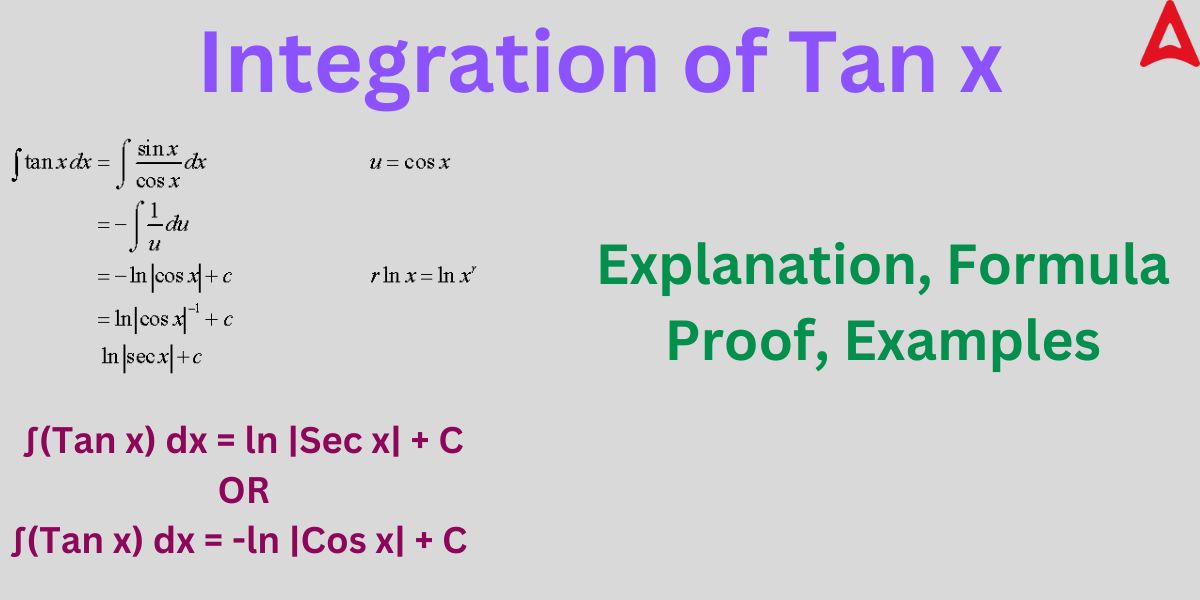
In the landscape of modern technology, the bridge between abstract mathematics and functional software is shorter than ever. While a student in a freshman calculus course might view the question “What is the integral of tan?” as a rite of passage involving trigonometric identities and natural logarithms, a software engineer or data scientist views it as a fundamental building block of algorithmic logic. In the digital realm, the integral of $tan(x)$—mathematically expressed as $-ln|cos(x)| + C$—is more than just a formula; it represents the sophisticated ways in which technology processes continuous change, optimizes signals, and trains the neural networks that power our daily digital interactions.
As we move deeper into an era defined by Artificial Intelligence (AI) and complex computational modeling, understanding the mechanics of symbolic computation becomes essential. This article explores the intersection of classical calculus and modern technology, examining how software solves these problems and why they remain critical in our high-tech ecosystem.
1. The Architecture of Symbolic Computation
To understand how a computer answers “What is the integral of tan?”, we must first look at the difference between numerical and symbolic computation. Most consumer software operates on numerical values—discrete data points used to render a video or calculate a bank balance. However, high-level tech tools like WolframAlpha, MATLAB, and specialized AI models use Symbolic Computation.
The Logic of Symbolic Integration
When a human solves $int tan(x) , dx$, they typically use the substitution method. By rewriting $tan(x)$ as $sin(x)/cos(x)$, one can set $u = cos(x)$, leading to the result involving the natural logarithm. Software engines are programmed to recognize these patterns through a process called “pattern matching” and the “Risch algorithm.”
The Risch algorithm is a complex method used in Computer Algebra Systems (CAS) to determine if an elementary function has an elementary integral. For tech developers, the ability to embed these mathematical rules into software allows for the creation of tools that can design bridges, simulate flight paths, or predict weather patterns with pinpoint accuracy.
Compilers and Mathematical Parsing
Modern programming languages, such as Python with the SymPy library, allow developers to treat mathematical expressions as objects. This is a massive leap from the early days of computing where every operation had to be manually translated into machine code. Today, a developer can write a single line of code to solve a complex integral, and the compiler handles the heavy lifting of algebraic manipulation. This abstraction is what enables rapid prototyping in tech research and development.
2. AI and the Evolution of Mathematical Problem Solving
The rise of Large Language Models (LLMs) like GPT-4 and specialized math-solvers has changed how we interact with calculus. No longer is the integral of tan a hurdle that requires a textbook; it is a query that an AI can solve and explain in milliseconds.
Neural Networks vs. Symbolic Engines
There is a fascinating tension in the tech world between “Probabilistic AI” and “Symbolic AI.” A standard LLM predicts the next token in a sequence, meaning it “remembers” that the integral of tan is $-ln|cos(x)|$. However, it doesn’t necessarily “understand” the underlying calculus.
To solve this, tech giants are integrating symbolic engines with neural networks. This hybrid approach ensures that the AI provides the conversational context while the symbolic engine handles the rigorous calculation. This ensures that in critical applications—such as autonomous driving or structural engineering software—the math is not just a “prediction” but a verifiable fact.
The Role of Machine Learning in Optimization
In the field of Machine Learning (ML), integration plays a quiet but vital role. While we often focus on derivatives (gradients) for optimization, integration is essential in calculating probability distributions and expected values. When developers build AI tools that must operate under uncertainty, they rely on the area under the curve—a concept rooted in the same fundamental calculus that gives us the integral of trigonometric functions.
3. Engineering the Real World: Tangents and Trigonometry in Tech
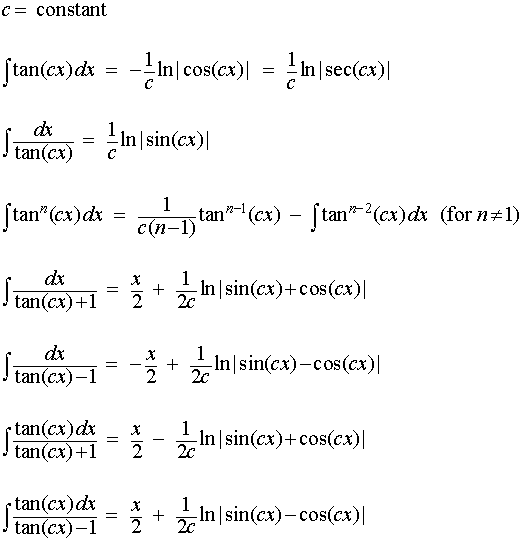
The practical application of the integral of $tan(x)$ extends far beyond the classroom. In various technological sectors, the behavior of trigonometric functions is used to model periodic phenomena.
Signal Processing and Audio Engineering
In digital signal processing (DSP), waves are everything. Whether it’s a 5G signal or a high-fidelity audio file, engineers use trigonometric functions to decompose signals into their constituent frequencies. The integration of these functions allows for the transition between time domains and frequency domains (via Fourier Transforms). While $tan(x)$ is less common in pure sine-wave synthesis due to its asymptotes, its integral appears in the calculations of phase shifts and the design of certain types of filters in electronic circuits.
Computer Graphics and Game Development
In the world of 3D rendering and game engine design (like Unreal Engine or Unity), “tangent space” is a critical concept for lighting and textures. Normal mapping—a technique used to make flat surfaces look bumpy or detailed—relies on calculations involving tangents. While the direct integral might not be calculated every frame, the mathematical relationship between the tangent of an angle and the rate of change is foundational to how light reflects off a digital surface, creating the photorealistic visuals we see in modern gaming.
Cybersecurity and Cryptography
Advanced digital security often relies on mathematical hardness. While the integral of tan is relatively simple, the broader field of “Elliptic Curve Cryptography” (ECC) uses complex algebraic curves. The logic used to develop software that can solve or verify integrals is the same logic used to test the strength of encryption algorithms. If a computer can easily reverse-engineer a mathematical process, that process is not secure for data encryption.
4. EdTech: The Digital Transformation of Mathematics
The way we learn “what is the integral of tan” has been revolutionized by Educational Technology (EdTech). This sector has turned static equations into interactive, dynamic experiences.
Interactive Learning Platforms
Platforms like Khan Academy or Brilliant.org use software to visualize the integral. Instead of seeing a series of symbols, a student can see the “area under the curve” of the tangent function as it approaches its vertical asymptotes. This visualization is powered by JavaScript libraries like D3.js or Three.js, which translate mathematical functions into pixels on a screen.
The Democratization of Expertise
Tech has democratized access to high-level mathematics. Twenty years ago, solving a non-trivial integral required an expensive graphing calculator or a library of tables. Today, open-source software like GNU Octave or R provides these tools to anyone with an internet connection. This has lowered the barrier to entry for fields like data science and quantitative finance, allowing a more diverse group of people to build technology based on mathematical principles.
5. The Future of Computational Mathematics
As we look toward the future, the relationship between calculus and technology is set to deepen through quantum computing and advanced simulation software.
Quantum Computing and Complex Functions
Quantum computers operate on qubits, which exist in a superposition of states. The math required to program these machines involves complex numbers and high-dimensional geometry. The integration of trigonometric functions is a baseline requirement for developing the algorithms that will one day solve problems in medicine and material science that are currently impossible for classical computers to handle.
Automated Theorem Proving
We are entering an era where software will not just solve integrals but will discover new mathematical theorems. “Lean” is a proof assistant and a programming language that allows mathematicians to verify proofs with total certainty. As tech continues to evolve, we may find that the simple integral of tan was just the beginning of a long journey toward fully automated, error-free mathematical reasoning.
Conclusion: The Integral Link
The question “What is the integral of tan?” may seem like a relic of high school mathematics, but in the context of modern technology, it is a window into the sophisticated systems that define our world. From the symbolic engines that parse our queries to the game engines that render our entertainment, the ability to process, integrate, and apply trigonometric functions is a cornerstone of digital innovation.
As tech professionals, developers, and enthusiasts, recognizing the mathematical foundations of our tools allows us to build better, more efficient, and more reliable systems. The integral $-ln|cos(x)| + C$ is a reminder that even in a world of “Move Fast and Break Things,” the unchanging laws of mathematics remain the ultimate source code for reality. Whether it’s through the lens of AI, engineering, or education, the integration of classical math into modern software continues to drive the next wave of technological evolution.
aViewFromTheCave is a participant in the Amazon Services LLC Associates Program, an affiliate advertising program designed to provide a means for sites to earn advertising fees by advertising and linking to Amazon.com. Amazon, the Amazon logo, AmazonSupply, and the AmazonSupply logo are trademarks of Amazon.com, Inc. or its affiliates. As an Amazon Associate we earn affiliate commissions from qualifying purchases.