
The landscape of modern healthcare is no longer defined solely by stethoscopes and manual charts. Today, we live in the era of “Healthtech,” where biological data is translated into digital insights through sophisticated algorithms and automated systems. One of the most critical, yet often misunderstood, data points in a digital Complete Blood Count (CBC) report is RDW-CV. Standing for Red Cell Distribution Width – Coefficient of Variation, RDW-CV is a metric that represents the variation in the size of red blood cells.
While it originated as a laboratory measurement, the rise of diagnostic software, machine learning, and personal health apps has transformed RDW-CV into a powerful digital biomarker. In this exploration, we will dive deep into the technological infrastructure that calculates this value, the role of AI in interpreting its fluctuations, and how digital security protocols protect this sensitive biological data.
The Intersection of Bioinformatics and Blood Analytics
At its core, RDW-CV is a computational result derived from automated flow cytometry. In the past, lab technicians would manually view blood smears under a microscope—a process prone to human error and limited by low sample sizes. Today, high-throughput diagnostic hardware utilizes laser-based technology to analyze thousands of cells per second, generating massive datasets that software then processes into the RDW-CV value.
What is RDW-CV? Decoding the Algorithm
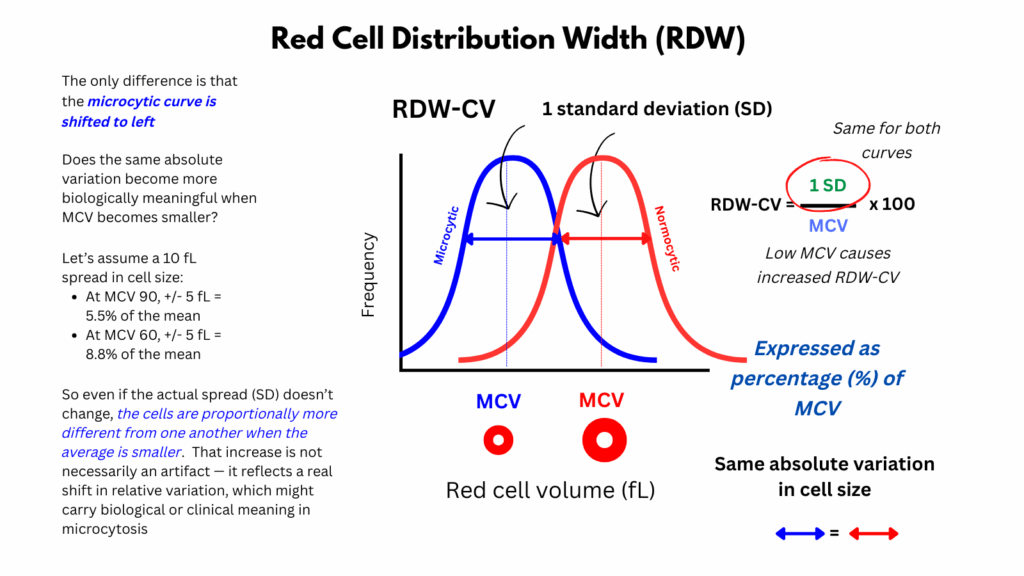
RDW-CV is a mathematical calculation. It is derived by taking the standard deviation (SD) of red blood cell volume and dividing it by the Mean Corpuscular Volume (MCV), then multiplying by 100 to get a percentage. In technical terms, it is a measure of “anisocytosis,” or the degree of variation in cell size.
From a tech perspective, this is a classic example of normalization in data science. By dividing the standard deviation by the mean, the software ensures that the “width” of cell distribution is relative to the average size of the cells, allowing for a standardized metric that can be compared across different patient populations and different hardware manufacturers.
From Labs to Laptops: The Digital Shift in Hematology
The transition from analog to digital hematology has allowed for the seamless integration of RDW-CV into Electronic Health Records (EHR). When a blood analyzer processes a sample, the raw data is transmitted via Laboratory Information Systems (LIS) to a central server. This digital shift allows for longitudinal tracking—the ability for software to plot a patient’s RDW-CV over months or years.
This technological capability is crucial because a single data point is often less informative than the trend. Advanced data visualization tools now allow clinicians to see “spikes” in RDW-CV, which may correlate with the onset of nutritional deficiencies or chronic inflammatory states, long before the patient presents with physical symptoms.
The Role of AI and Machine Learning in Interpreting RDW-CV
As we move deeper into the decade of Artificial Intelligence, the interpretation of RDW-CV is shifting from simple “reference range” checking to complex predictive modeling. Software developers are now building AI tools that use RDW-CV as a key input feature to predict a variety of health outcomes.
Predictive Analytics: Moving Beyond Reference Ranges
Traditional diagnostic software flags a result if it falls outside a predetermined range (typically 11.5% to 14.5% for RDW-CV). However, machine learning models can look at “normal” RDW-CV values in conjunction with hundreds of other digital data points—such as glucose levels, creatinine, and age—to identify subtle patterns.
For instance, research in the tech-med space has shown that AI algorithms can use RDW-CV to predict the risk of cardiovascular events or hospital readmission rates. By training neural networks on millions of historical blood reports, these tools can provide a “risk score” rather than just a laboratory number, moving diagnostics from a reactive state to a proactive, predictive one.
Integration with Wearables and Personal Health Records
The next frontier for RDW-CV is the integration of clinical data with consumer-facing health technology. While current smartwatches cannot measure RDW-CV directly (as it requires a physical blood sample), “Digital Twin” technology is emerging. Companies are developing platforms where users can upload their CBC data, which the app then correlates with lifestyle data from wearables (sleep patterns, heart rate variability, and activity levels).
This ecosystem creates a holistic digital profile. If a user’s RDW-CV is rising (indicating higher cell size variation), and their wearable data shows a decrease in aerobic capacity, the software can provide high-level insights into potential physiological stressors. This is the epitome of “Personalized Healthtech,” where the user is empowered by data clarity.
Cyber-Security and Privacy in Diagnostic Data
As RDW-CV and other hematological markers move through digital pipelines, the importance of robust digital security cannot be overstated. Health data is among the most sensitive information a person owns, making it a prime target for cyber-threats.
Protecting Sensitive Hematology Data
Every time a value like RDW-CV is calculated and sent to a patient portal, it must be protected by end-to-end encryption. In the United States, HIPAA (Health Insurance Portability and Accountability Act) sets the standard, but the tech industry often goes further. Modern healthtech stacks utilize Advanced Encryption Standard (AES) 256-bit encryption for data at rest and Transport Layer Security (TLS) for data in transit.
Software engineers must ensure that the API (Application Programming Interface) connections between the laboratory hardware and the patient-facing app are secure. A “man-in-the-middle” attack on diagnostic data could lead to the unauthorized disclosure of a patient’s health status, which has significant implications for insurance and personal privacy.
Blockchain and Decentralized Health Records
To combat the risks of centralized data silos, some tech innovators are looking toward blockchain technology. By storing RDW-CV results on a decentralized ledger, the patient gains ultimate ownership of their data. Instead of the data residing on a single hospital server, it is encrypted and distributed.
When a patient visits a new specialist, they can grant temporary “keys” to the doctor to view their RDW-CV trends. This ensures data integrity—the numbers cannot be tampered with—and provides a transparent audit trail of who accessed the information and when. This intersection of fintech security and medtech data is a burgeoning field in the technology sector.
The Future of Healthtech: Remote Monitoring and Real-Time Diagnostics
The ultimate goal of health technology is to make diagnostic insights like RDW-CV more accessible and actionable. We are currently witnessing a surge in at-home testing kits that sync directly with smartphone apps, bypassing the traditional physician-office bottleneck.
API Integrations for Personalized Health Platforms
The “API-ification” of health data is allowing different software ecosystems to talk to each other. For example, a nutrition app could theoretically pull RDW-CV data from a lab’s API to suggest specific dietary adjustments. If the RDW-CV indicates a trend toward macrocytic or microcytic variation, the software might suggest a focus on Vitamin B12 or Iron-rich data points in the user’s food log.
This level of automation requires sophisticated backend integration. Developers are focused on creating “interoperability standards,” such as FHIR (Fast Healthcare Interoperability Resources), which allow different health apps to exchange RDW-CV and other laboratory data without losing context or accuracy.
Telemedicine and the Democratization of Laboratory Results
Telemedicine platforms are perhaps the biggest beneficiaries of digital RDW-CV reporting. In a virtual consultation, a doctor can share their screen and show the patient a graphical representation of their blood metrics. This visual storytelling, powered by modern UI/UX design, helps patients understand that RDW-CV isn’t just a cryptic acronym—it’s a digital reflection of their cellular health.
As lab-on-a-chip technology advances, we may soon see point-of-care devices that can calculate RDW-CV in minutes using a single drop of blood and a smartphone attachment. The software behind these devices will utilize computer vision to analyze cell images, effectively turning a mobile phone into a high-powered hematology analyzer.

Conclusion: The Digital Evolution of the Blood Test
RDW-CV is more than just a line item on a medical report; it is a vital data point in the rapidly evolving healthtech landscape. From the complex algorithms that calculate the coefficient of variation to the AI models that predict future health risks, technology has elevated RDW-CV into a cornerstone of digital diagnostics.
As we continue to integrate bioinformatics with secure cloud computing and intuitive software design, the mystery of “what is RDW-CV” is replaced by the clarity of data-driven health management. In this tech-forward era, understanding our biological data is the first step toward optimizing our human potential, ensuring that every “bit” and “byte” of our health information is used to foster a longer, healthier life.
aViewFromTheCave is a participant in the Amazon Services LLC Associates Program, an affiliate advertising program designed to provide a means for sites to earn advertising fees by advertising and linking to Amazon.com. Amazon, the Amazon logo, AmazonSupply, and the AmazonSupply logo are trademarks of Amazon.com, Inc. or its affiliates. As an Amazon Associate we earn affiliate commissions from qualifying purchases.