
Understanding the ownership of Alphabet Inc. is not merely an exercise in curiosity; it is a fundamental requirement for any serious investor or financial analyst. Alphabet, the parent company of Google, is one of the most influential entities in the global economy, boasting a market capitalization that frequently hovers in the trillions of dollars. However, unlike a traditional democracy where one share equals one vote, Alphabet utilizes a complex, multi-tiered share structure that concentrates power in the hands of a few. For the retail investor, the question of “who owns Alphabet” is answered in two ways: who holds the economic interest, and who holds the decision-making power.
Decoding the Ownership Hierarchy: Class Shares and Strategic Control
The most critical aspect of Alphabet’s ownership is its share structure. To understand who truly controls the company, one must distinguish between the different classes of stock traded on the Nasdaq. Alphabet’s structure was intentionally designed to protect the company’s long-term vision from the short-term pressures of Wall Street, a move that has since been emulated by many other tech giants but remains a point of contention among corporate governance advocates.
Class A (GOOGL): The Common Investor’s Voice
Class A shares, traded under the ticker GOOGL, are the standard voting shares available to the public. Each share of Class A stock carries one vote. These are the shares typically held by retail investors and institutional funds who wish to have a formal, albeit limited, say in corporate matters such as board elections and shareholder proposals. While Class A represents a massive portion of the company’s market equity, its collective voting power is often overshadowed by the “insider” class of shares.
Class C (GOOG): Economic Interest Without the Vote
In 2014, Google underwent a significant stock split that created Class C shares, traded under the ticker GOOG. The defining characteristic of Class C shares is that they carry zero voting rights. This class was created to allow the company to issue stock for employee compensation and acquisitions without diluting the voting power of the founders. For the passive investor, Class C shares provide the same economic exposure to Alphabet’s growth as Class A, but they offer no participation in the company’s democratic processes.
Class B: The Founders’ “Super-Voting” Power
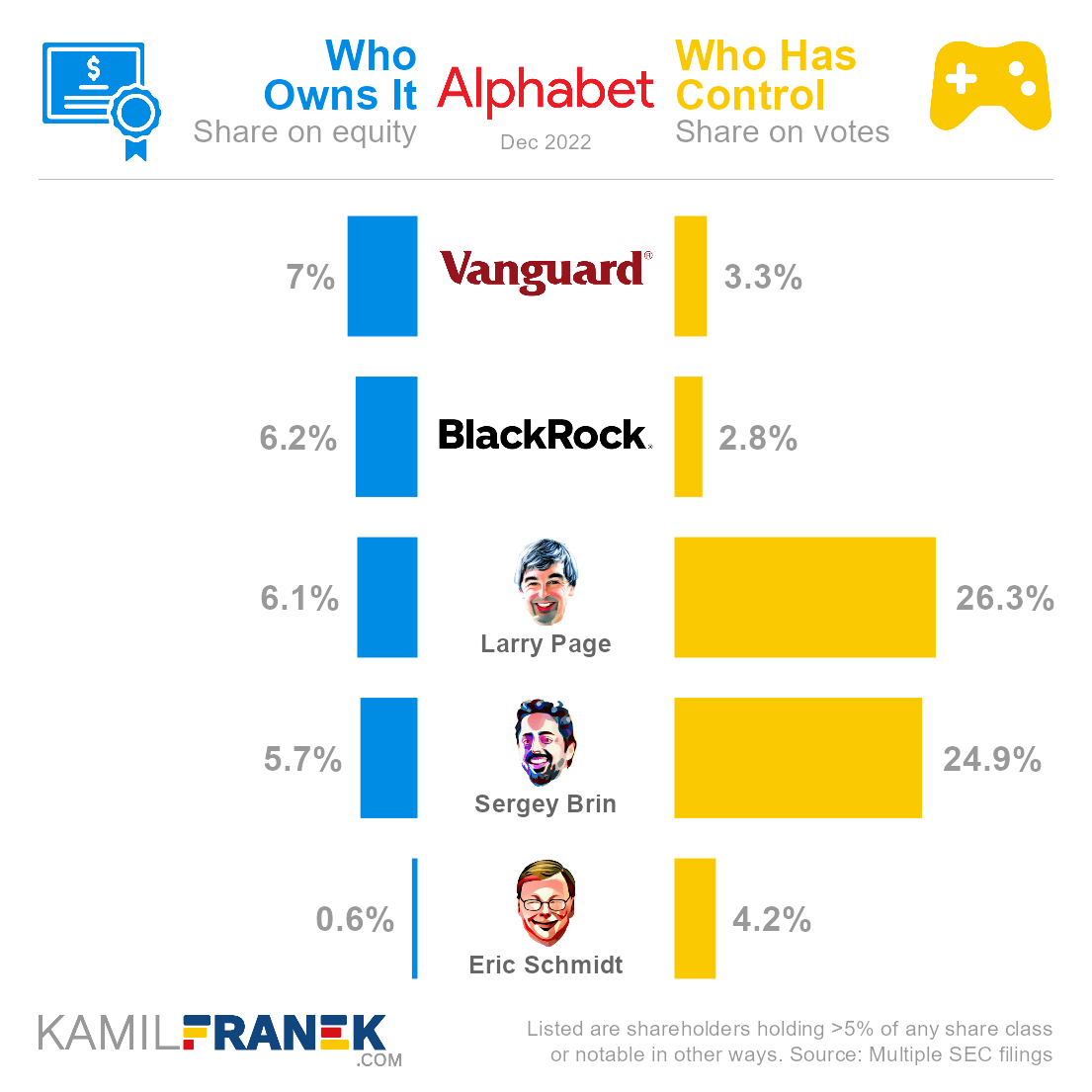
The real power at Alphabet lies in the unlisted Class B shares. These shares are not traded on public exchanges and are held almost exclusively by the company’s founders, Larry Page and Sergey Brin, and a few key insiders. Each Class B share carries ten votes. This “super-voting” mechanism ensures that even if the founders own a minority of the total equity, they maintain a majority of the voting power. As of recent filings, Page and Brin control over 51% of the total voting power, giving them ultimate authority over the company’s direction, board composition, and major strategic pivots.
Institutional Dominance: The Giants Behind the Scenes
While the founders hold the steering wheel, the fuel for Alphabet’s massive valuation comes from institutional investors. These are the mutual funds, pension funds, and investment banks that manage trillions of dollars for individual savers and large organizations. Because Alphabet is a cornerstone of the S&P 500 and the Nasdaq-100, almost every major institutional player has a significant stake in the company.
The Big Three: Vanguard, BlackRock, and State Street
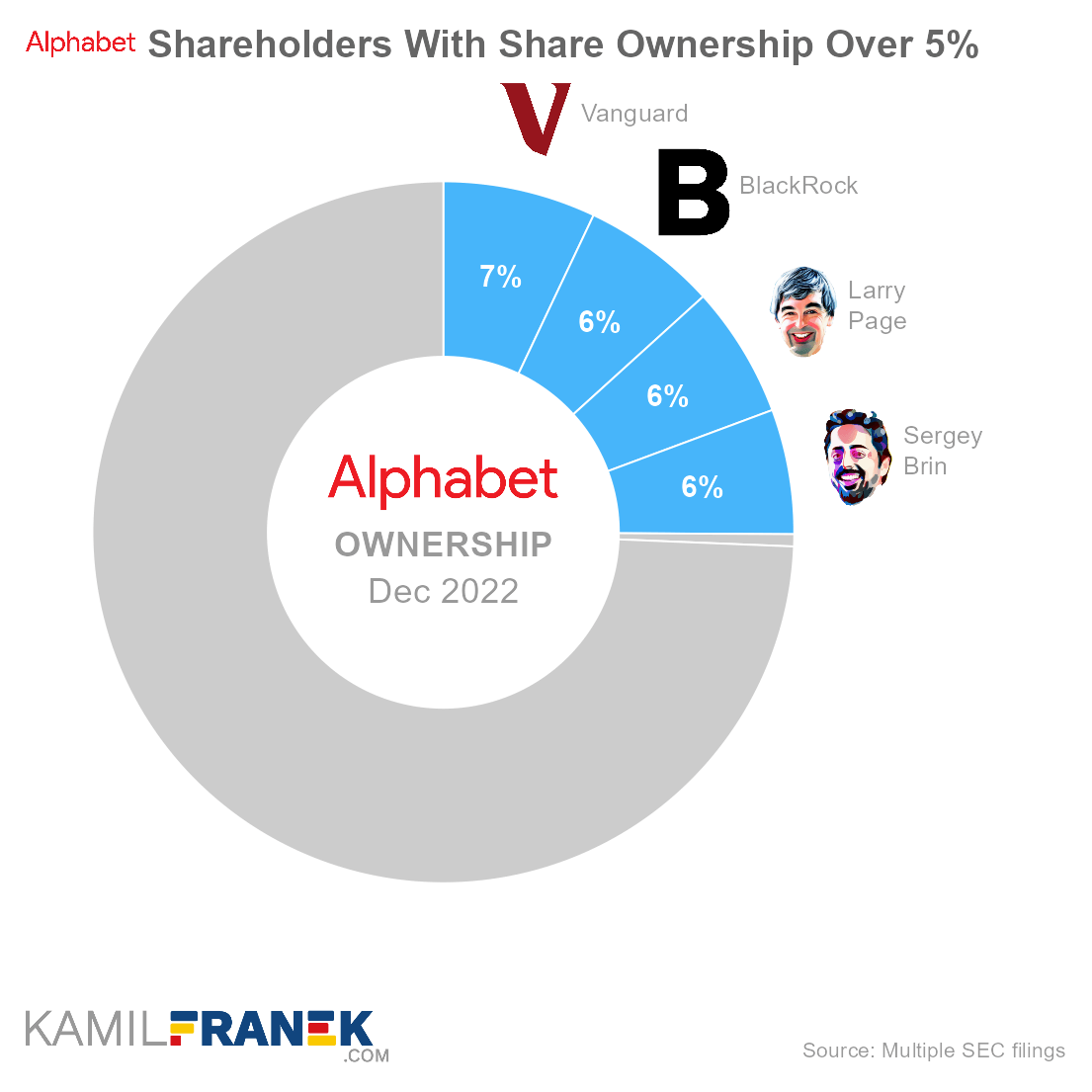
The “Big Three” asset managers are the largest external owners of Alphabet. The Vanguard Group typically holds the top spot, owning roughly 7% to 8% of the company’s outstanding shares. BlackRock follows closely behind, with State Street Global Advisors rounding out the trio. These firms do not “own” the stock in the traditional sense; rather, they hold it on behalf of the millions of individuals who invest in their index funds and ETFs. However, because they manage the proxies for these shares, their influence on corporate ESG (Environmental, Social, and Governance) initiatives is substantial.
Hedge Funds and Mutual Fund Heavyweights
Beyond the index fund giants, actively managed funds also play a massive role in Alphabet’s ownership. Firms like Fidelity Investments and T. Rowe Price maintain large positions, often betting on the company’s ability to dominate the AI landscape and cloud computing market. For these investors, Alphabet is viewed as a “core” holding—a stock that provides stability and growth, acting as a proxy for the health of the digital economy.
The Impact of Institutional Inflows on Stock Volatility
Institutional ownership currently sits at approximately 60% to 70% of Alphabet’s total float. This high level of institutional concentration usually results in lower volatility compared to speculative tech stocks. When large institutions “buy and hold,” it creates a price floor. Conversely, if a major fund decides to rebalance its portfolio and dump Alphabet shares, it can trigger significant price movements, making the tracking of institutional sentiment a vital task for any Alphabet shareholder.
Executive Ownership and the Role of Management
While Page and Brin are the most prominent individual owners, the current leadership team also holds significant equity, aligning their personal wealth with the company’s performance. This “skin in the game” is a key metric for investors who want to ensure that management is incentivized to drive long-term value rather than short-term gains.
Sundar Pichai’s Stake and Compensation
Sundar Pichai, the CEO of both Google and Alphabet, holds a substantial amount of Alphabet stock, primarily granted through Performance Stock Units (PSUs) and Restricted Stock Units (RSUs). While his voting power is negligible compared to the founders, his net worth is intrinsically tied to Alphabet’s stock price. His compensation packages are frequently tied to the company’s total shareholder return (TSR) relative to other S&P 500 companies, ensuring that his leadership focuses on maintaining Alphabet’s competitive edge.
The Legacy of the Founders: Page and Brin
Although Larry Page and Sergey Brin stepped down from their executive roles in 2019, they remains on the board and are the company’s largest individual shareholders. Their continued ownership of Class B shares means that Alphabet is, in many ways, still a “founder-led” company. This provides a level of stability and long-term thinking that is rare in the corporate world, but it also creates a “key man risk.” If the founders’ interests were to diverge from those of the minority shareholders, the public has very little recourse to change the company’s trajectory.
Inside Ownership Trends
Tracking whether insiders are buying or selling can provide clues about the internal health of a company. Generally, Alphabet insiders have been consistent sellers over the years, but this is usually interpreted as part of pre-planned 10b5-1 trading plans for personal diversification rather than a lack of confidence in the company. Given the sheer scale of their holdings, even a small divestment can amount to hundreds of millions of dollars.
Alphabet’s Financial Ecosystem: Where Ownership Meets Value
To understand why so many entities want to own Alphabet, one must look at the financial engine that powers it. Alphabet is not just a search engine; it is a conglomerate that functions like a venture capital fund with a massive, high-margin cash cow at its center.
Google Services: The Revenue Powerhouse
The vast majority of Alphabet’s value is derived from Google Services, which includes Search, YouTube, and the Play Store. This segment generates the “free cash flow” that allows Alphabet to engage in aggressive share buybacks. In recent years, Alphabet has authorized tens of billions of dollars in stock repurchases. For owners, this is a critical financial mechanic: by reducing the total number of shares outstanding, the company increases the percentage ownership of every remaining shareholder without them having to spend an extra dime.
Google Cloud and the Path to Profitability
For many years, Google Cloud was a drag on earnings, requiring massive capital expenditures. However, as it has reached a scale of profitability, it has become a new pillar for investor interest. Institutional owners are particularly focused on Cloud because it represents a recurring, high-margin revenue stream that diversifies the company away from its heavy reliance on advertising.
“Other Bets”: The Long-Shot Assets
Alphabet’s “Other Bets” category—which includes Waymo (autonomous driving), Verily (life sciences), and Wing (delivery drones)—represents the speculative side of ownership. While these ventures currently operate at a loss, they hold the potential for “moonshot” returns. Investors in Alphabet are not just buying a search engine; they are buying an option on the future of transportation, healthcare, and artificial intelligence.

Conclusion: What Alphabet Ownership Means for the Future
Ownership of Alphabet Inc. is a study in the balance between visionary control and institutional capital. The founders, through their Class B shares, maintain a grip on the company’s soul and strategy, while institutional giants like Vanguard and BlackRock provide the liquidity and market stability that allow the stock to thrive.
For the individual investor, owning Alphabet—whether through GOOG or GOOGL—means participating in a financial ecosystem that dominates the modern world. However, it also means accepting a secondary role in governance. As Alphabet continues to navigate the complexities of AI regulation, antitrust litigation, and global economic shifts, the concentration of power in its ownership structure will remain its most defining, and debated, financial characteristic. Whether you are an institutional fund manager or a retail investor with a few shares, you are part of a massive collective that owns the gateway to the world’s information.
aViewFromTheCave is a participant in the Amazon Services LLC Associates Program, an affiliate advertising program designed to provide a means for sites to earn advertising fees by advertising and linking to Amazon.com. Amazon, the Amazon logo, AmazonSupply, and the AmazonSupply logo are trademarks of Amazon.com, Inc. or its affiliates. As an Amazon Associate we earn affiliate commissions from qualifying purchases.