
In the rapidly evolving landscape of enterprise data storage, the demand for reliability, speed, and scalability has never been higher. While most casual users are familiar with SATA (Serial Advanced Technology Attachment) drives found in laptops and desktops, the backbone of modern data centers and corporate infrastructures often relies on a more robust technology: the SAS (Serial Attached SCSI) disk.
SAS represents a significant leap in storage interface technology, combining the high-performance heritage of the traditional Small Computer System Interface (SCSI) with the efficiency of serial communication. This article explores the intricate details of SAS disks, their architecture, how they compare to other storage solutions, and why they remain the gold standard for mission-critical enterprise environments.
The Evolution and Core Mechanics of SAS Architecture
To understand what a SAS disk is, one must first understand the legacy of SCSI. For decades, Parallel SCSI was the go-to interface for high-end servers. However, as data speeds increased, parallel technology hit a “physical wall” where signal interference and cable length limitations became insurmountable. The industry responded by moving to a serial point-to-point architecture, resulting in Serial Attached SCSI.
From Parallel to Serial Communication
In a parallel system, data is sent across multiple wires simultaneously. At high speeds, these signals can arrive out of sync—a phenomenon known as “clock skew.” SAS eliminates this by sending data serially (one bit at a time) at extremely high frequencies. This allows for much thinner cables, better airflow in server chassis, and significantly longer cable runs (up to 10 meters) without signal degradation.
Point-to-Point Connectivity
Unlike older technologies where devices shared a single bus, SAS utilizes a point-to-point architecture. This means each disk has a dedicated connection to the controller. If one drive fails or experiences latency, it does not impede the performance of other drives in the array. This design is fundamental to the high “Quality of Service” (QoS) that enterprise applications require.
SAS Expanders and Scalability
One of the most powerful features of SAS technology is its scalability. Through the use of SAS Expanders, a single SAS controller can theoretically support up to 65,535 devices. These expanders act like a high-speed switch for storage traffic, allowing data centers to scale their storage capacity vertically and horizontally with ease.
Key Features that Define SAS Performance and Reliability
SAS disks are not merely “faster versions” of consumer hard drives; they are engineered with different electrical and mechanical priorities. In the world of enterprise tech, downtime is measured in thousands of dollars per second, and SAS disks are built to mitigate that risk.
Dual-Porting for High Availability
Perhaps the most critical feature of a SAS disk is its dual-port capability. A SAS drive features two independent ports, allowing it to connect to two different controllers simultaneously. If one controller or “path” fails, the system can automatically switch to the second port to maintain access to the data. This redundancy is a requirement for “five-nines” (99.999%) uptime in professional environments—a feature notably absent in SATA drives.
Full-Duplex Communication
While SATA drives operate in half-duplex (meaning they can either read or write at any given time, but not both), SAS drives utilize full-duplex communication. This allows the drive to read and write data simultaneously, effectively doubling the potential throughput during heavy workloads. This is particularly beneficial for database servers and virtualized environments where multiple simultaneous requests are the norm.
Advanced Command Queuing and Error Recovery
SAS utilizes the SCSI command set, which is far more sophisticated than the ATA command set used by SATA. This includes advanced error recovery protocols and “Tagged Command Queuing” (TCQ). TCQ allows the disk to receive a large batch of requests and reorder them internally to execute them in the most efficient physical path possible, minimizing the movement of the disk’s mechanical head and reducing latency.
SAS vs. SATA: Choosing the Right Interface for the Workload

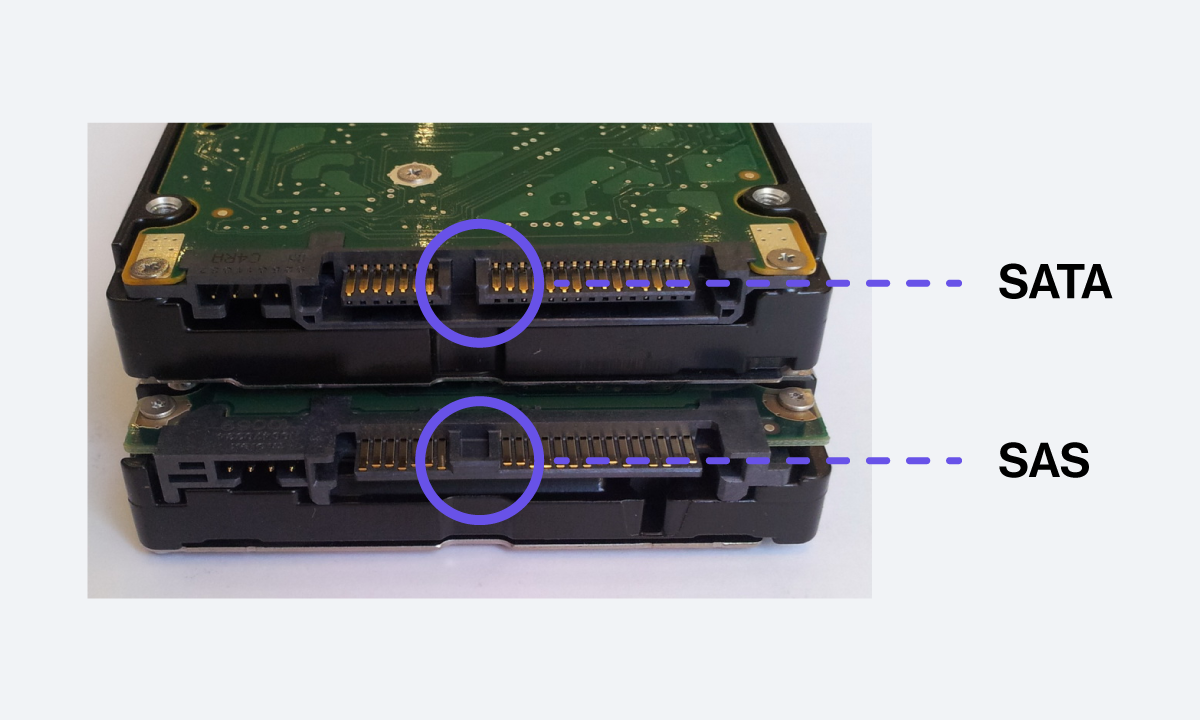
In any discussion about SAS disks, a comparison with SATA is inevitable. While both share some physical similarities—such as the ability to plug a SATA drive into a SAS backplane (but not vice-versa)—they serve very different masters.
Performance vs. Capacity
SATA disks are generally optimized for capacity and cost-per-gigabyte. They are ideal for “cold storage,” backups, and general-purpose computing. SAS disks, conversely, are optimized for performance. Standard SAS HDDs typically spin at 10,000 or 15,000 RPM, whereas SATA drives usually cap at 7,200 RPM. This higher rotational speed results in significantly lower seek times and higher Input/Output Operations Per Second (IOPS).
Data Integrity and Bit Error Rates
Enterprise data integrity is measured by the Bit Error Rate (BER). A typical consumer SATA drive might have a BER of one error in every 10^14 bits read. While that sounds impressive, in a multi-terabyte RAID array, that’s a statistical certainty for failure during a rebuild. SAS drives typically offer a BER of one error in every 10^16 bits, making them 100 times more reliable in terms of data corruption prevention.
Signal Voltage and Cable Length
SAS uses higher signaling voltages than SATA (800–1600 mV vs. 400–600 mV). This higher voltage allows SAS to maintain signal integrity over longer distances and through more connectors and backplanes. This makes SAS the only viable choice for large-scale external storage arrays (JBODs) where the disks may be several meters away from the host server.
Practical Applications in Modern Infrastructure
Understanding the technical specifications is only half the battle; knowing where to deploy SAS disks is what defines a successful IT strategy.
Enterprise Database Management
Databases for Finance, ERP, and CRM systems require constant, high-speed access to small blocks of data. The high IOPS and full-duplex nature of SAS disks ensure that transaction logs and data queries are processed without the bottlenecks that would plague slower SATA interfaces.
Mission-Critical RAID Arrays
When building a RAID (Redundant Array of Independent Disks) setup, the “rebuild time” is a critical vulnerability period. If a second drive fails while the array is reconstructing, the data is lost. Because SAS drives are more reliable and have higher throughput, rebuild times are significantly shorter, and the likelihood of a secondary URE (Unrecoverable Read Error) is vastly reduced compared to SATA-based arrays.
Tiered Storage Environments
Modern data centers often use a “tiered” approach. Tier 0 and Tier 1 (the most frequently accessed data) typically run on SAS SSDs or high-speed 15K SAS HDDs. Tier 2 and Tier 3 (archival or backup data) utilize high-capacity SATA drives. This hybrid approach allows organizations to balance the high cost of SAS performance with the low cost of SATA capacity.
The Future of SAS: Transitioning to SAS SSDs and 24G Standards
As the industry shifts toward Flash storage, the role of the SAS disk is evolving rather than disappearing. While NVMe (Non-Volatile Memory Express) has become the leader in raw speed for internal drives, SAS remains the king of external scalability.
The Rise of SAS SSDs
A SAS SSD takes the incredible speed of NAND flash and pairs it with the enterprise-grade features of the SAS interface. A SAS SSD offers the same dual-porting and error-correction benefits of a SAS HDD but with IOPS performance that is orders of magnitude higher. For enterprises that need to upgrade their storage without replacing their entire rack infrastructure, SAS SSDs offer a seamless “drop-in” performance boost.
SAS-4 and the 24G Standard
The technology continues to push boundaries with the introduction of SAS-4, also known as 24G SAS. This standard doubles the effective bandwidth of the previous 12G generation, providing up to 2400 MB/s per link. By using more efficient encoding (128b/150b), SAS-4 ensures that the interface remains competitive with NVMe for large-scale storage arrays and high-density server deployments.

Conclusion
A SAS disk is more than just a storage device; it is a specialized tool designed for the rigors of the modern enterprise. While the consumer world may have moved toward SATA and NVMe, the SAS ecosystem continues to provide the unique combination of reliability, massive scalability, and dual-path redundancy that the corporate world demands. Whether in the form of a high-speed 15K RPM mechanical drive or a cutting-edge 24G SSD, SAS remains a cornerstone of the global data infrastructure, ensuring that our most vital information remains both accessible and secure.
aViewFromTheCave is a participant in the Amazon Services LLC Associates Program, an affiliate advertising program designed to provide a means for sites to earn advertising fees by advertising and linking to Amazon.com. Amazon, the Amazon logo, AmazonSupply, and the AmazonSupply logo are trademarks of Amazon.com, Inc. or its affiliates. As an Amazon Associate we earn affiliate commissions from qualifying purchases.