
In the realm of audio technology, few elements evoke as much visceral reaction as “bass.” It is the foundation of modern music production, the driving force behind cinematic soundscapes, and the primary metric by which many consumers judge the quality of their audio hardware. However, from a technical perspective, “bass” is not a singular point on a spectrum but a complex range of frequencies that interact with physics, digital signal processing (DSP), and human physiology in unique ways.
To understand what frequency bass is, one must look beyond the simple thumping of a subwoofer. It requires an exploration of the electromagnetic principles of speaker drivers, the mathematics of sound waves, and the sophisticated software that allows us to manipulate these low-end signals in the digital age.

Defining the Low-End: The Spectral Range of Bass
In the field of acoustics and audio engineering, the human hearing range is generally cited as 20 Hz to 20,000 Hz (20 kHz). “Bass” occupies the bottom end of this spectrum. However, because the behavior of sound changes significantly as the wavelength grows longer, engineers further categorize the low-end into distinct sub-bands.
Sub-Bass: The Physical Sensation (20Hz – 60Hz)
The sub-bass region represents the absolute floor of human hearing. At 20Hz, the wavelengths are approximately 56 feet long. Because these waves are so large, they are often felt by the body as much as they are heard by the ears. In tech applications, such as high-end home theater subwoofers or club sound systems, reproducing this range requires immense power and large diaphragms. This is the range where “rumble” lives—the chest-thumping impact of an explosion in a film or the deep, atmospheric drone in electronic music.
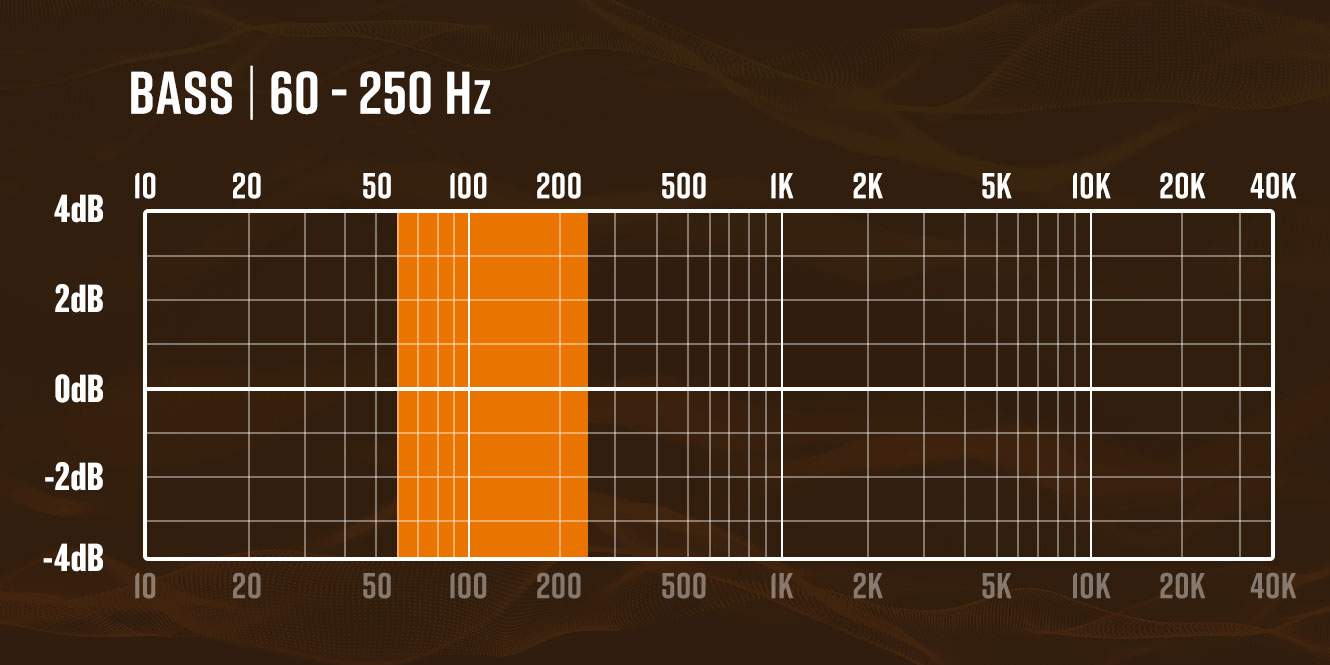
Mid-Bass: The Punch and Body (60Hz – 250Hz)
This is arguably the most critical frequency range for consumer tech. The mid-bass provides the “punch” or “kick” found in drums and the fundamental notes of a bass guitar. Most standard bookshelf speakers and high-quality headphones are designed to excel here. If a tech product has “bloaty” or “muddy” sound, it is usually due to an uncontrolled resonance or an over-emphasis in the 100Hz to 200Hz region. Balancing this range is the primary challenge for audio engineers when tuning consumer gadgets.
Upper Bass: The Bridge to Midrange (250Hz – 500Hz)
While some purists stop the definition of bass at 250Hz, the transition into the lower-midrange is vital for the “warmth” of a sound system. This frequency range contains the harmonics of lower instruments. If this range is neglected in the hardware design, the audio will sound “thin” or “tinny.” Conversely, too much energy here can obscure vocal clarity, a common issue in lower-end smart speakers where a single driver is tasked with handling too much of the frequency spectrum.
The Physics and Technology of Low-Frequency Reproduction
Reproducing low frequencies is one of the greatest challenges in hardware engineering. Unlike high-frequency treble waves, which are short and directional, bass waves are omnidirectional and require the displacement of large volumes of air.
Understanding Sound Waves and Oscillation
The frequency of bass is measured in Hertz (Hz), which represents cycles per second. A 40Hz bass note means the speaker cone must move forward and backward 40 times in one second. To create a perceived volume (amplitude) at such a low frequency, the speaker must move a significant amount of air. This is why “tweeters” (high-frequency drivers) are tiny and move rapidly, while “woofers” (low-frequency drivers) are large and have a much higher “excursion”—the distance the cone travels.
Driver Design: Why Bass Requires Surface Area
In the tech world, there is no replacement for displacement. To produce deep bass, a driver must have sufficient surface area. This is the primary reason why smartphones and ultra-thin laptops struggle with bass; their internal speakers are physically incapable of moving the volume of air required to generate a 60Hz wave. To circumvent this, tech companies use “passive radiators” or long-throw driver designs that allow small cones to move further than traditional speakers, creating the illusion of a larger driver.
Enclosure Technology: Ported vs. Sealed Systems
The “box” or enclosure is just as important as the driver itself. Modern audio tech utilizes two main types of enclosures to manage bass frequencies:
- Sealed Enclosures (Acoustic Suspension): These provide the most accurate, “tight” bass. The air inside the box acts as a spring, helping the driver return to its neutral position.
- Ported Enclosures (Bass Reflex): These use a tuned vent or “port” to redirect the sound from the back of the driver to the front. This increases efficiency and allows for deeper bass from a smaller box, though it can sometimes result in “one-note bass” if not engineered precisely via computer-aided design (CAD).
Digital Signal Processing (DSP) and Modern Bass Management
In the modern era, the “frequency” of bass is managed as much by software as it is by hardware. Digital Signal Processing (DSP) has revolutionized how we experience low-end sound, especially in portable and “smart” devices.
Crossover Networks and Frequency Allocation
A crossover is a technical filter that directs specific frequencies to the drivers best suited to handle them. In a high-tech soundbar system, for example, a digital crossover will strip away all frequencies below 100Hz from the small soundbar speakers and send them wirelessly to a dedicated subwoofer. This “frequency steering” prevents distortion and ensures that each component operates within its optimal range.
Active vs. Passive Equalization
Passive equalization uses physical components (resistors and capacitors) to shape sound, but modern tech relies on active DSP. Advanced algorithms can monitor a speaker’s performance in real-time. If a user turns the volume up to a level where the bass would normally distort the driver, the DSP automatically applies a “limiter” or a dynamic EQ, thinning out the bass slightly to protect the hardware while maintaining perceived clarity.
Psychoacoustics: The Illusion of “Missing Fundamental”
One of the most fascinating intersections of tech and bass is the “Virtual Pitch” or “Missing Fundamental” phenomenon. Through sophisticated software processing, engineers can trick the human brain into hearing bass frequencies that the speaker isn’t actually producing. By playing a series of overtones (harmonics) of a 50Hz note, the brain “fills in the gaps” and perceives the 50Hz fundamental. This tech is why a high-end smartphone can sometimes sound like it has more “depth” than its tiny speakers should allow.
Consumer Tech Trends in Bass Optimization
As we move further into the decade, the technology surrounding bass reproduction continues to evolve, moving away from “bigger is better” toward “smarter is better.”
AI-Driven Calibration and Room Correction
Bass frequencies are notoriously sensitive to room acoustics. A subwoofer placed in a corner might sound twice as loud (and twice as muddy) as one placed in the center of a wall due to “standing waves.” Companies like Sonos and Apple now use AI-driven room correction (such as Trueplay). By using the microphones on a smartphone or the device itself, the system analyzes how bass frequencies bounce off walls and automatically adjusts the EQ to neutralize “room modes,” ensuring the bass is clear and accurate regardless of placement.
Haptic Feedback and Bone Conduction
In the wearable tech space, the challenge of bass is even more acute. Since you cannot put a 12-inch woofer on someone’s head, companies are turning to haptic drivers. Some high-end gaming headsets and “bass vests” use tactile transducers that vibrate against the skin. This bypasses the eardrum and uses bone conduction or physical sensation to simulate the feel of low-frequency bass, providing an immersive experience without the need for massive sound pressure levels.
The Future of High-Fidelity Low-End
We are seeing a shift toward “Micro-LED” style miniaturization in audio—specifically with Solid-State Silicium (MEMS) speakers. While still in their infancy for bass applications, MEMS technology promises to create speakers on a silicon chip. Combined with ultra-efficient Class-D amplifiers and cloud-based DSP tuning, the future of bass technology lies in achieving “true” 20Hz reproduction in form factors that were previously thought impossible.

Conclusion
What frequency is bass? While the numerical answer lies between 20Hz and 250Hz, the technological answer is much broader. It is a synergy of hardware displacement, enclosure physics, and sophisticated digital manipulation. Whether it is the haptic rumble of a controller or the calibrated thrum of a smart home theater, bass remains the most technically demanding and rewarding aspect of the audio spectrum. As DSP and AI continue to advance, our ability to control, simulate, and enjoy these low-frequency waves will only become more precise, proving that in the world of tech, the “low-end” is always a high priority.
aViewFromTheCave is a participant in the Amazon Services LLC Associates Program, an affiliate advertising program designed to provide a means for sites to earn advertising fees by advertising and linking to Amazon.com. Amazon, the Amazon logo, AmazonSupply, and the AmazonSupply logo are trademarks of Amazon.com, Inc. or its affiliates. As an Amazon Associate we earn affiliate commissions from qualifying purchases.