
In the rapidly evolving world of health technology, the intersection of neurology and engineering has opened new doors for individuals living with motor impairments. Among the various kinetic disorders being addressed by modern hardware and software, “intention tremors” stand out as a unique challenge. Unlike resting tremors, which occur when a limb is at ease, intention tremors manifest during purposeful, goal-directed movement. From a technological standpoint, this is a complex problem of “signal noise” and “mechanical oscillation.”
As we delve into the digital and mechanical solutions for this condition, we find a burgeoning niche of tech—ranging from AI-driven diagnostic tools to gyroscopic wearables—designed to bridge the gap between human intention and physical execution.

Understanding the Mechanism: From Neurology to Digital Mapping
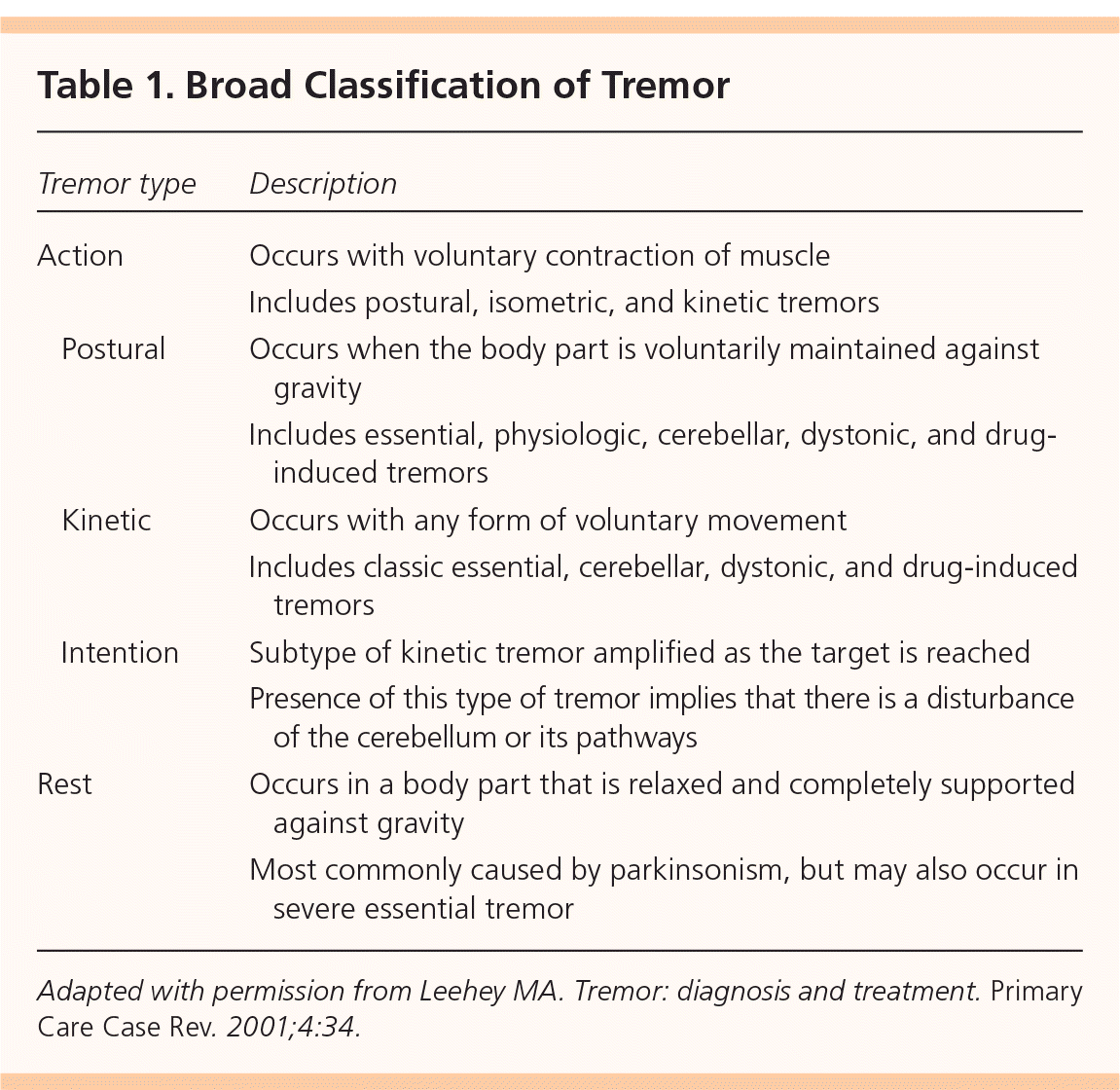
To build technology that mitigates intention tremors, engineers must first understand the biological “software” failure occurring in the brain. Intention tremors are typically associated with the cerebellum, the part of the brain responsible for coordinating voluntary movements and maintaining posture.
Defining Intention Tremors in the Digital Age
In the context of modern tech, an intention tremor can be viewed as a feedback loop error. When a person reaches for an object, the cerebellum sends and receives signals to fine-tune the trajectory. In those with cerebellar damage—often due to Multiple Sclerosis, stroke, or traumatic brain injury—the “correction” signals are delayed or exaggerated. This results in an oscillatory pattern that increases in amplitude as the hand nears its target. For developers and hardware engineers, this represents a kinetic “error rate” that requires high-frequency data processing to neutralize.
How Sensory Feedback Loops are Modeled in Software
Software engineers specializing in biomechanics utilize “Kinetic Modeling” to understand these tremors. By capturing movement data via high-speed cameras and motion-capture sensors, tech firms can create digital twins of a patient’s movement patterns. These models allow for the development of “smoothing algorithms.” Much like how an image stabilizer in a smartphone camera removes the shake from a video, these algorithms are now being integrated into software interfaces to help users navigate digital environments despite physical oscillations.
Wearable Solutions: The Hardware Revolution in Kinetic Stability
The most visible tech advancements in the realm of intention tremors are found in wearable hardware. For decades, the only solutions were pharmacological or surgical. Today, “Active Damping” technology—the same principle used to keep skyscrapers stable during earthquakes—is being miniaturized for the human arm.
Gyroscopic Stabilization in Smart Utensils
One of the most successful applications of tech for intention tremors is the development of stabilized utensils. Brands like Liftware have pioneered handheld devices that use built-in sensors and motors to detect the direction of a tremor. The device then moves in the opposite direction, canceling out the shake. From a tech perspective, this involves micro-electromechanical systems (MEMS) and high-speed microcontrollers that process movement in milliseconds, ensuring the utensil remains level while the user’s hand oscillates.
Active Damping Systems and Exoskeleton Sleeves
Beyond utensils, the tech industry is moving toward “Soft Robotics” and “Exoskeleton Sleeves.” Startups are currently testing sleeves embedded with fluid-filled actuators or electromagnetic dampers. These wearables use “Active Damping” to provide resistance against involuntary movements without hindering the user’s intentional path. By applying a counter-force through the sleeve, the technology “absorbs” the kinetic energy of the tremor, allowing for smoother, more controlled gestures. This represents a significant leap in wearable gadgets, moving from simple health tracking to active physical intervention.
AI and Machine Learning in Tremor Diagnosis and Management

Artificial Intelligence is redefining how we identify and categorize intention tremors. Because these tremors can be subtle in their early stages, AI tools are being trained to see what the human eye might miss.
Deep Learning Algorithms for Early Detection
Data scientists are now using Deep Learning (DL) to analyze gait and hand-eye coordination patterns. By feeding thousands of hours of kinetic data into neural networks, AI can distinguish between an essential tremor, a resting tremor, and an intention tremor with high accuracy. This “Diagnostic Tech” is often delivered via cloud-based platforms where clinicians can upload a patient’s movement data for an instant, AI-driven analysis. This reduces the time to diagnosis and allows for more personalized tech-intervention strategies.
Smartphone Sensors as Diagnostic Tools
The gadgets we carry every day are becoming the front lines of neuro-tech. Modern smartphones are equipped with incredibly sensitive accelerometers and gyroscopes. New apps are utilizing these internal sensors to perform “Tremor Quantification.” By having a user perform a specific task—like drawing a spiral on a screen or holding the phone while reaching for a button—the app can measure the frequency (measured in Hertz) and amplitude of the tremor. This data is then synced to the cloud, providing a longitudinal look at the user’s condition that was previously impossible without expensive laboratory equipment.
The Future of Neuro-Interfaces and Brain-Computer Integration (BCI)
The “final frontier” for addressing intention tremors lies in Brain-Computer Interfaces (BCI). This is where tech moves from being a wearable accessory to an integrated part of the human nervous system.
Neuralink and the Digital Suppression of Kinetic Oscillations
Companies like Neuralink and Synchron are working on implantable chips that can “read” and “write” neural signals. For an individual with an intention tremor, a BCI could theoretically intercept the “jittery” signal coming from the cerebellum and “clean” it before it reaches the muscles. Alternatively, it could provide “Deep Brain Stimulation” (DBS) through a smarter, more responsive digital interface. Unlike traditional DBS, which provides a constant electrical pulse, the next generation of “Smart DBS” uses AI to provide stimulation only when it detects the onset of a tremor, preserving battery life and reducing side effects.
Non-Invasive Neuromodulation and App-Based Therapies
Not all neuro-tech requires surgery. Non-invasive neuromodulation devices use “Transcutaneous Electrical Nerve Stimulation” (TENS) or “Vibratory Therapy” to calm the nervous system. These devices are often paired with smartphone apps that allow users to calibrate the intensity of the stimulation based on their current activity. This “Software-as-a-Treatment” (SaaT) model reflects a broader trend in the tech industry where hardware is merely a vehicle for sophisticated, algorithm-driven therapy.
The Digital Accessibility Frontier: UX and UI Design
Beyond physical tools, the tech world is recognizing its responsibility to make the digital landscape accessible to those with intention tremors. This has birthed a new era of “Inclusive Design” in software development.
Designing User Interfaces for Kinetic Impairment
For someone with an intention tremor, clicking a small “X” to close a pop-up can be an exercise in frustration. Tech giants like Google, Apple, and Microsoft are implementing “Filter Keys” and “Bounce Keys” at the OS level. These software features ignore brief or repeated keystrokes and can be set to ignore “jittery” mouse movements. Furthermore, “Target Expansion” tech is being integrated into web browsers, where the clickable area of a button dynamically expands as the cursor nears it, compensating for the lack of precision inherent in an intention tremor.
Voice Control and Eye-Tracking as Workarounds
The rise of Natural Language Processing (NLP) and eye-tracking tech has provided a “hands-free” alternative for those with severe tremors. Virtual assistants like Alexa and Siri, and eye-tracking hardware like the Tobii Dynavox, allow users to bypass manual input entirely. For a user with intention tremors, the ability to control a smart home or operate a computer via voice or gaze is not just a convenience—it is a transformative technological liberation.
As we look toward the future, the term “intention tremor” will likely trigger a suite of technological responses rather than a medical prognosis of limitation. Through the synthesis of AI, high-performance hardware, and inclusive software design, the tech industry is effectively “stabilizing” the world for those who move through it with a shake. In this niche of innovation, the goal is clear: ensuring that a person’s digital and physical “reach” is never compromised by the oscillations of their grasp.
aViewFromTheCave is a participant in the Amazon Services LLC Associates Program, an affiliate advertising program designed to provide a means for sites to earn advertising fees by advertising and linking to Amazon.com. Amazon, the Amazon logo, AmazonSupply, and the AmazonSupply logo are trademarks of Amazon.com, Inc. or its affiliates. As an Amazon Associate we earn affiliate commissions from qualifying purchases.