
Navigating the landscape of labor costs and personal income requires a clear understanding of state-specific mandates. In Arizona, the minimum wage is not just a static number but a dynamic figure tied to the economic pulse of the nation. As of January 1, 2024, the minimum wage in Arizona increased to $14.35 per hour, a significant jump from the previous year’s $13.85. This adjustment is part of a broader fiscal trend aimed at maintaining the purchasing power of workers in an era of fluctuating inflation.
For business owners, investors, and employees alike, understanding these figures is essential for effective financial planning. Arizona stands as one of the more progressive states regarding wage floors, significantly outpacing the federal minimum wage. This article explores the mechanics behind these increases, the implications for the state’s economy, and what stakeholders need to know to remain financially resilient.

The Mechanics of the Fair Wages and Healthy Families Act
The current trajectory of Arizona’s minimum wage is governed by the Fair Wages and Healthy Families Act, a landmark piece of legislation approved by voters as Proposition 206 in 2016. This act did more than just mandate a one-time increase; it established a permanent framework for how wages would be calculated in the Grand Canyon State.
Proposition 206 and the Consumer Price Index (CPI)
The primary driver behind Arizona’s annual wage adjustments is the Consumer Price Index for All Urban Consumers (CPI-U). By law, the Industrial Commission of Arizona must review the cost of living every year. If the CPI-U increases, the minimum wage must be adjusted to the nearest five cents. This ensures that as the cost of groceries, housing, and fuel rises, the baseline pay for workers does not lose its real-world value. For the 2024 increase, the 3.6% rise in the CPI between August 2022 and August 2023 was the direct catalyst for the $0.50 per hour raise.
The Specific Provisions for Tipped Employees
Arizona law allows for a “tip credit,” which is a critical detail for those in the hospitality and service industries. Employers are permitted to pay employees who customarily receive tips up to $3.00 less than the statutory minimum wage, provided that the employee’s total earnings (hourly wage plus tips) equal at least the full minimum wage for all hours worked. In 2024, this means the base pay for tipped workers can be as low as $11.35 per hour. However, the burden of proof lies with the employer to ensure that tips bridge the $3.00 gap; if they do not, the employer must make up the difference.
Regional Variations and Local Mandates: The Case of Flagstaff
While $14.35 is the standard across most of the state, Arizona allows municipalities to set their own, higher minimum wages. This creates a localized financial environment that businesses and workers must navigate carefully.
Flagstaff’s Independent Wage Path
Flagstaff is the most notable exception to the state-wide rate. Driven by a higher-than-average cost of living and local ballot initiatives, Flagstaff’s minimum wage reached $17.40 per hour in 2024. For tipped workers in Flagstaff, the minimum base wage is $15.90. This discrepancy means that a business operating in both Phoenix and Flagstaff must manage two distinct payroll structures, highlighting the importance of localized financial management and compliance.
The Economic Impact of Regional Disparity
The wage gap between Flagstaff and the rest of the state serves as a micro-economic case study. High-wage zones often see a “border effect,” where labor may migrate toward the higher-paying city, while businesses might consider relocating to the outskirts where costs are lower. From a personal finance perspective, workers in Flagstaff must weigh the $17.40 wage against the city’s significantly higher housing costs, illustrating that a higher nominal wage does not always equate to higher discretionary income.
The Business Finance Perspective: Adapting to Rising Labor Costs
For entrepreneurs and small business owners in Arizona, the consistent rise in the minimum wage presents both a challenge and an opportunity for financial optimization. Labor is often the largest line item on a profit and loss statement, and a $0.50 increase per hour can translate to thousands of dollars in additional annual expenses for a medium-sized team.
Strategies for Offsetting Increased Overhead
To maintain profit margins without compromising service quality, many Arizona businesses are turning to refined financial tools and operational efficiencies.
- Pricing Adjustments: Slight, incremental increases in product pricing can help absorb labor costs.
- Lean Operations: Investing in automated inventory management or self-service kiosks can reduce the total man-hours required for daily operations.
- Retention as a Cost-Saver: While the minimum wage is a floor, paying slightly above it can reduce turnover. The financial cost of recruiting and training a new employee often far outweighs the cost of a modest wage increase for an existing, experienced staff member.
Budgeting for Future Escalations
Because Arizona’s wage is tied to inflation, it is a “known unknown.” Business owners should bake a 3% to 5% annual labor cost increase into their five-year financial projections. By treating the minimum wage as a variable expense that trends upward, companies can avoid the “sticker shock” that comes with the official announcement from the Industrial Commission each autumn.
Personal Finance and the “Living Wage” Gap
For the individual earner, $14.35 per hour represents a gross annual income of approximately $29,848 for a full-time worker (40 hours per week, 52 weeks per year). While this is a substantial improvement over the federal $7.25 rate, it brings into focus the concept of a “living wage” versus a “minimum wage.”
Calculating the Real Value of $14.35
In many parts of Arizona, particularly the rapidly growing Maricopa County, the cost of housing has outpaced wage growth. Financial experts often suggest the “30% rule,” where no more than 30% of gross income should go toward housing. At the current minimum wage, a worker has roughly $746 per month allocated for rent—a figure that is increasingly difficult to match with market rates in Phoenix or Scottsdale. This reality necessitates a focus on side hustles, micro-investing, and aggressive budgeting for those at the entry-level of the workforce.
The Role of State-Mandated Paid Sick Time
The Fair Wages and Healthy Families Act also includes provisions for earned paid sick time, which is a hidden but vital financial benefit. Employees accrue one hour of paid sick time for every 30 hours worked. For larger employers (15+ employees), the cap is 40 hours per year; for smaller employers, it is 24 hours. From a personal finance standpoint, this provides a safety net that prevents a single illness from derailing a monthly budget, ensuring that income remains stable even during health emergencies.
Future Outlook: Arizona in the National Economic Context
Arizona’s approach to the minimum wage places it among the top tier of states nationally. As federal discussions regarding a $15.00 minimum wage continue to stall, Arizona’s self-correcting mechanism ensures it will likely surpass that milestone within the next two years without the need for further legislative intervention.
Anticipating the 2025 Adjustments
Given current inflationary pressures, it is highly probable that the 2025 minimum wage will approach or exceed $14.80. Investors looking at the Arizona market must consider these rising labor costs as a permanent fixture of the state’s economic identity. However, higher wages also mean more consumer spending power, which can drive growth in the retail and service sectors, creating a cyclical benefit for the state’s economy.
Compliance and Legal Safeguards
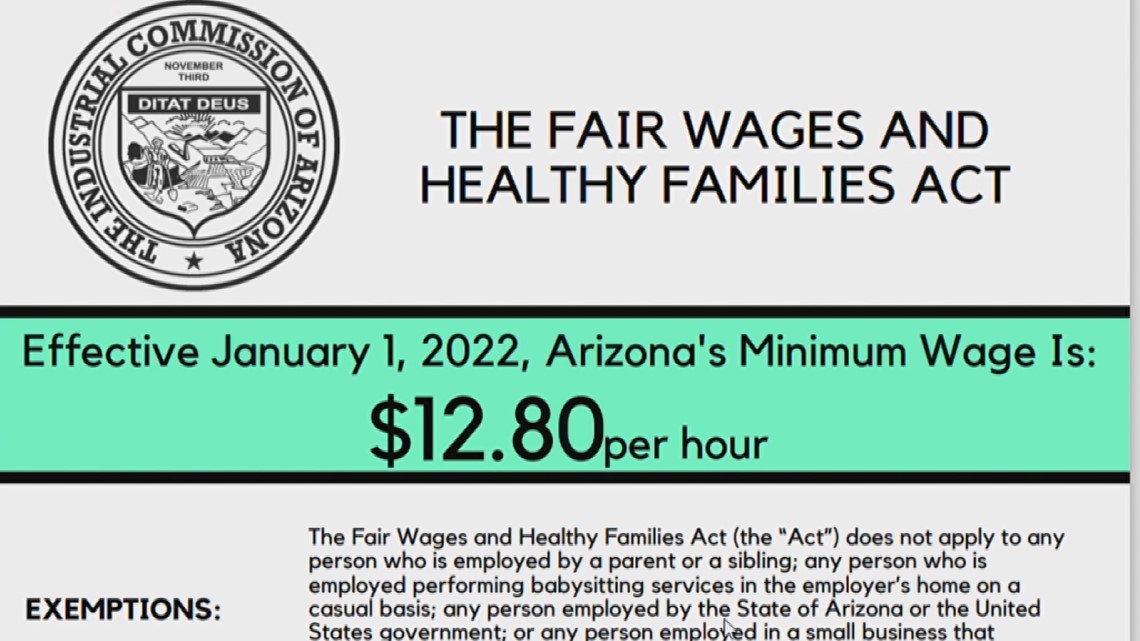
For any entity operating within the state, compliance is non-negotiable. The Industrial Commission of Arizona requires that a “Minimum Wage Poster” be displayed in a conspicuous place where employees can easily read it. Failure to comply with wage laws can lead to back-pay requirements, civil penalties, and audits. Using modern financial and payroll software that automatically updates for state-specific tax and wage changes is no longer a luxury—it is a necessity for maintaining a healthy business finance structure.
By understanding the nuances of the $14.35 rate, the mechanics of inflation adjustments, and the specific rules for tipped labor, both employers and employees in Arizona can better navigate their financial futures. Whether you are balancing a corporate budget or managing a household, these figures are the foundation upon which Arizona’s modern economy is built.
aViewFromTheCave is a participant in the Amazon Services LLC Associates Program, an affiliate advertising program designed to provide a means for sites to earn advertising fees by advertising and linking to Amazon.com. Amazon, the Amazon logo, AmazonSupply, and the AmazonSupply logo are trademarks of Amazon.com, Inc. or its affiliates. As an Amazon Associate we earn affiliate commissions from qualifying purchases.