
In an era where data breaches are no longer a matter of “if” but “when,” the demand for skilled cybersecurity professionals has reached an all-time high. For those looking to enter the field, the first major milestone is often the CompTIA Security+ certification. But what exactly is Security+, and why has it become the global benchmark for foundational technical security skills?
Security+ is a vendor-neutral certification issued by CompTIA (the Computing Technology Industry Association) that validates the baseline skills necessary to perform core security functions and pursue an IT security career. Unlike platform-specific certifications, Security+ focuses on the universal principles of digital defense, making it an essential credential for anyone aiming to protect networks, devices, and data in the modern tech landscape.

Understanding the CompTIA Security+ Framework
The CompTIA Security+ certification is designed to be the first security credential an IT professional should earn. It establishes the core knowledge required of any cybersecurity role and provides a springboard into intermediate-level cybersecurity jobs. As the technological landscape shifts toward the cloud and remote work, the framework of the exam has evolved to meet these new challenges.
What Does the Certification Cover?
At its core, Security+ emphasizes practical, hands-on ability to identify and address security threats, attacks, and vulnerabilities. It isn’t just about memorizing definitions; it’s about understanding how to apply security principles to real-world scenarios. The certification ensures that a candidate can not only recognize a security incident but also troubleshoot and mitigate it using the latest tools and techniques.
The exam covers a broad spectrum of technical topics, including risk management, incident response, forensics, enterprise networks, and hybrid/cloud operations. By mastering these areas, professionals prove they have the foundational “boots-on-the-ground” skills required to secure an organization’s digital assets.
The Evolution of the Exam: From SY0-601 to SY0-701
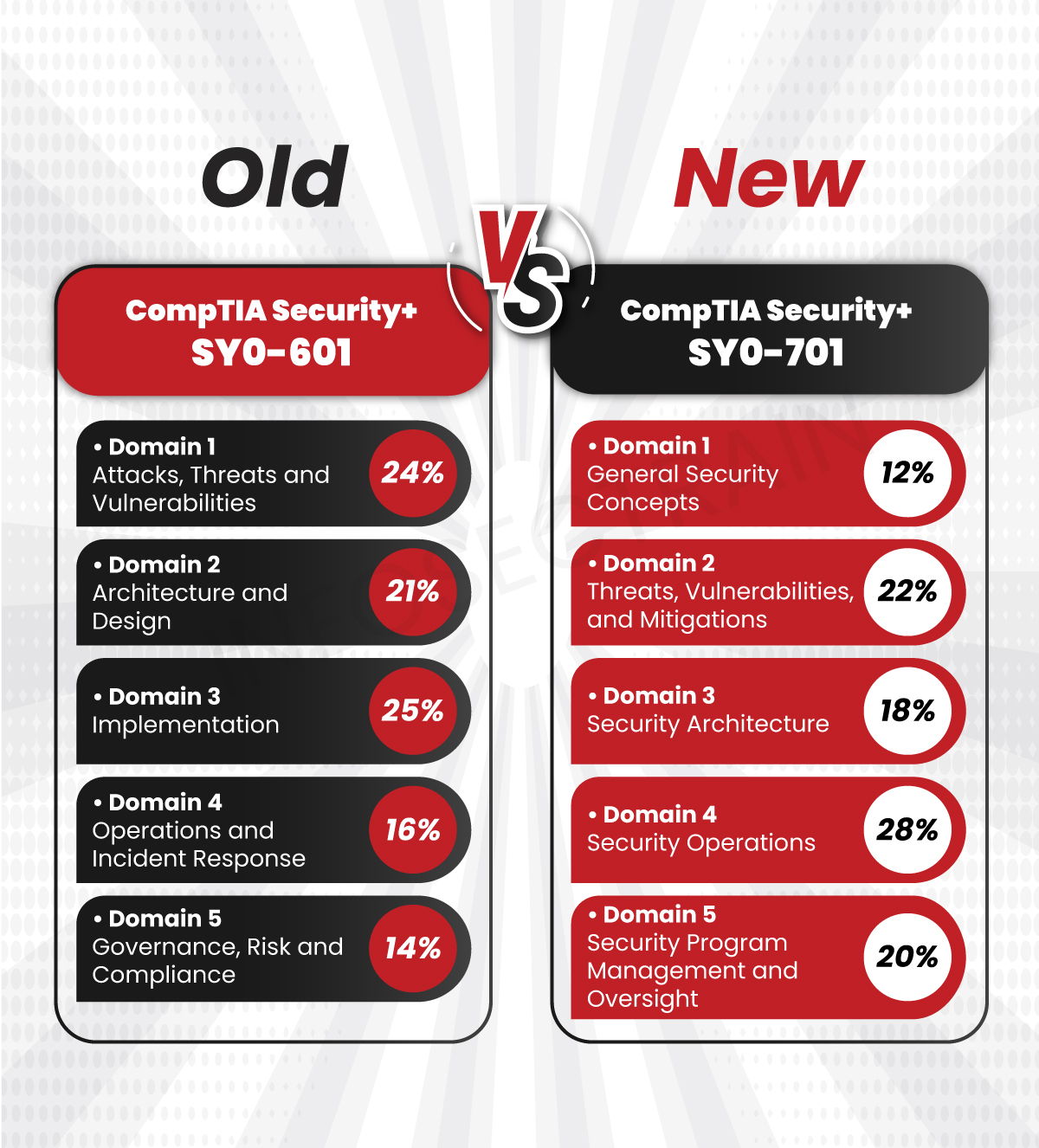
CompTIA regularly updates the Security+ exam to reflect the current state of the tech industry. The transition from the SY0-601 version to the SY0-701 version reflects a significant shift in the cybersecurity world. The latest iteration places a much heavier emphasis on cloud security, virtualization, and the “Shift Left” philosophy—integrating security earlier in the software development lifecycle.
The new exam objectives also highlight the importance of automation and orchestration in security operations. As hackers begin to use AI and machine learning to launch sophisticated attacks, security professionals must understand how to use similar technologies to defend their networks. This evolution ensures that anyone holding the Security+ certification is equipped with the most current technical knowledge available.
The Core Domains of Security+
To earn the Security+ credential, candidates must demonstrate proficiency across several technical domains. These domains represent the pillars of modern digital security and provide a structured approach to understanding the complexities of the field.
General Security Concepts and Threats
The first pillar involves understanding the “Who, What, and Why” of cybersecurity. This includes a deep dive into various types of threats, such as malware, ransomware, social engineering, and insider threats. Tech professionals must be able to distinguish between an APT (Advanced Persistent Threat) and a script kiddie, and understand the motivations behind various threat actors.
Furthermore, this domain covers the fundamental concepts of the CIA Triad: Confidentiality, Integrity, and Availability. These three principles form the bedrock of all security policies. A professional must know how to implement encryption to ensure confidentiality, use hashing for integrity, and design redundant systems to ensure availability.
Architecture, Design, and Implementation
The second major domain focuses on the “How.” This is where the technical heavy lifting occurs. It involves designing secure network architectures that can withstand modern attacks. Key topics include the implementation of Zero Trust models, securing cloud environments, and understanding the nuances of hardware, software, and data security.
In this section, candidates learn about secure protocols (such as SSH, HTTPS, and TLS) and how to deploy them effectively. There is also a significant focus on identity and access management (IAM). In a world where identity is the new perimeter, understanding multi-factor authentication (MFA), Single Sign-On (SSO), and privileged access management is critical for any tech professional.
Operations, Incident Response, and Governance
The final technical pillars deal with the day-to-day management of security and what happens when things go wrong. Operations and incident response involve using tools like SIEMs (Security Information and Event Management), vulnerability scanners, and packet sniffers to monitor network health.
Governance, risk, and compliance (GRC) might sound administrative, but in the tech world, it is highly technical. It involves understanding how to implement security controls that satisfy legal and regulatory requirements like GDPR, HIPAA, or PCI-DSS. This domain ensures that technical solutions align with organizational policies and risk appetite, creating a holistic security posture.
Why Security+ is the Industry Gold Standard for Beginners
There are dozens of cybersecurity certifications available, but Security+ remains the most recommended starting point for those in the tech industry. Its reputation is built on two primary factors: its global recognition and its alignment with government standards.
Global Recognition and Vendor Neutrality
One of the greatest strengths of Security+ is its vendor neutrality. While certifications from companies like Microsoft, Cisco, or Amazon (AWS) are valuable, they focus specifically on those companies’ products. Security+, however, teaches the underlying technology and logic that applies across all platforms.
Whether an organization uses Azure or AWS, Windows or Linux, the security principles remain the same. This makes Security+ holders highly versatile. Employers value the certification because it proves the candidate has a solid foundation that can be applied to any technical environment, reducing the amount of basic training required when a new hire joins the team.
DoD 8570 Compliance and Career Opportunities
In the United States, and increasingly globally, the Security+ certification is a mandatory requirement for many government and defense-related roles. It meets the ISO 17024 standard and is approved by the U.S. Department of Defense (DoD) to fulfill Directive 8570/8140 requirements. This means that for many technical roles within the public sector or for government contractors, you cannot even be considered for the job without this certification.
Beyond government roles, the Security+ opens doors to various career paths, including:
- Security Administrator
- Systems Administrator
- Help Desk Manager / Tier 2 Support
- Junior IT Auditor
- Network Engineer
Preparing for Success: Study Strategies and Resources
Earning the Security+ is no small feat. The exam is known for its “performance-based questions” (PBQs), which require candidates to perform tasks in a simulated environment rather than simply answering multiple-choice questions.
Hands-on Labs vs. Theoretical Knowledge
While reading textbooks is necessary, practical experience is what truly prepares a candidate for the exam and the job. Tech-focused students should utilize virtual labs to practice configuring firewalls, setting up VPNs, and analyzing log files. Understanding the command line in both Windows (PowerShell) and Linux is also vital, as many security tools are terminal-based.
Successful candidates often spend as much time in a lab environment as they do with their study guides. Being able to visualize how a packet moves through a network or how a specific vulnerability is exploited makes the theoretical concepts much easier to grasp.
Recommended Study Materials and Practice Exams
The tech community offers a wealth of resources for Security+ candidates. Standard materials include the CompTIA official study guide, but many supplement this with third-party resources like Professor Messer’s video series, Mike Chapple’s courses, or Jason Dion’s practice exams.
Practice exams are particularly crucial. They help candidates get used to the wording of CompTIA questions, which can often be tricky. Learning how to identify the “best” answer among several technically correct ones is a skill in itself.
Beyond the Exam: The Future of Your Cybersecurity Path
Obtaining the Security+ certification is not the end of the journey; it is the beginning. The tech field moves fast, and staying relevant requires a commitment to continuous learning.
Stacking Certifications for Career Growth
CompTIA offers a “stackable” certification path. Once you have earned Security+, the logical next steps are often the CySA+ (Cybersecurity Analyst) for those interested in defense and analysis, or the PenTest+ for those interested in offensive security and ethical hacking. Eventually, many professionals aim for the “gold standard” of advanced certifications, the CISSP (Certified Information Systems Security Professional).
Each new certification builds upon the technical foundation laid by Security+, allowing professionals to specialize in areas like forensics, cloud security, or security architecture.

Staying Current in an Ever-Evolving Tech Landscape
Finally, it is important to remember that a certification has a shelf life. CompTIA Security+ must be renewed every three years through Continuing Education Units (CEUs). This ensures that professionals stay up-to-date with the latest technological advancements, from the rise of AI-driven threats to the implementation of quantum-resistant cryptography.
In conclusion, Security+ is more than just a piece of paper; it is a rigorous validation of the technical skills required to protect our digital world. For anyone serious about a career in technology and security, it is the essential first step toward a successful and impactful career.
aViewFromTheCave is a participant in the Amazon Services LLC Associates Program, an affiliate advertising program designed to provide a means for sites to earn advertising fees by advertising and linking to Amazon.com. Amazon, the Amazon logo, AmazonSupply, and the AmazonSupply logo are trademarks of Amazon.com, Inc. or its affiliates. As an Amazon Associate we earn affiliate commissions from qualifying purchases.