
In the rapidly evolving landscape of modern technology, the concept of power management is undergoing a paradigm shift. For decades, the primary constraint on portable electronics and remote sensors has been the battery—a finite reservoir of chemical energy that eventually depletes, requiring replacement or recharging. However, a transformative field known as energy harvesting is paving the way for a “set-and-forget” digital ecosystem. Energy harvesting, also referred to as power scavenging or ambient power, is the process by which energy is derived from external sources, captured, and stored for use in small, wireless autonomous devices.
From the vibration of industrial machinery to the stray radio waves emitted by our Wi-Fi routers, the environment is saturated with untapped energy. By converting these ambient sources into usable electricity, energy harvesting enables electronics to operate indefinitely without a traditional power grid or frequent human intervention. This article explores the technical mechanisms, diverse sources, and future-reaching applications of this critical technology.
The Core Principles and Components of Energy Harvesting Systems
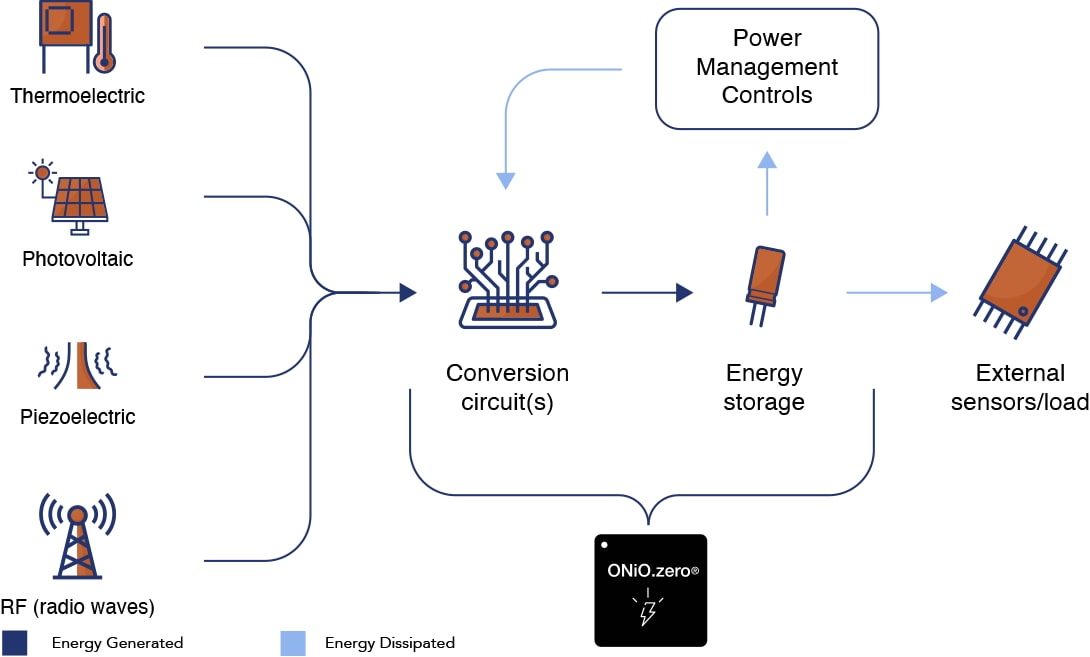
At its technical heart, energy harvesting is an exercise in high-efficiency conversion. Because the amount of energy available in the environment is often minuscule—measured in microwatts or milliwatts—the system must be meticulously engineered to minimize internal loss. A typical energy harvesting system consists of four primary technical stages: the source, the transducer, the power management integrated circuit (PMIC), and the storage element.
The Transducer: Bridging the Physical and Digital Worlds
The transducer is the front-end component responsible for converting one form of physical energy into electrical energy. Depending on the source, this could be a photovoltaic cell (light), a piezoelectric crystal (pressure/vibration), or a thermoelectric generator (heat). The efficiency of the transducer determines the overall viability of the system. In recent years, advances in material science, such as the development of thin-film polymers and nanostructured semiconductors, have significantly boosted the sensitivity of these transducers, allowing them to “wake up” even in low-energy environments.
Power Management and the PMIC
Since ambient energy is often sporadic—the sun goes down, machines stop vibrating, or thermal gradients shift—the raw electricity generated by the transducer is rarely stable enough to power a microchip directly. This is where the Power Management Integrated Circuit (PMIC) comes in. The PMIC acts as the brain of the system, performing functions such as rectification (converting AC to DC), voltage regulation, and Maximum Power Point Tracking (MPPT). MPPT is a critical technical logic that ensures the system extracts the maximum possible power from the transducer regardless of changing environmental conditions.
Energy Storage and Ultra-Low Power Consumption
Because the energy harvested is often lower than the peak power required for data transmission, it must be accumulated over time. Systems typically use supercapacitors or specialized thin-film batteries to store these small “sips” of energy until enough is gathered to perform a task, such as sending a Bluetooth signal. Furthermore, the success of energy harvesting is intrinsically linked to the “Ultra-Low Power” (ULP) design of the target device. Modern microcontrollers now feature “sleep” modes that consume nano-amps of current, allowing them to remain dormant while the energy harvester slowly fills the storage reservoir.
Key Sources of Ambient Energy in the Tech Ecosystem
The choice of energy harvesting technology depends heavily on the deployment environment. Engineers categorize these sources based on their physical properties and the density of power they can provide.
Photovoltaic Energy: Beyond the Solar Farm
While most people associate photovoltaic (PV) cells with massive rooftop panels, energy harvesting focuses on “indoor” or “micro-PV.” These cells are optimized to capture energy from artificial light sources like LED or fluorescent bulbs. New technologies, such as Perovskite solar cells, are being integrated into the casings of remote controls and keyboards. These materials are particularly effective because they can be made flexible and transparent, allowing tech designers to turn almost any surface into a power-generating interface.
Kinetic and Piezoelectric Harvesting
Kinetic energy harvesting leverages motion and vibration. This is particularly relevant in industrial settings (IIoT) and smart infrastructure. Piezoelectric materials generate an electric charge when subjected to mechanical stress. For instance, sensors embedded in a bridge can harvest the vibrations caused by passing vehicles to power structural integrity monitors. Similarly, in the world of wearables, “human-kinetic” harvesting uses the motion of a person’s gait or arm movements to provide supplementary power to smartwatches or fitness trackers.
Thermal and Radio Frequency (RF) Energy
Thermoelectric Generators (TEGs) operate on the Seebeck effect, which produces electricity when there is a temperature difference between two surfaces. In tech applications, TEGs can harvest the heat dissipated by a computer processor or even the body heat of a user.
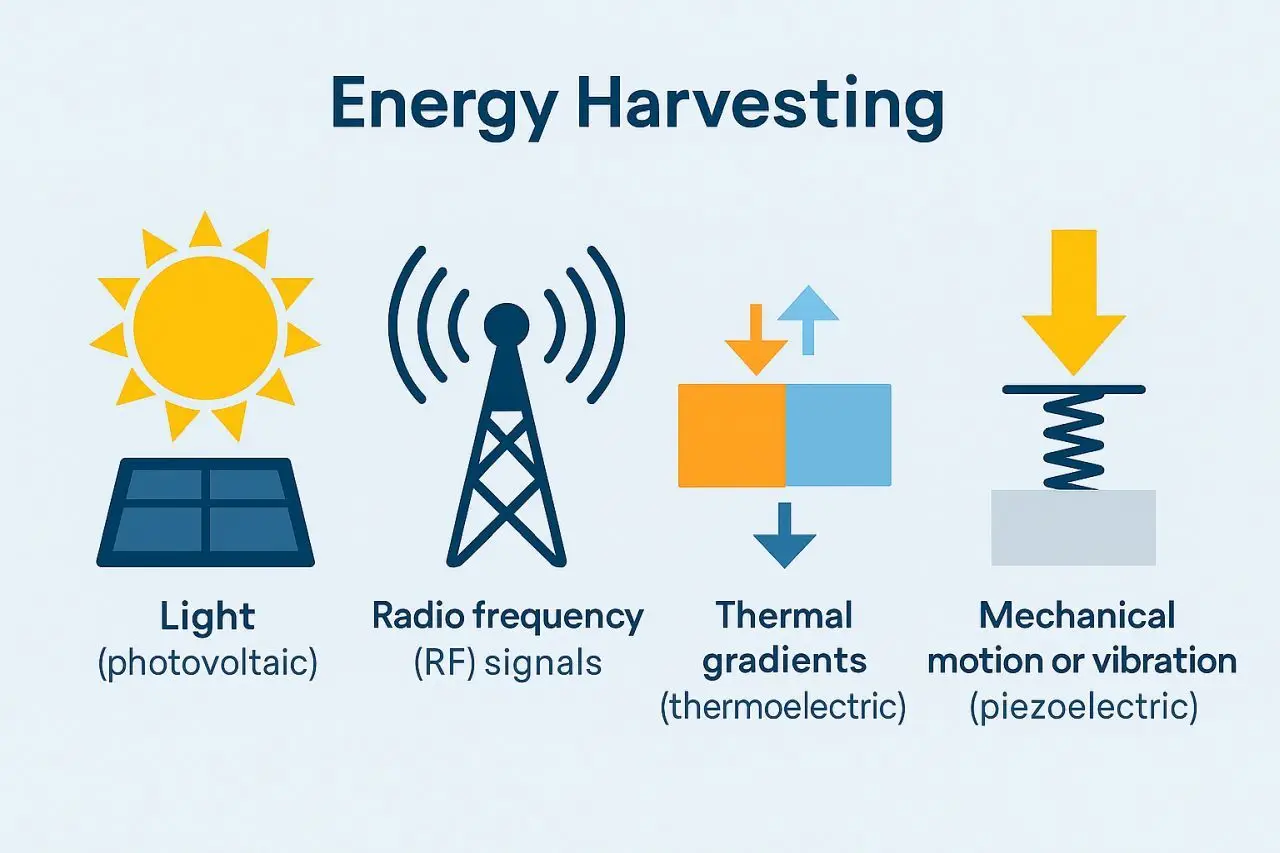
Radio Frequency (RF) harvesting is perhaps the most “futuristic” of the categories. It involves capturing the electromagnetic energy emitted by cellular towers, Wi-Fi routers, and television broadcasts. Through a specialized antenna called a “rectenna” (rectifying antenna), these ambient waves are converted into DC power. While the power density of RF harvesting is relatively low, it is becoming increasingly viable for low-power smart home sensors that exist within the “electromagnetic smog” of modern cities.
Applications in the Modern Tech Landscape
The move toward energy harvesting is not merely an academic exercise; it is a necessity driven by the explosion of the Internet of Things (IoT). As we move toward a world with trillions of connected sensors, manually changing batteries becomes logistically impossible and environmentally disastrous.
Powering the Internet of Things (IoT) and Smart Cities
In a Smart City framework, thousands of sensors monitor air quality, traffic flow, and waste management. Energy harvesting allows these sensors to be placed in hard-to-reach locations—underground pipes, high-voltage power lines, or atop streetlights—without the need for wired power or battery maintenance. By using kinetic energy from wind or vibration and solar energy from the sun, these nodes can operate for decades, providing a continuous stream of data for urban AI management systems.
Healthcare and Wearable Technology
In the medical tech field, energy harvesting offers a path toward permanent implanted devices. Currently, pacemakers require invasive surgery to replace batteries every decade. Research into biomechanical and thermal harvesting suggests a future where an implant could be powered indefinitely by the patient’s own heartbeat or blood flow. In the consumer space, wearables are moving toward “hybrid power” models, where energy harvested from the sun and body heat extends the time between charges from days to months.
Industrial Monitoring and “Zero-Power” Computing
In “Industry 4.0,” sensors are used to predict machine failure before it happens. These sensors are often placed on vibrating motors or high-heat furnaces—perfect environments for kinetic and thermal harvesting. This creates a self-sustaining feedback loop where the heat or vibration of the machine itself provides the energy needed to monitor its health. This leads to the concept of “Zero-Power” computing, where devices have no internal battery at all, operating solely on the energy they can scavenge from their immediate surroundings.
Technical Challenges and the Roadmap to Scalability
Despite its promise, energy harvesting faces significant engineering hurdles that prevent it from replacing batteries entirely in high-drain devices like smartphones or laptops.
Efficiency and Power Density Constraints
The primary challenge is the low power density of ambient sources. For example, while a smartphone might require several watts to operate, RF harvesting might only provide microwatts. This creates a “power gap” that can only be bridged by either increasing the efficiency of the harvester or drastically reducing the power requirements of the electronics. We are seeing progress on both fronts: more efficient PMICs that can harvest energy at 90% efficiency and “asynchronous” processors that only consume power when a specific event occurs.
Advanced Materials and AI Integration
The future of energy harvesting lies in material science. The development of “smart materials” that can harvest energy from multiple sources simultaneously—such as a hybrid film that captures both light and heat—is a major area of research.
Furthermore, Artificial Intelligence is playing a role in optimization. AI algorithms are being integrated into the firmware of harvested devices to perform “energy-aware” task scheduling. If the algorithm detects that ambient light levels are dropping (decreasing incoming power), it can automatically throttle the device’s data transmission frequency to ensure that the stored energy lasts through the night. This intelligent orchestration between energy availability and consumption is the key to making energy harvesting reliable for mission-critical tech.
Conclusion: The Shift Toward Autonomous Tech
Energy harvesting represents a fundamental shift in how we think about tech and electricity. We are moving away from a centralized model of power toward a decentralized, autonomous model where the device is responsible for its own energy needs. While we are still in the early stages of this transition, the integration of energy-scavenging capabilities into IoT, healthcare, and industrial sectors is already reducing our reliance on toxic batteries and expensive wiring.
As transducers become more sensitive and microchips become more efficient, the “energy gap” will continue to shrink. In the near future, the question will no longer be “how long does the battery last?” but rather “how much energy can the environment provide?” By turning the world around us into a vast, invisible power grid, energy harvesting is ensuring that the next generation of technology is not just smarter, but truly self-sustaining.
aViewFromTheCave is a participant in the Amazon Services LLC Associates Program, an affiliate advertising program designed to provide a means for sites to earn advertising fees by advertising and linking to Amazon.com. Amazon, the Amazon logo, AmazonSupply, and the AmazonSupply logo are trademarks of Amazon.com, Inc. or its affiliates. As an Amazon Associate we earn affiliate commissions from qualifying purchases.