
In the realm of automotive technology, few components are as fundamental—yet as misunderstood—as the brake pedal. For the average driver, it is simply a lever used to slow or stop a vehicle. However, from a technological perspective, the brake pedal has transitioned from a simple mechanical interface into a sophisticated electronic sensor. As we move deeper into the era of electric vehicles (EVs) and autonomous driving systems, the brake pedal is undergoing a radical transformation, evolving into a high-tech communication node between the human driver and the vehicle’s central processing unit.

Understanding the Core Technology of Modern Braking Systems
To understand what the brake pedal is today, one must first look at the layers of technology that sit beneath the floorboard. Historically, the brake pedal was a purely mechanical device. When pressed, it used leverage to push a piston in a master cylinder, forcing hydraulic fluid through lines to squeeze the brake pads against a rotor. While this hydraulic foundation still exists in many vehicles, the modern “tech stack” of a braking system is far more complex.
The Mechanical Foundation: Hydraulic Pressure and Vacuum Boosters
Even in modern tech-heavy vehicles, the mechanical lineage is present. The brake pedal serves as the primary input for the Hydraulic Braking System (HBS). To make the pedal easier for a human to press, engineers integrated vacuum boosters. These devices use engine vacuum to multiply the force applied by the driver’s foot. However, as internal combustion engines are phased out, this vacuum-based technology is being replaced by electronic brake boosters (eBoosters), which use high-speed electric motors to provide the necessary pressure, allowing for faster response times and better integration with safety software.
The Shift to Sensors: Electronic Brake-by-Wire Systems
The most significant technological leap in recent years is the transition to “Brake-by-Wire.” In this configuration, the physical connection between the pedal and the master cylinder is often secondary or non-existent under normal operating conditions. Instead, the brake pedal is equipped with sophisticated sensors—typically Hall effect sensors or displacement sensors—that measure exactly how far and how fast the pedal is being depressed. This data is sent to an Electronic Control Unit (ECU), which then commands electric actuators to apply the brakes. This allows for a customizable “pedal feel” where software determines the resistance and travel of the pedal, rather than the physical state of the brake pads.
Regenerative Braking: How Software Redefines the Pedal’s Role
In the context of modern green technology and electric mobility, the brake pedal is no longer just about friction. It is now a critical tool for energy management. This is achieved through a technological process known as regenerative braking, where the electric motor acts as a generator to reclaim kinetic energy.
The Intersection of Kinetic Energy and Battery Storage
When a driver lifts their foot off the accelerator or lightly presses the brake pedal in an EV, the vehicle’s software switches the motor’s polarity. Instead of consuming electricity to turn the wheels, the wheels turn the motor, generating electricity that is sent back into the high-voltage battery. The brake pedal acts as a “blending” tool. The software must seamlessly manage the transition between regenerative braking (slowing down via the motor) and friction braking (slowing down via the physical discs). The technology required to “blend” these two forces without the driver feeling a change in pedal pressure is a feat of modern software engineering.
“One-Pedal Driving”: The Software Logic Behind Deceleration
Perhaps the most disruptive tech trend related to braking is “one-pedal driving.” In this mode, the vehicle is programmed to provide significant regenerative braking the moment the driver eases off the accelerator. This effectively reduces the frequency with which the physical brake pedal needs to be used. While the brake pedal remains for emergency stops and final halting, the software takes over the majority of deceleration tasks. This shift highlights how digital logic is slowly subsuming tasks that were once purely mechanical and manual.
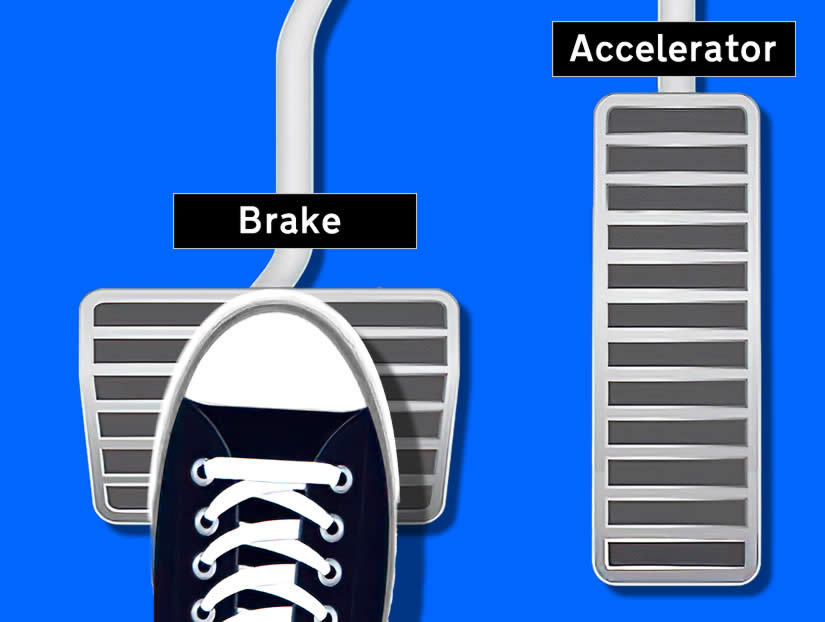
Smart Braking and ADAS: When the Machine Takes Control
The brake pedal is no longer an isolated component; it is a primary actor in the Advanced Driver Assistance Systems (ADAS) ecosystem. The integration of sensors, cameras, and artificial intelligence (AI) means that the vehicle often makes decisions about the brake pedal before the human driver does.
Emergency Braking Systems (AEB) and Radar Integration
Automated Emergency Braking (AEB) is one of the most critical safety technologies of the last decade. Using a combination of LiDAR, Radar, and computer vision, the vehicle’s onboard computer constantly monitors the road ahead. If the software detects an imminent collision and determines that the human driver’s input on the brake pedal is insufficient—or non-existent—it can override the system. The “smart” brake pedal will actually move or the system will build pressure independently of the driver’s foot. This represents a fundamental shift in vehicle tech: the transition from “human-commanded” to “software-monitored” braking.
Haptic Feedback: Communicating via the Pedal
As cars become more digital, the “feel” of the road is often lost. To combat this, tech companies are developing haptic feedback brake pedals. If the car’s sensors detect a lane departure or a potential hazard, the brake pedal can vibrate or provide a “kickback” sensation to alert the driver. This turns the pedal into a two-way communication device. It doesn’t just receive input from the driver; it provides tactile data back to the human, using haptic motors to bypass visual or auditory distractions.
The Future of the Brake Pedal in Autonomous Vehicles
As we look toward Level 4 and Level 5 autonomy, the very existence of the brake pedal is being questioned. In a world where the software is the driver, the physical interface between a human foot and the braking system becomes an optional design choice rather than a necessity.
Virtualization: Do We Even Need a Physical Pedal?
Many concept vehicles from leading tech firms and traditional OEMs (Original Equipment Manufacturers) feature retractable pedals or entirely flat floors. In these designs, the brake pedal is virtualized. If a human needs to take over, they might use a joystick, a touch-sensitive pad, or a voice command. The engineering challenge here lies in “latency.” In a traditional system, the delay between pressing the pedal and the car slowing down is measured in milliseconds. In a fully digital or virtualized system, the software architecture must ensure zero-latency communication to maintain safety standards equivalent to mechanical systems.
Redundancy and Digital Security in Braking Circuits
As the brake pedal becomes more reliant on software, the tech industry is focusing heavily on redundancy and digital security. If a vehicle’s braking is controlled by a wire, it is theoretically susceptible to software glitches or even cyber-attacks. Therefore, the technology behind modern brake pedals includes “fail-safe” architectures. This often involves dual-core processors that check each other’s math in real-time. If the primary electronic circuit fails, a secondary backup—or a physical hydraulic bypass—must engage instantly. The “tech” of the brake pedal, therefore, includes some of the most rigorous cybersecurity and redundant hardware protocols found in any consumer gadget.
Conclusion
The brake pedal is far more than a simple tool for stopping; it is a sophisticated gateway where human intent meets digital execution. From the early days of hydraulic leverage to the modern era of regenerative software, eBoosters, and AI-driven emergency response, the technology behind the pedal has moved from the realm of basic physics into the world of advanced computer science.
As we progress toward a future defined by electrification and autonomy, the brake pedal will continue to evolve. It will become smarter, more communicative, and eventually, perhaps even invisible. For now, it remains the most vital piece of technology in the vehicle, representing the ultimate fail-safe in an increasingly automated world. Understanding the tech behind the brake pedal is essential for anyone looking to grasp the future of mobility and the complex integration of hardware and software that keeps us safe on the road.
aViewFromTheCave is a participant in the Amazon Services LLC Associates Program, an affiliate advertising program designed to provide a means for sites to earn advertising fees by advertising and linking to Amazon.com. Amazon, the Amazon logo, AmazonSupply, and the AmazonSupply logo are trademarks of Amazon.com, Inc. or its affiliates. As an Amazon Associate we earn affiliate commissions from qualifying purchases.