
Navigating the administrative requirements for a United States passport can often feel like a journey through a bygone era of financial transactions. While most of our modern economy thrives on credit card taps and instant digital transfers, the U.S. Department of State remains strict about its payment methods, particularly for mail-in renewals and certain execution fees. At the heart of this process is the money order—a reliable, “prepaid” financial instrument that serves as a bridge between cash and a certified check.
Understanding what a money order is, why it is required, and how to manage the financial logistics of obtaining one is essential for any traveler. This guide explores the money order as a critical tool in your personal finance toolkit, ensuring your passport application is processed without delays.

1. The Role of Money Orders in Modern Personal Finance
In an era of Venmo, Zelle, and high-speed credit processing, the money order might seem like an antiquated relic. However, in the world of government filings and high-security transactions, it remains a gold standard for several logistical and financial reasons.
The Anatomy of a Money Order
A money order is a certificate, usually issued by a government or banking institution, that allows the stated payee to receive cash on demand. Unlike a personal check, which relies on the availability of funds in your bank account at the moment the check is cashed, a money order is “guaranteed.” Because you pay for the money order upfront with cash or a debit card, the funds are already secured. This eliminates the risk of “bouncing” a payment, which is why government agencies prefer them for high-volume processing.
Why the State Department Requires Money Orders
The U.S. Department of State processes millions of applications annually. Managing personal checks carries a significant administrative burden; if a check is returned for non-sufficient funds (NSF), it triggers a cascade of legal and financial hurdles. By requiring money orders (or cashier’s checks), the Department ensures that the payment is valid the moment it is received. For the applicant, this provides a layer of security: you don’t have to worry about a check being delayed in the mail and then bouncing because of other transactions in your account.
Comparing Money Orders to Other Financial Instruments
When compared to personal checks, money orders offer better privacy, as they do not contain your bank account or routing numbers. Compared to cashier’s checks, money orders are generally easier to obtain and cheaper for smaller amounts (typically under $1,000). For a passport, which usually costs between $100 and $200 depending on the service, the money order is the most cost-effective “guaranteed” payment method available.
2. A Step-by-Step Financial Roadmap: Obtaining Your Money Order
Securing a money order is a straightforward financial transaction, but it requires precision. A single mistake in the amount or the “Pay To” line can result in your application being rejected, costing you weeks of travel time.
Determining the Exact Fee Amount
Before heading to a financial service provider, you must determine the exact cost of your passport. As of 2024, the fees vary significantly:
- Adult Renewal (DS-82): Typically $130 for a passport book.
- First-Time Adult Applicant (DS-11): $130 (application fee) plus a $35 execution fee.
- Expedited Service: An additional $60.
- Child Passports: $100 plus the $35 execution fee.
Note that when applying in person at a “Passport Acceptance Facility” (like a local post office), you often need two separate payments: one to the “U.S. Department of State” for the application fee, and one to the facility for the execution fee. The money order is almost always used for the larger “U.S. Department of State” fee.
Selecting the Best Issuing Institution
You have several choices when purchasing a money order, each with different fee structures:
- United States Postal Service (USPS): This is often the most convenient choice, especially if you are applying at a post office. USPS money orders are highly secure and recognized immediately by other government branches.
- Banks and Credit Unions: Most banks offer money orders to their members. While sometimes more expensive than the post office, they offer the convenience of withdrawing funds directly from your account.
- Retailers (Walmart, Western Union, 7-Eleven): These are often the cheapest options, with fees sometimes under $1.50. However, ensure the money order is printed clearly and that the brand is reputable.
3. The Technical Side of the Transaction: Proper Documentation

Once you have the physical money order in hand, it is your responsibility to fill it out correctly. Unlike a digital payment where fields are validated automatically, a paper money order is a manual document where errors are permanent.
Identifying the Payee
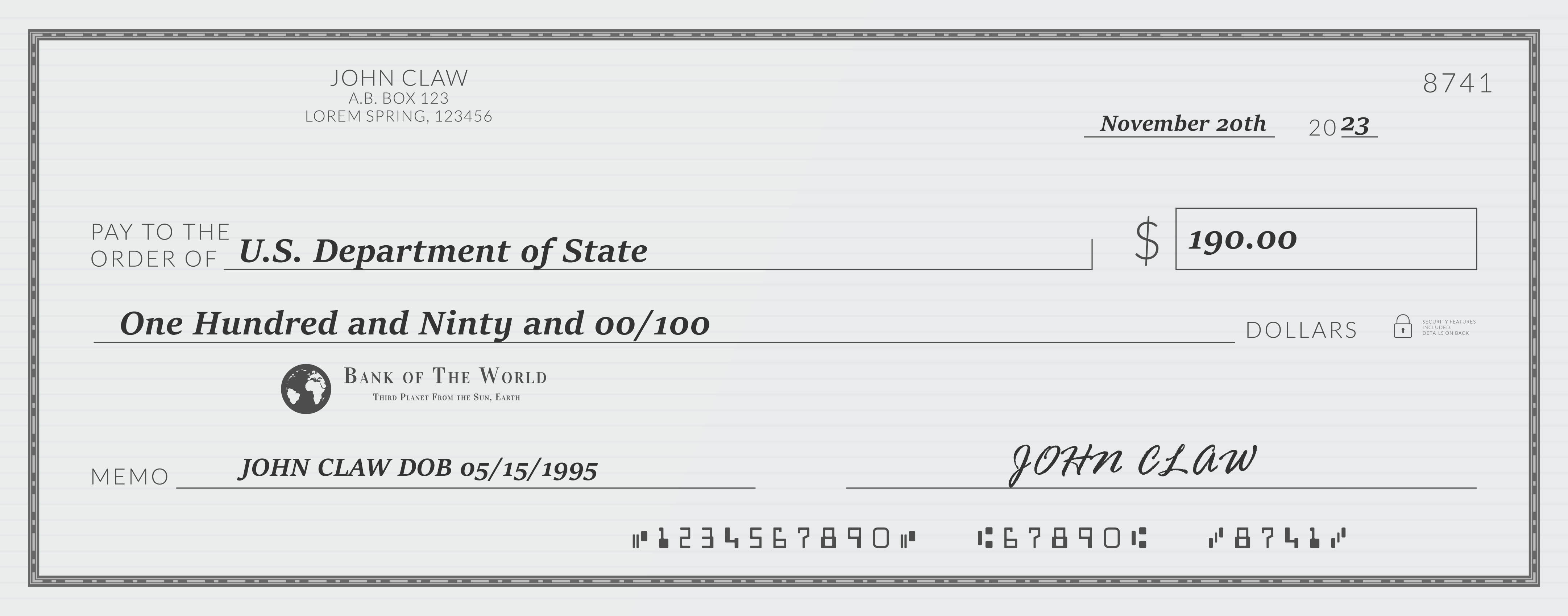
For all passport applications, the payee must be written as “U.S. Department of State.” Do not abbreviate this to “USDOS” or “State Dept.” Government automated clearing houses require the full name to ensure the funds are routed to the correct federal treasury account.
Essential Formatting for Federal Acceptance
When filling out the money order, use black or blue ink and write in clear, legible block letters. Most money orders will require the following information:
- Pay To: U.S. Department of State.
- Purchaser’s Name: Your full legal name, exactly as it appears on your passport application.
- Purchaser’s Address: Your current mailing address.
- Memo Line: It is highly recommended to write the applicant’s full name and date of birth in the memo section. If you are renewing your own passport, this might seem redundant, but if the money order becomes separated from your application file, this information allows the Department of State to reunite them.
4. Cost Analysis: Fees and Limits Associated with Money Orders
From a personal finance perspective, it is important to factor in the total cost of the transaction, not just the face value of the passport fee.
Issuance Fees Across Different Providers
While the passport fee itself is non-negotiable, the “convenience fee” for the money order varies.
- USPS: Usually charges around $2.10 for amounts up to $500.
- Walmart/Grocery Stores: Often charge between $1.00 and $1.50.
- Banks: Can charge anywhere from $5.00 to $10.00, though some “preferred” accounts offer them for free.
If you are applying for a family of four, these fees can add up. However, the security of a money order usually outweighs the small transaction cost compared to the risk of a lost or stolen personal check.
Handling Multiple Payments for Family Applications
When applying for multiple family members simultaneously, the Department of State generally prefers a separate money order for each individual application. From a financial management standpoint, this is much cleaner. If one family member’s application has an issue, it won’t hold up the entire group’s processing due to a “bundled” payment. Always ensure the name of the specific applicant is written on their respective money order.
5. Risk Management: Safeguarding Your Payment Until Processing
A money order is essentially “cash” once it is signed. If you lose it before mailing it, or if it is stolen, recovering those funds can be a bureaucratic nightmare. Proper risk management is essential.
The Importance of the Purchase Receipt
Every money order comes with a detachable receipt or a carbon copy. Do not throw this away. This receipt is your only proof of purchase and your only way to track the payment. Keep this receipt in a safe place until you have your new passport in your hand. The receipt contains the serial number and the 11-digit identification number necessary to check the status of the funds.
Tracking and Refund Procedures for Lost Instruments
If you suspect your money order was lost in the mail, you can use the issuer’s website (such as the USPS Money Order Tool) to see if it has been cashed. If it hasn’t been cashed after 60 days, you can apply for a refund. However, be aware that there is usually a processing fee for a refund (at USPS, it is approximately $6.95), and the process can take several weeks. This highlights the importance of using tracked mail (like USPS Priority Mail) when sending your passport application.
Conclusion
The money order remains a vital financial tool for international travelers, providing a secure, guaranteed method of payment that satisfies the stringent requirements of the U.S. Department of State. By treating the money order not just as a “fee” but as a financial transaction requiring precision and record-keeping, you protect your investment and ensure a smoother path to your next destination. Whether you are purchasing your instrument at the local post office or your neighborhood bank, the key to success lies in accuracy, legibility, and diligent tracking of your receipts. In the world of personal finance, sometimes the most reliable path forward is the one that has stood the test of time.
aViewFromTheCave is a participant in the Amazon Services LLC Associates Program, an affiliate advertising program designed to provide a means for sites to earn advertising fees by advertising and linking to Amazon.com. Amazon, the Amazon logo, AmazonSupply, and the AmazonSupply logo are trademarks of Amazon.com, Inc. or its affiliates. As an Amazon Associate we earn affiliate commissions from qualifying purchases.