
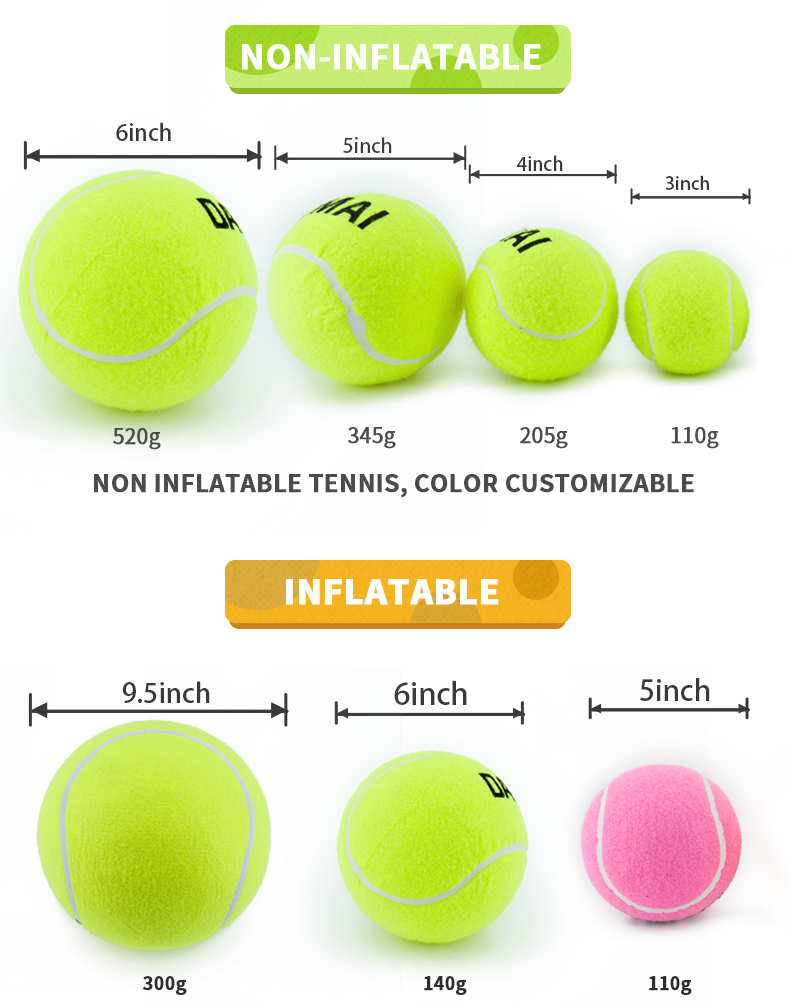
In the world of professional sports, the difference between a championship-winning shot and a forced error often comes down to millimeters. While fans marvel at the velocity of a serve or the spin of a backhand, the silent protagonist of this drama is the tennis ball itself. Specifically, the diameter of a tennis ball is not a random measurement but a highly engineered specification that dictates the physics of the game. According to the International Tennis Federation (ITF), a standard tennis ball must have a diameter between 2.57 inches (6.54 cm) and 2.70 inches (6.86 cm).

While this may seem like a simple range, the technology required to maintain these dimensions under the stresses of professional play is a marvel of modern materials science and manufacturing precision. This article explores the technical nuances of the tennis ball’s diameter, the engineering behind its construction, and the digital tools used to measure its performance.
The Science of Standardization: Why 2.57 Inches Matters
The standardization of a tennis ball’s diameter is the cornerstone of competitive fairness. If a ball were too small, it would travel through the air with less aerodynamic drag, reaching speeds that would be nearly impossible for a human to react to. Conversely, a ball that is too large would catch too much air, slowing the game down to a crawl. The 2.57 to 2.70-inch range is the “Goldilocks zone” of tennis technology.
The ITF Technical Specifications and Regulatory Tech
The International Tennis Federation (ITF) utilizes rigorous testing protocols to ensure that every manufacturer—from Wilson to Head—adheres to precise geometric standards. These standards are not just about size; they include mass (56.0–59.4 grams), bounce (53–58 inches when dropped from 100 inches), and deformation characteristics.
To measure these parameters, laboratories use automated compression testers and high-speed digital calipers. These machines apply a specific amount of force to the ball to measure its “forward deformation” and “return deformation.” This ensures that the ball’s diameter remains consistent even when subjected to the violent impact of a 130-mph serve. The technology behind these measurements has evolved from manual gauges to laser-based micrometers that provide accuracy within microns.
Aerodynamics and the Surface Area-to-Volume Ratio
From a fluid dynamics perspective, the diameter of the ball determines its Reynolds number—a dimensionless quantity that helps predict flow patterns in different fluid flow situations. The specific diameter of the tennis ball, combined with the “fuzz” or felt on the surface, creates a boundary layer of air that clings to the ball as it moves.
If the diameter fluctuates, the surface area changes, which directly impacts the Magnus effect—the phenomenon that causes a spinning ball to curve. Engineers use Computational Fluid Dynamics (CFD) software to simulate how a ball of a specific diameter interacts with air at varying altitudes and humidities. This tech allows manufacturers to design balls specifically for “High Altitude” play, where the diameter and internal pressure are tweaked to compensate for thinner air.
Material Science: The Internal Tech of a Pressurized Sphere
The diameter of a tennis ball is not just a result of its outer shell; it is a product of internal pressure and rubber chemistry. Maintaining a constant diameter requires the ball to resist the atmospheric pressure pushing inward while containing the high-pressure gas pushing outward.
Vulcanization and the Core Membrane
The core of a modern tennis ball is a sophisticated rubber compound. During the manufacturing process, raw rubber is mixed with various chemicals and then “vulcanized”—a chemical process that involves heating the rubber with sulfur to create cross-links between polymer chains. This creates a viscoelastic material that can deform upon impact and return to its original diameter instantly.
The technology involved in creating the core’s “recipe” is a closely guarded secret among top-tier manufacturers. The goal is to create a membrane that is impermeable enough to prevent the escape of pressurized air. Even a microscopic leak would cause the internal pressure to drop, leading to a “dead” ball that fails to meet the diameter requirements under compression.
Internal Pressure vs. Atmospheric Resistance
Most professional-grade tennis balls are pressurized to approximately 12 psi (pounds per square inch) above the surrounding atmospheric pressure. This internal gas—often a mix of air and nitrogen—acts as a structural component. Without this pressure, the rubber walls of the ball would need to be much thicker to maintain the 2.57-inch diameter, which would make the ball too heavy for play.
In recent years, “pressureless” ball technology has emerged, primarily for practice and coaching. These balls use a specialized high-density rubber core to maintain their diameter and bounce without the need for internal gas. While they are more durable, the “tech” of a pressureless ball results in a different feel—often described as “heavy”—highlighting how vital the pressurized gas technology is to the standard player experience.

Manufacturing Technology: From Raw Rubber to Finished Felt
The journey from raw materials to a perfectly sized sphere is a masterclass in automated precision. Every step of the production line is monitored by sensors to ensure that the final product does not deviate from the target diameter.
Precision Molding and Sizing
The production begins with “slugs” of rubber that are placed into hemispherical molds. These molds are machined using CNC (Computer Numerical Control) technology to ensure that the interior radius is exact. Two hemispheres are then joined using a specialized adhesive and heat-pressed together.
The seam—the area where the two halves meet—is a critical point of failure. If the seam is too thick, the ball becomes an ellipsoid rather than a sphere, failing the diameter test. Modern factories use robotic optical inspection systems that rotate the ball 360 degrees, using computer vision to detect any irregularities in the sphere’s geometry.
The Role of “Optic Yellow” Felt
Once the rubber core is formed, it is covered in two “dumbbell-shaped” pieces of felt. The felt itself is a high-tech blend of wool and nylon. The thickness of this felt is factored into the ball’s final diameter.
The “nap” of the felt—the fuzziness—is not just for aesthetics. It is engineered to provide friction against the court and the air. Manufacturers use “needle-punch” technology or woven techniques to control the density of the felt. A ball designed for clay courts may have a different felt tech than one designed for grass, though both must ultimately result in the same total diameter to remain legal for play.
Smart Courts and Tracking: Digitizing the Diameter
As tennis enters the era of “Big Data,” the physical diameter of the ball is being integrated into digital tracking ecosystems. We no longer just measure the ball in a lab; we measure it in real-time as it flies across the court.
Optical Tracking Systems (Hawk-Eye)
The most famous technology in tennis is Hawk-Eye. This system uses a network of high-speed cameras positioned around the stadium to track the ball’s trajectory. For Hawk-Eye to work, the software must “know” the exact diameter of the ball. By calculating the number of pixels the ball occupies on each camera frame and cross-referencing that with the known diameter (e.g., 6.7 cm), the system can triangulate the ball’s position in 3D space with millimeter accuracy.
This technology has revolutionized officiating. When a ball “pancakes” on the line, it deforms, momentarily changing its diameter at the point of impact. The tracking software accounts for this deformation tech to determine if the edge of the ball touched the white line, even by a fraction of an inch.
The Future of ‘Smart’ Tennis Balls
The next frontier in tennis technology is the “Smart Ball.” Some startups are experimenting with embedding micro-sensors (MEMS—Micro-Electro-Mechanical Systems) inside the rubber core. These sensors include accelerometers and gyroscopes that can transmit data via Bluetooth to a smartphone.
The challenge in this tech is maintaining the ball’s diameter and balance. A sensor that is too heavy or poorly placed would create an “unbalanced” ball that wobbles in the air. Furthermore, the sensor must be rugged enough to survive the 50G forces of a professional strike while remaining small enough not to interfere with the ball’s natural compression. As this technology matures, the “diameter” of a tennis ball will not just be a physical measurement, but a housing for a sophisticated data-gathering hub.
Conclusion: The Engineering of the Perfect Bounce
What diameter is a tennis ball? Physically, it is a sphere between 2.57 and 2.70 inches. But technologically, it is the result of decades of research into polymer science, aerodynamic modeling, and precision manufacturing. The diameter is the anchor point for every other aspect of the ball’s performance, from its flight path to its interaction with the racquet strings.
As materials science continues to advance, we may see balls that hold their pressure longer or felt that adapts to different humidity levels. However, the fundamental dimensions will likely remain unchanged, preserved by the rigorous standards of the ITF and the digital eyes of tracking systems like Hawk-Eye. In the intersection of sports and technology, the tennis ball remains a testament to the idea that even the simplest objects require the most complex engineering to achieve perfection.
aViewFromTheCave is a participant in the Amazon Services LLC Associates Program, an affiliate advertising program designed to provide a means for sites to earn advertising fees by advertising and linking to Amazon.com. Amazon, the Amazon logo, AmazonSupply, and the AmazonSupply logo are trademarks of Amazon.com, Inc. or its affiliates. As an Amazon Associate we earn affiliate commissions from qualifying purchases.