
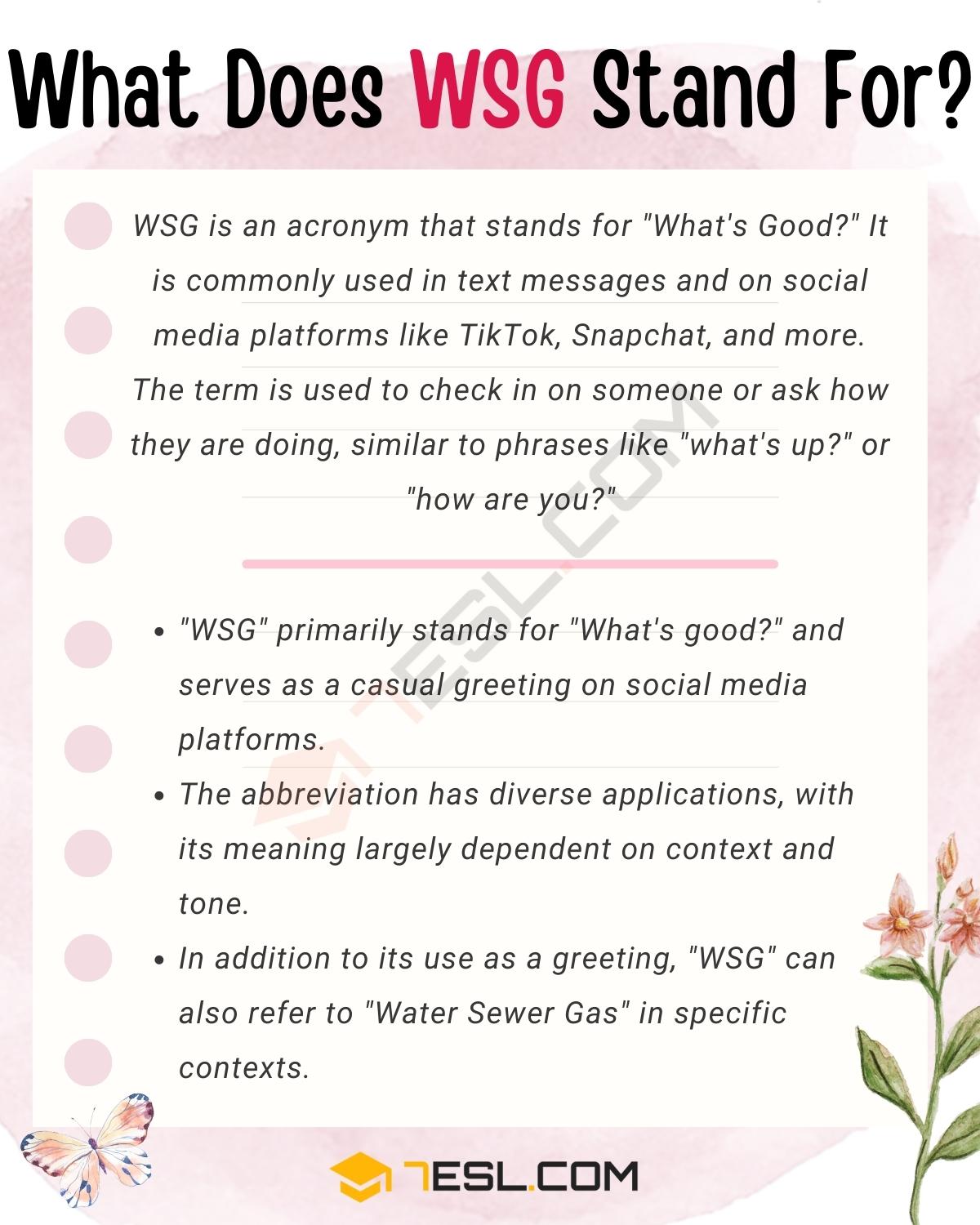
The digital landscape is shifting at an unprecedented pace, not just in terms of hardware and software, but in the very language we use to interact with technology. As social media platforms like TikTok, Snapchat, and Instagram become the primary hubs for interpersonal connection, a new lexicon has emerged. One of the most ubiquitous terms currently circulating through these digital channels is “wsg”—an acronym for “What’s good?”
While it may seem like a simple greeting, the question of what to say to “wsg” opens up a broader conversation about modern communication technology, natural language processing, and the psychological impact of instant messaging on society. Understanding how to respond is not just a matter of social etiquette; it is an exploration of how software and interface design have condensed human expression into hyper-efficient bursts of data.

Understanding “WSG” in the Modern Messaging Ecosystem
The term “wsg” is a byproduct of the “mobile-first” era. In the early days of the internet, IRC and SMS forced users to be brief due to character limits and the clunkiness of T9 predictive texting. Today, even though we have unlimited character counts and high-speed 5G connectivity, the habit of brevity remains. “WSG” functions as a low-friction “ping” used to initiate a conversation or check the status of a contact.
The Origins and Rise of “What’s Good?” on Social Media
Historically, “What’s good?” originated in African American Vernacular English (AAVE) as a multifaceted greeting that serves as both a “How are you?” and a “What is happening?” When this phrase migrated to digital platforms, it was shortened to “wsg” to fit the rapid-fire nature of messaging apps. The rise of TikTok and short-form video content has accelerated the adoption of this slang, as creators use it to engage with their audience instantly. In this tech-driven context, “wsg” is more than a question; it is a tool for maintaining “ambient awareness”—the tech-enabled sense of staying constantly connected to one’s social circle.
Why Microspeak Dominates Mobile-First Platforms
User Interface (UI) design significantly influences how we speak. On apps like Snapchat, where messages disappear, or TikTok, where comments are displayed in small, scrollable windows, there is a design-driven incentive to be concise. This “microspeak” allows users to transmit maximum meaning with minimum physical effort. For developers and tech innovators, the prevalence of terms like “wsg” provides valuable data on how language is evolving toward efficiency. This trend toward linguistic compression is a direct result of the “attention economy,” where users must communicate quickly before the recipient scrolls away.
Contextual Responses: How to Navigate Digital Interactions
Knowing what to say to “wsg” depends heavily on the platform and the technical medium being used. Because digital communication lacks the non-verbal cues of face-to-face interaction—such as tone of voice and body language—the choice of words and punctuation carries significant weight.
The Casual Check-in: Low-Friction Responses
If a user receives “wsg” on a platform like WhatsApp or iMessage, the most common response is a status update or a reciprocal inquiry. Standard responses include:
- “Nm, hbu?” (Nothing much, how about you?) – This is the standard “low-latency” response designed to keep the channel open without requiring deep emotional investment.
- “Chilling, just [Activity].” – This provides a “status update,” functioning similarly to a social media story but in a private 1-to-1 format.
From a technical perspective, these responses are part of a feedback loop. The goal is to keep the “streak” or the interaction alive, a mechanic that many apps use to boost daily active users (DAUs).
Leveraging Emojis and Multimedia in Tech-Native Speech
In modern communication, text is often insufficient. To add depth to a “wsg” response, users frequently employ emojis, GIFs, or Bitmojis. Tech companies have invested heavily in these features because they bridge the gap between text and emotion. Responding to “wsg” with a simple ” ” or ” ” can convey a sense of camaraderie that words might fail to capture. The integration of high-resolution cameras in smartphones has also made the “photo response” a standard. Instead of typing what is good, a user might send a quick “Snap” of their current environment, using visual data to answer a linguistic question.

Professional vs. Social Boundaries in Messaging Apps
As Slack, Microsoft Teams, and Discord blur the lines between professional and personal communication, “wsg” has begun to appear in workplace settings, particularly among Gen Z and Millennial tech workers. However, the response in a professional software environment must be calibrated differently. While “wsg” might be acceptable in a casual Discord channel for developers, it would likely be out of place in a formal email. This highlights the “context-switching” skills required by modern digital citizens, who must navigate different linguistic protocols across various software ecosystems.
The Role of AI and Predictive Text in Shaping Slang
One of the most fascinating aspects of modern slang like “wsg” is how it interacts with Artificial Intelligence. Our smartphones are no longer passive tools; they are active participants in our conversations through autocorrect, predictive text, and AI-driven smart replies.
How Algorithms Learn and Suggest Contemporary Phrases
Keyboards like Gboard (Google) and the iOS QuickType keyboard use machine learning to adapt to user behavior. If a large segment of the population begins using “wsg,” the algorithm stops “correcting” it to “was” or “egg” and begins suggesting it as a likely next word. This creates a feedback loop where the software reinforces the use of slang. When you wonder what to say to “wsg,” your phone’s AI might already be suggesting “Not much” or “Hbu” in the predictive bar, effectively automating our social interactions.
Large Language Models (LLMs) and the Nuances of Informal Dialogue
With the advent of LLMs like ChatGPT and Claude, the tech world has achieved a new milestone in understanding slang. These models are trained on vast datasets that include social media archives, allowing them to understand the nuance of “wsg.” If you ask an AI “what to say to wsg,” it can provide responses ranging from sarcastic to sincere based on the requested persona. This indicates a future where AI personal assistants may handle our “low-value” social interactions, responding to greetings like “wsg” on our behalf to maintain social presence without manual input.
The Impact of Instant Messaging Features on Human Connection
The technology behind our screens does more than just transmit “wsg”; it shapes the psychological experience of the conversation. Features that we now take for granted have fundamentally altered the “vibe” of a digital chat.
Read Receipts, Typing Indicators, and the Pressure of the “Ping”
When someone sends “wsg,” the recipient is often met with the “typing…” bubble or the “Read” notification. These are UX (User Experience) choices designed to create a sense of urgency and real-time presence. The “pressure” to respond to “wsg” is a direct result of these features. In the tech community, this is often discussed in terms of “synchronous vs. asynchronous” communication. “WSG” is a tool for forcing a conversation into a synchronous state, demanding immediate engagement.
Voice Notes and Video Messaging: Adding Depth to Slang
To combat the “flatness” of text slang, apps have introduced voice notes and video messages. Responding to “wsg” with a 5-second voice clip adds the dimension of prosody—the rhythm and pitch of the voice. This is a technical solution to a social problem: the potential for slang to be misinterpreted. As bandwidth increases and storage becomes cheaper, we are seeing a shift away from the three-letter acronym toward richer, media-heavy responses that provide more context than “wsg” ever could on its own.
Future Trends: Beyond the Three-Letter Acronym
As we look toward the future of tech, the way we greet each other will continue to evolve. We are moving toward a post-text world where Augmented Reality (AR) and Virtual Reality (VR) may render “wsg” obsolete.
The Shift Toward Visual and Decentralized Communication
In a spatial computing environment, such as that proposed by the Apple Vision Pro or Meta Quest, a greeting might not be typed at all. It could be a gesture, a haptic pulse, or an avatar’s expression. “WSG” is a product of the “glass slab” (smartphone) era. As we move toward wearable tech, our digital vocabulary will likely shift toward more intuitive, integrated forms of signaling.
Conclusion: The Intersection of Language and Innovation
“What to say to wsg” is more than a question about social trends; it is a reflection of our current technological epoch. It represents the intersection of linguistic evolution and software engineering. As long as we continue to use digital platforms to connect, we will continue to invent shorthand like “wsg” to navigate the constraints of our interfaces. By understanding the tech-driven origins of this slang, we gain insight into the future of human connection—a future that is increasingly fast, efficient, and mediated by the powerful algorithms in our pockets. Whether you respond with a simple “nm” or a complex multimedia message, you are participating in a grand experiment in digital sociology.
aViewFromTheCave is a participant in the Amazon Services LLC Associates Program, an affiliate advertising program designed to provide a means for sites to earn advertising fees by advertising and linking to Amazon.com. Amazon, the Amazon logo, AmazonSupply, and the AmazonSupply logo are trademarks of Amazon.com, Inc. or its affiliates. As an Amazon Associate we earn affiliate commissions from qualifying purchases.