
In the rapidly evolving landscape of artificial intelligence, particularly in the realm of generative AI, the ability to communicate effectively with models is paramount. We’ve all become somewhat familiar with “prompts” – the instructions we give to AI to tell it what we want it to create. Whether it’s generating stunning images from a simple text description or drafting comprehensive articles on complex topics, the positive prompt is our primary tool. But what happens when the AI gives you something close to what you want, yet persistently includes elements you explicitly don’t want? This is where the concept of a “negative prompt” enters the scene, revolutionizing how we interact with and refine AI outputs.

A negative prompt is essentially a set of instructions given to an AI model that tells it what to avoid or exclude from its output. While a positive prompt directs the AI towards a desired outcome, a negative prompt acts as a filter, guiding the AI away from undesirable features, styles, or content. It’s a powerful tool that allows users to exert finer control over the AI’s creative process, enhancing quality, precision, and efficiency in AI-generated content.
The Art of Exclusion: Understanding Negative Prompts
To truly grasp the power of negative prompts, it’s crucial to understand their fundamental role alongside their positive counterparts. Think of it as sculpting: the positive prompt is like adding clay to form the desired shape, while the negative prompt is like chipping away excess material, refining the form, and removing imperfections.
Defining the Unwanted: Positive vs. Negative Directives
At its core, prompt engineering is about instructing an AI model using natural language. A “positive prompt” is a direct command: “Generate a realistic image of a cat sitting on a windowsill at sunset.” The AI then aims to fulfill all aspects of this description.
A “negative prompt,” conversely, is a list of things you don’t want to see in the final output. Using the cat example, if the AI consistently generates cats with too many whiskers, or an unnatural sky, your negative prompt might include “too many whiskers, unnatural sky, blurry, distorted.” These negative directives don’t tell the AI what to do, but rather what not to do, nudging it away from specific errors or unwanted interpretations.
This dual approach provides a significantly more nuanced control mechanism. Instead of repeatedly modifying your positive prompt to try and implicitly exclude something (e.g., trying to describe a “cat with normal whiskers” rather than just excluding “too many whiskers”), the negative prompt offers a dedicated channel for exclusion. This separation of concerns simplifies prompt engineering, making it clearer for both the human user and the AI model.
The Underpinnings: How AI Interprets “Don’t”
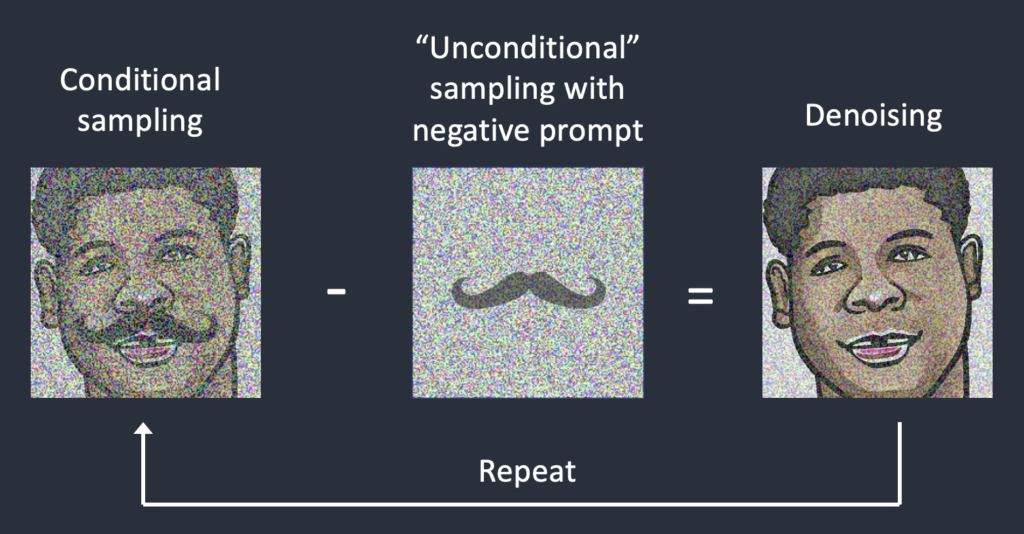
For those interested in the ‘Tech’ aspect, understanding how AI models interpret negative prompts sheds light on their effectiveness. Many modern generative AI models, particularly diffusion models used for image generation (like Stable Diffusion or Midjourney), operate by progressively refining an initial noisy image into a coherent one, guided by the input prompt.
When a positive prompt is given, the model learns to steer the generation process towards concepts associated with that prompt in its vast training data. When a negative prompt is introduced, the model essentially performs a contrasting operation. It learns to steer away from concepts present in the negative prompt. This is often achieved through techniques like “classifier-free guidance,” where the model calculates the difference between the probability distribution of generating an image with the prompt and without it. When a negative prompt is added, the model also considers the probability distribution of generating an image with the negative prompt, and then actively works to reduce the likelihood of those features appearing.
In simpler terms, the AI generates an output that satisfies the positive prompt while simultaneously attempting to move through its latent space (the conceptual space where AI ideas reside) in directions that minimize the presence of the negative prompt’s elements. It’s a sophisticated balancing act that allows for incredible precision in the final output.
Why Negative Prompts Are Indispensable in AI Creation
The integration of negative prompts has become a game-changer for anyone seriously engaging with generative AI. Their benefits extend far beyond mere convenience, impacting the quality, control, and efficiency of AI-powered creative workflows.
Elevating Quality and Aesthetic Standards
One of the most immediate and impactful benefits of negative prompts is their ability to significantly enhance the aesthetic quality of AI-generated content. Generative AI, despite its brilliance, can sometimes produce artifacts or inaccuracies that detract from the overall output.
-
Image Generation: In visual AI, common issues include distorted limbs (especially hands and feet), unnatural anatomy, blurry elements, watermarks, text overlays (when not intended), repetitive patterns, or a generally “ugly” or “low quality” feel. By including terms like “deformed,” “ugly,” “blurry,” “extra limbs,” “bad anatomy,” “text,” “watermark,” “duplicate,” or “monochrome” (if you want color), users can dramatically reduce the occurrence of these flaws. This ensures that the generated images are not just visually interesting, but also technically sound and aesthetically pleasing, making them suitable for professional applications like ‘Brand’ marketing or high-quality content creation.
-
Text Generation: While less obvious, negative prompts can also refine text outputs. They can help avoid repetitive phrases, jargon, overly complex sentences, or common AI “tells” that make text sound robotic. Prompting “no repetition,” “concise,” or “avoid jargon” can lead to clearer, more engaging, and more human-like prose, which is critical for effective communication in ‘Brand’ messaging or ‘Tech’ documentation.
Gaining Unprecedented Control and Precision
Beyond merely cleaning up outputs, negative prompts empower users with a level of control previously unattainable. This precision is invaluable for achieving specific artistic visions or adhering to strict guidelines.
Imagine a graphic designer working on ‘Brand’ assets for a client. They might need images in a very specific style, devoid of certain elements. A positive prompt might describe the core subject and desired style, but a negative prompt could exclude unwanted color palettes (“no red, no yellow”), specific objects (“no cars, no buildings”), or even broader themes (“no fantasy, no abstract”). This level of granular control allows creators to guide the AI with surgical precision, ensuring that the output aligns perfectly with their intent and brand guidelines.
This precision is also vital for iterating on designs. Instead of starting from scratch when an unwanted element appears, a simple adjustment to the negative prompt can often rectify the issue, saving time and creative energy.
Boosting Efficiency and Reducing Iteration Cycles
In any creative or production workflow, time is money. For businesses and individuals leveraging AI for content creation, efficiency directly impacts profitability. Negative prompts contribute significantly to streamlining the process.
- Fewer Reruns: Without negative prompts, users often find themselves generating multiple variations of an output, hoping that one iteration will randomly avoid the unwanted elements. This trial-and-error approach is time-consuming and computationally expensive. By specifying exclusions upfront, the AI has a clearer direction, often producing satisfactory results in fewer attempts.
- Reduced Post-Production: For visual content especially, AI-generated images often require extensive editing in software like Photoshop to remove artifacts or unwanted details. With effective negative prompting, much of this post-production work can be minimized or even eliminated. Getting the image “right” in the initial generation phase translates directly to time saved, which can be particularly beneficial for creators on tight deadlines or businesses aiming to optimize their content production costs – a direct link to the ‘Money’ aspect of our website topics.
- Faster Prototyping: For ‘Tech’ companies developing AI-powered applications or ‘Brand’ agencies exploring visual concepts, negative prompts accelerate the prototyping phase. Rapidly generating diverse, high-quality options without common flaws allows for quicker decision-making and iteration, speeding up the entire development or creative process.
Practical Applications: From Pixels to Prose
The versatility of negative prompts shines through in their wide range of applications across different AI modalities. While most prominent in image generation, their utility is expanding into text and other generative tasks.
Crafting Flawless Visuals with Negative Prompts
Image generation is undoubtedly where negative prompts have made their most significant splash. The visual nature of the output makes errors and unwanted elements immediately apparent, and negative prompts offer a direct solution.
Common negative prompt terms for image generation include:
- Anatomy & Quality:
deformed, ugly, disfigured, bad anatomy, missing limbs, extra limbs, mutated, blurry, low resolution, jpeg artifacts, noise, pixelated - Objects & Environment:
text, watermark, signature, logo, border, frame, street, car, building(if you want a natural landscape) - Colors & Styles:
monochrome, grayscale, black and white, realistic(if you want cartoon),3D render, digital art(if you want a photograph) - Composition & Lighting:
bad lighting, unnatural light, dark, grainy, cropped, cut off
For a photographer seeking to generate a surreal portrait, they might use a positive prompt like “a woman with glowing eyes in a mystical forest, cinematic lighting.” To ensure the image feels artistic and not just a weird mash-up, they might add a negative prompt: ugly, deformed, bad anatomy, blurry, noise, low quality, cropped, text, watermark, photo, realistic (if they want a painted style). This combination allows the AI to focus its creativity while avoiding common pitfalls that could render the image unusable for a ‘Brand’ campaign or personal art project.
Refining Text Outputs and Avoiding Repetition
While visual anomalies are often more glaring, text generation can also benefit from negative prompting, albeit in subtler ways. The goal here is usually to improve clarity, conciseness, and naturalness.
Examples for text generation (though support varies across models and platforms):
- Style & Tone:
formal, jargon, overly technical, informal, slang, repetitive, verbose, long sentences - Content Exclusion:
avoid specific topic X, no statistics, don't mention Y - Structure:
no bullet points, no headings(if you want a continuous paragraph)
For a content creator writing a ‘Tech’ article, a positive prompt might be “Explain blockchain technology for a layperson.” A negative prompt could be jargon, overly technical terms, long paragraphs, repetitive, boring, confusing. This guides the AI to produce an accessible, engaging, and clear explanation without needing extensive human editing to simplify complex language or remove redundant phrases. For ‘Brand’ communication, this ensures messaging is always on point and easily digestible by the target audience.
Mastering the Craft: Tips for Effective Negative Prompting
Like any skill, effective negative prompting requires practice, experimentation, and a nuanced understanding of how AI models behave. It’s an iterative process that blends technical knowledge with creative intuition.
The Iterative Dance: Experimentation and Specificity
The most crucial advice for mastering negative prompts is to experiment. What works for one model or one type of image might not work for another.
- Start Simple, Then Refine: Begin with a few common negative terms and gradually add more specific ones as you identify recurrent issues in your outputs.
- Be Specific but Not Overly Restrictive: Instead of just “bad quality,” try
blurry, low resolution, jpeg artifacts. Instead of “no cars,” considersedans, trucks, SUVsif you want to be very precise. - Iterate and Observe: Make small changes to your negative prompt and observe how the output changes. This feedback loop is essential for learning what terms are most effective for your desired outcome.
- Leverage Communities: AI art communities and forums are goldmines for discovering effective negative prompt lists and strategies. Many users share their successful prompt combinations, providing a valuable resource for learning.
Navigating the Pitfalls: Over-Constraining and Unexpected Outcomes
While powerful, negative prompts are not a magic bullet and can lead to unintended consequences if used without care.
- Over-Constraining the AI: Too many negative terms, or overly strong negative weighting, can sometimes stifle the AI’s creativity. The model might become so focused on avoiding negatives that it struggles to generate anything meaningful or interesting, leading to bland, empty, or nonsensical outputs. It’s a delicate balance: enough constraint to guide, but not so much as to paralyze.
- Unexpected Interpretations: AI models sometimes interpret prompts in ways we don’t anticipate. A negative prompt intended to remove one element might inadvertently remove another desired feature, or even introduce a new, unexpected anomaly. For example, telling an AI “no background” might result in a transparent image or a distorted subject without a proper base.
- Model-Specific Behavior: Different AI models (e.g., Stable Diffusion, Midjourney, DALL-E 3) have varying sensitivities and interpretations of prompts. A negative prompt that works wonders in one might have little effect or an adverse effect in another. Users need to adapt their strategies based on the specific AI tool they are using, tying back to understanding specific ‘AI Tools’ in the ‘Tech’ domain.
The Broader Impact: Negative Prompts in the AI Ecosystem
The evolution of prompt engineering, including the sophisticated use of negative prompts, is more than just a technical refinement; it signifies a growing human-AI collaboration that has broader implications for creativity, ethics, and the future of work.
A Critical Skill for the AI-Powered Future
As AI becomes more integrated into creative industries, ‘Tech’ development, and ‘Brand’ marketing, prompt engineering is emerging as a vital skill. Being able to articulate precisely what you want – and don’t want – from an AI is becoming as important as knowing how to use traditional software.
For designers, marketers, writers, and artists, mastering negative prompts means unlocking greater efficiency and creative potential. It allows them to leverage AI as a powerful co-creator rather than just a blunt instrument, yielding higher quality results with less effort, directly impacting their productivity and potentially their ‘Money’ earning capabilities through more efficient workflows. This expertise positions individuals at the forefront of the AI revolution, enabling them to harness its capabilities to their fullest.

Ethical Considerations and Responsible AI Generation
The ability to finely control AI outputs, particularly with negative prompts, also touches upon important ethical considerations. While often used to improve quality, negative prompts can also be employed to steer AI away from generating harmful, biased, or inappropriate content. For instance, excluding terms associated with stereotypes or explicit content can contribute to more responsible AI deployment.
However, the power to exclude also comes with the responsibility to use it wisely. Biased negative prompts could inadvertently reinforce certain exclusions or limit the diversity of AI outputs. As such, the ethical deployment of negative prompting strategies requires thoughtful consideration and a commitment to creating inclusive and beneficial AI experiences. ‘Digital Security’ and ethical guidelines surrounding AI use become increasingly relevant here, emphasizing the need for conscious choices in how we direct our AI tools.
In conclusion, the negative prompt is far more than a simple toggle; it’s a sophisticated linguistic tool that significantly enhances our capacity to communicate with and direct artificial intelligence. By allowing us to define the boundaries of what is acceptable, it elevates the quality, precision, and efficiency of AI-generated content across various domains. As AI continues its rapid advancement, mastering the art of the negative prompt will undoubtedly be a cornerstone of effective and responsible human-AI collaboration, shaping the future of creativity, technology, and business.
aViewFromTheCave is a participant in the Amazon Services LLC Associates Program, an affiliate advertising program designed to provide a means for sites to earn advertising fees by advertising and linking to Amazon.com. Amazon, the Amazon logo, AmazonSupply, and the AmazonSupply logo are trademarks of Amazon.com, Inc. or its affiliates. As an Amazon Associate we earn affiliate commissions from qualifying purchases.